




House Passes Lindsey Graham’s Neocon Russia Sanctions Bill
The House of Representatives sent legislation placing strict sanctions on Russia to President Donald Trump's desk in honor of the late Republican South Carolina Sen. Lindsey Graham.
Nicole Silverio · Sep 16, 2026 · 4 min read
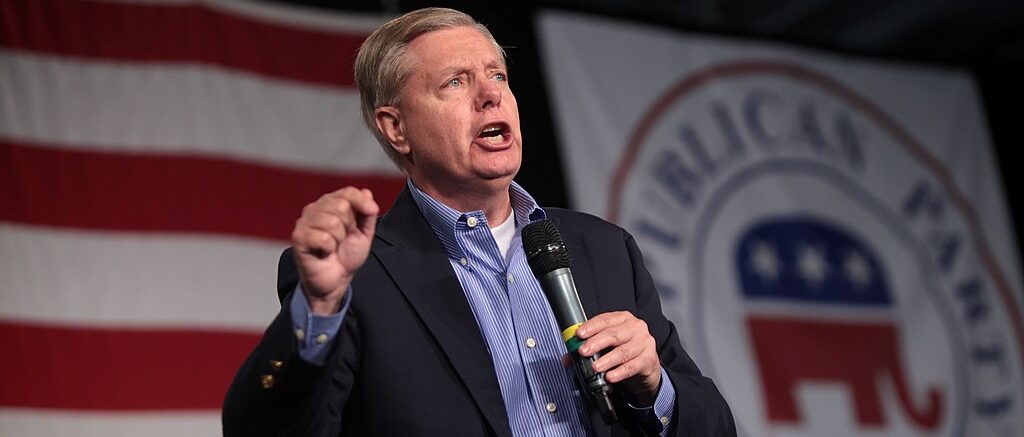

The House of Representatives sent legislation placing strict sanctions on Russia to President Donald Trump’s desk in honor of the late Republican South Carolina Sen. Lindsey Graham.
The Lindsey O. Graham Sanctioning Russia and Iran Act of 2026 would target Russian leadership, banks and its oil “shadow fleet” by requiring Trump to impose tariffs of up to 100% on goods from the top five importers of Russian oil and gas and up to 500% on goods imported from Russia. Although it passed the Senate in a 86-11 vote on Aug. 7, the bill did not receive the same level of enthusiasm in the House.
The House passed the bill by a vote of 262 to 159.
Speaker Mike Johnson previously told The Washington Examiner that “there should be bipartisan consensus” around the bill. He indicated he would only move the bill forward if the White House supported it, but stated there were “pockets of concern” within the Republican caucus.
“There should be bipartisan consensus,” Johnson said. “It should be a suspension-level vote where we could put it on the floor and have more than two-thirds support it. But I need to make sure the Democrats will be with us on that, and we got to build consensus around it.”
House Majority Leader Steve Scalise said Republicans were not in full agreement on the bill when it was still under discussion.
“We’re working through it. We want to bring it, but not sure exactly when yet that decision has not been made,” Scalise said. “We’ve got a few folks that we’ll be talking to still about it.”
Neocon senators such as Republican Arkansas Sen. Tom Cotton, Armed Services chair Roger Wicker and Foreign Relations Committee chair Jim Risch supported the bill. Senate Majority Leader John Thune also supported the bill, calling it a “great tribute” to Graham.
House Minority Leader Hakeem Jeffries and others in his party argued the bill would give Trump new tariff authorities. Democratic leadership, including Foreign Affairs ranking member Gregory Meeks and House and Ways Committee ranking member Richard Neal, argued the bill would cause “more harm than good” by handing Trump new powers.
“House Democrats are rock solid in our support for Ukraine, but the Lindsey O. Graham Sanctioning Russia And Iran Act would do more harm than good,” the lawmakers said. “This bill would dramatically expand presidential tariff authorities while failing to mandate sanctions on Russia, both of which are unacceptable. These flaws would raise Americans’ prices while undermining support for Ukraine in the long term.”
“We continue to seek bicameral, bipartisan negotiations to craft a bill that can win strong support in both chambers and deliver on our promise to Ukraine,” the statement continued. “In the meantime, the president has ample authority to expand sanctions on those fueling Russia’s war machine, including those targeted by this bill, and we renew our call on him to do so without further delay.”
Republican Kentucky Rep. Thomas Massie hinted he would vote against the legislation.
“Haven’t seen it. Haven’t heard about it. All I can say is in 14 years I’ve never voted to sanction a sovereign country,” Massie told Politico in late August.
China and India are expected to be the largest targets of the bill since they are the largest buyers of Russian energy. The Senate included Iran in the bill per Trump’s request, but the sanctions would have little effect since Iran has already been subject to extensive U.S. sanctions for decades.
Russian sanctions have been condemned by BRICS, a 11-nation alliance including China, Russia, India, Brazil and South Africa. The alliance is Russia’s primary strategy to bypass Western sanctions and reduce reliance on the U.S. dollar for international trade. While many countries have punished Russia, a large portion of the global population and emerging economies have chosen to remain neutral or deepen its ties with Russia.
Iran, Egypt, the United Arab Emirates and Ethiopia joined BRICS in January 2024, indicating the alliance is growing. It accounts for 40% of the global gross domestic product (GDP).
Democratic Connecticut Sen. Richard Blumenthal, a co-sponsor of the bill, urged the House in an Aug. 30 interview to pass the bill, arguing it was a “moment of urgency.”
“It is a moment of extreme urgency, for the reason that Putin may try to escalate, but also because Putin is on his heels economically,” Blumenthal said on “Face the Nation.” “And this kind of sanctions bill, throttling the flow of revenue to his war machine could undercut completely his ability to wage this brutal, murderous war.”
Graham first introduced the bill on April 1, 2025, although it stalled for over a year as the Trump White House wanted more waiver authority over the sanctions and tariffs. The bill was subsequently introduced by Graham’s sister, Republican South Carolina Sen. Darline Graham, on July 16.
The late senator advocated for spending billions of dollars of taxpayer money on Ukraine, going so far as to call it “the best money [the U.S. has] ever spent” in a May 2023 statement. The statement caused outraged Russian officials to issue an arrest warrant against Graham. He called for the assassination of Russian President Vladimir Putin in a March 2022 statement.
All content created by the Daily Caller News Foundation, an independent and nonpartisan newswire service, is available without charge to any legitimate news publisher that can provide a large audience. All republished articles must include our logo, our reporter’s byline and their DCNF affiliation. For any questions about our guidelines or partnering with us, please contact [email protected].
Get every new post by email
No spam, no account needed. Unsubscribe anytime.


