




Italy Scrambles Warships Toward Red Sea As Houthis Close In On Global Shipping Chokepoint
Italy is preparing to bolster naval protection for merchant shipping in the Red Sea as Houthi forces advance toward one of the world's most important maritime chokepoints.
Francis Kapper · Sep 18, 2026 · 5 min read
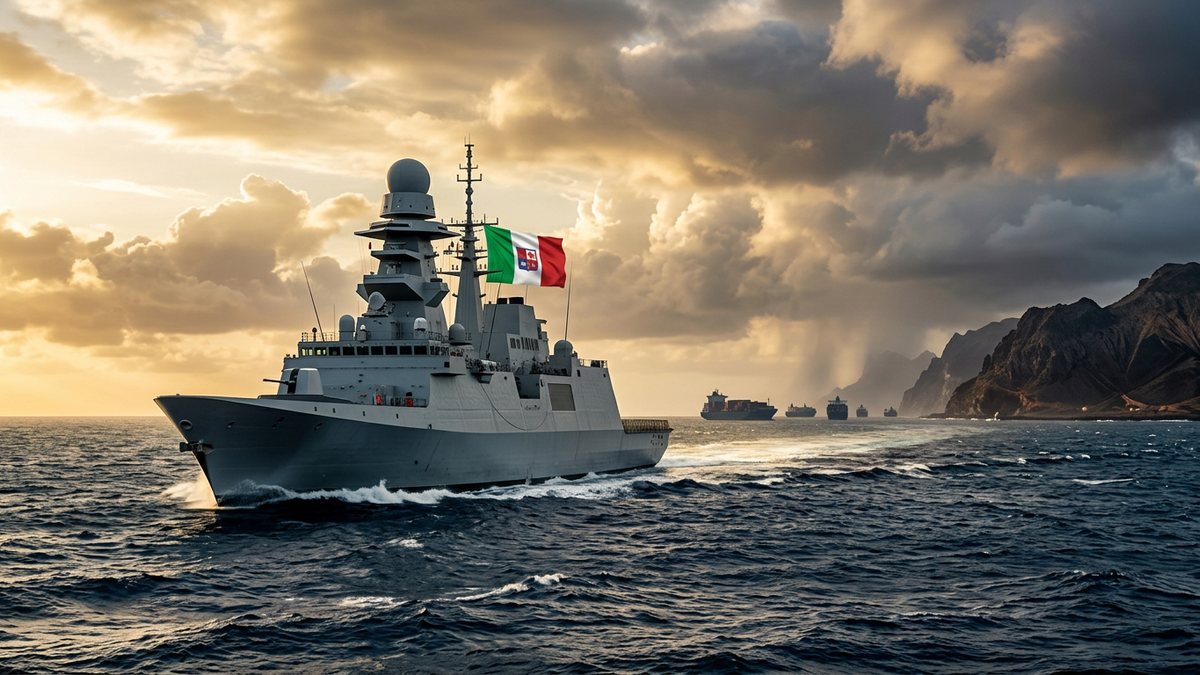
Italy is preparing to bolster naval protection for merchant shipping in the Red Sea as Houthi forces advance toward one of the world’s most important maritime chokepoints.
Italian Defense Minister Guido Crosetto says Rome cannot afford to wait for a sluggish European response as the security situation around the Bab el-Mandeb Strait deteriorates, according to the Italian Ministry of Defense. The Houthis have proved remarkably difficult to dislodge, routing Saudi-backed forces during their latest offensive while repeatedly striking Saudi oil infrastructure, including the kingdom’s critical East-West Pipeline. Even a seven-week U.S. bombing campaign in 2025 involving more than 1,000 strikes ended in a ceasefire with the Houthis still intact and capable of threatening regional targets.
Italy already participates in the European Union’s Operation Aspides, but Crosetto is calling for additional warships as conflict threatens shipping routes at both ends of the Middle East, Reuters reported.
“After what I said, something moved within Aspides [the European Union’s naval mission in the Red Sea], but we need more ships,” Crosetto told Reuters Friday.
The Italian Ministry of Defense, the Italian Ministry of Foreign Affairs, the Pentagon and the White House did not respond to a request for comment.
“NATO Allies recognise the impact of instability and conflict in the southern neighbourhood on their own security,” a NATO official told the DCNF. “Allies regularly discuss a broad range of security challenges including those related to freedom of navigation. On a related note, at the NATO Summit in Ankara, all Allies called on Iran to fully respect freedom of navigation in the Strait of Hormuz while also reaffirming that Iran must never have a nuclear weapon. We want to see peace and stability return to the region as soon as possible.”
Italy and Greece are currently providing the most meaningful European support for the maritime security effort, Crosetto said, though he declined to estimate how many additional vessels would be necessary, Reuters reported. Rome has not disclosed which naval assets it could send or the precise scope of any additional mission.
Italy is not sending a token naval force into the region.
The Italian Navy operates the Cavour aircraft carrier with F-35B stealth fighters, the large Trieste amphibious assault ship, two Horizon-class air-defense destroyers, eight submarines and 10 modern FREMM multi-mission frigates, according to the Italian Navy. Italy has also demonstrated that it can deploy a carrier strike group alongside major NATO navies, including operating Cavour with F-35Bs during high-end allied exercises, according to the Italian Navy.
“U.S. Naval Forces Central Command and U.S. 5th Fleet remain aware of the security situation in the Red Sea and Bab el-Mandeb and continue to monitor developments that could affect maritime security and freedom of navigation,” Cmdr. Joe Hontz, force public affairs officer for U.S. Naval Forces Central Command, U.S. 5th Fleet and Combined Maritime Forces, told the DCNF.
Crosetto ordered the Italian Navy to prepare what is necessary to ensure Italian ships can transit the area safely, arguing that bureaucratic delays could directly harm Italy’s economy and its citizens, according to the Italian Ministry of Defense.
“When a maritime route is interrupted, goods arrive late, costs increase and prices rise for families and businesses,” Crosetto said, according to the Italian Ministry of Defense.
The Iran-backed Houthis have rapidly expanded their position along Yemen’s Red Sea coastline. Houthi forces seized the port city of Mocha before reaching the strategically positioned Perim Island inside the Bab el-Mandeb Strait, Reuters reported, citing four Yemeni government sources.
The Bab el-Mandeb is only about 18 miles wide at its narrowest point and connects the Red Sea with the Gulf of Aden, making it a crucial passage for ships traveling between Asia and Europe through the Suez Canal.
“We do not discuss intelligence assessments or internal deliberations for operational security reasons,” a U.S. Central Command spokesperson told the DCNF.
About 40% of Italy’s trade with the rest of the world moves through the Suez Canal, Reuters reported, citing the Italian shipowners association Assarmatori.
Ships traveling between the Suez Canal and the Indian Ocean must also pass through the Bab el-Mandeb Strait at the southern end of the Red Sea, meaning any sustained disruption there can effectively choke off the same Europe-Asia trade route. Petroleum volumes moving through Bab el-Mandeb in June were equivalent to roughly 7% of global oil production, Reuters reported, citing commodities analytics firm Kpler.
Italy is not starting from scratch in the Red Sea. The Italian frigate Bergamini escorted a merchant vessel through the waterway in August while operating under Aspides, according to the Italian Ministry of Defense.
Aspides is a defensive EU maritime operation tasked with accompanying merchant vessels, monitoring threats and protecting ships from attacks at sea, according to the European External Action Service. The mission does not conduct strikes against targets on land.
Italy’s push to keep the Red Sea open is beginning to intensify as the country is already being hammered by another energy shock at home. Italian consumer prices rose 3.3% year-over-year in August, while regulated energy prices jumped 18.6% and non-regulated energy prices climbed 17%, according to Italy’s national statistics agency ISTAT.
The country has little fiscal breathing room to absorb another prolonged crisis. Italy’s public debt is expected to reach roughly 138.5% of GDP this year while economic growth remains anemic, with the European Commission forecasting just 0.5% expansion in 2026, according to the European Commission.
Economy Minister Giancarlo Giorgetti warned Friday that the cost of servicing Italy’s debt is rising at an “alarming” pace as geopolitical tensions push up inflation and borrowing costs, Reuters reported.
Rome is already spending billions trying to shield households from the fallout. The government plans to extend fuel excise-tax relief and scrap road taxes for roughly 14.5 million vehicles beginning in 2027, measures expected to cost more than 5 billion euros combined, Reuters reported.
Italy’s shipping industry has backed a larger naval role as the threat grows. Assarmatori President Stefano Messina said the Italian Navy is capable of operating while Europe determines its broader response through Aspides, Reuters reported.
Pressure around Bab el-Mandeb is adding another potential choke point for global shipping while commercial traffic through the Strait of Hormuz remains well below recent averages amid the continuing U.S.-Iran war, Reuters reported, citing preliminary Kpler shipping data.
All content created by the Daily Caller News Foundation, an independent and nonpartisan newswire service, is available without charge to any legitimate news publisher that can provide a large audience. All republished articles must include our logo, our reporter’s byline and their DCNF affiliation. For any questions about our guidelines or partnering with us, please contact [email protected].
Get every new post by email
No spam, no account needed. Unsubscribe anytime.


