




Japan Pushes Back On Nuclear Shift Speculation As Debate Over America’s Nukes Heats Up
Japan insists its longstanding nuclear weapons policy remains unchanged, even as officials consider a historic shift that could allow American nuclear weapons onto Japanese territory amid growing threats from China, Russia and North Korea.
Francis Kapper · Oct 24, 2026 · 6 min read
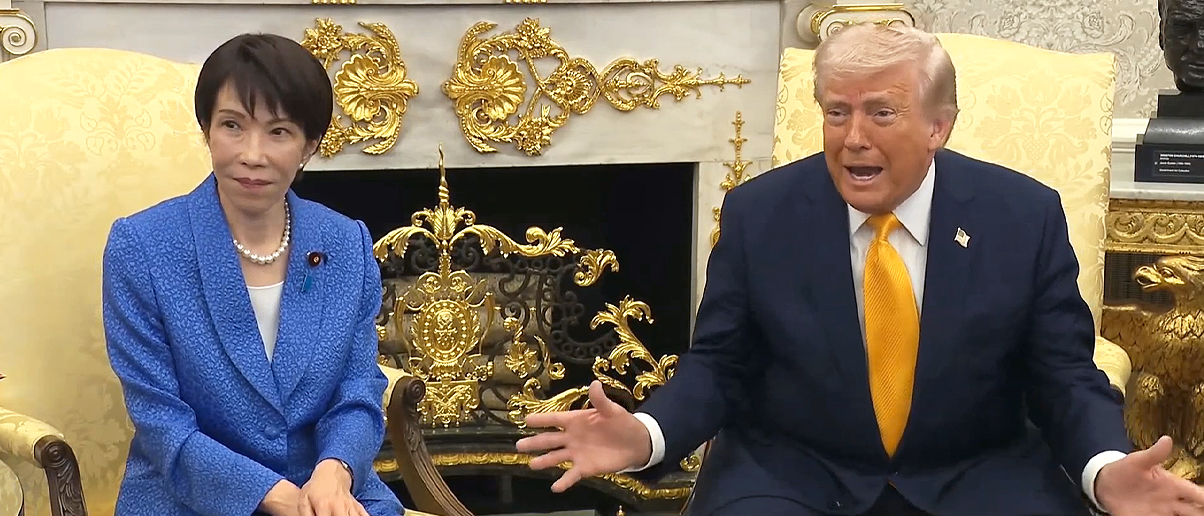

Japan insists its longstanding nuclear weapons policy remains unchanged, even as officials consider a historic shift that could allow American nuclear weapons onto Japanese territory amid growing threats from China, Russia and North Korea.
The Japanese Embassy in Washington told the Daily Caller News Foundation that Tokyo remains committed to its decades-old nuclear restrictions despite growing speculation about potential changes. Japanese Defense Minister Shinjiro Koizumi is nevertheless scheduled to meet his Finnish counterpart Monday to discuss Helsinki’s recent nuclear policy overhaul, the Japan Times reported, citing Japan’s Defense Ministry.
“The [Japanese] Government adheres to the Three Non-Nuclear Principles as a set of policy guidelines,” the Japanese Embassy in Washington told the DCNF. “Japan will continue to maintain and strengthen the NPT [Treaty on the Non-Proliferation of Nuclear Weapons] regime and advance realistic and practical efforts toward a world without nuclear weapons. Japan’s position remains unchanged.”
Experts had differing opinions as to what this could mean for the future of peace in Asia.
“It would be a really bad idea.” Allen R. Carlson, an associate professor of government at Cornell University, told the DCNF. “It would infuriate Beijing, and I am not convinced it adds much to deterrence that re-emphasizing existing commitments would not. This is not an argument for placating or accommodating China in East Asia. Rather, there is a way to show resolve without provoking: reiterate, unequivocally, existing US security commitments to our allies in the region, starting with Taiwan, but including South Korea and Japan.”
“In the short term, positioning nuclear weapons in Japan could strengthen deterrence by signaling that the United States might be prepared to engage in limited nuclear operations in East Asia,” Eric Heginbotham, a principal research scientist at the Massachusetts Institute of Technology’s Security Studies Program and co-director of its Wargaming Lab, told the DCNF. “These would necessarily be so-called tactical nuclear weapons. But China will not give us its quest to maintain or strengthen its military options vis-à-vis Taiwan, so this will not be the end of the story. “
Japan’s longstanding Three Non-Nuclear Principles, established in 1967, prohibit the country from producing, possessing or permitting nuclear weapons onto its territory, according to Japan’s Foreign Ministry.
However, Japanese officials are considering relaxing the third restriction, potentially permitting American nuclear-armed warships to enter Japanese ports, the Japan Times reported.
The proposal follows Finland’s decision to overturn longstanding nuclear restrictions, allowing nuclear weapons onto its territory under circumstances involving national defense, NATO operations or defense cooperation, according to the Finnish government.