




Medical Technology Tariffs Make Health Care More Expensive
The great Arthur Laffer always tells us that when you tax something you get less of it, and when you tax something less you get more of it. That's why President Donald J. Trump's tariffs on medical technology produce less innovation and higher prices for patients.
Stephen Moore and Phil Kerpen · Oct 19, 2026 · 4 min read


WASHINGTON — The great Arthur Laffer always tells us that when you tax something you get less of it, and when you tax something less you get more of it. That’s why President Donald J. Trump’s tariffs on medical technology produce less innovation and higher prices for patients.
Trump is at his best when he treats higher prices as the enemy. His historic tax cuts and regulations moved America in the right direction. So did his health care transparency rules and prescription drug reforms that let consumers buy drugs directly. When it comes to medical technology — the equipment that turned our hospitals into high-tech wonderlands — the administration’s principal policy has been a hefty tax in the form of tariffs.
That raises costs, especially in a healthcare sector where there is still far too little choice and competition. Those costs are passed on to patients either directly, through higher bills, or indirectly, through higher premiums or higher taxes that fund government health care programs.
The usual protectionist argument that domestic production can replace imports fails because technology supply chains are global and regulatory approval processes are long. The U.S. already dominates manufacturing these devices. But very few high-end machines can be made without foreign parts and systems that are being hit by Trump’s blanket tariffs, and replacing parts with alternative suppliers requires a costly and time-consuming Food and Drug Administration (FDA) recertification process.
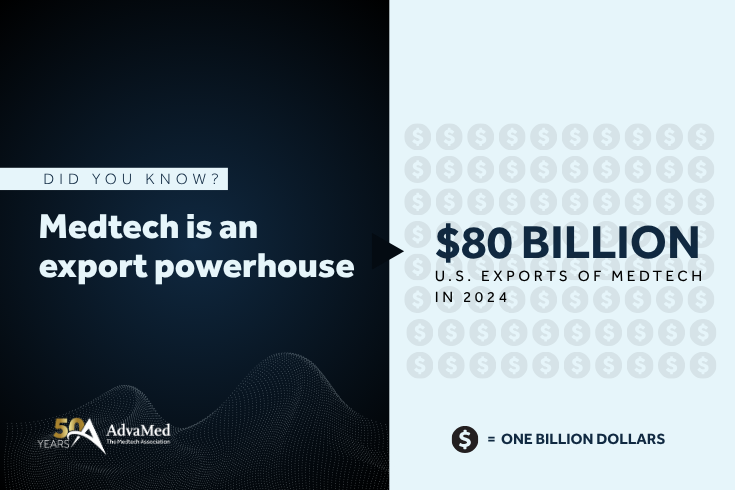
American-made products already command about 70 percent of the domestic medical tech market by value, supporting about three million direct and indirect jobs and generating $250 billion a year from more than 16,000 facilities in all 50 states, according to estimates from the industry group AdvaMed. These jobs have grown three times faster than manufacturing overall since 2018, with average pay around $97,000. Companies have invested more than $340 billion into manufacturing and research since 2017, and the industry exported about $80 billion in 2024. This is not a domestic industry that needs protection from foreign competitors. It’s a booming engine of the American economy, but tariffs are driving up costs.
The remaining imports are not widgets somebody forgot to make in Ohio. They are the key parts of U.S. systems that only a handful of plants on earth know how to build. Superconducting MRI magnets are still wound in Oxford, England, because that is where the magnet line and the people who run it sit.
Medical cyclotrons, the $2 million to $4 million accelerators that make Positron Emission Tomography (PET) doses, are the same kind of product. Only a small set of firms in Belgium, Japan, and Canada sell them. American hospitals that install the machines do not have a mass-production alternative next door.
The isotope behind most nuclear-medicine scans is technetium-99m, made from molybdenum-99. The United States still imports its commercial Mo-99 from a few reactors in Europe, South Africa and Australia. Taxing it when it’s imported doesn’t conjure a domestic reactor. It does make building one more expensive.
Similar supply-chain impacts affect nearly every piece of high-end medical technology, and even if domestic suppliers are available, changing even a screw vendor can require full requalification. So, the price hit is real, and it lands on capital equipment hospitals replace rarely.