




‘No Slack’ Left In US Refineries As Diesel Tops $6.50 A Gallon
U.S. refineries have little room to absorb another supply shock as diesel prices keep climbing, an energy analyst told the Daily Caller News Foundation.
Simon August · Sep 21, 2026 · 7 min read

U.S. refineries have little room to absorb another supply shock as diesel prices keep climbing, an energy analyst told the Daily Caller News Foundation.
The national average price of diesel reached a record $6.51 a gallon Monday, up from $6.23 a week earlier and $3.70 a year ago, according to the American Automobile Association (AAA).
“There is no slack in the U.S. refining system,” Tom Kloza, chief energy adviser at Gulf Oil, told the DCNF.
“Refiners have been running above 95% of capacity for many months, shattering any previous streaks,” Kloza said. Running that close to capacity leaves the fuel system “subject to problems if there are any unplanned outages, fires, hurricanes, etc.”
Diesel has risen about $2.61 a gallon nationally since just before the military action against Iran at the end of February, adding roughly 37 cents to 44 cents a mile to truckers’ costs, Avery Vise, vice president of trucking at FTR Transportation Intelligence, told the DCNF.
Truckers who book loads one at a time through freight brokers, known as the spot market, pass those costs on quickly, Vise said.
“For capacity sourced in the spot market via freight brokers, the fuel costs are passed on to shippers basically right away because spot rates generally are intended to cover those costs,” he said.
Companies that hire truckers under contract pay fuel surcharges that are billed when the freight is delivered and usually paid within 30 to 60 days, Vise said. FTR has not analyzed whether shippers then pass those surcharges on to retailers.
The Department of Energy did not immediately respond to the DCNF’s request for comment.
The Energy Information Administration (EIA), which publishes a separate weekly average, put the price at $6.285 a gallon for the week of Sept. 14 and releases its next figure Tuesday.
Kloza told the trucking publication Overdrive on Sept. 15 that the U.S., Europe and Asia “could see diesel prices of $8-$10/gallon before this is all over.”
“I do believe that we could see ‘stupid’ prices for diesel of $7-$9/gallon but that would not be my base case,” Kloza told the DCNF.
“Another parabolic rally for diesel could happen if more Red Sea refineries are targeted by the Houthis or Iran,” he said. A hurricane in the Gulf of Mexico could also send prices sharply higher.
Reaching an $8 national average “really requires more supply shocks,” Kloza added.
“At the outset, $8 a gallon at the national level in time to affect holiday freight seems implausible, but so did $6.50 a gallon diesel eight months ago,” Vise said. “It is not clear that transportation fuel costs have ever affected retail prices enough to matter, but the premise of $8 diesel certainly raises that possibility.”
The conditions behind $8 diesel would likely hit retailers harder by cutting into shoppers’ spending, because gasoline “almost certainly would rise to a record level” as well, Vise noted.
“I wouldn’t use the term shortage yet in the U.S.,” Kloza said. “We have diesel but inventories are quite low for this time of year.”
The potential for diesel shortages “is real,” though FTR would not yet call it a likely outcome, Vise told the DCNF.
U.S. inventories of ultra-low sulfur distillate, the base stock for diesel, are 9% below the level at the same point in 2022, the next lowest in many years for this time of year, he said.
“Timing is not on diesel’s side, either,” Vise added. The U.S. should be building up distillate inventories ahead of the heating oil season in the Northeast and Midwest and the extra diesel use by farm equipment during the fall harvest.
He called the strain on diesel “a global problem,” and stated that refiners also have an incentive to export it, Vise said. Pushing refineries that are already running hard “runs some risk of equipment breakdowns in the process that could put even more stress on supply,” he said.
Russia banned diesel exports on July 8 after Ukrainian strikes strained its domestic fuel market, and the ban on producer exports runs through Sept. 30, the DCNF reported.
Refiners may be able to rebuild inventories before the heating season, when Europe and the Northeast “see a lot of diesel molecules go to furnaces,” Kloza said.
“Northeastern heating oil costs are now in the realm of $6.20-$6.75/gal,” Kloza wrote on X on Sept. 19.
“Truckers keep a close eye on diesel prices because fuel is one of the biggest operational costs for owner-operators,” a spokesperson for the Owner-Operator Independent Drivers Association (OOIDA) told the DCNF.
“Our members often work load-to-load and can’t simply raise their rates when fuel spikes the way their larger competitors can,” the OOIDA spokesperson said.
More than 90% of U.S. trucking companies are small businesses, and they are the first to feel it when prices jump, according to the spokesperson. The rise in diesel costs “has quickly eaten up what little margin mom-and-pop trucking businesses have left,” the spokesperson said.
“Diesel is one of trucking’s largest operating expenses, so an increase of this magnitude creates immediate pressure on motor carriers, who run on tight margins,” Henry Hanscom, chief advocacy and public affairs officer at the American Trucking Associations, told the DCNF. “When families spend more at the pump, they have less to spend elsewhere, and that can translate into weaker demand for the goods trucks move.”
“There is no overnight policy fix for a global energy shock, and policymakers should resist actions that sound appealing but provide little relief or create larger problems,” he added.
The right response is to “protect energy reliability, strengthen the supply chain, and pursue durable policies that lower the cost of operating safely and efficiently,” Hanscom emphasized.
Spot rates for dry van trailers have risen enough to fully cover the added fuel cost, Vise said, because “capacity is tight, and the truck freight market already was heating up.”
Carriers in the spot market “in theory should be fine,” provided they “have either the cash or creditworthiness to cover very high and rising fuel costs until they are paid,” he underscored.
In the spring of 2022, when diesel prices surged after Russia invaded Ukraine, “dry van and refrigerated spot rates continued to fall,” Vise said.
UPS resets its fuel surcharge every week based on the EIA’s national average, the company says on its website.
FedEx set its fuel surcharge on FedEx Ground shipments at 29% for Sept. 21 through Sept. 27, up from 28% the week before, according to its website. The surcharge also applies to FedEx Home Delivery, the service that brings packages to households, and is charged on the residential delivery fee as well as the package rate, FedEx says on the same page.
FedEx Freight, which hauls large commercial shipments, set its fuel surcharge at 58.6% of its transportation charges for Sept. 16 through Sept. 22, the company says on its website.
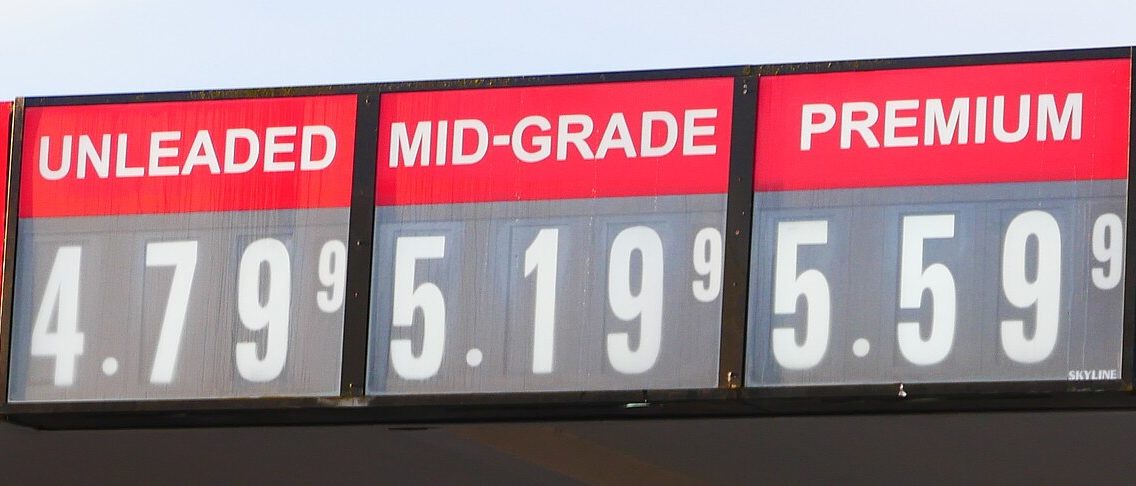
Regular gasoline averaged $4.48 a gallon Monday, up from $3.18 a year ago, according to AAA.
The spokesperson for the National Retail Federation (NRF) was out of the office Monday, Will Granados, the group’s director of media relations, told the DCNF. The NRF’s Sept. 9 Global Port Tracker report forecast that September would narrowly be the busiest month of 2026 for imports at the nation’s major container ports.
Consumers “keep buying despite tariffs, inflation and high fuel prices, and retailers keep bringing in merchandise to meet demand,” NRF Vice President for Supply Chain and Customs Policy Jonathan Gold said in the release.
Matt Muenster, chief economist at the fuel management firm Breakthrough, expects prices to keep rising through at least mid-November, Overdrive reported.
“More regional volatility is likely given the intense stress the supply side of the market is under,” Muenster told the outlet.
The EIA’s weekly national average rose 31.8 cents from the previous week. Diesel averaged $8.04 a gallon in California and $6.03 on the Gulf Coast, the cheapest region, for the week of Sept. 14, according to the EIA.
The Federal Motor Carrier Safety Administration (FMCSA) lifted federal limits on driving hours for interstate truckers hauling gasoline and diesel from Sept. 16 through Dec. 16, according to the waiver. The agency said in the waiver that it acted in response to “global supply disruptions” and expected increases in fall demand, including from agricultural harvesting.
All content created by the Daily Caller News Foundation, an independent and nonpartisan newswire service, is available without charge to any legitimate news publisher that can provide a large audience. All republished articles must include our logo, our reporter’s byline and their DCNF affiliation. For any questions about our guidelines or partnering with us, please contact [email protected].
Get every new post by email
No spam, no account needed. Unsubscribe anytime.


