




Adoniram Judson's Bible Buried in a Pillow
Through imprisonment, fever, and the loss of his family, America's first foreign missionary finished the Burmese Bible — its manuscript once sewn inside a prison pillow.
FaithTap · Sep 26, 2026 · 10 min read
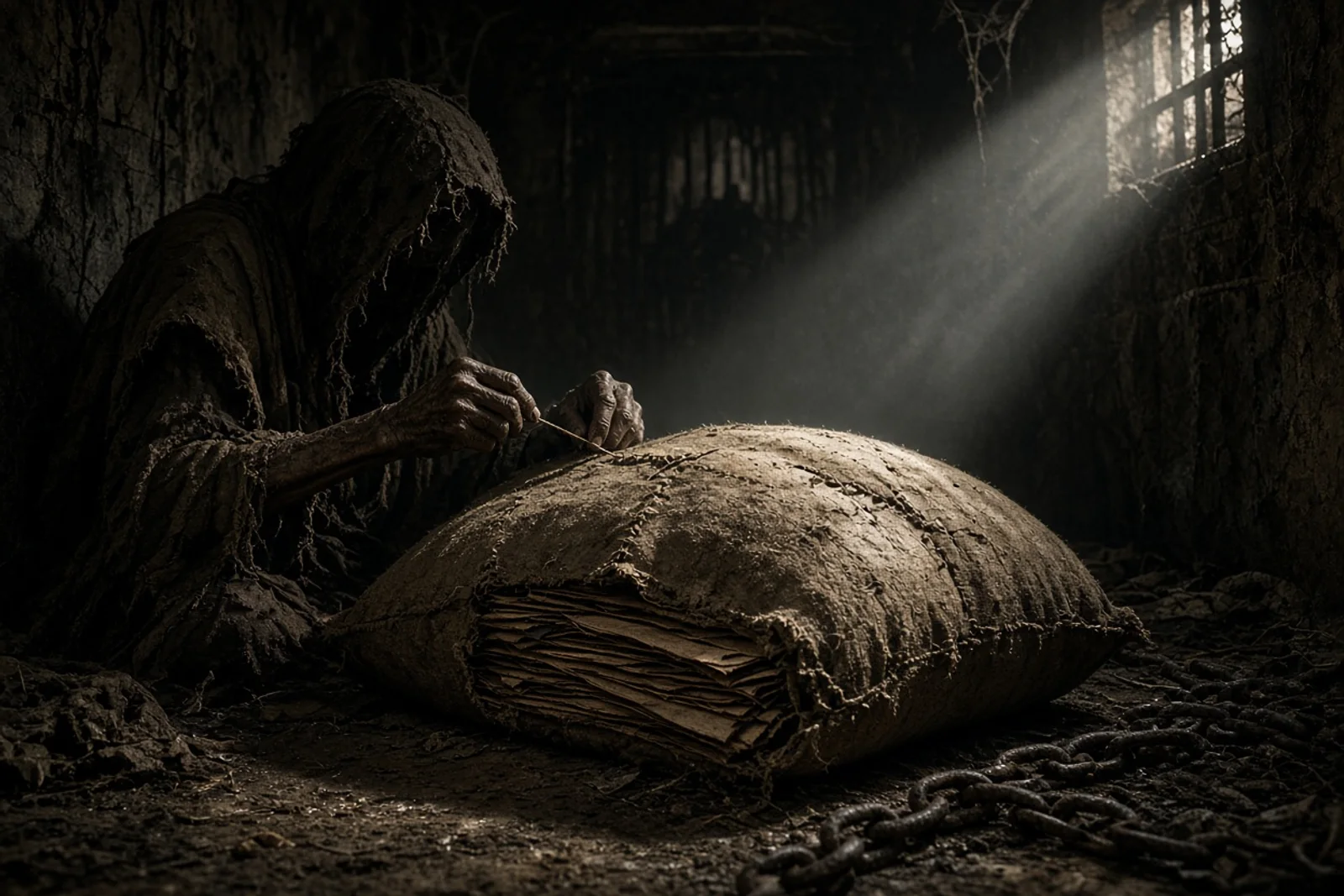
The door came off its hinges before it ever opened properly, and I remember thinking, in that first useless heartbeat, that the rice would go cold. Adoniram and Ann were still at the table, the lamp between them, when the Burmese officer filled the doorway with his shoulders and his voice cracked over the room like a whip. Mr. Judson, you are under arrest. I was standing near enough to see Ann's hand go still over her plate. I was near enough to see Adoniram's face change from a husband's face to something else, something braced.
I had come into that household two years after the Judsons landed at Rangoon, back in the July heat of 1813, when the mission was young and the language was still a wall Adoniram was learning to climb one brick at a time. By the summer they took him, he had given ten years to it — ten years bent over paper, testing Burmese words against Greek ones, praying the meaning would not slip through his fingers on the way from one tongue to the other. I had watched him write by lamp oil until his eyes burned. I had watched Ann copy pages in her clear hand so there might be two of everything, in case fire or flood or carelessness took one. None of us imagined it would be soldiers.
They dragged him out with a rope looped under his arms, the way you'd haul a criminal too dangerous to walk on his own two legs, and Ann stood in the doorway with her hands pressed to her mouth. I stood beside her. Neither of us said anything for a long while after the sound of him was gone down the road. Then she turned back into the house, and I saw her eyes go straight to the writing table, to the stacked pages that were the whole of ten years, and I understood before she said a word what she meant to do.
They took him to Let-Ma-Yoon, the prison whose name the Burmese spoke the way you'd speak of a grave already dug. Three sets of fetters. A room with no window worth the name, and heat that sat on a man like another body pressed against his. I went with Ann more than once to the outer gate, carrying whatever food or cloth the guards would allow past them, and I smelled that place before I ever saw the walls of it — a smell you did not forget, of old blood and unwashed men and river mud baked hard by the sun.
Ann did not weep in front of the guards. I want that remembered. She would straighten her shawl and speak to them in the Burmese she had labored over nearly as hard as her husband had, asking, bargaining, refusing to be turned away entirely even when they refused her everything she asked. But at night, back in the house that no longer had a husband and father sleeping in it, I heard her, and I understood that the calm at the prison gate cost her everything she had.
It was during those first weeks that she came to me with a pillow in her hands — an ordinary, lumpy, unremarkable pillow, the kind no soldier would look at twice — and asked for my needle. I did not ask what she meant to do with it. I had already seen her gathering the loose sheets of the translation from the table, the Gospels and the parts of the Old Testament Adoniram had carried furthest, and I understood that whatever she was building, it was meant to hide something too precious to leave lying where hands might find it.
We worked by lamplight, the two of us, easing pages flat and folding them small, packing them into the pillow's belly the way you'd pack a wound, and then closing the seam so that no line of thread betrayed what it held. When she was finished it looked exactly like what it pretended to be — something a man rests his head against, nothing more. She carried it to the prison herself, past the guards who searched the food baskets for coins and never thought to press their fingers into stuffing. She left it with him, so that at night, in that furnace of a room, Adoniram Judson slept with the Burmese Bible under his skull and did not know, some nights, if it was the last soft thing he would ever touch.
I think of him there through the whole stretch of that first year — through fever, through the swelling in his feet that came from irons no one had thought to loosen, through news that reached him in fragments about the war outside those walls, a war between his own countrymen's cousins across an ocean and the kingdom that now held him. Nearly two years he spent inside Let-Ma-Yoon, and for a long stretch of it Ann came almost daily, thinner each time I saw her, carrying whatever she could scrape together to keep him from starving outright.
Then came the morning the prisoners were driven out in a line and marched away from Rangoon altogether, toward a place called Oung-pen-la, and nobody could tell us with any certainty whether it was toward mercy or toward execution. I remember the road that day, the dust the guards raised, the way Ann ran alongside as far as they would let her go, and how afterward she came home and simply sat, for a long time, not speaking, because there was nothing left in that direction to hope toward except silence.