




Faraday: The Bookbinder Who Lit the World
A blacksmith's son with no schooling and a deep, quiet faith discovered electromagnetic induction — the principle behind every generator on Earth.
FaithTap · Oct 8, 2026 · 9 min read
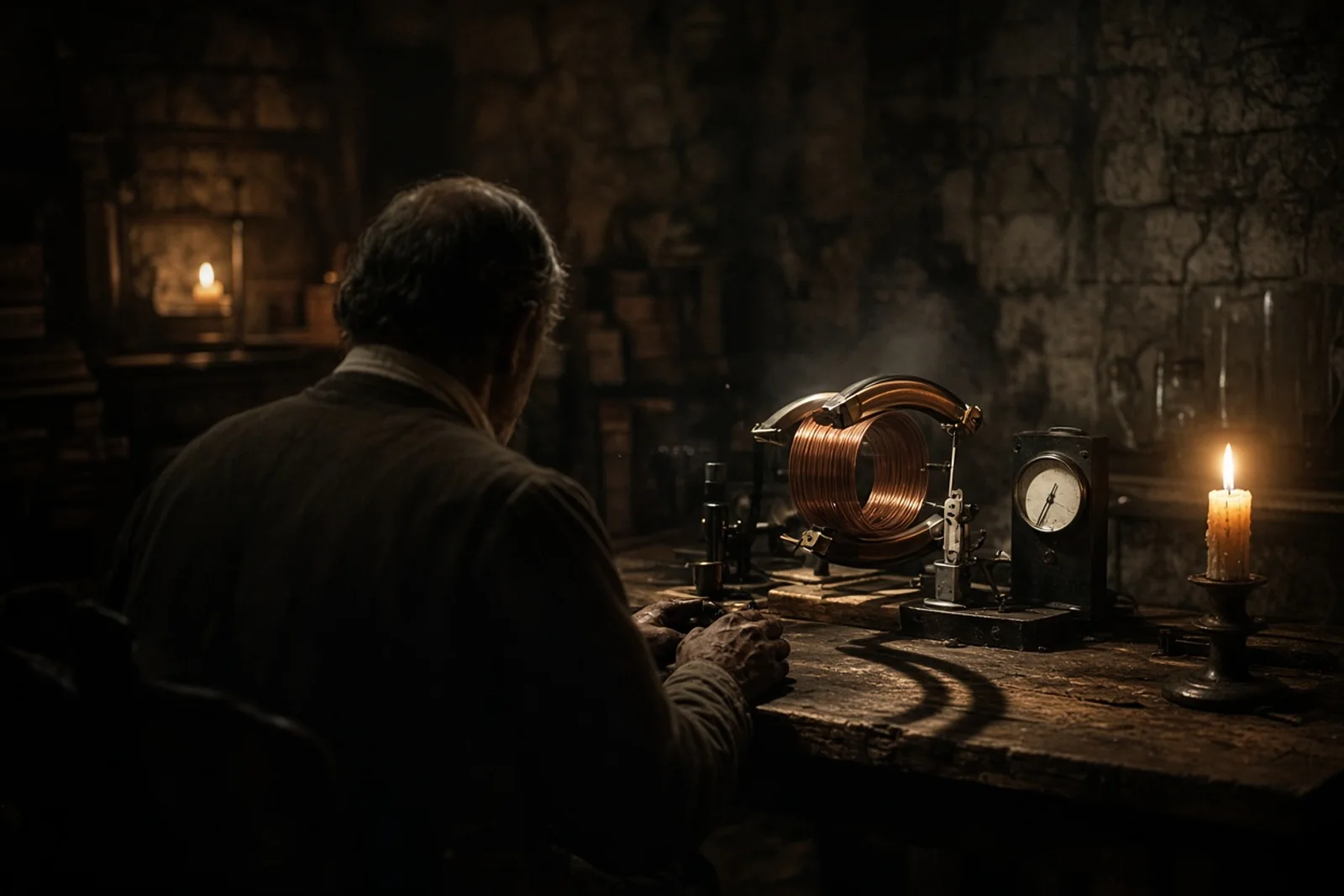
I first knew him as a pair of ink-stained hands across a workbench, folding signatures of paper into neat quires while I swept shavings and fetched glue pots for old Riebau's shop. Michael Faraday was fourteen then, bound seven years to the trade of bookbinding, and I was younger, running errands, watching him the way you watch someone waiting for a train that has not yet been built. He read every page he bound before he sewed it shut. I used to tease him for it. He would look up, patient, and say a book was worth nothing to a man who only touched its spine.
He had no schooling to speak of beyond a village day school, reading, writing, a little arithmetic. His father was a blacksmith too often ill to hammer a steady wage out of the forge, and there were nights in that house on Jacob's Wells Mews when bread was the whole of supper. I never heard Faraday complain of it. He carried something steadier than hunger, a quiet churchgoing faith from his people, the Sandemanians, who believed the Bible plain and true and asked no more of the world than honesty. It sat in him like ballast. Whatever else moved through that shop, sums, chemistry pamphlets, the Artist's Repository he copied by candlelight, that ballast never shifted.
By the time his apprenticeship neared its end I had lost the thread of his days and picked it up again through gossip carried on the London streets, the kind that travels through the shops of Blackfriars and the coffeehouses near St. Paul's. He had gone to Tatum's house for lectures on electricity and mechanics, sitting among clerks and medical students, taking notes he later bound into a book of his own. He had joined a society of young men calling themselves philosophical, meeting each week to hear one another lecture and argue. And somewhere in that stretch he heard Humphry Davy speak at the Royal Institution, and wrote out every word of it afterward, bound the notes himself, and sent them to the great man with a plea for work of any kind, however low.
Davy took him on as a chemical assistant in 1813. I remember thinking, when I heard it, that the ink-stained boy from the bindery had walked straight through a door that should have stayed shut to him. No family, no university, no fortune. Only patience, and hands that knew how to make things hold together.
Years turned. I found myself years later doing rough work about the Royal Institution myself, carrying coals, minding jars, glad of the wage, and so I came to stand nearer the man again than I had any right to expect, in the basement rooms below Albemarle Street where he now kept his own laboratory. By then the year was 1831 and Faraday was no apprentice to anyone. He had liquefied chlorine, found benzene lurking in gas-works residue, lectured to crowds who came as much for the spectacle of his hands as for the chemistry in them. But there was an older question he had never let go of, one that had sat unanswered in his notebooks since 1825. If a current could be made to run through a wire and stir a needle at a distance, as the Dane Oersted had shown ten years before, might a current in one wire wake a current in another, merely by nearness, merely by change.
The basement smelled of hot metal and lamp oil that August. I recall the ring he had made, iron, about six inches across, wound round with two separate windings of copper wire, insulated with twine and calico so the coils would not touch and steal each other's current. It looked less like an instrument than a puzzle a locksmith might set for himself on a slow afternoon. One winding he meant to connect to a voltaic pile, the battery of the day, stacked plates soaking in acid. The other he ran to a galvanometer, a needle balanced to flinch at the faintest whisper of current.
I fetched him wire that week, and files, and once a fresh vial of acid when the old one had gone thin and useless. He worked the way he had bound books, unhurried, checking every join before trusting it, muttering figures to himself that meant nothing to me and, I suspect, everything to him. On the twenty-ninth of August he set the ring on the bench, connected one coil to the pile, and asked me to watch the galvanometer needle while he closed the circuit.
Nothing happened, and then something did, and it was over before I had time to be certain I had seen it. The needle jumped, held for the space of a breath, and swung back to rest, though the battery current in the other coil was, so far as any of us standing there could tell, running on steady and unchanged. Faraday broke the circuit again to test it and the needle jumped a second time, the opposite way. He said nothing for a moment. I have thought since that this was the closest I ever saw him come to being caught entirely off his own guard.
He explained it to me later, more patient with an idle laboratory hand than any man of his standing needed to be. The current did not have to flow steadily to have effect. It was the change in it, the starting and the stopping, that stirred something in the neighboring wire, some invisible strain in the space around the ring that his instruments could only report, never show. He called what passed through that iron a line of force, though he had no better word for it than any of us did, and I remember him turning the ring over in his hands as though it might, if he looked hard enough, reveal the shape of the thing he had just proven existed.