




Father Damien Chooses the Leper Colony
When Hawaii exiled its leprosy patients to Molokai, one priest volunteered to live among them — knowing the assignment had no way back.
FaithTap · Sep 27, 2026 · 10 min read
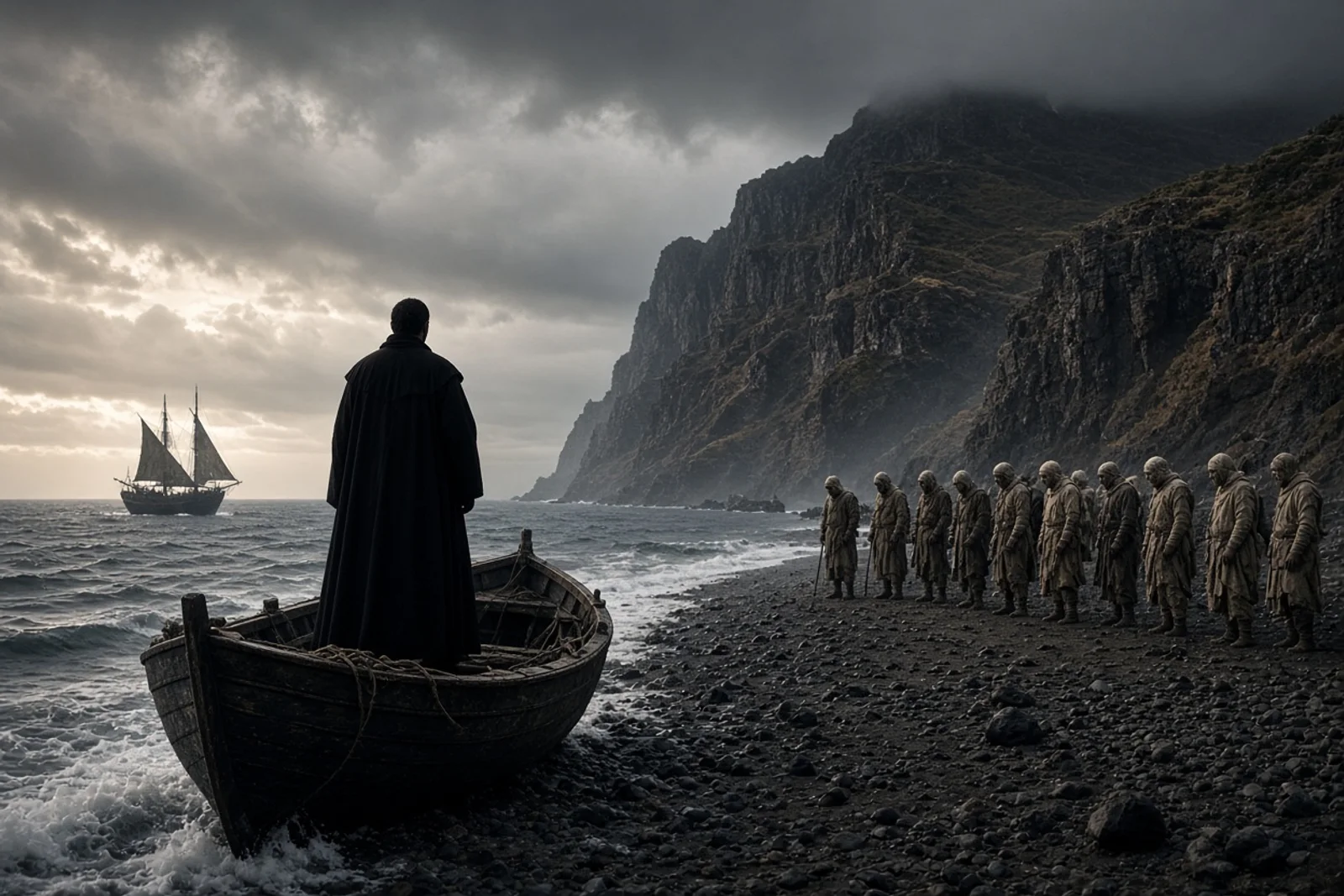
The surf at Kalawao runs high most mornings, and that morning it ran higher than I had ever seen it, white water breaking over black rock, and I stood on the shingle with the others who could still stand, watching a boat fight its way toward us through the channel between Molokai and the world we had already lost.
I had been on that shore two years by then, sent over on a cattle boat much like this one, my hands already going numb in patches, my face not yet marked enough to frighten children, though it would be. Six hundred of us lived under those cliffs, penned in by a wall of rock nearly two thousand feet high on one side and open water full of sharks on the other, and we had learned by then not to expect much from any boat that came. Boats brought rice, sometimes. Boats brought more of us. This one brought cattle lowing in their pen amidships, and fifty more sick men and women clinging to the rail, and among them a young priest in a black cassock who did not look away from us the way the sailors did.
His name, we would learn, was Damien, though he had been born Joseph de Veuster, a farmer's son from a town in Belgium called Tremeloo, and he had crossed an ocean at twenty-three to take his brother's place on a mission neither of them had ever seen, his brother too sick himself to go. He had spent eight years riding the districts of Hawaii island, Puna and Kohala and Hamakua, building chapels with the same hands that would soon be building for us, and when the bishop asked for volunteers to serve the settlement on Molokai, he did not wait to be asked twice. Three other priests said they would go, in their turn, later. Damien went first, on the tenth of May, 1873, on that boat with the cattle.
We watched him come ashore soaked to the knees, and we watched him not flinch at the smell of us, which by then none of us could smell ourselves but knew from the faces of every official who had ever been sent to count us. There had been ministers before him, Congregational men, Mormon elders, family who followed their own into exile out of love rather than duty. He was not the first kind face at Kalawao. But something in the way he stood on that beach, not stepping back, not holding a handkerchief to his face, made the crowd of us go quiet in a way I had not heard since the day we arrived ourselves.
The superintendent of the board of health had written to the bishop, before Damien came, that as long as we could still care for ourselves we managed well enough, but once the disease took our hands and our feet and our sight, he said, even demons would pity us and wish us a quicker death. That was the truth of Kalawao before Damien. We had food, most weeks. We had cloth to wrap wounds that would not close. We did not have anyone to dig a grave when a man's hands had rotted past holding a shovel, or to sit with a woman through the last fever when her own children had already been sent away sick themselves, or dead.
He changed that within the first year, though not by any miracle anyone could point to. He simply did the things no one else would do. He dressed the ulcers himself, unwrapping and rewrapping bandages that no other man on that peninsula would touch with bare hands. He helped us raise the frames of our own houses, driving nails alongside patients whose fingers could no longer close around a hammer. When the dead needed burying, and there were more dead most weeks than there were hands left whole enough to dig, he took up the spade.
He learned our language quickly, faster than any missionary I had known, and he used it not for sermons alone but for arguing, for planning, for teasing children in the yard behind the chapel. He organized a choir, and a band with borrowed instruments, and a school for the children born to patients or sent along with sick parents who had nowhere else to leave them. He put in pipes and dug for water so that we would not have to carry it from the far stream every day on backs that could no longer bear the weight. He planted trees along the paths, and I remember thinking at the time it was a strange thing to do in a place most of us assumed we would die in within a few years, planting shade for people who might never sit under it.
He rebuilt the old church, Saint Philomena, adding to it board by board until it could hold more of us than it was ever meant to, and on Sundays the sound of the choir came out through the open windows across the whole settlement, voices some of them ragged with the disease itself, but voices all the same. He was not a quiet man about our needs. He wrote to the government in Honolulu, and he wrote to his own superiors in the church, and he did not soften his letters when he thought we were being given too little. Some officials found him difficult. We did not care. We had never had anyone difficult on our behalf before.
Word of him began to travel beyond Molokai in a way none of us expected, ships' officers carrying stories to Honolulu, and from Honolulu out across the ocean to places we had never seen and never would. Visitors started coming, careful men who kept their distance on the beach and asked questions about the priest who lived among the lepers, and some of them wrote what they saw, and it went further still, to newspapers in cities whose names meant nothing to most of us. For the first time since the quarantine began, people outside Molokai were made to think about what happened to us once the boat left the harbor.