




Mendel Discovers Genetics in the Monastery Garden
An Augustinian friar counting pea plants in his abbey garden quietly discovered the laws of heredity — the foundation of all modern genetics.
FaithTap · Sep 21, 2026 · 9 min read
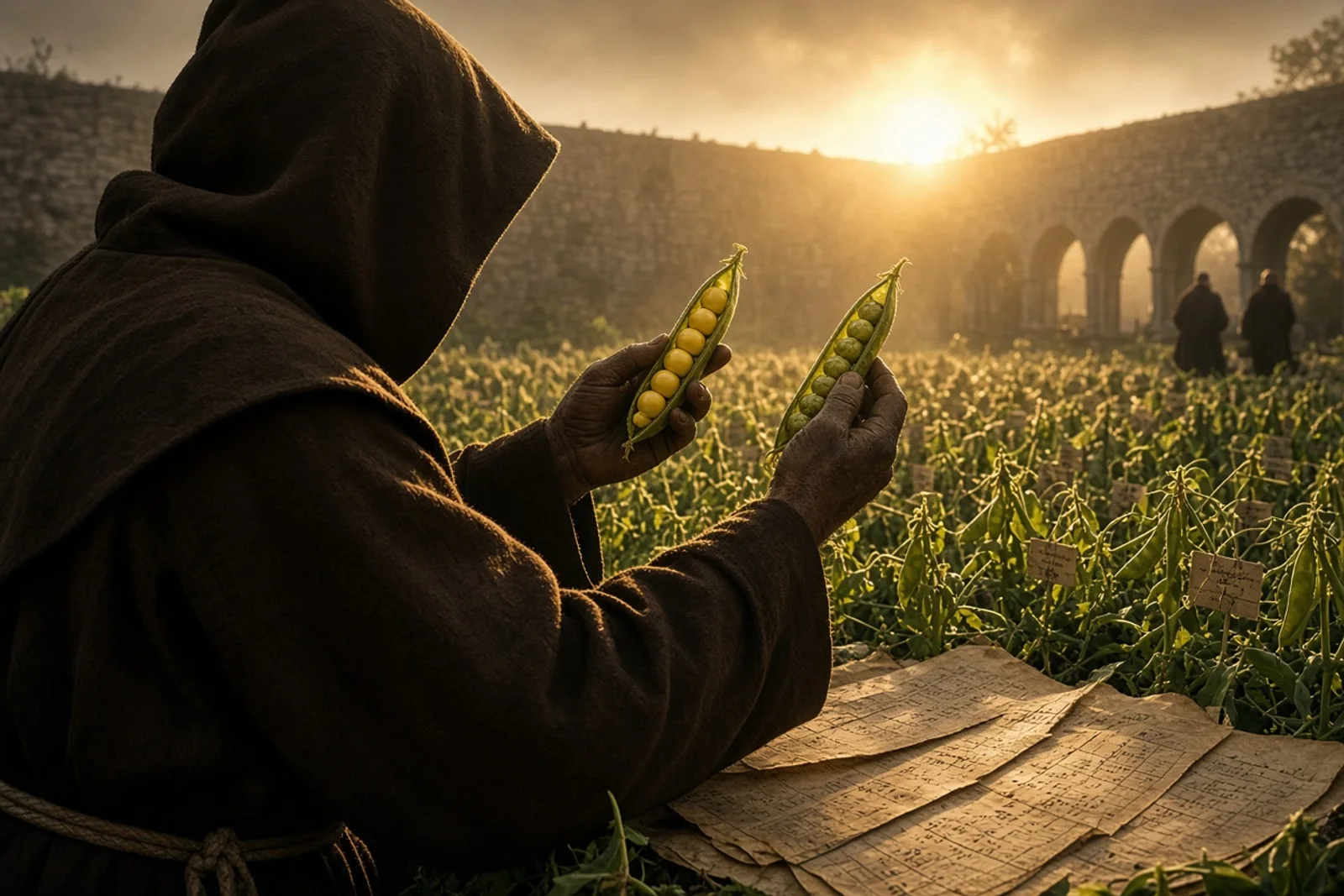
The frost was still on the trellis wire when Brother Mendel bent down and counted the same row for the third time that morning, and I knew better by then than to ask him why. Ten years old rows planted, ten thousand pods counted before, and still he checked his own numbers as if the peas might have lied to him overnight. I held the ledger open against my forearm so the wind wouldn't take the pages, and I watched his lips move without sound, tallying green against yellow, smooth against wrinkled, the whole business as quiet and as serious as a man saying his rosary.
I had come to the Abbey of St. Thomas as a boy who could dig a straight furrow and little else, hired to help keep the garden behind the monastery walls in Brno. Nobody told me at first why one particular friar spent more hours among the pea trellises than in the chapel choir. Later I understood that Abbot Cyrill Napp himself had asked it of him — that the two men shared a fascination with how living things pass their likeness down, father to son, blossom to blossom, and that the abbot had all but ordered the garden turned into a kind of church of counting.
Brother Mendel had not always seemed suited for much of anything, they said. He had trained for the parish, gone through the motions expected of a young priest, and failed at it plainly enough that his own mentor, Abbot Napp, wrote of an unconquerable timidity in him, a man not fit to stand before a sickbed or a coffin and find the right words. But he had grown up on his family's farm before the monastery ever took him in, and he had gone to Vienna to study science and mathematics, and somewhere in that unlikely combination — a farmer's hands and a mathematician's patience — the abbot saw exactly what the garden needed.
So it began in 1856, the year I first carried seed packets out to the beds behind the abbey wall. Row after row of Pisum sativum, the common garden pea, chosen not for beauty but for practicality. He explained it to me once, leaning on his hoe, that a pea plant would give you dozens of pods and hundreds of seeds from a single planting, and that its flowers kept mostly to themselves, self-pollinating inside their own petals unless a man took a fine brush and moved the pollen himself. That mattered to him more than anything. He did not want the wind or the bees deciding his results. He wanted to be the only hand in the whole transaction.
By the second summer I had learned to see what he saw — not vegetables, but variables. He had settled on seven characteristics to track, and he made me learn them the way I might have learned catechism: the shape of the seed, round or wrinkled; the color of the seed's flesh inside, yellow or green; the color of the seed coat; the shape of the pod; the color of the unripe pod; whether the flowers grew at the tip of the stem or along its length; and the height the plant would reach, tall or short. Seven small facts, and around them he built a labor that would run to nearly thirty thousand individual plants before it was through.
I remember the tedium most of all, because tedium was the whole method. Every plant tagged. Every cross recorded by hand, in a hand that never seemed to hurry. When he crossed a tall plant with a short one, he did not guess at what might happen. He waited, and he counted, and when the offspring came in overwhelmingly tall, he did not call it settled. He let those tall hybrids self-pollinate for another generation, and then another, watching for the short trait to vanish outright or merely go into hiding.
It went into hiding. That was the discovery inside the discovery — the short stems did not disappear from the bloodline, they simply waited, folded away somewhere unseen, and came back out in the next generation in numbers that repeated themselves too cleanly to be an accident. Three plants tall to every one short, again and again, bed after bed, year after year, and I watched him write those ratios down with the flat calm of a man confirming something he had already suspected in his bones.
He gave the traits letters instead of names, the way you'd give a soldier a number instead of a face. A capital letter for what showed itself, a small letter for what hid — Aa, Bb, Cc, tidy little pairs standing in for round seeds and wrinkled ones, yellow pods and green ones. I did not understand at the time that he was inventing a language that would outlive every man in that garden. To me it looked like a monk keeping very strange accounts.
Not everyone thought the accounts were worth keeping. I carried word once, from the abbey offices to the garden gate, of a letter Abbot Napp had written to Brother Mendel, and though I was not meant to read it, the page sat open on the potting bench long enough for me to catch the shape of it. The bishop had laughed, apparently, right in front of people, at the idea of a man of Mendel's education spending his days prying into what Napp's letter called the germinal proclivities of peas, when he might have been occupied with the writings of the Church Fathers instead. Napp wrote that he could not afford to have the monastery become the joke of the diocese. I looked up from the page and out at Brother Mendel, forty yards off, adjusting a paper tag on a pea vine with the unhurried attention of a man handling something sacred, and I thought: let them laugh from the diocese offices. He is not going to stop.