




Mother Teresa Starts With One Rupee
She left her convent with a few rupees and a calling to the poorest of the poor — and built an order serving the dying in over a hundred countries.
FaithTap · Oct 3, 2026 · 10 min read
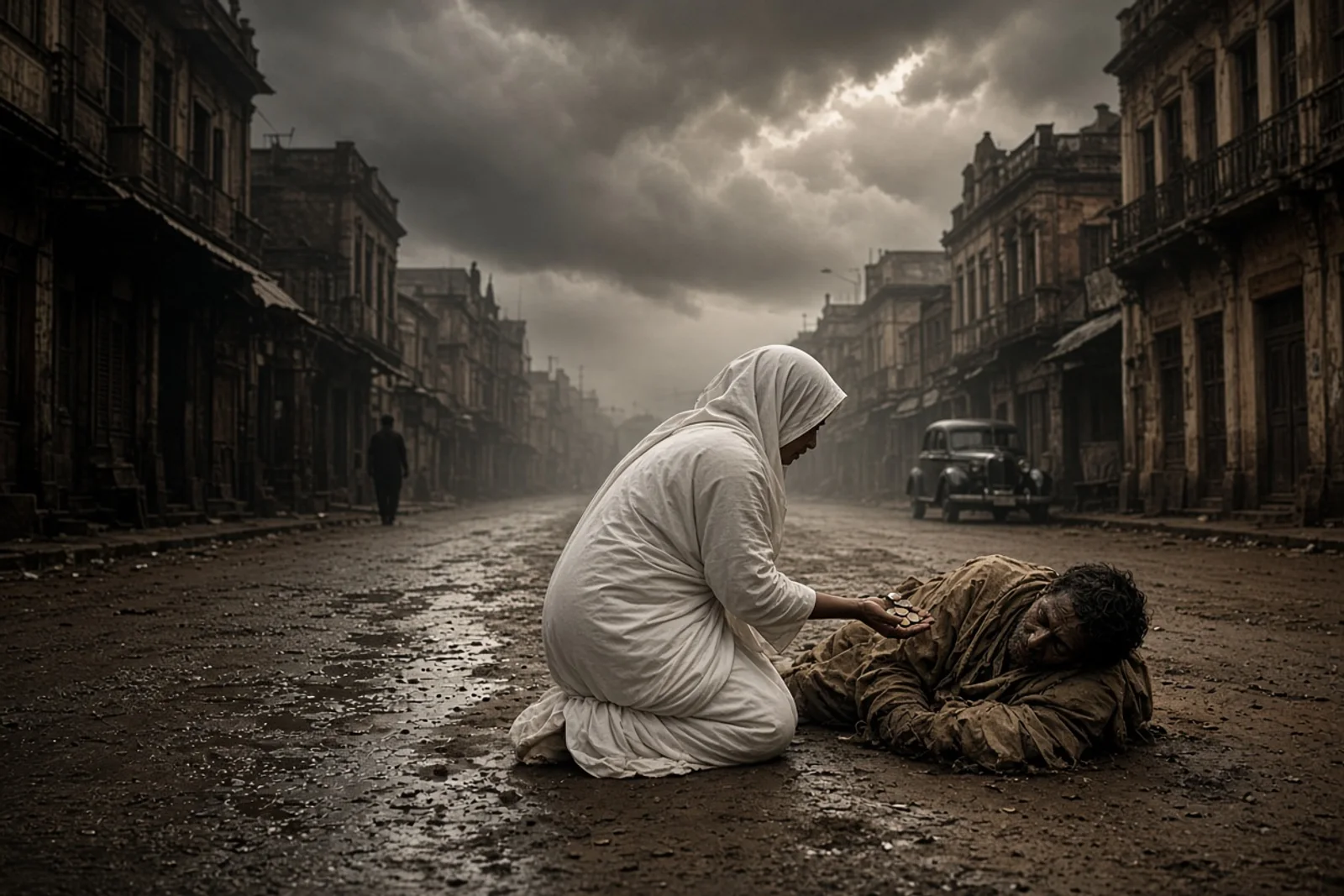
The stick in her hand made thin lines in the dust, and I remember thinking it was strange that a grown woman would kneel in the dirt of Motijhil like that, her sari already gray at the hem, her knees pressed into the same mud we children walked through barefoot every day. She was drawing letters. Bengali letters, one after another, patient as a tide coming in, and she looked up at us with an expression that made none of us want to run away, which was rare, because grown strangers usually meant trouble in our part of Calcutta.
I did not know her name that first week. Someone said she had been a teacher once, at a proper school, the kind with walls and a gate and girls in clean uniforms. It was hard to believe, looking at her sandals worn through at the sole, her white sari with no ornament on it at all, nothing but the plain cotton and the blue thread at the border that every poor woman in the city wore. But it was true. Her name, we learned later, was Teresa, and before she came to kneel in our dust she had spent eighteen years behind convent walls not far away.
She had been born far from India, in a town called Uskup, under a name that meant nothing to us then — Agnes Gonxha Bojaxhiu. At twelve years old, in that distant town, she had felt something she described as a call, a certainty that would not leave her alone. At eighteen she said goodbye to her family and did not look back, sailing first to Dublin to train with the Sisters of Loreto, then onward to India, where in 1931 she took her vows and became, officially, a nun of the order. For seventeen years after that she taught geography and catechism to the daughters of Calcutta's better families at St. Mary's High School, and by every account she loved it. She loved the girls, loved the discipline of the classroom, loved the high walls that kept the world's worst hunger at a comfortable distance.
But the walls had windows, and from them she could see the city as it actually was. Bodies on the pavement that did not always get up in the morning. Children with swollen bellies picking through refuse a few hundred yards from where her students recited their lessons in clean pinafores. She told people afterward that something in her would not let that image go, no matter how she prayed over it, no matter how she told herself that her calling was already fulfilled inside those walls.
The break, when it came, took a particular date. On the fifteenth of August in 1948, the Church kept the feast of the Assumption, the day Mary's body was said to have been carried whole into heaven, and Teresa spent it in prayer, deliberately, choosing it as the last full day of her old life. She wanted the ending and the beginning bound together, the poor and their bodies — bodies that the world called filthy, worthless, better left in the gutter — set beside the teaching that every human body was sacred enough to rise. The next morning, the sixteenth, she walked out of the convent that had been her home for eighteen years, and for the first time since she was a girl, she was not wearing the habit of Loreto.
She told an interviewer years afterward that the sacrifice of leaving her family for the convent had been the hardest thing she had ever done — until this. Walking down that street in Calcutta, she said, she had barely gone a few dozen steps before the fear caught up with her. No house. No income. No community around her. She was a nun still, bound by her vows, carrying nothing but the Pope's temporary permission to live outside convent walls long enough to try something new. She did not know, in that moment, where she would sleep that night. She had become, for the length of one terrifying morning, exactly what she intended to serve: a person with nothing.
She could not go straight to the slums and start healing anyone. She barely knew how. The people she meant to serve were not simply hungry — they were often sick past anything comfort alone could touch, bodies marked with sores, disfigured by leprosy, dying of tuberculosis on cardboard in the open air. So before she ever knelt in Motijhil with her stick and her alphabet, she took a train to Patna, in the flat green delta country along the Ganges, and enrolled with the Medical Missionary Sisters under a woman named Mother Dengel. For four months she studied wounds, fevers, the discipline of a ward. The sisters there remembered her afterward as quick — she absorbed in months what nurses usually took far longer to learn, because she intended to use every hour of it.
She came back to Calcutta with clean bandaging technique and almost no money. What she had, by every account, amounted to a handful of coins — a few rupees, no more, the entire treasury of the mission she was starting. I think of her sometimes counting them in her palm the way we counted our own scraps of change in Motijhil, turning them over, doing the arithmetic of survival. There was no convent now to feed her, no salary from St. Mary's, no guarantee from Rome beyond a signature granting her leave to try. She had decided, before she ever taught a letter of the alphabet, that she would depend on nothing but what turned up. People later called it trust in providence. It looked, from where I stood as a child, like a woman with almost nothing choosing to give away what little she had left.
The open-air school began simply because there was no roof to put it under. She gathered whichever children would sit still — and in that neighborhood, with parents working from before dawn until after dark, there were always children loose in the lanes with nothing to do — and she taught them what she could with a stick and a patch of bare ground, because paper cost money she did not have. Hygiene came next, then arithmetic, then whatever fragments of scripture and comfort she could offer between the lessons. She was not the only person in Calcutta who pitied the slum children. She may have been the only one who moved in among them to teach.