




The Damascus Road
The early church's fiercest persecutor was knocked to the ground by a light and a voice — and became the apostle who carried the faith across the Roman world.
FaithTap · Sep 23, 2026 · 10 min read
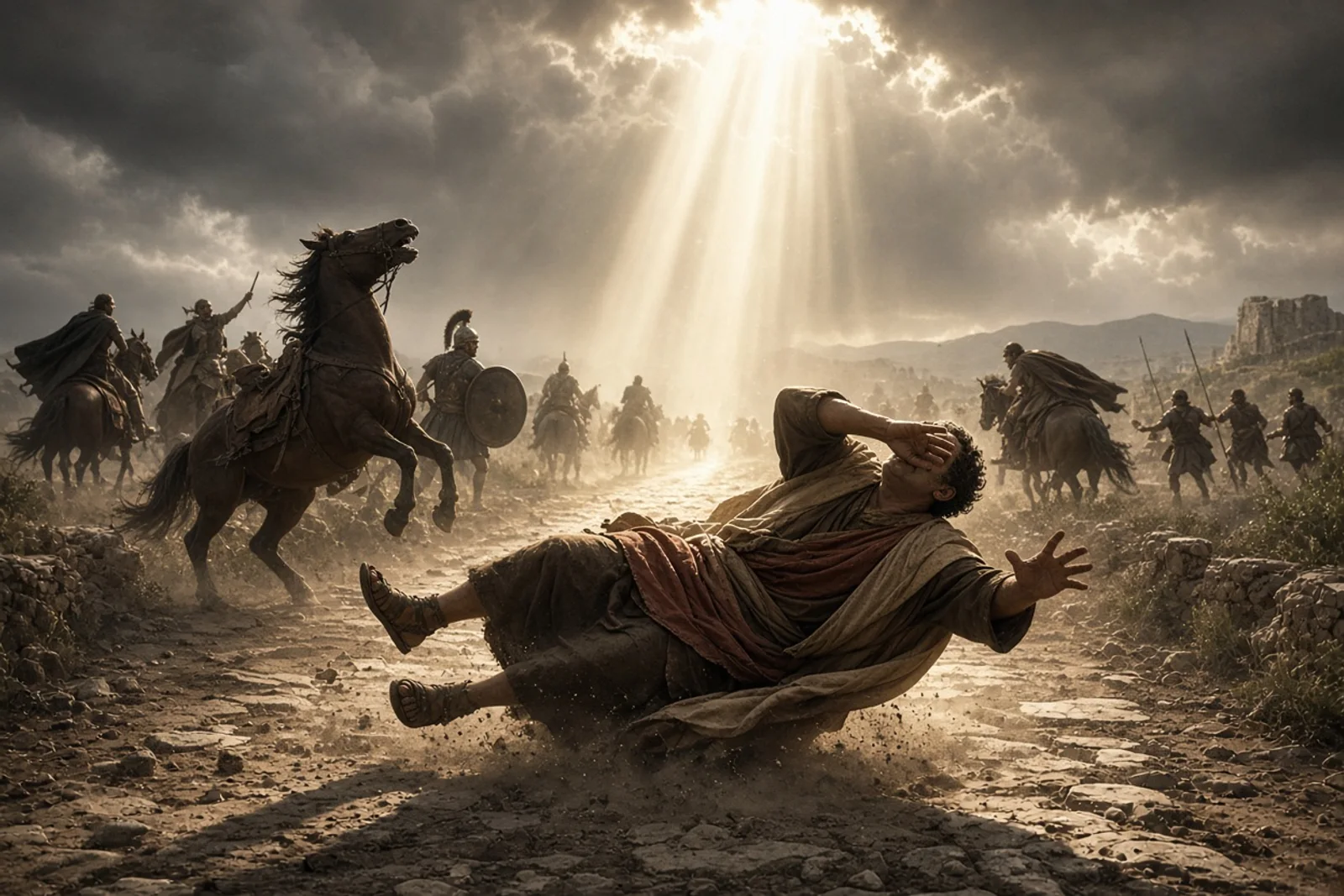
I carried the satchel with the letters in it, the ones sealed by the high priest himself, and I remember thinking how light they were for what they meant. Parchment and wax, nothing more, but enough to drag men and women out of their houses in Damascus and bind them for the journey back to Jerusalem. I was one of the party assigned to Saul of Tarsus for that errand, one of several who walked beside the mules and watched the road for bandits, and I did not think much about the weight of what we were doing. We were doing the will of the council. That was enough for me then.
Saul did not travel like a man doing a chore. He travelled like a man on fire. I had seen him in the city before we left, moving from house to house with the zeal of someone who believed every follower of the Nazarene was a splinter working its way toward the heart of Israel, and he meant to dig out every one of them. He spoke of the Way as a disease. He used the word rage without embarrassment. I had heard him breathe threats against them the way another man might breathe threats against a debtor who owed him money, except Saul owed them nothing and hated them anyway, purely, for what they believed.
The road from Jerusalem to Damascus is not short. Six days, seven if the weather turns, north through the hill country and down along routes worn smooth by centuries of traders and pilgrims and soldiers before us. We left in the cool of early morning so the mules would not suffer, and by midday the sun over that country has no mercy in it at all. I remember the dust most of all, fine as flour, rising with every hoofbeat, settling into the creases of our clothes and the folds of our eyelids. Saul rode ahead of most of us, or walked ahead, depending on the terrain, always a pace faster than the pace we kept.
We talked, on that road, the way men talk when there is nothing else to do but walk. Someone mentioned the stories, the ones about the Nazarene's followers claiming he had risen, claiming they had seen him. Saul did not laugh at these stories. He answered them the way a man answers an insult, sharply, with his jaw set. I understood, even then, that his hatred of the Way was not cold calculation. It was personal. It came from somewhere I could not see into, some place where his whole understanding of God and the Law and what pleased God sat close together, tight as bricks in a wall, and any crack in that wall felt to him like a crack in the world itself.
By the time we came within sight of Damascus, the walls pale in the distance, the orchards outside the gates green against all that brown hill country, it was near midday again. I remember that because I remember the light. Not the ordinary brightness of noon, which I had felt on my neck and shoulders every day of that journey, but something else entirely, something that came down on us all at once like a curtain dropped from a great height.
I went down. I did not choose to go down. My knees simply were not there anymore, and the ground came up to meet my face, and around me I heard the others falling too, the whole party, men and mules stumbling and crying out, and for a moment I thought we had been struck by something out of the sky, a fire from heaven the way the old stories tell of fire falling on wicked cities. I could not see anything but light. I could not hear anything clearly either, except a sound, a voice, though I could not have told you a single word of it. It was not meant for me. I understood that even in my terror. Whatever was being said, it had one destination, and that destination was lying a few feet from me in the road, and he was the only one of us who seemed to understand what the sound was saying.
I heard him answer. I heard him say the word Lord, and I remember that more than anything else from that whole day, because Saul did not use that word carelessly, and he did not use it for anyone he considered beneath the God of Israel. Something in his voice had already broken by the time he said it. Whatever he saw in that light, whatever he heard in that voice, he already knew before he asked his question that the answer was going to undo him.
Then came the second thing he said, "who are you, Lord," and then a silence in which none of us breathed, and then the answer came, and though I did not hear the words plainly, I saw what they did to him. His whole body went rigid, and then loose, like a man who has just learned his house has burned down with his family inside it. I had never seen anyone look like that. Not fear exactly. Something under fear. The face of a man discovering that everything he had built his life on for forty years had been standing on air.
I do not know how long we lay there. Time does strange things when the sky opens. When the light finally lifted, when I could blink and see the ordinary world again, the dust, the mules shifting their feet nervously, the orchard trees still green and unbothered by any of it, I looked over and saw Saul getting up slowly, one hand out in front of him, patting at the air the way a blind man does when he is trying to remember the shape of a room he can no longer see.