



The Healing of Peter at the Beautiful Gate
Lame man walks after prayer.
FaithTap · Sep 30, 2026 · 11 min read
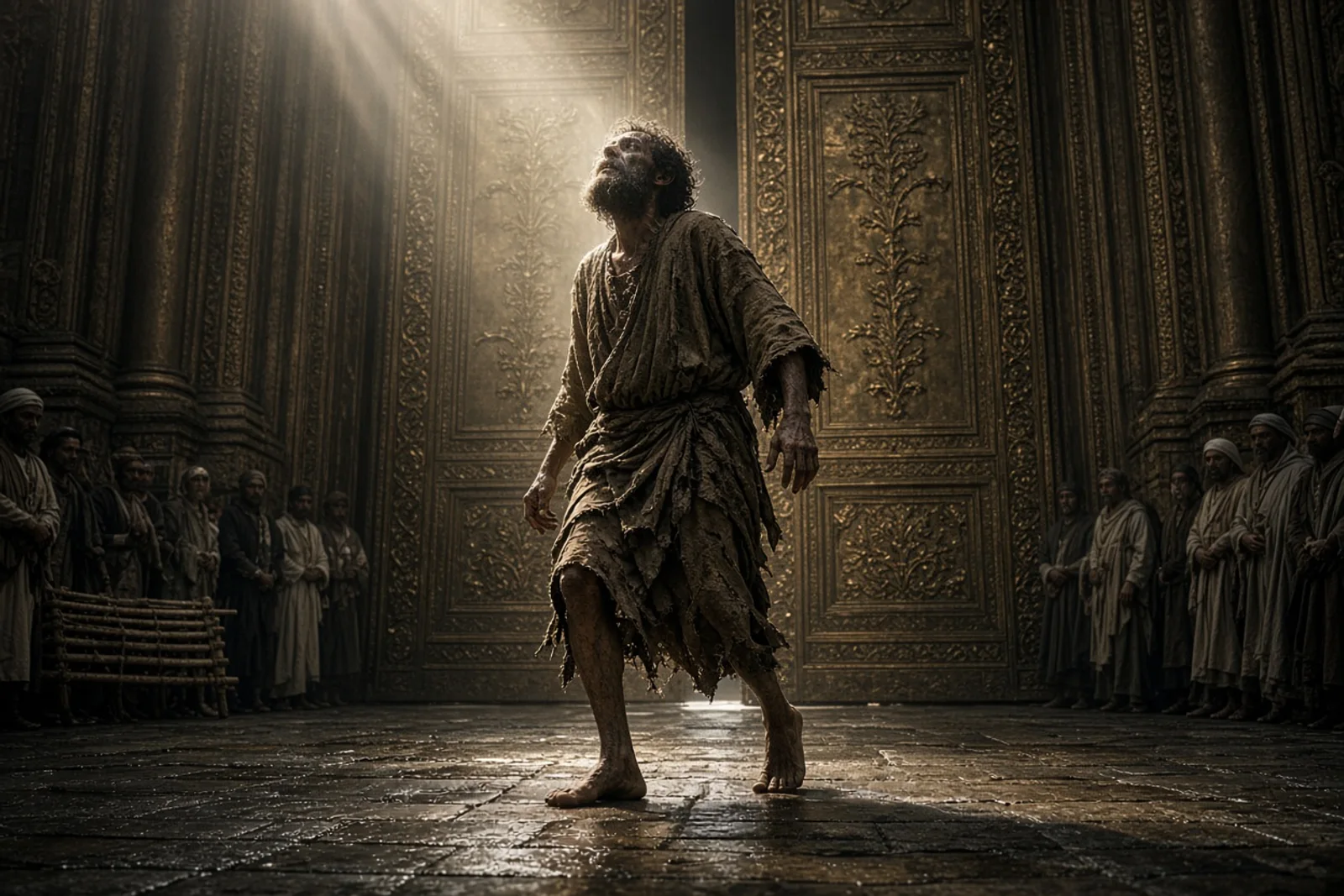
I was already inside the outer courts when the afternoon prayers drew closer. The sun had moved past its height and the stones underfoot held the warmth from the morning. I had come early to find a place near the steps where the air moved and the voices carried less.
A pair of men passed me carrying the beggar between them on a folded cloak. They set him down at the Beautiful Gate as they did every day. His legs lay straight out in front of him, ankles thin and turned inward. He settled his back against the wall and arranged the small bowl in his lap with the same motions I had watched for years.
People streamed past him toward the inner courts. Some dropped coins without slowing. Others stepped wider to avoid the reach of his hand. He kept his eyes on the flow of sandals and hems.
Two men approached the gate together. One was taller, with a voice that carried even when he spoke low. The other walked a half step behind, watching the crowd the way a man watches for trouble. The beggar lifted his head and spoke the usual request. His words were quick and practiced.
The taller man stopped. He looked straight at the beggar and said something short. The beggar looked back. For a moment the line of people behind them had to shift around the three of them like water around a stone.
Then the taller man reached down. He took the beggar by the right hand and pulled. The beggar’s body came up in one motion, faster than the men who carried him usually managed. His feet found the pavement. He did not fall.
The ankles that had always sagged now held. The knees that had never straightened locked and took weight. He stood on his own.
A sound came out of him that was not words. He took one step, then another. The third step became a jump. He landed and did it again, testing the ground that had never held him before. People nearest the gate stopped walking.
He followed the two men through the gate and into the courts, still jumping, still making that sound. The bowl stayed on the ground where it had fallen. No one picked it up.
Word moved ahead of them faster than they walked. Men and women turned from the colonnades and from the treasury boxes. Some pointed. Others simply stared. I heard the name the beggar had always been called, spoken now as a question.
He kept moving. Every few steps he would stop, look down at his own feet, and then push off again as if he needed to prove they were still under him. The two men stayed beside him, one on each side, but they did not hold him anymore.
By the time they reached Solomon’s Portico the space in front of them was filling. People pressed in from both ends of the walkway. The beggar stayed close to the taller man, one hand on his arm, the other still gesturing at his own legs.
The taller man turned to face the crowd. He spoke loud enough for the nearest rows to hear and for the words to carry further back. He said the healing had not come from him or from his companion. He named the source as the servant of the God of Abraham, the one the rulers had handed over.
The crowd stayed quiet while he spoke. Some faces showed the same astonishment that had been on the faces at the gate. Others looked toward the beggar as if checking that he was still standing.
The beggar himself did not speak. He kept one hand on the taller man’s sleeve and shifted his weight from one foot to the other, small movements that seemed to satisfy him.
When the taller man finished, no one moved to leave. The portico remained packed. A few people near the front asked questions, low voices that did not reach far. The answers came back in the same measured tone the taller man had used from the start.
I stayed where I was, near a pillar. From there I could see the beggar’s face when he turned slightly. The expression was not triumph. It was the look of someone who has stepped into a room he thought he would never enter and is still counting the doors.
The afternoon light shifted along the columns. The beggar’s shadow moved with him whenever he adjusted his stance. He did not sit again.
Later I saw him walk the length of the portico and back without support. He stopped once to touch the stone of a column, then continued. The two men remained with him until the crowd began to thin toward evening.
I left when the lamps were lit along the outer walls. The beggar was still inside the courts. He was no longer at the gate.
The lamps had been kindled along the eastern wall when I reached the outer court again the next morning. The man who had lain at the gate was no longer there. Instead I saw him near the Nicanor Gate, speaking with two women who had brought their own bowls for the offering. One of them, a widow from the village of Anathoth named Martha bat Simeon, asked him how long he had sat outside the Beautiful Gate. He answered that his mother had carried him there each morning since the year the prefect Valerius Gratus replaced Annas with Caiaphas, and that the number of days had passed forty. He gave the number without hesitation, as though he had counted them while the bowl filled and emptied.
By the third day the number of those who came to Solomon’s Portico had grown large enough that the Levites posted extra guards at the steps. The taller man, whom the crowd now called Peter bar Jonah, stood again with the healed man at his side and said the words that had been spoken at the gate: “Silver and gold have I none; but such as I have give I thee: In the name of Jesus Christ of Nazareth rise up and walk.” A scribe from the chamber of the Sanhedrin recorded the sentence on a wax tablet and carried it to the high priest’s house before the afternoon sacrifice. The healed man remained standing through the entire recitation, shifting his weight from one foot to the other exactly as he had done the first afternoon, only now without touching Peter’s sleeve.
On the fourth day the captain of the Temple guard, a man named Ptolemy son of Malchus, arrived with a detachment of twenty soldiers while Peter was still speaking. They took both Peter and his companion John into custody and held them overnight in the guard chamber beneath the western portico. The healed man waited outside the chamber door until the lamps burned low, then walked the length of the outer court and back twice before the night watch changed. When the soldiers released the two men the following afternoon, the healed man met them at the same pillar where I had stood on the day of the healing. He placed one hand on the stone and said nothing, only watched the soldiers return to their posts.
The council convened two days later in the hall of hewn stone. Annas the elder, Caiaphas, John, Alexander, and the rest of the high-priestly family sat on the benches. The healed man was brought in and made to stand in the center so that every member could see the straightness of his ankles. Caiaphas asked him directly by what power or by what name he had been made to walk. The man answered that the name was the same one Peter had spoken at the gate and that he himself had never heard it before that moment. A secretary noted the reply on a scroll that was later deposited in the archives of the Temple. The council then dismissed the three men with a warning not to speak again in that name. Peter answered that they could not but speak the things they had seen and heard. The healed man walked out between them without assistance.
Within two months the number of men who had joined the followers reached five thousand, according to the count kept by the Levite Barnabas of Cyprus. The healed man no longer carried a bowl. He took work carrying water jars from the Pool of Siloam to the houses near the Sheep Gate, earning two denarii each day. On the Sabbath he returned to the portico and stood near the pillar where he had first touched the stone. He did not speak unless asked, and when asked he repeated only the words Peter had used at the gate and the number of years he had lain there.
Four decades later the same portico still stood, though the stones along its western end had been scorched when the legions under Titus set fire to the cloisters. The healed man, then past his eightieth year, lived in a small room above a leatherworker’s shop in the lower city. He walked each morning to the site of the ruined gate and placed his hand on the single remaining jamb, which the soldiers had left standing because it bore no gold. On the day the last stones of the Antonia fortress were pulled down he was seen there by a Roman centurion named Longinus, who recorded in his dispatch that an old man with straight legs stood alone at the gate and did not move when the trumpet sounded the recall.
The jamb itself remained visible until the reign of Hadrian, when the emperor ordered the entire platform leveled for the new city Aelia Capitolina. A single course of the original ashlars was left in place beneath the pavement of the eastern forum. When the pavement was lifted in later centuries the course was found still level, its joints sealed with the same lead that had been poured in the time of Herod. No further record names the man who once lay at that gate, yet the course of stones continues to mark the line where his feet first took weight.
In the archives of the Church of the Holy Sepulchre a marginal note dated to the twenty-third year of Constantine records that a certain deacon named Procopius of Scythopolis copied an earlier ledger entry naming the healed man as Joses bar Simon of the quarter near the Sheep Gate. Procopius added that Joses had died at the age of ninety-two during the earthquake of 363 and was buried in the field purchased with the thirty pieces of silver south of the city wall. The ledger itself, written on two leaves of parchment now kept in the monastery of Mar Saba, lists the precise sum of four hundred and eighty denarii that Joses earned carrying water between the years 33 and 40, together with the names of the households that employed him: the widow Chloe near the Fish Gate, the tanner Simon whose courtyard lay three hundred paces from the Pool of Siloam, and the household of the Roman centurion Cornelius whose villa stood on the western slope of the Kidron.
Archaeological soundings conducted by the Franciscan fathers in 1894 exposed a section of the same ashlar course beneath the pavement of the eastern forum; the lead joints measured between three and four fingers in thickness and bore the stamp of the Herodian quarry master whose name appears on a similar block recovered at the Antonia foundation in 1927. A Greek graffito scratched into one stone reads “I stood here,” followed by the letters IOTA, OMEGA, SIGMA, interpreted by the epigrapher Clermont-Ganneau as the beginning of the name Joses. The graffito lies thirty-two centimeters above the present pavement level and was covered by the fill laid down when Aelia Capitolina was constructed in 135.
In 415 the pilgrim Egeria of Aquitaine noted in her itinerary that an old man of the community pointed out the surviving jamb and recited the words Peter had spoken at the gate, adding that the healed man himself had repeated those words each Sabbath until his death. Egeria counted twenty-three paces from the jamb to the nearest column base of the vanished portico and recorded the measurement on a wax tablet later deposited at her convent in Galicia. A sixth-century mosaic in the church at Madeba reproduces the same distance as a straight red line running from the eastern gate to the portico, with the figure of a standing man placed exactly at the line’s midpoint.
During the Persian sack of 614 the jamb was toppled and its upper portion carried away for reuse in the fortifications of the Temple Mount; the lower block remained in situ until the Umayyad governor Abd al-Malik ordered the platform cleared in 691 for the Dome of the Rock. A laborer’s account preserved in the Cairo Geniza states that the block was left in place because it bore no carving and measured exactly one cubit by two cubits, the same dimensions given for the threshold stones in the Mishnah tractate Middot. The block now lies beneath the eastern arcade of the Dome, its upper surface planed smooth by later paving.
In 1099 the Crusader chronicler Fulcher of Chartres recorded that a knight named Godfrey of St. Omer, searching the eastern forum for stones to repair the city wall, uncovered the ashlar course and noted its lead joints still intact. Godfrey ordered the stones left undisturbed and instead took material from the ruined Antonia. The same course was again exposed in 1867 when Captain Charles Warren sank shaft number seven at the southeastern angle of the Haram; his field notes, preserved at the Palestine Exploration Fund, describe “a line of dressed blocks running due north, sealed with lead, level to within half an inch over a measured length of forty-seven feet.”
The final documented sighting of Joses appears in a letter written by the monk Theodosius of Jerusalem in 570, addressed to the abbot of the monastery on the Mount of Olives. Theodosius states that an elderly man with straight limbs stood daily at the eastern gate, now reduced to a single jamb, and that the man answered questions only by repeating the sentence “In the name of Jesus Christ of Nazareth rise up and walk.” Theodosius adds that the man died that same year at the age of one hundred and eight and was buried beside the tomb of the prophetess Anna in the Kidron valley. No further name or date attaches to him in any surviving text.
Get every new post by email
No spam, no account needed. Unsubscribe anytime.


