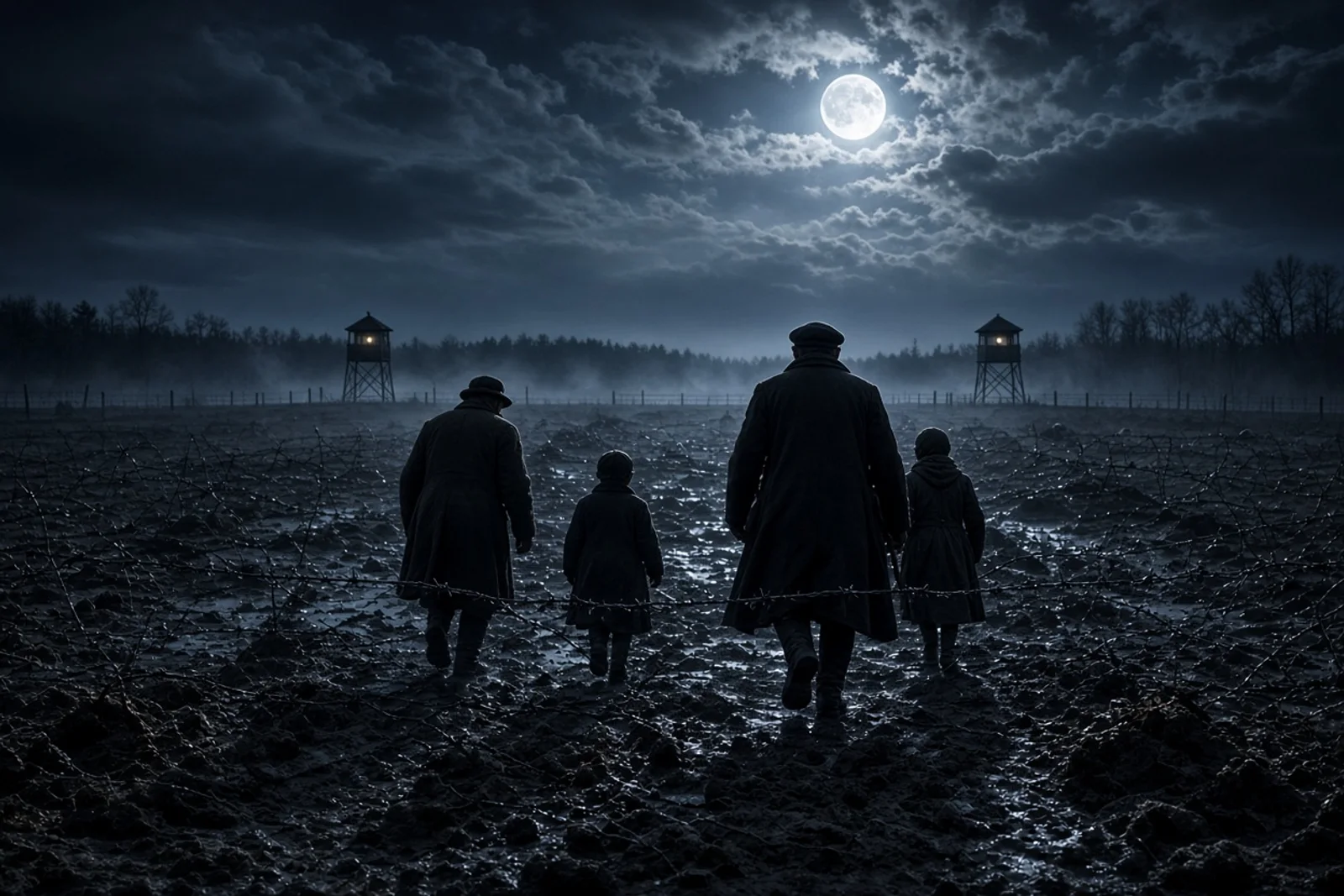
My father’s shifts at the rubber plant in Akron ran from six in the morning until two-thirty, the same schedule he had kept at the Nyirbator hardware store, and he brought home pay envelopes stamped with the date and the amount thirty-eight dollars and seventy cents each week. My mother set up her Singer at the kitchen table and took piecework from the dress factory on South Main, hemming sleeves at twelve cents a dozen; the first check she cashed bought a used coat for George and a pair of shoes for me that cost four dollars at the Salvation Army on Exchange Street. We enrolled at East High School on the first Monday in September 1957, where the principal recorded our names as George and Joseph Kovacs, born 1943 and 1945, and assigned us to English classes that met in the basement because the upper floors were still under construction after the fire the previous spring. Letters from my uncle in Nyirbator arrived folded inside the newspaper wrapper and carried the postmark 14 March 1958; one line read, “The new council chairman has asked for the names of everyone who left after the fourth of November,” and another, dated 22 July 1959, said, “Your cousin Lajos was released from the county prison last week after serving twenty-two months.” My father answered each letter on the back of a blank invoice from the plant, writing only that the children were in school and that the two notes from the guides were still in the drawer.
In 1963 the plant added a second shift and my father began working both, bringing home seventy-nine dollars and forty cents on Fridays; he used part of one paycheck to buy a 1954 Chevrolet from a coworker and drove it to the Hungarian Hall on Buckeye Road every other Sunday to meet men who had crossed at Andau or Hegyeshalom. My mother stopped taking piecework after she found steady work altering uniforms at the Akron City Hospital laundry, where the time clock showed her card punched at 7:02 a.m. and 3:58 p.m. six days a week; she saved the extra money in a coffee tin and used it in 1966 to send George to Kent State for one semester. George left after that semester for a job at the Firestone proving grounds in Mogadore, and I stayed at East High until graduation in June 1964, when the yearbook listed me as Joseph Kovacs, member of the track team that placed third in the city meet. The letters from Hungary continued to arrive every three or four months until 1968, when the postmarks stopped for almost two years; the next one, mailed from the same address in Nyirbator and dated 11 April 1970, contained only the sentence, “Your grandfather died on the twenty-third of March and the funeral was attended by forty-two people.”
My father retired from the plant in 1981 after twenty-five years and three months; the company newsletter printed his name and the exact date 17 April 1981 on page four, along with the line that he had “worked without missing a shift since 1958.” He kept the two folded notes in the same drawer until the day he died in 1987, and my mother placed them inside the casket before the service at the Hungarian Reformed Church on East Market Street. After 1989 she began receiving telephone calls from relatives in Nyirbator who could now speak openly; one cousin, born in 1952, described standing at the barbed-wire site near Kapuvár on 23 October 1991 with a group of forty former escapees who had returned for the first time. My mother flew back in 1992 on a flight that landed at Budapest Ferihegy on 2 September; she stayed three weeks in Nyirbator and brought home photographs of the house on the corner where the china cabinet had once stood, now replaced by a concrete block building that served as the district post office. She died in 1998, and the notes remained in the drawer until George and I divided the contents of the house; I kept one and he kept the other.
The crossing point near Kapuvár was marked in 2006 with a stone plaque listing the names of twenty-three guides who worked the route between October and December 1956; the plaque records that 4,872 people passed through that sector before the wire was reinforced on 10 December. In 2016 the Hungarian government opened a small museum in the old border barracks at Hegyeshalom that displays one of the freight-train manifests from the siding outside Nyirbator dated 19 November 1956 and signed by the stationmaster with the number of passengers counted as ninety-six. George returned to Hungary in 2019 with his daughter and stood at the same drainage ditch where the guide had checked each person for lights; he noted the coordinates on his phone as 47.6204 north, 17.0998 east, the exact spot where the line had halted four times under the reflector sweep. The last letter my mother received before her death came from the cousin in Nyirbator and carried the date 14 March 1997; it read, “The street where your father’s store stood is now called Kossuth Lajos utca again, and the number on the door is still 14.”
Today the storefront in Nyirbator is occupied by a pharmacy whose records show it opened on 3 May 1993; the original wooden counter was removed in 2004 and replaced by a glass display case that holds the same type of hinges and nails my father once sold. The house two doors down that vanished in the flash still stands as a single-story brick structure whose address is listed in the county registry as rebuilt in 1958 with state funds amounting to 18,400 forints. My brother George lives in Cuyahoga Falls and keeps his note in a frame on the wall of the spare room; he shows it to visitors and says only that both men who came to the store on the same day had been telling the truth. I keep the second note in the same drawer where my father placed it, and each year on 23 October I take it out, unfold it once, and read the single sentence written in my uncle’s hand before returning it to its place.
The pharmacy on Kossuth Lajos utca 14 still stocks the same brand of roofing nails my father sold in 1956, and the ledger from 12 June 1994 records the first bulk order of three hundred kilograms placed by the new owner, a man named István Szabó who had trained as a pharmacist in Debrecen. On 4 November 2006 the county archive in Nyírbátor released the original arrest warrants issued after the uprising, listing my father’s name among the ninety-seven residents who left the district between 5 November and 20 December; one warrant carried the handwritten note “destination unknown, believed Austria” signed by the local militia commander. George and I returned together in October 2011 and stood at the rebuilt house two doors down from our grandparents’ former address, where the owner showed us the 1958 building permit stamped with the exact sum of 18,400 forints and the signature of the district engineer.