Contra Pritchard On Liberal Happiness
...
Shelf Tester · Jul 21, 2026 · 7 min read
Cassie Pritchard, on Twitter:
I get why so many liberals are fundamentally disdainful of democracy these days—it’s because liberalism is exhausted. It’s out of answers. Liberalism won, it delivered the world it promised, and people still aren’t content. They’re not satisfied. So the people must be wrong.
We are unfathomably richer than our ancestors. Output per capita in America today is on the order of 900 times greater than before the invention of agriculture, about ~225 times higher than in 1 CE, and about the same (225 times) higher than Europe in 1000 CE. If measurable productivity were really the greatest object of human society, then we shouldn’t just be a little bit happier than people in the distant (or even recent!) past—we should be ecstatic. We should already be living in a utopian age of overwhelming contentment. We should be currently experiencing a kind of paradise.
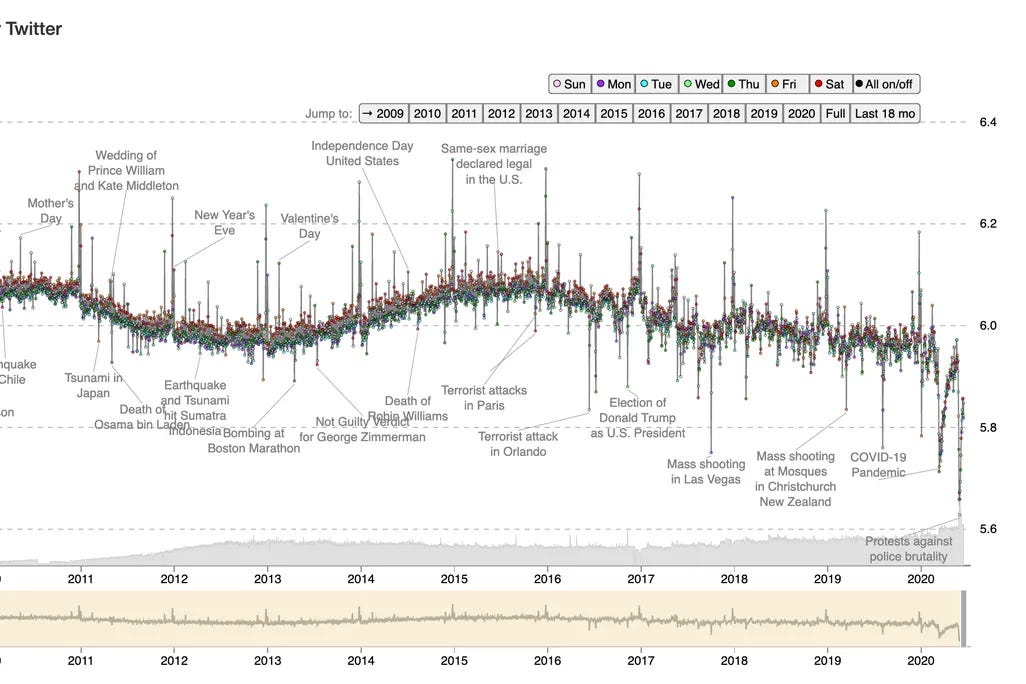
The Kingdom of Heaven, as liberalism conceives of it, has already been made real on Earth. We are living in their Eden, and 20% of people are depressed. We’ve stopped reproducing ourselves. We’re overwhelmingly dissatisfied with our governments, anxious about our economies, and pessimistic about the future.
Based on Pritchard’s own politics, I imagine she is using this to argue for socialism, but other people use the same reasoning to push fascism, theocracy, or other postliberal commitments. It’s a fair argument and deserves an answer. We’ll start with an elegant mathematical response which will satisfy nobody, then try to address the emotional impact.
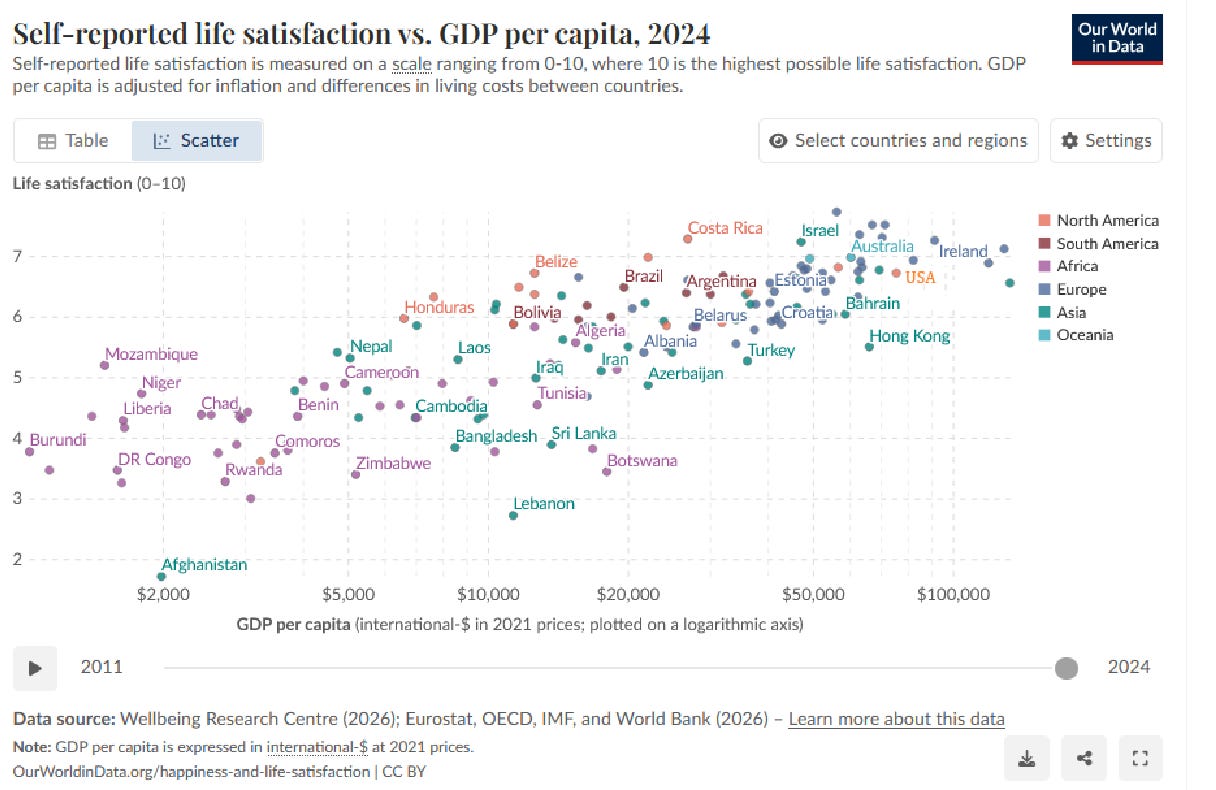
The elegant mathematical response is: happiness scales with log(income), not with income:
In a large U.S. sample, the shape of the association between happiness and Log(income) was extremely systematic: from $10,000/y to over $500,000/y, average happiness rose almost perfectly linearly with Log(income), with group-level correlations of 0.98-0.99 across a range of happiness measures, including both in-the-moment experience and overall life satisfaction.
So if income increased 225x since the medieval era, then using observed coefficients, happiness should have increased about three points on a 1-10 scale. If the average serf would have rated his condition 3/10, we should be at 6/10.
These “observed coefficients” are from graphs like this one, from Our World In Data:
According to the Maddison Project, medieval England c. 1000 AD had a GDP per capita of $1,151. The closest country on this graph is Burundi at $1,031. Asked to rate their happiness on a 1-10 scale, most Burundians say 3 - 41; most Americans say 6 - 7.
This relationship survives various potential challenges2. The graph above shows the correlation on a national level, so isn’t just about relative position in society (there’s a different relationship for that). And there’s no sign that the effect plateaus near the current level - see the Killingsworth/Kahneman/Mellers collaboration for more. You can just keep making people happier and happier by giving them more income, maybe forever. It just takes a lot of cash. Also, at some point you’ll need a better scale (if average US happiness is 7, the 1-10 scale commits you to the dubious claim that it’s impossible to be twice as happy as the average American, but in fact there are probably long tails of bliss and suffering).
So why don’t we feel happier than ever?
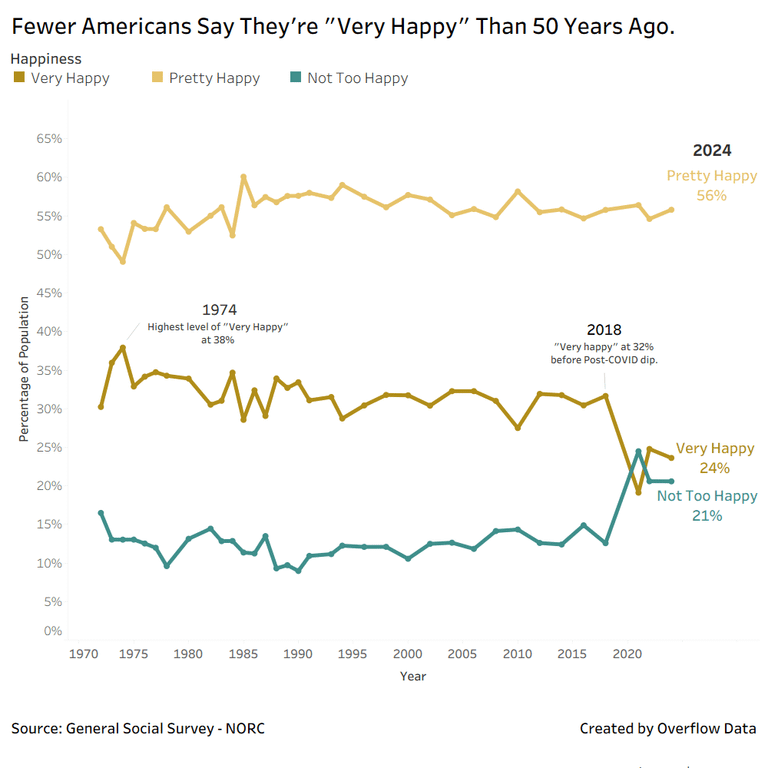
One answer is that log-linear relationships are hard to move. Back in the 1950s when everyone assumes everyone was happy, US GDP per capita was about $20,000 (compared to $75,000 today). Looking at the graph, that predicts that happiness then should have been 6/10, compared to today’s 6.5/10.