
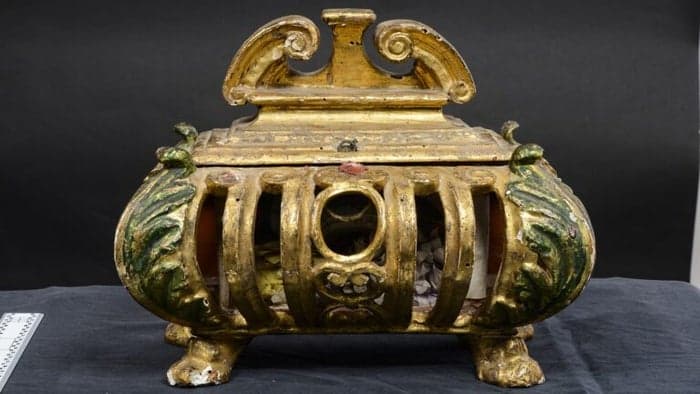
A 17th-century reliquary Urn that was stolen from the Church of San Michele Arcangelo di Cangiano resurfaced in New England.
The FBI announced it obtained the artifact on Feb.11; it announced the recovery April 30.
The Urn was “one of 17 ecclesiastical artifacts stolen from the Church of San Michele Arcangelo di Cangiano,” between 2012 and 2022, the FBI’s Boston office said in a statement.
The gilded artifact has an ornate Baroque design and was used to hold Catholic relics.
Kristen Setera, a spokesperson for the FBI’s Boston office, told Fox News Digital the Urn was discovered missing during an inventory conducted in November 2022.
Investigators later traced the roughly 400-year-old artifact to a New England antiques dealer. The dealer purchased it from another dealer in Italy.
“We do not know how or who stole the Urn from the church, but we do know it was sold to a New England-based antiques dealer and shipped to the United States,” Setera said.
The FBI worked with Italian authorities to identify the New England antiques dealer. The dealer was subsequently interviewed by agents.
“During the interview, the Urn was examined and information was gleaned on how the antiques dealer came to acquire the Urn,” Setera said. “Based on this interview and examination of the Urn, the determination was made the Urn was the one missing from the church of San Michele Arcangelo.”
“This information was shared with the antiques dealer, who ultimately agreed to turn over the Urn to the FBI for repatriation to Italy,” she added.
The FBI and the Italian Ministry of Culture worked together throughout the process.
There was a formal repatriation ceremony in Italy on April 29, the FBI said.
The Baroque Urn “represents a significant piece of Italian history,” the agency added — and is “subject to protection by the Italian State based on the Accords in force with the Vatican City State.”
Ted E. Docks, special agent in charge of the FBI’s Boston Division, said the recovery was “incredibly exciting.”
“After all, this reliquary Urn is a tangible link to intense religious devotion and a connection to the generations who lived and prayed with it,” Docks said in a statement.
“It represents the intersection of faith, history and art — elements that are invaluable to the people of Italy and to humanity as a whole,” he added.