
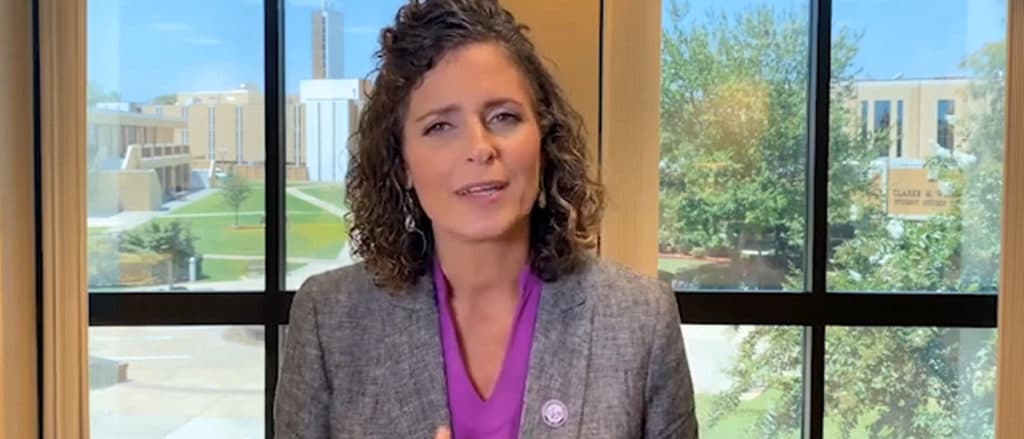
Newly resurfaced videos reveal Republican Louisiana Rep. Julia Letlow promised to create a diversity, equity and inclusion (DEI) office at the university where she worked and ensure more “women of color” were hired into leadership roles.
Letlow publicly claims to oppose “woke ideology,” and has been endorsed by President Donald Trump in her primary Senate race against incumbent Bill Cassidy. However, a 2020 video shows Letlow participating in a panel interview as a semifinalist for the University of Louisiana, Monroe’s presidential search, where she detailed plans to lead diversity measures and ensure more women, especially ‘women of color,’ would be hired for senior leadership roles.
“One of the first things I would do, I believe we need a division on this campus, a division of diversity, equity, and inclusion with leadership that goes all the way to the top with a full staff,” Letlow said when asked how she would increase diversity at the university. “And I believe that having that strong division, having that leadership—if you have a person around the table that is cognizant and fighting for diversity, equity, inclusion before any decision is made for the university, then that’s how you change.”
Letlow added that the university has “an issue” with its current diversity metrics, which she considers “shameful.” She then brought up the leftist term “unconscious bias,” which refers to the idea that people are naturally prejudiced against certain groups of people without realizing it.
“I believe that there are a lot of people on this campus who have never heard of unconscious bias. They don’t know that it exists,” she stated. “A lot of people have lived in Northeast Louisiana their whole lives. And so we just need those educational opportunities right here on this campus. I would be committed to that.”
She even explicitly stated that there were “not enough” black women on staff at the school.
“We have 8% African-American faculty women on this campus. That’s not enough. That does not reflect our student population. And so that would be number one for me,” Letlow said. “Of course, it affects me personally. We don’t have enough women at the top. We don’t have enough women of color at the top. And so, I would be committed to that.”
Finally, she added the president of the university “needs to have diversity on their senior council.”
“ou avoid groupthink when you have more diverse voices at the table. It’s time. It’s time.”
During her bid to become ULM president, Letlow also recorded a “meet the candidate” video in which she describes herself as a “strong and progressive leader” and said the university still experiences the repercussions of segregation to this day.
“The repercussions of the era of segregation have led to challenges that can still be felt today,” Letlow said. “And it will take an unwavering dedication and long-term plan of action to ensure that all students and employees feel welcome, and that everyone is treated equitably.”
Letlow previously served as an ombudsperson and special projects coordinator at ULM from October 2007 to July 2011 under her maiden name, Barnhill, then in communications positions from 2015 up until she assumed office in April 2021, according to her LinkedIn profile. During her first stint at the university, Letlow appears to have required textbooks that promote critical race theory and other race and gender ideology ideology.
A spring 2011 Health Communication course at ULM, instructed by Letlow (then Barnhill), required a textbook that praises Hillary Clinton and bashes the supposed privilege of “married heterosexuality.”
The book, “Communicating Health,” denies that there is one single “truth,” and favorably cites philosopher Michel Foucault, who has been called called the “father of wokeness.” It explores concepts such as “privilege and marginalization,” especially as they relate to “gender, race, ethnicity, social class, disability, and sexuality.”
The course materials center on concepts of critical race theory and “cultural sensitivity,” and teach that those with knowledge on a particular subject, such as medicine, may use their “power” to “limit the voices of people based on their race, ethnicity, or gender.” Students are taught that they must acknowledge their own “ethnocentrism” in order to address such disparities, and are encouraged to “interview someone you consider to be part of a health/illness culture that is outside of your own multicultural health identity.”
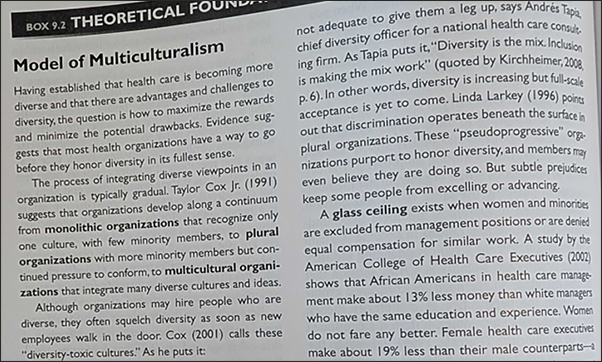
(Athena du Pré, Communicating About Health: Current Issues and Perspectives, 2010, Pg. 232)
The book even teaches that America isn’t actually a democracy because of its “structures of power,” and tells students to use their positions as communicators in medicine to address “structural inequities” like racism and poverty. It also suggests that gay people receive “lower quality health care” due to “cultural homophobia” and says sex education classes unfairly “privilege married heterosexuality over all other sexual practices.”
The radical textbook also cites Hillary Clinton as an example of how “political action can bring about positive change.”
Letlow also appears to have requested the book “Communicating About Health” for a spring 2011 public speaking course, according to ULM’s course adoption records.
The book warns organizations against hiring people whose beliefs align with the company’s, and suggests hiring “diverse employees” who will be “well suited to serve diverse consumers, possibly expanding the organization’s clientele.” It goes on to bring up topics of “multiculturalism,” “biases” and “unconscious assumptions.”
Health organizations should make “diversity a priority” and should consider hiring diversity officers, the book states.
“Health promoters can help equalize disparities by advocating for community resources, public policies, and issue of social justice to help communities overcome their marginalized status,” the book reads.
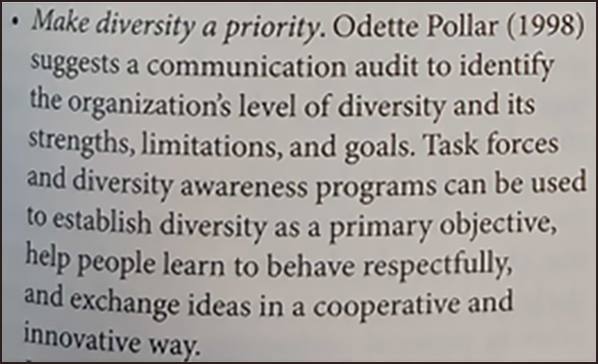
(Athena du Pré, Communicating About Health: Current Issues and Perspectives, 2010, Pg. 249)
Reached for comment, Letlow campaign manager Parker Carey suggested that it’s Letlow’s opponent in the Louisiana primary who advocates a woke agenda.
“Any honest story about DEI in this race starts with the person who actually etched it into federal law: Bill Cassidy,” Carey told DCNF. “Cassidy co-authored and voted for Biden’s $1.2 trillion spending bill loaded with DEI provisions. He voted for the CHIPS Act and its DEI research requirements. He also helped negotiate gun control legislation whose grant programs became so wrapped up in DEI priorities that the Trump administration had to shut them down.”
“Julia Letlow, by contrast, has spent the last five years in Congress fighting DEI and the woke agenda,” Carey continued. “She authored the Parents’ Bill of Rights. She voted to strip DEI from the military. She voted to reverse Biden’s Title IX rewrite. President Trump endorsed Julia for the U.S. Senate because she has stood with him and fought for the America First agenda, while Bill Cassidy voted to convict him and spent years attacking him.”
The DCNF previously exposed Letlow for helping to initiate DEI workshops, associating with an anti-racist organization and signing a statement “condemning racism and embracing diversity” during her time at ULM.
All content created by the Daily Caller News Foundation, an independent and nonpartisan newswire service, is available without charge to any legitimate news publisher that can provide a large audience. All republished articles must include our logo, our reporter’s byline and their DCNF affiliation. For any questions about our guidelines or partnering with us, please contact [email protected].