



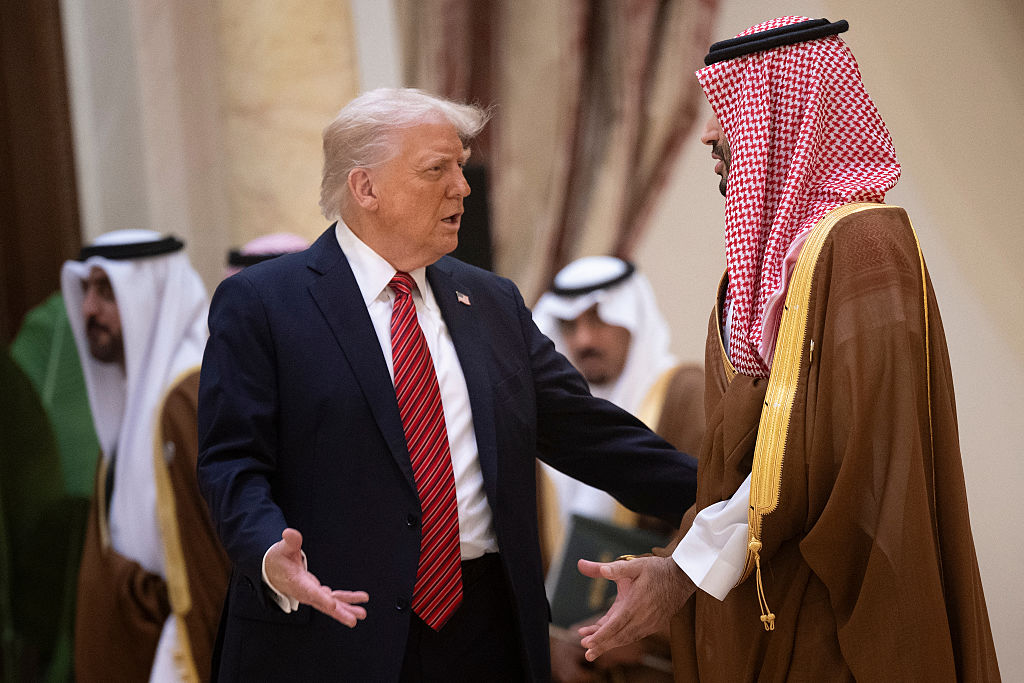
President Donald Trump is elevating his push to secure a historic normalization agreement between Saudi Arabia and Israel — a major foreign policy goal he argues could reshape the Middle East and extend the success of his first-term Abraham Accords.
According to The Associated Press, the effort will take center stage Tuesday when Trump hosts Saudi Crown Prince Mohammed bin Salman at the White House for a high-profile visit filled with ceremony and quiet strategic pressure.
“I hope that Saudi Arabia will be going into the Abraham Accords very shortly,” Trump told reporters aboard Air Force One on Friday as he headed to Florida for the weekend.
While Trump continues to project confidence, internal assessments reflect a more cautious approach. Three administration officials, speaking anonymously to discuss sensitive deliberations, said Saudi Arabia is unlikely to join the accords in the near term — but they believe a deal could be reached by the end of Trump’s second term.
Saudi Arabia resisted previous overtures from both the Trump and Biden administrations. King Salman opposed normalization during Trump’s first term, and Crown Prince Mohammed hardened his position after the Hamas attacks of October 7, 2023, which plunged Israel and Gaza into war.
MBS has since signaled more openness than his father, but his core condition remains a guaranteed path to a Palestinian state — something Israeli leaders firmly reject.
Trump may attempt to frame his 20-point Gaza peace plan as that path. But pushing too hard risks alienating Israel, whose cooperation is central to the administration’s diplomatic strategy.
One administration official said the most realistic outcome this week would be for Saudi Arabia to publicly acknowledge Trump’s plan as a potential starting point for Palestinian statehood and signal willingness to consider the Abraham Accords.
Trump has repeatedly argued that if Saudi Arabia signs on, “everybody” in the Arab world will follow. He points to shifting regional dynamics — especially Iran’s weakened proxies and a U.S. strike that set back Tehran’s nuclear ambitions — as evidence that the moment is ripe.
“We have a lot of people joining now the Abraham Accords, and hopefully we’re going to get Saudi Arabia very soon,” Trump said during a recent speech to business leaders attended by Princess Reema Bandar Al Saud, the Saudi ambassador to Washington. With a laugh, he added, “I’m not lobbying.”
Still, the obstacles are real.
Images of destruction from the Gaza war continue to dominate Arab media. Critical issues — disarming Hamas, building a postwar governing structure, and expanding security oversight — remain unresolved and threaten the fragile ceasefire.
“As long as the scenes on Saudi television continue to be scenes of devastation and misery in Gaza, I think it’s going to be very hard for MBS to move in this direction,” said Jonathan Schanzer of the Foundation for Defense of Democracies. But he noted that Saudi Arabia has historically found ways to advance normalization quietly.
The crown prince arrives in Washington with significant demands, including U.S. security guarantees for the kingdom and approval to purchase advanced U.S.-made F-35 fighter jets. Trump, officials said, appears unlikely for now to authorize the jets — a sale complicated by Israel’s military edge and concerns that sensitive technology could find its way to China.
Even so, Trump remains known for unexpected decisions.
“The crown prince’s price for normalization has only risen,” said John Hannah, former national security adviser to Vice President Dick Cheney. But Hannah warned against giving up leverage too quickly. “It would be folly not to insist that the ultimate integration of these planes into the Saudi order of battle be tied to normalization.”
Trump’s meeting with the crown prince may not produce an immediate breakthrough — but it could mark a crucial moment in his long-running campaign to secure what he has repeatedly called the Middle East’s “ultimate deal.”