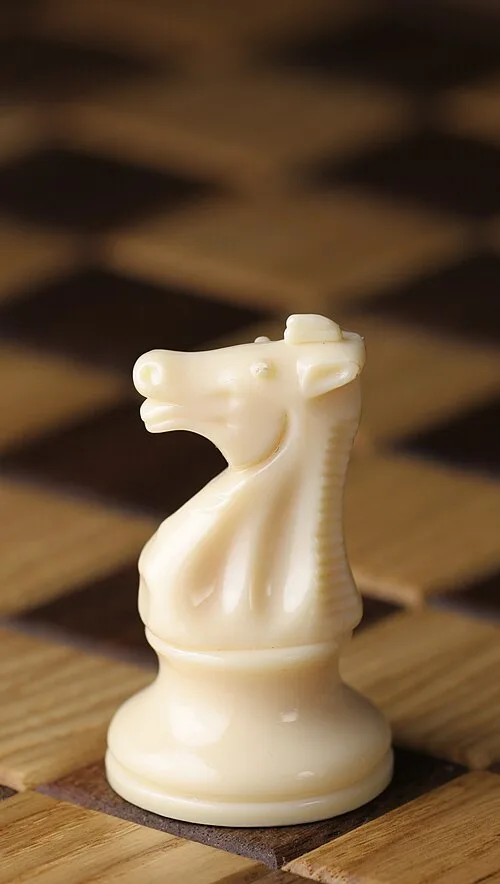
Overview
The knight (♘, ♞) is a piece in the game of chess, represented by a horse's head and neck. It moves two squares vertically and one square horizontally, or two squares horizontally and one square vertically, jumping over other pieces. Each player starts the game with two knights on the b- and g-, each located between a rook and a bishop.
Movement
Compared to other chess pieces, the knight's movement is unique: it moves two squares vertically and one square horizontally, or two squares horizontally and one square vertically (with both forming the shape of a capital L). Consequently, a knight alternates between light and dark squares with each move. When moving, the knight can jump over pieces to reach its destination. Knights capture in the same way, replacing the enemy piece on the square and removing it from the board. A knight can have up to eight available moves at once. Knights and pawns are the only pieces that can be moved in the chess starting position.
Value
Knights and bishops, also known as , have a value of about three pawns. Bishops utilize a longer range, but they can move only to squares of one color. The knight's value increases in since it can jump over blockades. Knights and bishops are stronger when supported by other pieces (such as pawns) to create outposts and become more powerful when they advance, as long as they remain . Generally, knights are strongest in the of the board, where they have up to eight moves, and weakest in a corner, where they have only two.
From Wikipedia (CC BY-SA 4.0).