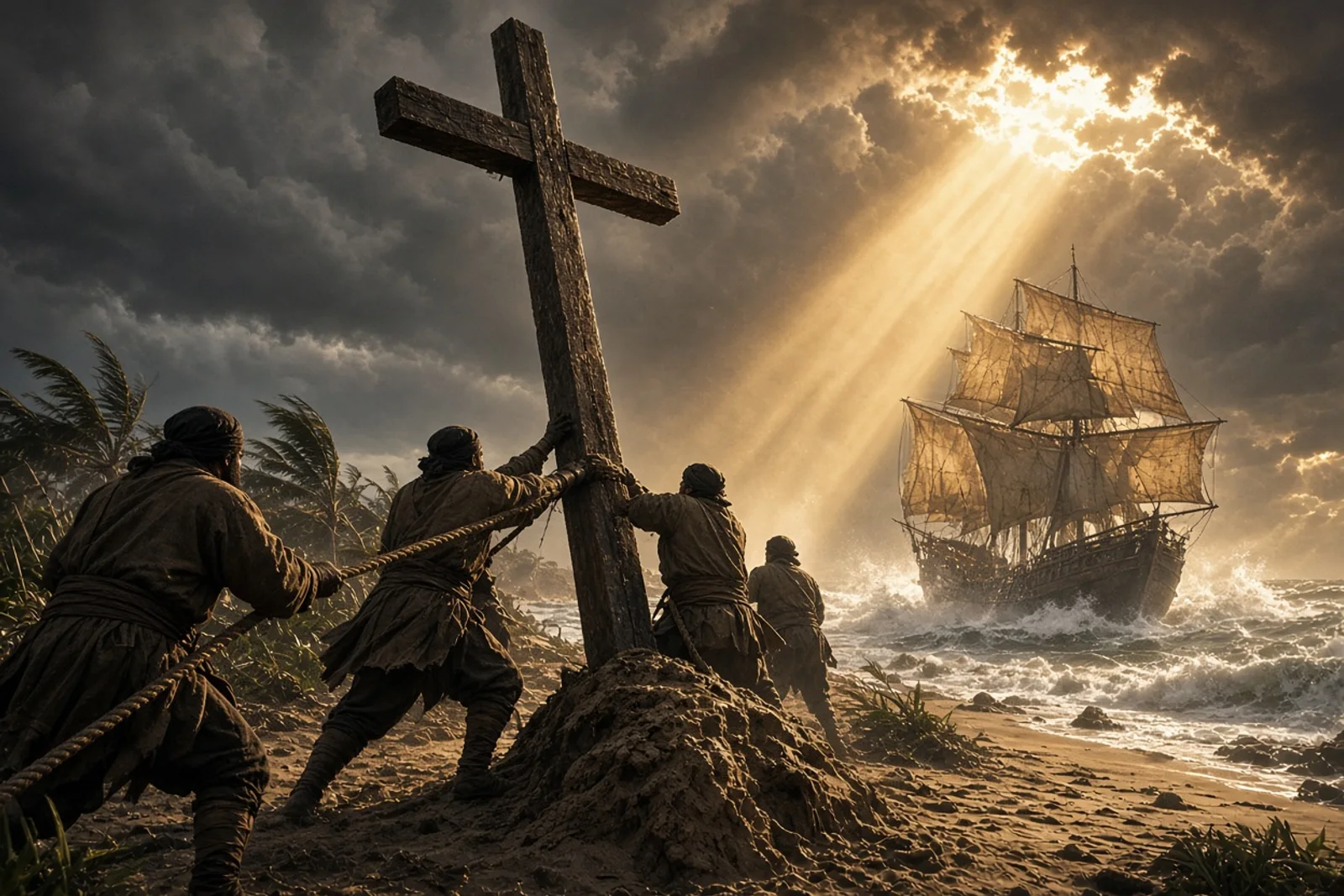



Apollo 13 Comes Home
The call came across the loop like nothing at all — stir the cryo tanks, Swigert, routine as flipping a light switch on a wall you've flipped a thousand times. I had my headset on, my console cold under my palms, half my mind already on the coffee going stale in a styrofoam cup at my elbow. Two hundred thousand miles out. Third trip to the Moon in a year. We were bored, and we said so out loud, and thirteen minutes later the room stopped breathing.
The telemetry jumped like a struck nerve. Master alarm lights flared across board after board, and in my ear a voice — flat, controlled, fighter-pilot flat — said the words that would outlive every one of us in that room. Houston, we've had a problem. I remember looking at the number on my screen and thinking it had to be a bad sensor, a glitch, the kind of thing you chase down with a raised eyebrow and a checklist. Nothing in any simulation we'd ever run looked like this. Gene Kranz stood at his station with his hands flat on the console, and I watched him do the thing he always did, which was get quieter instead of louder.

Lovell was the one who told us what we didn't want to hear. He said he could see something venting outside the spacecraft, streaming off into the dark, catching the sunlight like a small silver cloud that didn't belong there. It was oxygen. It was the ship bleeding out in vacuum, and there was no way to stop it, and every one of us doing the math in our heads arrived at the same ugly number — the fuel cells were dying, and the fuel cells were the marrow of that ship.
Within the hour we understood the shape of it. Tank two had blown, and in blowing it had torn something in tank one as well, and between the two of them they were the reason those three men had power, water, oxygen to breathe. The Moon was still ahead of them, close enough that Lovell and Haise should have been strapping into a lunar module named Aquarius to set it down in the Fra Mauro highlands. That plan was gone in the time it takes a valve to fail. Nobody said the word abort out loud right away. Somebody didn't have to. We all felt the mission tilt underneath us like a deck at sea.
The decision that saved them was so simple it barely qualifies as brilliant, except that nobody in that room had ever rehearsed it for real. Aquarius still had her own oxygen, full and untouched, and her own engine, meant only to kiss the lunar surface and later lift off it. Command module Odyssey was dying around them. So the crew climbed through the tunnel into the lander and turned it into something it was never built to be — a lifeboat, built for two men for two days, now carrying three men for four.

I remember Fred Haise sleeping with his head against the ascent engine cover because there was nowhere else to put a body, and Swigert curled on the floor plating, and how the numbers we watched for power and water started behaving like rationed bread. The temperature inside dropped into the fifties in Aquarius and into the forties in the dead command module. The men put on their lunar overshoes just to keep their feet from going numb, and pulled on a second pair of underwear beneath their suits, and none of it looked like the space program anybody had sold to the public eighteen months before.
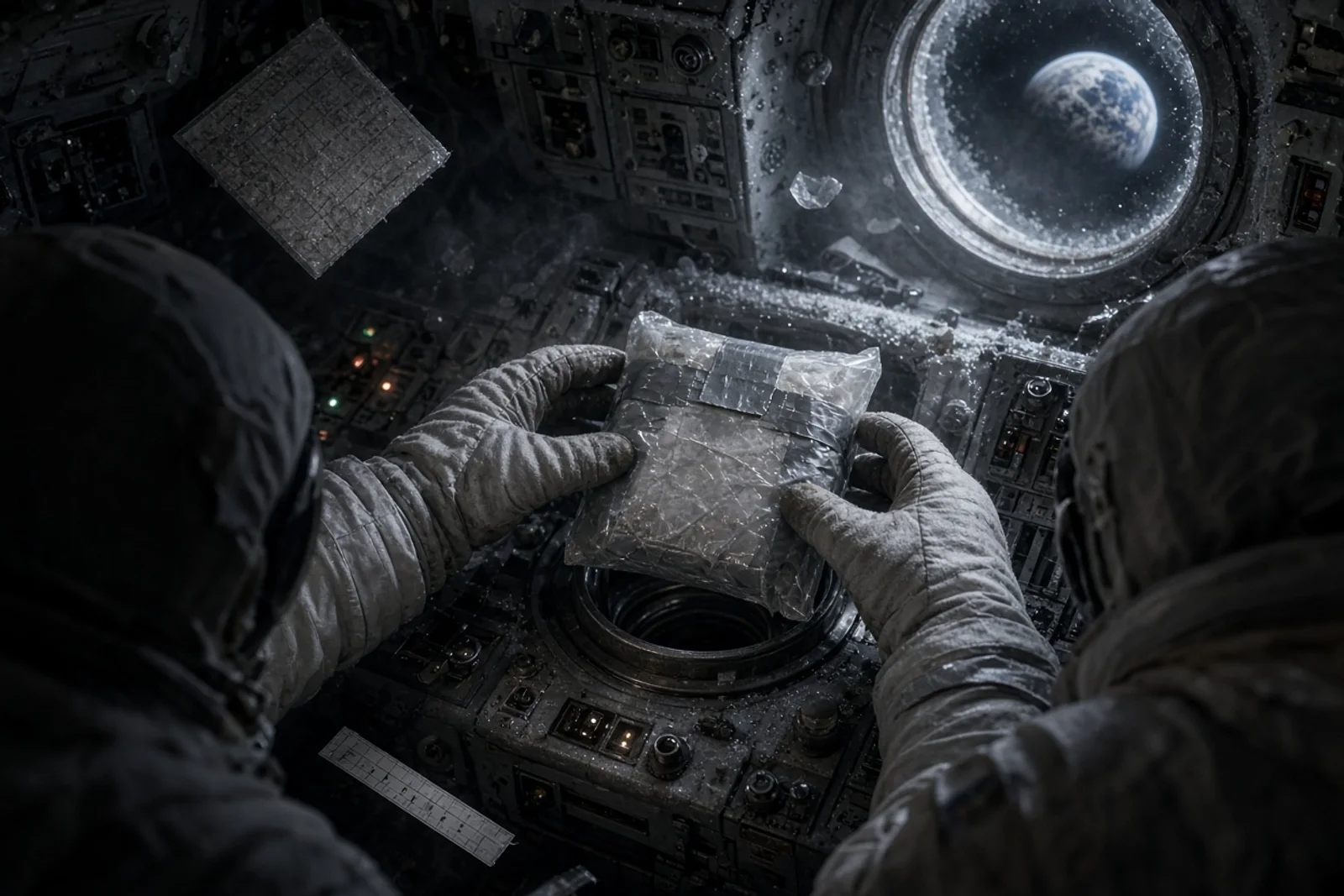
Carbon dioxide became its own quiet emergency, the kind that kills you without any drama at all if you let it. The lunar module's canisters were round. The command module had plenty of the square lithium hydroxide canisters, but they didn't fit the fittings built for round ones, and three men breathing into a sealed can for four days will poison their own air with their own lungs if nobody solves that shape problem. Down in Houston a team of engineers took exactly what the astronauts had on board — tape, a sock, cardboard from a checklist cover, a plastic bag — and built a way to jam a square peg into a round hole hard enough to keep three men alive. When Lovell read the instructions up and matched them piece by piece against what was floating around the cabin, I watched grown men on the console exhale like they'd been holding it for an hour.
Every burn after that was a decision made twice — once with a slide rule, once with a prayer nobody said aloud. There was no computer horsepower to spare, no room for the kind of guidance systems the mission had trained on for years, so the crew and the ground did trajectory work with pencils and paper and the LM's engine, meant to land on the Moon, doing the job of getting them home instead. They looped around the far side, out of every radio's reach for a handful of minutes that stretched like hours for everyone sitting in that room in Houston, and when the signal came back, it was still Lovell's voice, still steady.

He looked back at the Moon going away behind them, close enough to touch by any ordinary measure, and knew he was never landing on it. I've turned that thought over more times than I can count in the years since — a man circling the one thing he'd trained a decade to walk on, watching it recede, and saying nothing about it over the air that anyone remembers as complaint. There wasn't time for grief. There was a return trajectory to fly and a spacecraft with barely enough power to blink.
The flight directors rotated through in teams, each one taking the weight for a while and handing it off — Milton Windler's Maroon Team, then Glynn Lunney's Black Team relieving them as the hours dragged past, Capcoms trading off at the microphone, Joseph Kerwin taking over from Jack Lousma to keep a familiar voice going up to a crew that hadn't slept properly in days. Deke Slayton and Neil Armstrong stood in front of cameras and reporters back on the ground, translating what we understood into what the world needed to hear, while behind them in the control room the real arithmetic kept grinding forward, hour by hour, watt by watt.
Windler's people had already worked out, before they even handed off their console positions, that the numbers were going to be tighter than tight but survivable if nothing else broke — oxygen fine, water thin, power thin, the partial shutdown of Aquarius's systems buying back margin that would matter later. Nobody rested easy on that news. It just meant the math had a chance of working if human beings kept doing everything right for another day and a half.
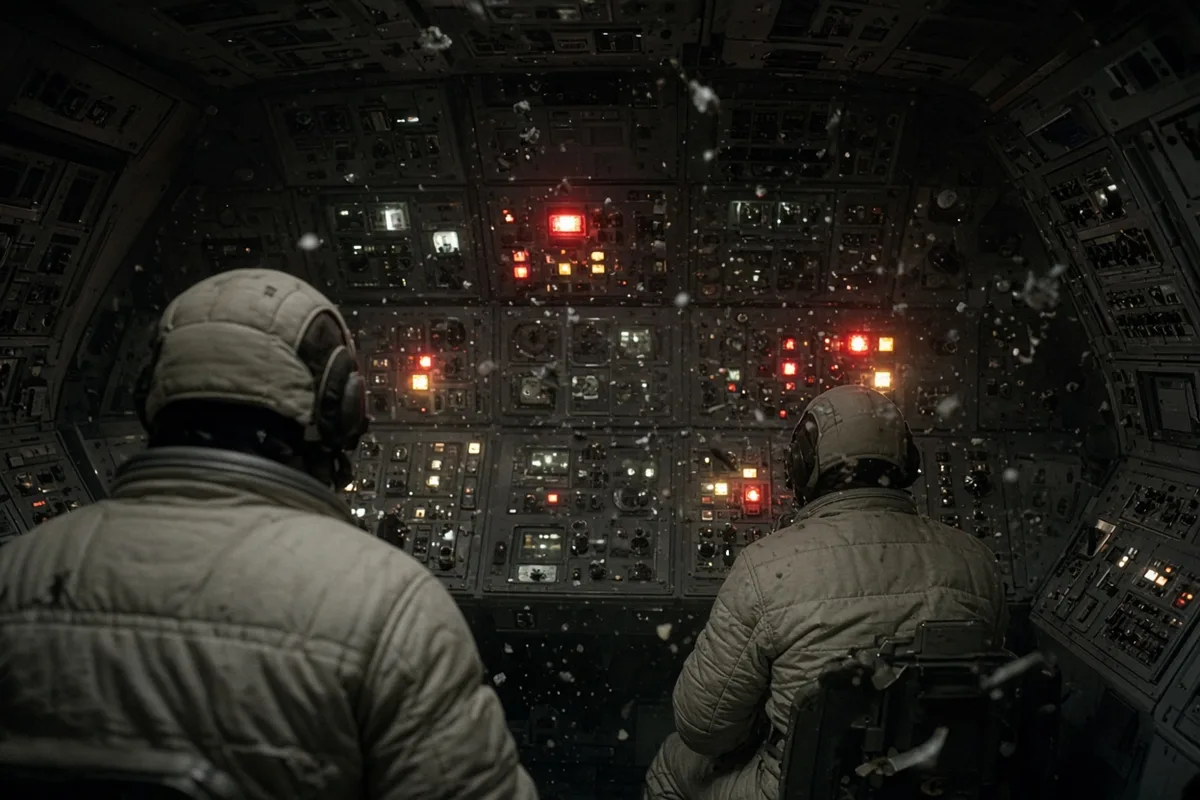
Sleep became something men did in fragments, if at all. Lovell told Mission Control he'd try, and was back at it within two hours because a spacecraft doesn't stop needing attention just because its crew is exhausted. The plan for the last stretch home came up to them piece by piece — a final course correction roughly five hours before hitting the atmosphere, and then something nobody had ever done in this direction: charging two of Odyssey's three dead batteries using power from Aquarius, running backward through a procedure built for the opposite purpose, like siphoning gas uphill.
That charge took fifteen hours, and through every one of them there was no guarantee the command module — cold, dark, dormant for days — would wake up right when it mattered most. Bringing Odyssey back to life meant flipping switches in a sequence built under pressure, testing systems that had been sitting in near-freezing silence since the explosion, hoping condensation hadn't shorted anything vital in the meantime. When the powerup began to take, and system after system in that dead ship blinked back into readiness, I heard something close to a cheer go around that room, quiet, held down, the kind men allow themselves when they're not ready to celebrate yet.

The last hours came at us in a checklist rhythm — warm the reaction control thrusters on the command module, bring Aquarius's systems up one more time for the final push, run the midcourse correction on the lunar module's own thrusters since Odyssey still had no engine to spare. Every step had to happen in order, at the right minute, because there wasn't fuel or power or time to do anything twice.
Jettisoning the service module came first, and when it finally drifted free and the crew got their first real look at it through Odyssey's windows, the damage silenced the loop for a moment — an entire panel blown outward, wiring and insulation exposed to space, a wound bigger than any of us had pictured from the numbers alone. Seeing it, I understood for the first time just how much closer to the edge those three men had actually been standing.
Then came the lunar module, the little ship that had kept three men breathing for the better part of four days, cut loose to burn up in the atmosphere it would never see the surface of. Somebody in that room said goodbye to Aquarius out loud, and meant it the way you mean it for something that earned the word.

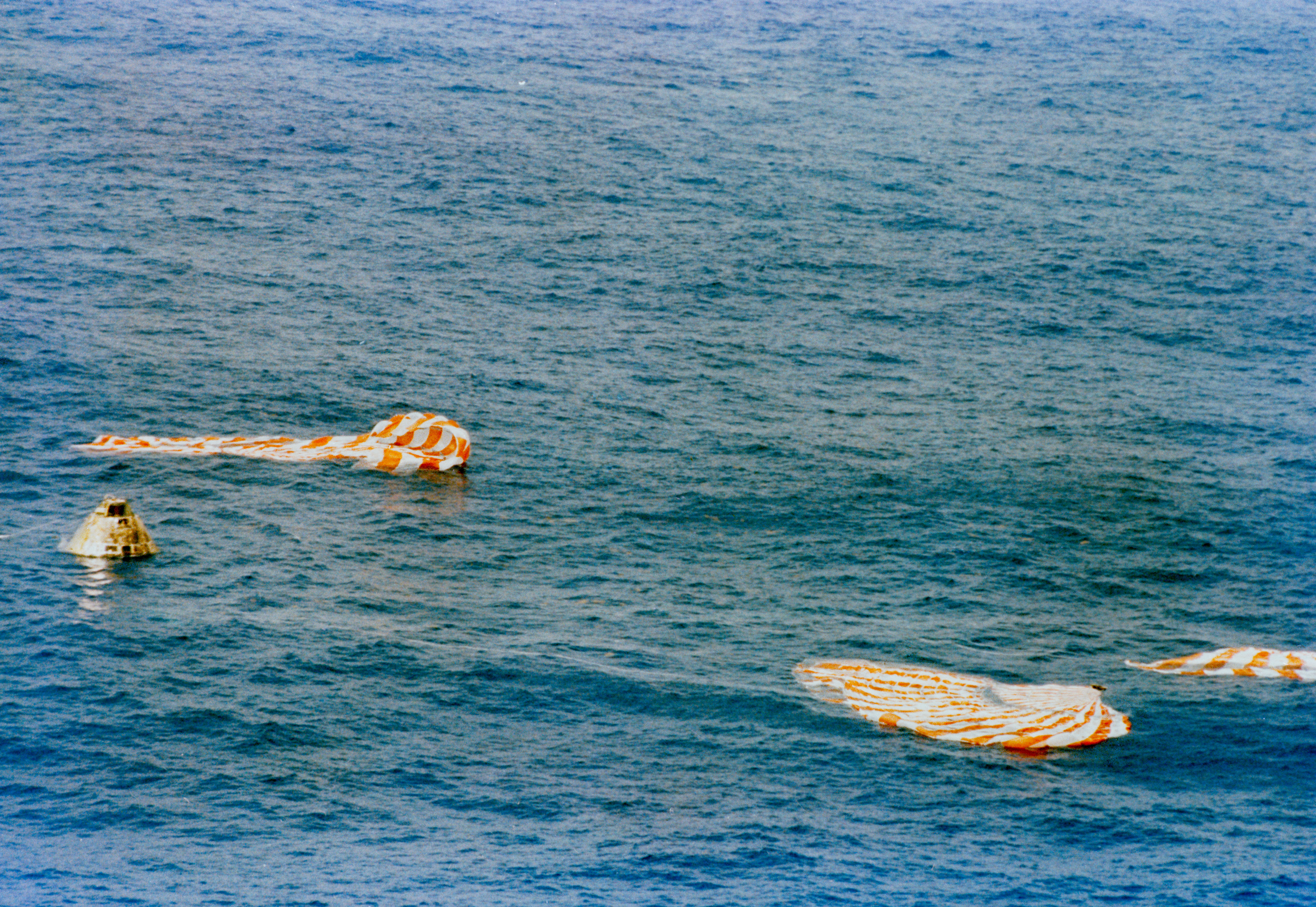
Reentry blackout runs a few minutes on a good day, the ionized air around the capsule swallowing every radio signal whole while the world down below waits without any proof of life. This blackout ran longer, and every second past the expected mark felt like a year folding itself into that room, controllers staring at silent boards, nobody saying the thing everybody was thinking. Then the signal broke through, faint, then clearer, and the ship was still talking, and somewhere over the Pacific three parachutes bloomed against the sky.
The recovery ship spotted the capsule coming down under those canopies, and it hit the water within sight of the carrier, close enough that men watching through binoculars said afterward they could see it break the clouds before it ever touched the sea. Navy divers were in the water fast, guiding the capsule, popping the hatch, and the astronauts came out into sunlight and salt air looking thinner than the men who'd left five days before, but alive, upright, grinning in a way that read all the way back to Houston.
In the control room, the thing that had been building in silence for four days broke all at once — men who hadn't slept, who averaged maybe twenty-seven years old and hadn't shaved, throwing whatever was in reach into the air, some of them crying without pretending otherwise. Kranz had said once, later, that watching your crew die is something that stays with a man forever, and none of us in that room had wanted to find out whether we'd have to carry that. We didn't have to.
What came after was quieter, the way things always are once the danger passes and the paperwork begins. Ken Mattingly, pulled off the mission days before launch over a measles exposure that never developed into the disease, would fly later, on Apollo 16. Swigert, thrown into a crew with barely any notice, went on afterward into a life beyond NASA, into public service, before his early death cut it short. Lovell never flew in space again, his one shot at the lunar surface gone with the tank that blew two hundred thousand miles from home, and he carried that particular unfinished business for the rest of his days without ever, that I heard, sounding bitter about it.
Budgets kept shrinking in the seasons after, the country's attention already drifting elsewhere before the explosion and drifting further after it, and the missions numbered eighteen, nineteen, twenty never left the drawing board, cut before their hardware ever saw a pad. The command module itself, the one called Odyssey, ended up on display, first one place and then another, a blunt cone of scorched metal that once held three men and very nearly held their deaths.
I think sometimes about the six ounces of water rationed to a man per day, about lithium hydroxide canisters taped into shapes they were never built to be, about a slide rule doing the work no computer on board had the power left to do. Success, in the end, got measured backward from where everyone expected it to land — not a bootprint in gray dust at Fra Mauro, but three sets of footprints on the steel deck of a carrier, and a capsule still sealed tight enough to bring them home.