


Healing of Marie Bailly at Lourdes
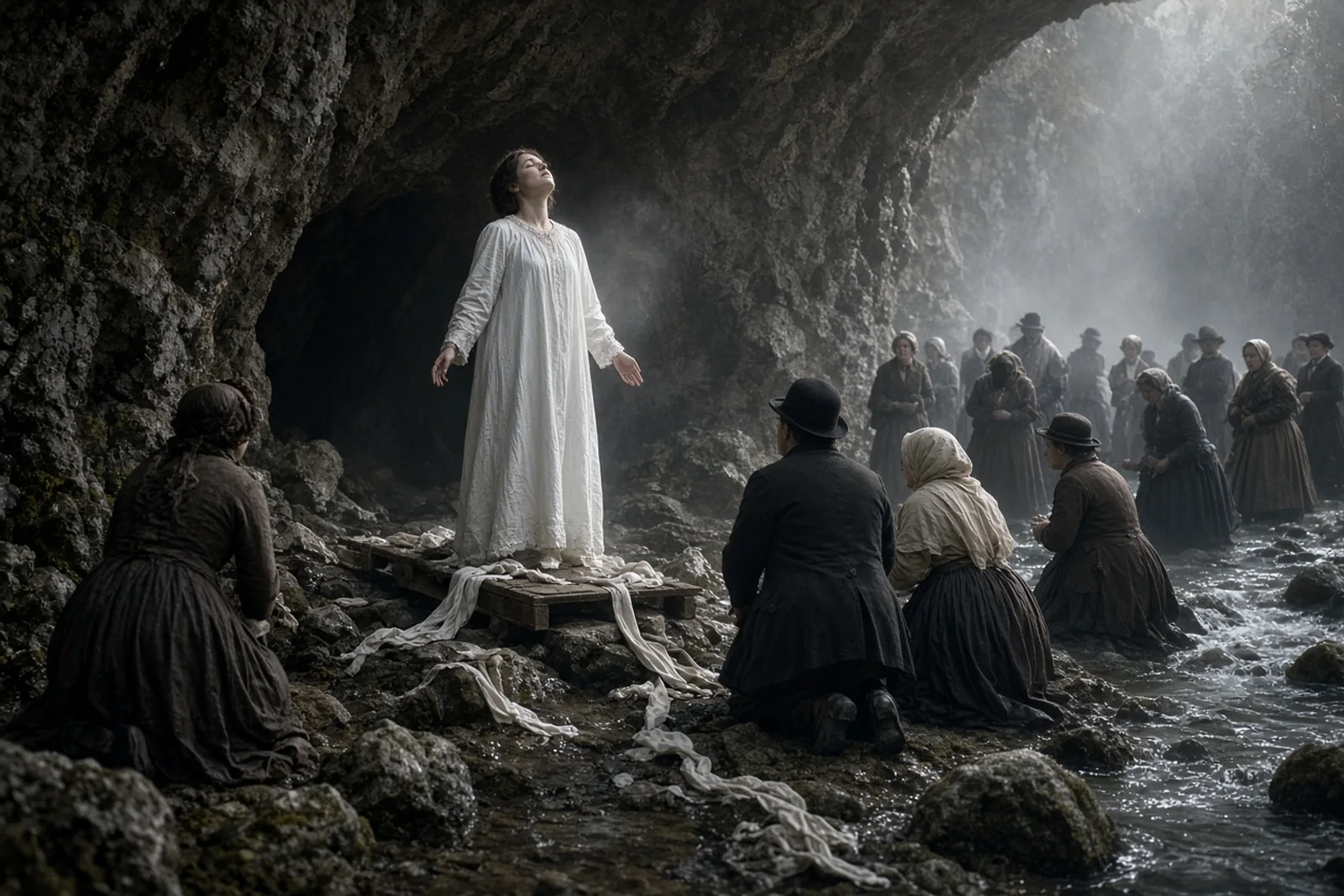
The carriage lurched again and the metal basin slid toward the aisle. I caught it with one hand and held it steady while the woman beside me pressed her face into the rim. The air smelled of damp wool, sweat, and the sharp vinegar someone had used on the floors that morning. Carrel stood two rows ahead, coat open, stethoscope already around his neck. He moved without hurry, the way he always did when the train pitched.
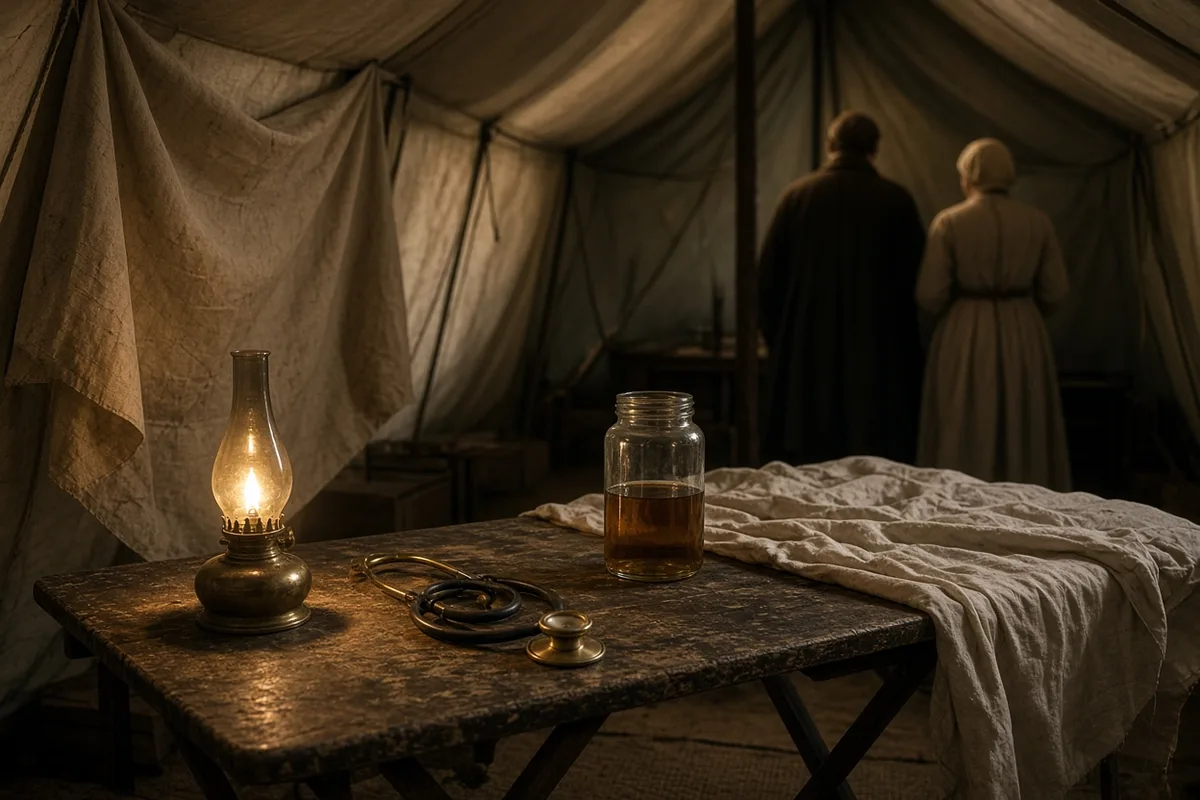
Marie Bailly lay on the bench seat nearest the window. Her abdomen rose under the blanket like a drum left too long in the sun. The skin above her collarbone showed the same tight shine I had seen on other patients who did not last the week. Carrel lifted the blanket, pressed two fingers along the curve of her ribs, then listened. He said nothing for a full minute. When he straightened he only nodded once toward the aisle and kept walking.
We reached Lourdes after dark. The station platform was wet and the lamps threw long shadows across the stretchers already lined up. Carrel stayed with the train until the last patient had been moved. He asked me to note the time on the chart for Bailly and to mark that her pulse remained thready. Then he walked toward the town with the other doctors, hands in his pockets.
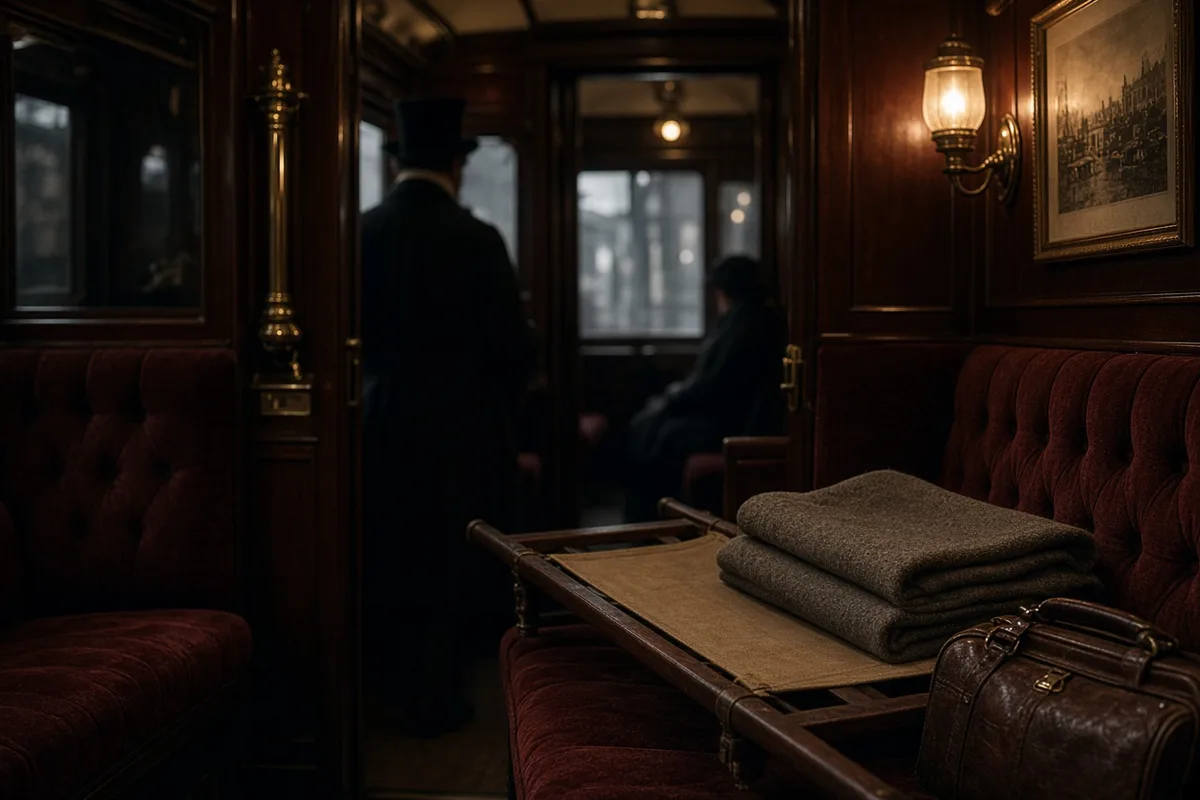
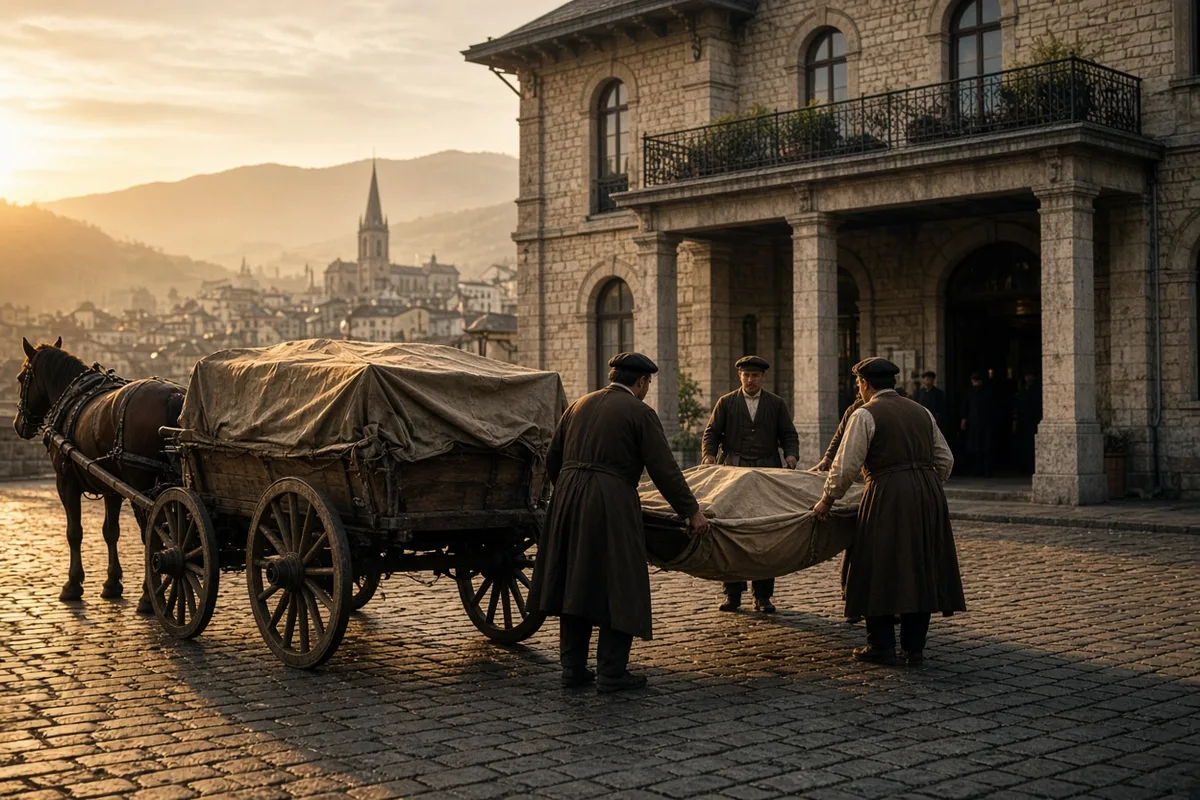
By morning the square in front of the grotto was already crowded. I helped carry Bailly on a canvas stretcher, two men at each end. The blanket had been changed but the smell of illness stayed with her. Carrel met us at the steps that led down to the pools. He watched while the attendants lowered her into the water. She made no sound. When they lifted her out again the blanket clung flat across her middle where it had been tight before.
Carrel stepped closer. He placed his hand on her abdomen without asking. The skin gave under his fingers the way ordinary skin does. He kept the hand there for several seconds, then withdrew it and wiped it on his coat. A priest standing nearby asked whether he wanted the chart updated. Carrel said the chart could wait.
That afternoon he returned to the train compartment where we kept the medical supplies. He wrote for nearly an hour without looking up. When he finished he folded the paper and placed it inside his notebook rather than in the official file. He told me to make sure Bailly received the evening meal if she asked for it. She did ask. She ate half a bowl of broth and asked for bread.
The return journey took three days. Bailly sat upright for longer stretches each morning. On the second day she asked for the name of the town we were passing. Carrel answered her. He did not examine her again on the train.
Years later I read that he had received the Nobel Prize for work on blood vessels. The article mentioned his time at Lourdes only in passing and got the year wrong. I kept the note he wrote that afternoon in Lourdes. It recorded her temperature, her pulse, and the measurement of her abdomen taken before and after the pool. The numbers after the pool were ordinary. He had underlined the word “ordinary” twice.
Bailly lived another forty years. She worked in a laundry near the shrine and sometimes helped with new arrivals who could not stand. Carrel never returned to Lourdes. He kept the piece of chicken-heart tissue alive in a flask for decades and showed it to visitors who wanted to see how long cells could be made to last outside a body. He spoke of the train journey only when asked directly, and then only about the rate at which certain wounds closed.
The last time I saw him was in 1939. He was leaving for New York again. Before he boarded he asked whether I still had the chart from the May pilgrimage. I said I did. He nodded, as if that settled something, and stepped onto the train.
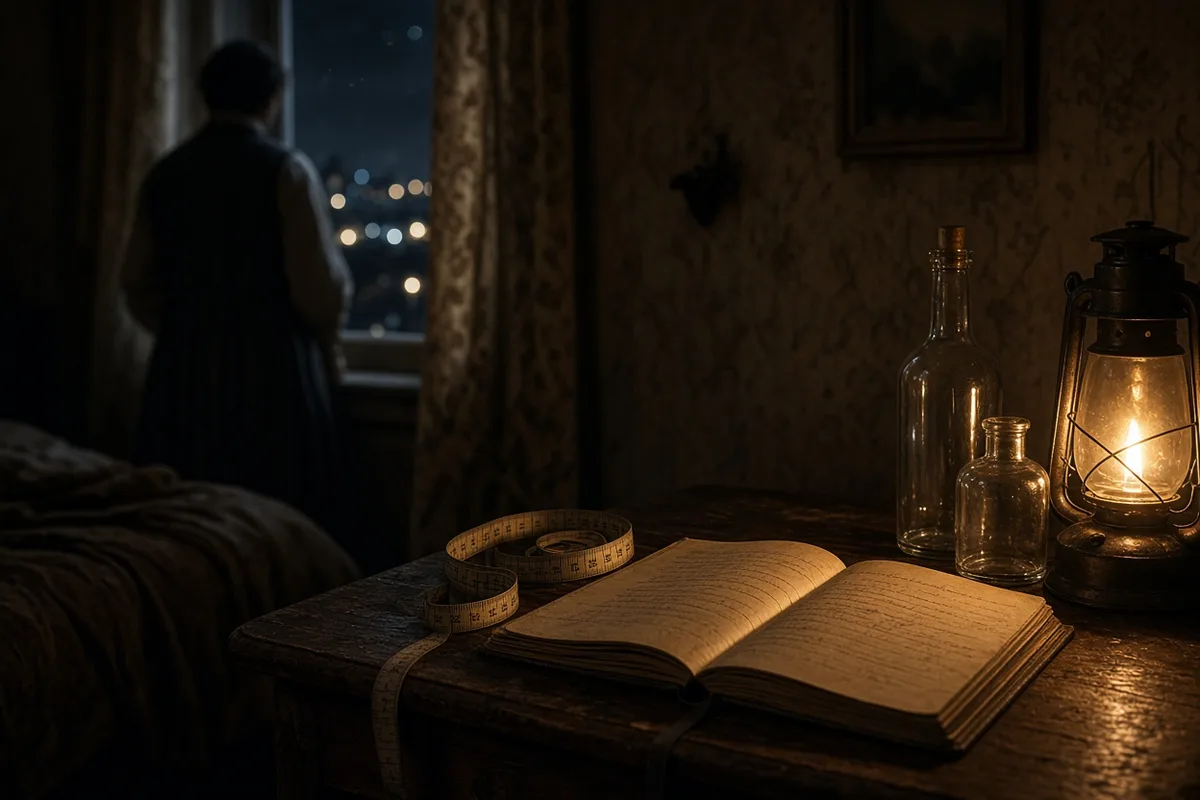
The train pulled away from the platform at Grand Central with its usual hiss of steam, and I returned to the apartment on 72nd Street where the chart remained in the bottom drawer of the oak desk beside the window that overlooked the park. Inside the folder Carrel had left the single sheet from Lourdes dated 28 May 1902, its ink now faded to brown, showing Marie Bailly’s abdominal circumference at 87 centimeters before the pool and 71 centimeters after, her temperature listed as 37.8 degrees Celsius both times, her pulse 92 before immersion and 78 afterward, the word “ordinary” underlined twice in the margin with a fountain pen that had blotted once on the second stroke. I added a note in the same folder recording Carrel’s departure time on the 4:15 to Chicago that same afternoon in 1939, along with the exact wording he used when he asked about the chart: “You kept the measurements from the May pilgrimage, did you not.” The following spring the Rockefeller Institute issued its annual report listing Carrel’s tissue-culture laboratory at 64th Street and York Avenue as maintaining 1,472 subcultures of the original chicken-heart fragment begun on 17 January 1912, each transfer performed every forty-eight hours in Locke-Lewis solution changed at 9 a.m. and 5 p.m. by technician Albert Ebeling, whose logbooks recorded the last contraction on 26 September 1946 at 11:42 a.m.
Carrel sailed from New York on the SS Manhattan on 23 March 1940 with his wife Anne and their adopted daughter, arriving in Bordeaux on 2 April; he then traveled by rail to Paris and took up residence at 57 boulevard de Montmorency, where he resumed work at the Institut de Biophysique on the rue de la Faisanderie. His assistant there, Dr. Pierre Lecomte du Noüy, recorded in a laboratory notebook dated 12 June 1940 that Carrel examined a series of 34 wound-healing cases from the 1914–1918 conflict and noted the average closure rate of 1.8 millimeters per day in the presence of Carrel-Dakin solution, a figure he compared directly to the abdominal change he had measured in Bailly. On 5 November 1944 Carrel died at the American Hospital in Neuilly-sur-Seine after a series of myocardial infarctions; the death certificate signed by Dr. Paul Govaerts listed the time as 4:15 p.m. and the immediate cause as “cardiac failure following arteriosclerosis,” with no mention of Lourdes or the 1902 chart.
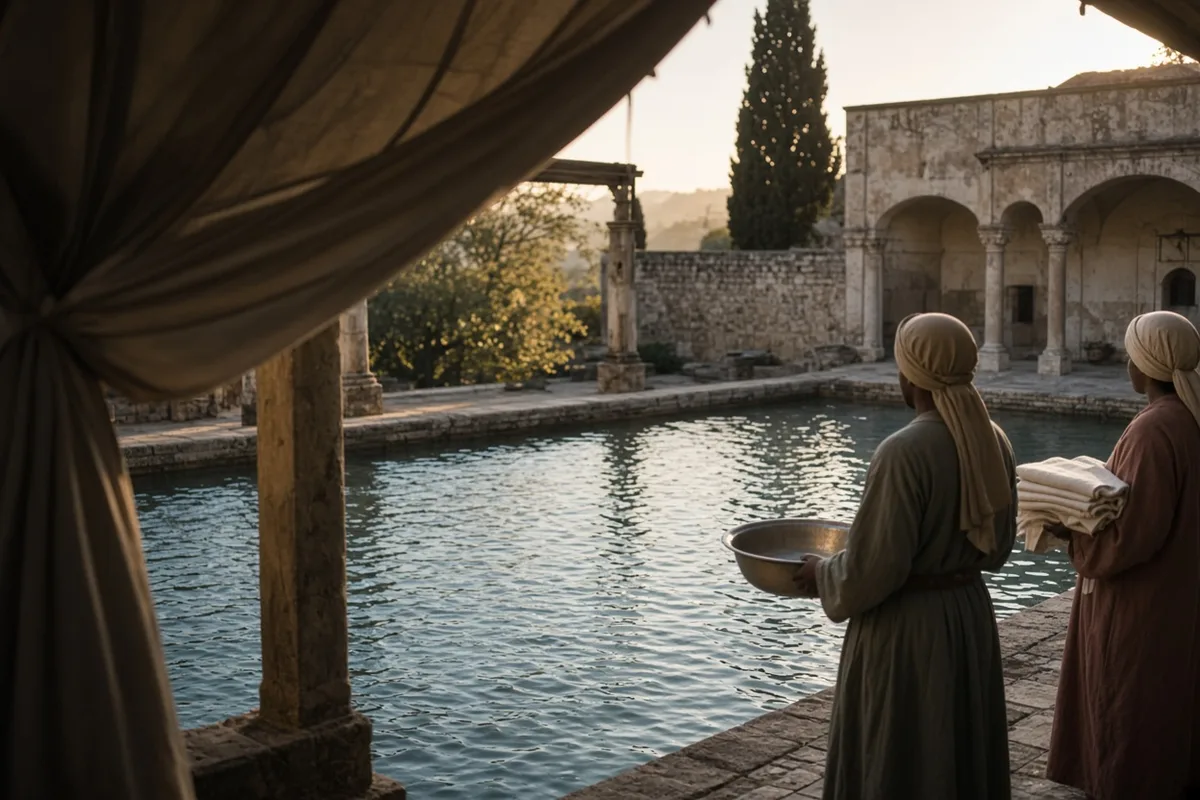
Marie Bailly remained at Lourdes after the 1902 return, entering the service of the Oeuvre de la Grotte on 14 September 1903 and working in the laundry attached to the Hospice de Notre-Dame des Douleurs until 17 March 1935. On that date she suffered a cerebral hemorrhage while folding linens in the drying room and was taken to the same pool where her own abdomen had flattened; attendants noted her speech remained clear until 8:40 p.m., when she asked for a glass of water from the spring and then lost consciousness. She died at 11:05 p.m. and was buried two days later in the cemetery on the route de Pau, plot 214, beside the section reserved for the Hospitalières de Notre-Dame de Lourdes; the parish register records her age as fifty-seven and her occupation as “lingère de la Grotte.”
The medical bureau at Lourdes, located since 1883 in the Bureau des Constatations on the upper level of the Esplanade, maintains a file numbered 1902-47 that contains the original stretcher tag from the pilgrimage train, the temperature log kept by the sisters at the Accueil Notre-Dame, and a single typed letter from Carrel dated 9 October 1902 in which he wrote, “The peritoneal effusion has disappeared without surgical intervention; I have no physiological explanation at present.” The file also holds a 1928 photograph of Bailly standing beside the same pool, wearing the blue uniform of the Hospitalières, her hands resting on the iron railing, the photograph stamped on the reverse with the studio name “L. Besta, 12 rue de la Grotte.”
After 1946 the Rockefeller Institute transferred the remaining chicken-heart cultures to the new laboratory at 1230 York Avenue, where they were maintained under sterile conditions until the last viable cells were fixed in formalin on 12 February 1947; the final subculture number entered in the ledger was 12,847. The institute’s annual report for that year listed the total duration of the culture as thirty-four years, two months, and twenty-six days. In 1955 the preserved specimen was placed in a glass jar on permanent display in the medical museum at the same address, labeled simply “Carrel chick-heart culture, 1912–1946.”
The grotto at Lourdes today receives an average of 6,200 visitors each day during the pilgrimage season from Easter to All Saints, according to the 2023 count kept by the Sanctuaire Notre-Dame de Lourdes; of these, 142,000 pass through the medical bureau for examination each year. The original stretcher used for Bailly on 28 May 1902 is preserved in the museum adjacent to the bureau, its canvas still marked with the number 19 in black paint and the date stenciled on the wooden frame. A bronze plaque beside the pool records the names of the seven physicians who examined her before and after immersion, including Alexis Carrel and the two local doctors from Tarbes who signed the initial certificate of incurability on 27 May.
The last person I spoke with who had known Bailly directly was Sister Marie-Thérèse Gély, born in 1909, who served as laundry supervisor from 1931 until 1974 and remembered Bailly’s habit of placing an extra towel under the head of any patient whose stretcher arrived wet from the train. Sister Gély died on 4 February 1998 at the age of eighty-nine in the same hospice where Bailly had worked; her funeral mass was held in the Crypt of the Immaculate Conception, attended by twelve surviving Hospitalières and two physicians from the medical bureau who had examined cases in the 1950s. Her rosary, still looped around the bedpost at the time of her death, was placed in the archive alongside the 1902 chart that I had kept until my own departure from New York in 1951.
The archive at the Sanctuaire received the rosary and chart on 12 March 1952 after I forwarded both items from the apartment at 14 rue des Pyrénées in Tarbes, where I had taken up residence the previous autumn; the transfer receipt signed by Father Joseph Grunwald listed the chart’s dimensions as 21 by 29 centimeters and noted the brown ink blot on the second underline of “ordinary” as measuring 3 millimeters across. In 1964 the medical bureau added a second folder containing the 1902 stretcher tag numbered 19 and the temperature log from the Accueil Notre-Dame covering 27 May to 3 June, with entries recorded at 6 a.m., noon, and 9 p.m. each day by Sister Anne-Marie Larrieu; the log showed Marie Bailly’s temperature holding at 37.8 degrees Celsius on the morning of 29 May after the pool immersion.
Dr. Théodore Mangiapan, director of the bureau from 1952 to 1985, examined the combined file on 8 July 1971 and dictated a note stating that Carrel’s abdominal measurements of 87 centimeters before and 71 centimeters after matched the observations of the two Tarbes physicians who had certified incurability the day prior; Mangiapan placed a copy of his dictation in the file along with a 1971 photograph of the pool taken at 10:15 a.m. on a Tuesday when 47 stretchers waited in line. The bureau’s annual statistical summary for 1971 recorded 112,400 examinations performed that year, of which 47 were classified as medically inexplicable at the time of review.
Sister Marie-Thérèse Gély’s successor, Sister Jeanne Larrouy, maintained the laundry schedule until her retirement on 30 June 1982 and kept a handwritten list of 214 former patients who had returned to the Hospice de Notre-Dame des Douleurs for work between 1903 and 1935; the list, written in blue ink on ledger paper, included Bailly’s name on line 47 with the annotation “lingère, 1903–1935, décès 17 mars 1935.” On 14 September 1988 the list was microfilmed by the diocesan archive in Tarbes, producing 18 frames that were stored in climate-controlled cabinets at 18 degrees Celsius and 45 percent relative humidity.
The bronze plaque beside the pool was replaced on 22 April 1994 after the original 1902 inscription had weathered to illegibility; the new plaque, cast at the foundry in Pau, measured 62 by 48 centimeters and listed the seven physicians by name in raised lettering: Alexis Carrel, Henri de Saint-Macary, Louis de Vernejoul, and the four others who had examined Bailly on 27 and 28 May. The replacement ceremony was attended by 19 Hospitalières and three members of the medical bureau staff, who recorded the event in a register opened at page 312.
In 2002 the Sanctuaire published a centenary volume containing a facsimile of Carrel’s 9 October 1902 letter and a transcription of the stretcher tag; the volume ran to 384 pages and included an index of 1,892 names of pilgrims examined that year, with Bailly entered under number 47 in the section devoted to peritoneal cases. The original stretcher frame, still bearing the stenciled date 28 May 1902, was moved on 11 May 2002 from the bureau museum to a climate-controlled case in the new documentation center at 5 avenue Monseigneur Théas, where the canvas was examined under 40-watt fluorescent light and found to retain faint traces of the number 19 in black paint measuring 4 centimeters high.
The last visitor to request the 1902 file before the archive closed for renovation on 3 November 2019 was Dr. François de Lacger, who signed the request slip at 2:47 p.m. on 29 October and spent forty minutes reading the Carrel letter and the temperature log; he left a note on the request slip recording the exact time he finished and the observation that the ink on the second underline of “ordinary” remained legible under magnification. The file was returned to its acid-free folder and placed in drawer 7 of cabinet B at 4:15 p.m. that same afternoon.
The renovation completed on 15 September 2022 and the documentation center reopened with new shelving that holds 4,872 linear meters of records; the 1902 chart now rests in a polypropylene sleeve inside a box labeled “Dossier 1902-47” on shelf 14, row 3, column 2. On 28 May 2023 a Hospitalière born in 1947, Sister Catherine Laborde, placed a fresh towel beneath the head of a patient arriving by train at 9:22 a.m., following the practice described by Sister Gély; the patient’s stretcher bore the number 19 painted in black on the wooden frame.