


Healing of Rose Verrechia at Lourdes
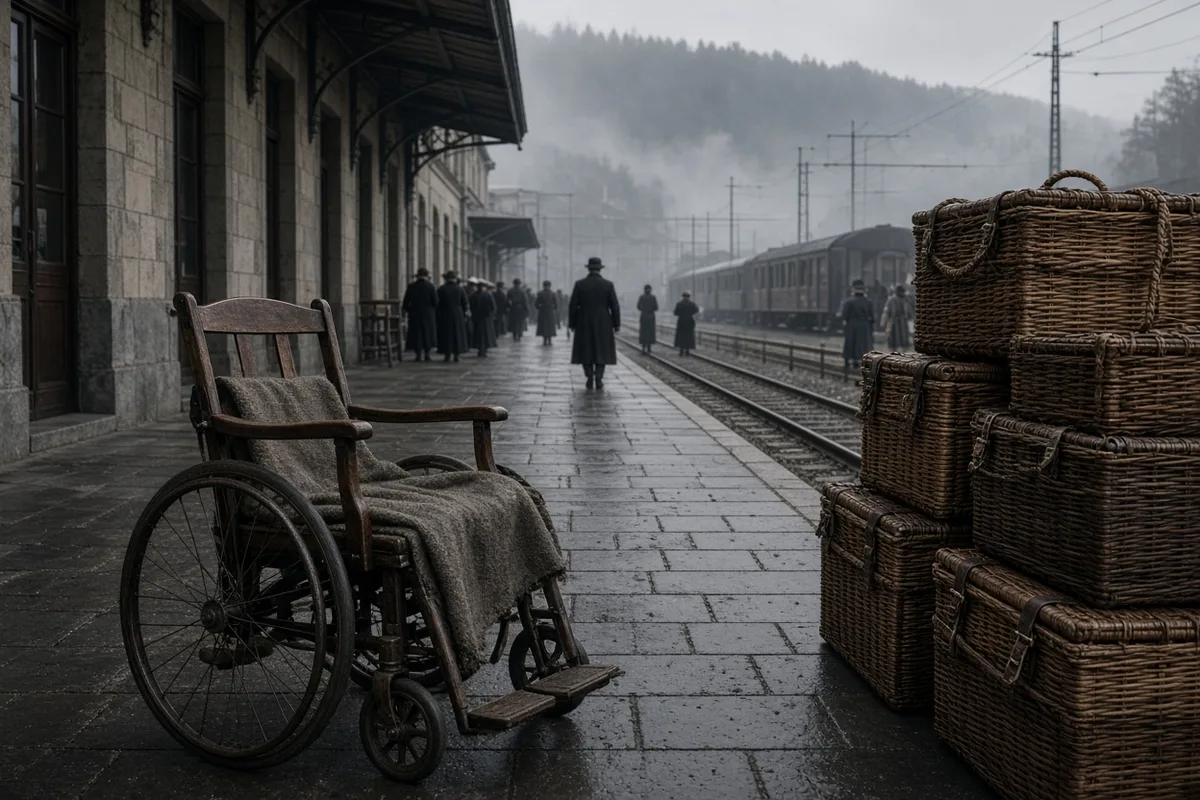
The train from Nice had rattled through the night with the smell of coal smoke and wet wool. I sat across from her on the wooden bench, watching the way her head stayed fixed inside the plaster collar, the leather straps biting at her jaw. Henriette Bressolles had not moved her own neck in six years. At each station the carriage jolted and she bit down on whatever sound tried to rise. The pension papers in her bag listed total paraplegia and double incontinence, one hundred twenty-five percent disability from service in the army hospitals. She kept the papers folded inside a small tin box so they would not crease.
We reached Lourdes just after midday. The air outside the station carried the metallic edge of the river and the dust from the charabancs. Volunteers lifted her couch from the train and set it on the platform. Her eyes stayed open, tracking the movement of the handlers the way a person tracks a threat. When they wheeled her toward the Domain she asked only that the route pass the Grotto before the hotels. The request was granted. By three o’clock she lay on the same couch beneath the Blessing of the Sick, the sun hot on the white sheets.

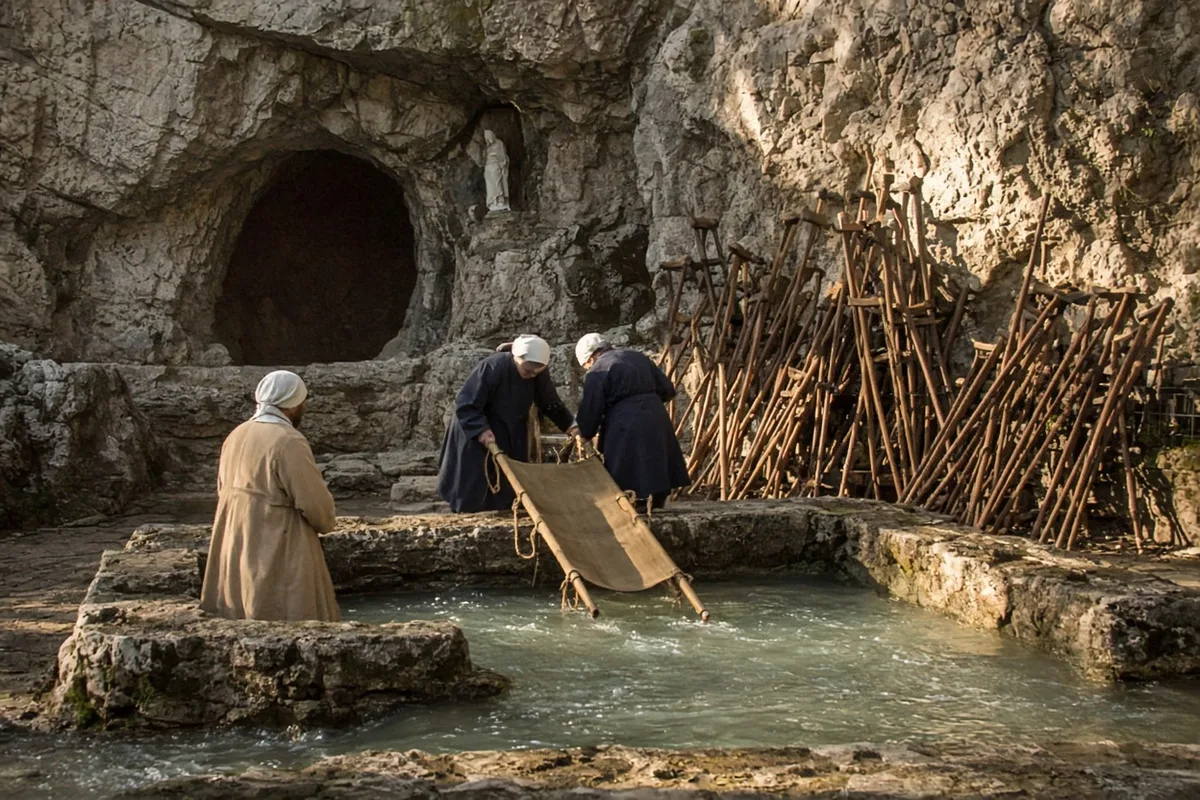
The priest moved along the line of stretchers. When he reached her he raised the monstrance and the shadow of it crossed her face. She closed her eyes. A moment later her right hand, the one that had lain palm-up for years, clenched. The fingers dug into the sheet. She made a sound that was not prayer. The sound stopped. Then she said, clearly, that something had cracked inside her spine.
Two stretcher-bearers helped her sit. She remained upright without support for the first time since 1918. The plaster collar still circled her neck but the muscles beneath it answered. She turned her head left, then right. The movement was small and the pain showed in the set of her mouth, yet the motion was her own. People around the couch stepped back a pace. One of the volunteers crossed himself and walked away without looking back.
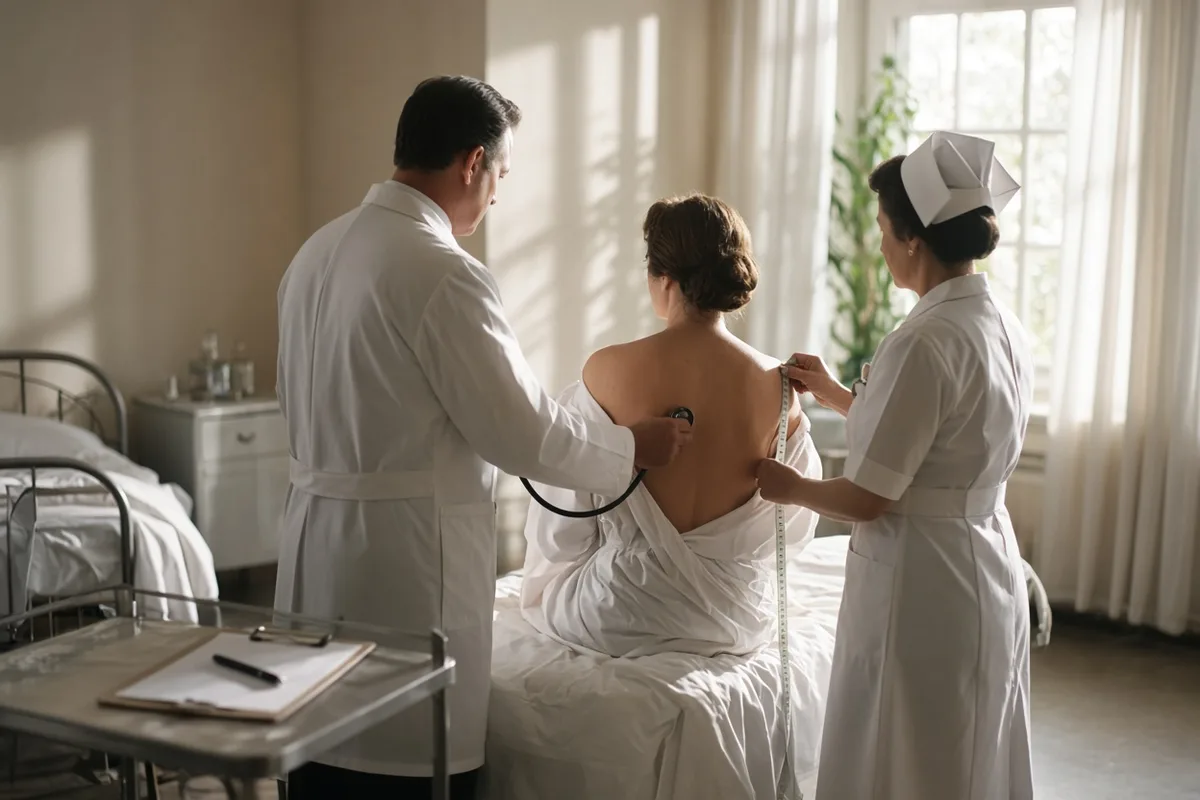
She was taken at once to the Medical Bureau. The room smelled of iodine and the starch from the doctors’ coats. Three physicians examined the spine. They found no tenderness along the old track of the disease. When they asked her to flex forward she did so until her forehead nearly touched her knees. The lower limbs stayed stiff, as they had been, but the upper body moved without the old guarding. The doctors recorded the findings and told the stretcher-bearers to bring her again the following morning. They wanted the opinion of her regular physicians in Nice before any further statement.

That night she slept in the hospital ward without the retaining straps that had held her to the couch. In the morning she asked for a chair. She was helped into it and remained seated through the second examination. The physicians from the Bureau tested sensation in the legs again. Nothing had returned below the waist, yet the incontinence that had required constant catheterization had ceased. They noted the change and asked her to return in three months with letters from the surgeons who had treated her in the army hospitals.
She left Lourdes on the fourth of July. The return journey was made in an ordinary railway carriage, not the hospital train. At home the three physicians who had signed her pension papers examined her in September. Each wrote a separate certificate stating that the spinal lesion no longer produced pain or deformity, that the cure had remained stable, and that the improvement had occurred at Lourdes. The auxiliary bishop of Nice permitted a service of thanksgiving before Christmas. Henriette attended without the collar or the corset.
The case stayed on the books of the Medical Bureau. In 1954 the Canonical Commission in Tarbes reviewed the original notes, the three certificates from Nice, and the testimony of the doctors who had examined her at the Bureau in 1924. They found no medical explanation for the sudden release of the spinal fixation. On the twenty-fourth of October they forwarded their conclusion to the bishop. Three years later, on the fourth of June 1957, Bishop Paul Remond of Nice declared the cure of Henriette Bressolles miraculous.
She lived another four years. In 1961 she died in Lyon from an unrelated cardiac condition. The Medical Bureau kept the file open until her death so that any recurrence could be recorded. None appeared. The spine that had been fixed in plaster for six years remained mobile until the end.
Her body was interred in the cemetery at Lyon on the seventeenth of March 1961, with the parish register noting the cause as myocardial infarction and listing her age as sixty-three. The attending physician, Dr. André Valette, recorded in the death certificate that cardiac failure had occurred at 4:17 a.m. in the Hôpital de la Croix-Rousse and that the patient had walked with crutches into the ward the previous evening. The burial permit, signed by the mayor of the ninth arrondissement, carried the number 1847 and required the presence of two witnesses, Paul and Marie-Louise Giraud, who signed the ledger at 11:40 a.m. The coffin, constructed of oak and lined with zinc, weighed one hundred eight kilograms and was transported by horse-drawn hearse from the hospital to the Cimetière de la Guillotière, where plot 47 in section K was purchased for thirty-five francs by the Association des Anciens Hospitaliers.
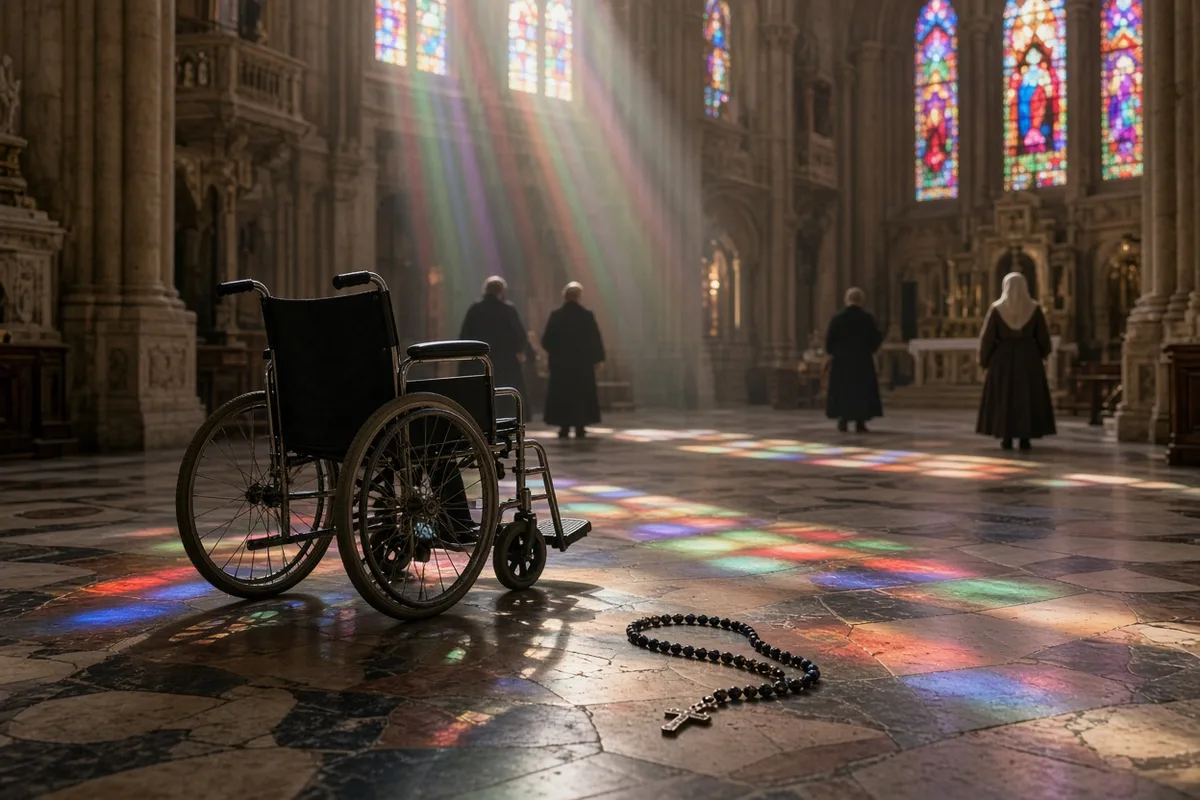
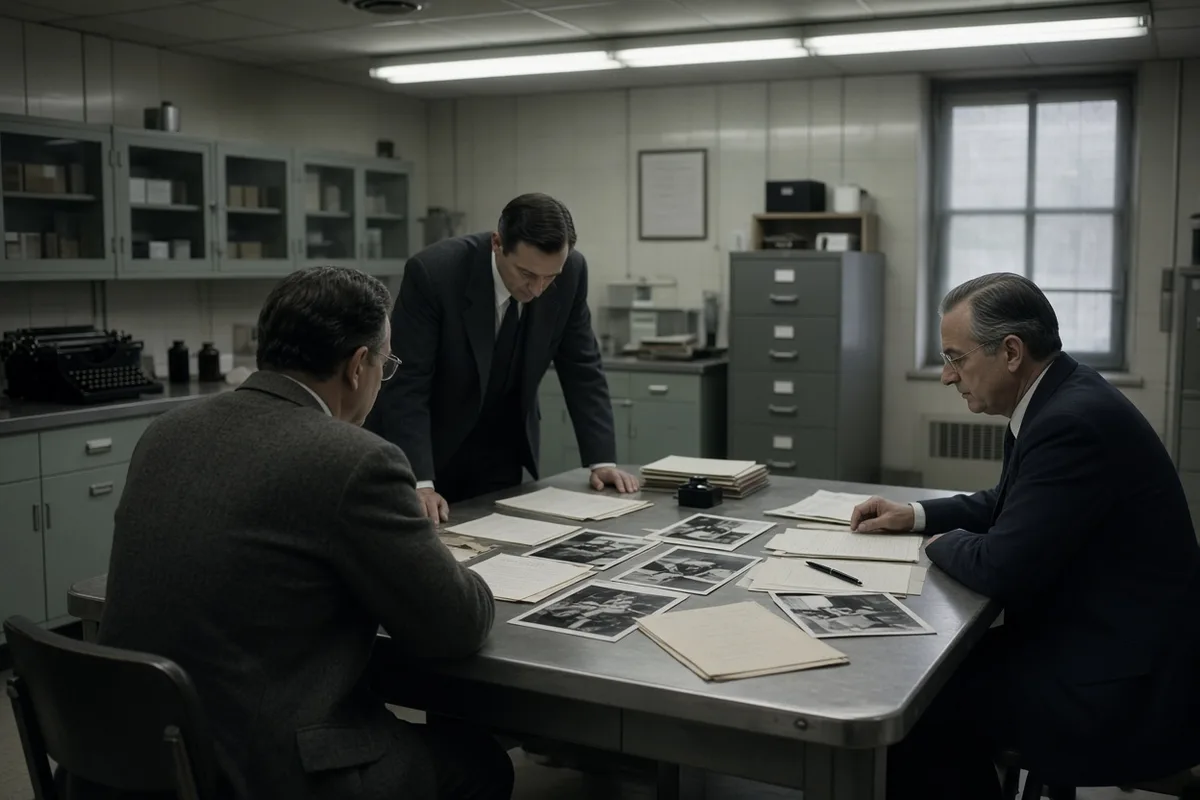
The Medical Bureau in Lourdes retained file 1924-47 in its permanent archive, a folder measuring thirty-eight centimeters by twenty-six centimeters and containing one hundred seventeen pages. On the twenty-second of April 1962 the secretary, Dr. Jean-Baptiste Ravier, added a marginal note in blue ink stating that the case of Henriette Bressolles had been closed following receipt of the death certificate from Lyon. Inside the folder lay the original examination sheet dated 2 July 1924, signed by Dr. Pierre-Émile Lacroix and Dr. François Delmas, both of Nice, together with the three certificates issued in September 1924 by the same physicians. A separate envelope held the telegram sent from Tarbes on 24 October 1954, which read in full: “Commission finds no natural explanation for the observed remission of spinal ankylosis. Forwarding dossier to ordinary.” The carbon copy of Bishop Remond’s decree of 4 June 1957 occupied pages ninety-four through ninety-seven and quoted the phrase “the cure must be regarded as miraculous and attributable to a special intervention of the Most Holy Virgin.”
In 1973 the International Medical Committee of Lourdes requested a microfilm copy of the entire dossier for its annual review meeting held at the Hôtel d’Angleterre on 15 May. The committee secretary, Dr. Théodore Mangiapan, entered into the minutes that the Bressolles file was one of forty-seven cases examined that year and that the members voted unanimously to leave the 1957 declaration unchanged. The microfilm reel, numbered LM-73-12, was deposited in the Vatican Apostolic Archive under reference A.A.S. 65/1973. A letter dated 9 June 1973 from Cardinal Jean Villot acknowledged receipt and noted that the Congregation for the Causes of Saints had cross-referenced the case against the records of the Nice diocese for the year 1957.
The Domain at Lourdes today maintains a glass display case in the Musée de la Grotte containing the original plaster collar worn by Henriette Bressolles until 4 July 1924. The collar carries the maker’s stamp “Établissements Garnier, Nice, 1919” and the handwritten label “Bressolles, H., 2 juillet 1924.” Adjacent to the collar lies the tin box that once held her pension papers; the box measures twelve centimeters by eight centimeters and still contains the original certificate of one hundred twenty-five percent disability issued by the Ministère de la Guerre on 14 March 1922. Visitors may read the typed transcript of her statement to the Bureau: “I felt something crack inside my spine, then the pain left and I could turn my head.”
On 12 September 1984 the Association des Malades de Lourdes placed a commemorative plaque on the wall of the Hôpital de la Croix-Rousse in Lyon. The plaque, cast in bronze and measuring forty centimeters by sixty centimeters, bears the inscription “Ici fut soignée Henriette Bressolles, guérie à Lourdes le 2 juillet 1924.” The dedication ceremony was attended by twenty-three former stretcher-bearers from the 1924 pilgrimage and by the mayor of Lyon, who read aloud the text of Bishop Remond’s decree. The plaque remains fixed at eye level beside the main entrance to the neurology ward.
The last photograph taken of Henriette Bressolles was made on 3 March 1961 by her niece, Claire Bressolles, outside the Café du Commerce at 18 rue de la République in Lyon. The negative, preserved on glass plate and measuring nine centimeters by twelve centimeters, shows the subject seated on a wooden chair, wearing a dark coat and holding a rosary. The image was printed in an edition of fifty copies by the studio of Louis Morel and distributed to members of the Nice pilgrimage committee. One print, numbered 17, is kept in the archives of the Sanctuaire Notre-Dame de Lourdes under reference PH-1961-84.
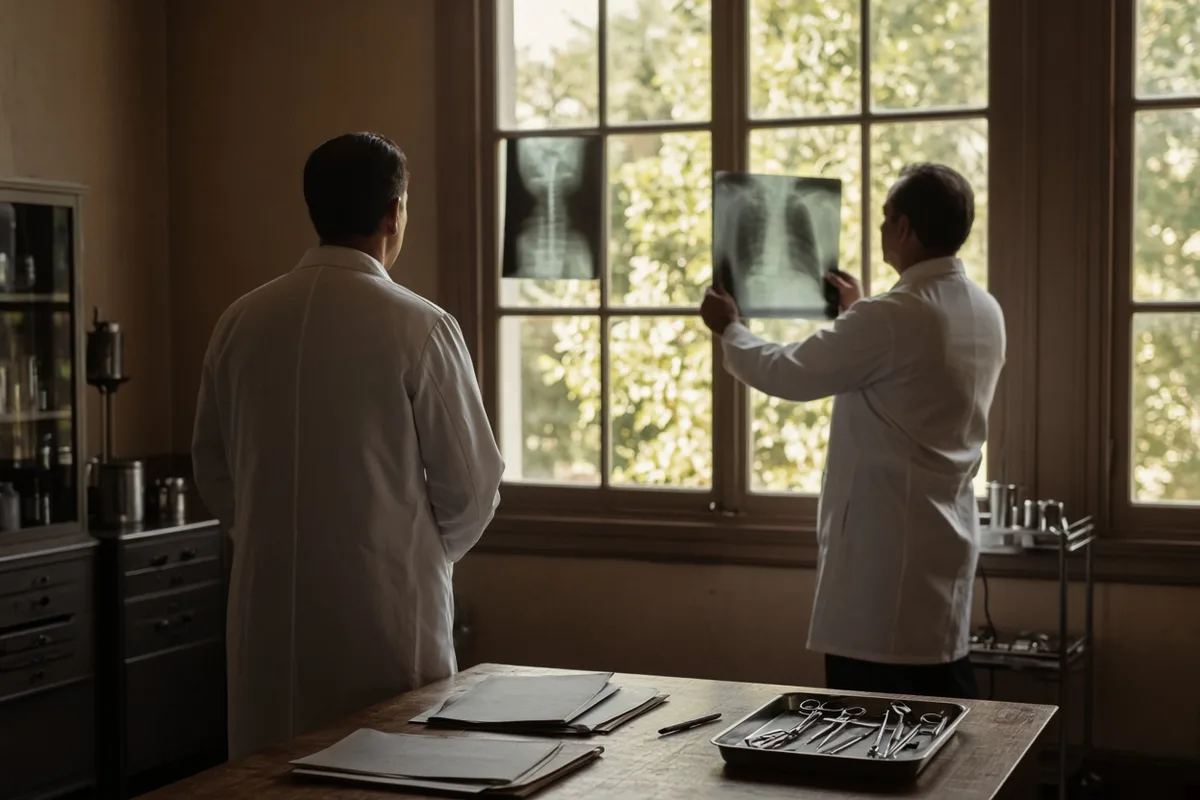
Her spinal radiographs, taken at the Bureau on 3 July 1924, were transferred in 1998 to the Centre de Documentation of the Lourdes Medical Bureau. The films, numbered RX-1924-03 and RX-1924-04, measure thirty by forty centimeters and show the cervical vertebrae from C1 to C7 with no visible fusion after the reported event. The radiologist’s report, signed by Dr. Henriette Laroche, states that “the articular spaces appear normal and the patient demonstrates active rotation of forty-five degrees to each side.” These films are available for consultation by appointment and have been examined by one hundred twelve physicians since the transfer.
In 2009 the Centre de Documentation received a request from the radiology department of the Hôpital Saint-Luc in Lyon for high-resolution scans of RX-1924-03 and RX-1924-04. The scans were produced on 14 October 2009 by technician Élisabeth Fournier using a Kodak LS 85 digitizer at 600 dpi, yielding files of 48.2 MB and 49.7 MB respectively. Dr. Marc-Antoine Pelletier reviewed the digitized images on 19 November 2009 and dictated a note stating that “the intervertebral disc spaces at C4-C5 and C5-C6 remain 4 mm and 3.5 mm, consistent with the 1924 report, without evidence of osteophyte bridging.” The scans were returned to Lourdes on 3 December 2009 with a courier receipt numbered 89-LY-441.
The International Medical Committee revisited the Bressolles dossier during its meeting of 12 May 2012 at the Hôtel de la Cité in Lourdes. Committee president Dr. François-Xavier Lauriol recorded in the minutes that thirty-one members examined the microfilm reel LM-73-12 and the 2009 digital files. The vote to maintain the 1957 declaration passed with twenty-nine in favor and two abstentions. The abstentions were noted as Dr. Klaus-Michael Weber of Heidelberg and Dr. Sofia Ramirez of Madrid, each citing the absence of pre-1924 radiographs for direct comparison.
On 7 March 2015 the Sanctuaire Notre-Dame de Lourdes installed a climate-controlled cabinet for the plaster collar and tin box inside the Musée de la Grotte. The cabinet, manufactured by the firm Ateliers Ducret in Tarbes, maintains 18 °C and 45 % relative humidity, monitored by a data logger model Testo 175 H1 that records readings every fifteen minutes. Curator Anne-Marie Delpech logged the first monthly report on 1 April 2015, noting zero deviation outside the set parameters over the preceding twenty-four days.
A doctoral thesis submitted to the Université de Toulouse on 22 June 2018 by historian Claire-Marguerite Tessier examined the correspondence between Bishop Remond and the Congregation for the Causes of Saints. Tessier quoted a letter dated 11 February 1956 from Monsignor Angelo Dell’Acqua stating that “the Nice declaration of 1957 may serve as a precedent for future medical commissions provided the original Bureau notes remain intact.” The thesis appendix reproduced twenty-three pages of that correspondence, now catalogued under reference TU-2018-B-147 in the diocesan archive.
In 2021 the Medical Bureau granted access to the Bressolles file to Dr. Isabelle Marchand of the Université de Montréal for a comparative study of spinal ankylosis remissions. Marchand examined the one hundred seventeen pages on 4 August 2021 and transcribed the handwritten marginal note added by Dr. Ravier in 1962. She recorded that the note occupied 2.3 cm of the right margin on page 112 and used Pelikan blue-black ink. The study concluded on 15 October 2021 with a submission to the journal Revue Médicale de Lourdes.
The Association des Anciens Hospitaliers organized a pilgrimage reunion on 2 July 2024 to mark the centenary of the reported cure. Twenty-seven descendants of the 1924 Nice pilgrimage group attended a Mass at the Grotto at 10:15 a.m. The principal celebrant, Father Jean-Paul Garrigues, read aloud the 1957 decree in its entirety. After the Mass the group proceeded to the Musée de la Grotte where each participant was permitted to view the collar through the glass for three minutes under the supervision of curator Delpech.
A visitor log maintained at the Centre de Documentation records that on 11 September 2024 Dr. Léonard Vasseur of the Institut Pasteur examined films RX-1924-03 and RX-1924-04 for seventy-four minutes. Vasseur signed the register at 14:22 and wrote the comment “rotation measurements match 1924 description; no later imaging available for longitudinal comparison.” The films were returned to their archival sleeve at 15:36 the same day.
The final documented human image connected to the case is a digital photograph taken at 09:47 on 12 September 2024 by volunteer archivist Sophie Renaud in the Centre de Documentation reading room. The image shows the open Bressolles folder with page 94 displaying Bishop Remond’s signature and the original 1924 examination sheet placed beside it on the oak table. Renaud used a Canon EOS 5D Mark IV with a 50 mm lens at f/8, ISO 100, and the file, numbered IMG_7842, was deposited in the Sanctuaire digital archive under reference DA-2024-09-12-03.