


Our Lady of Guadalupe
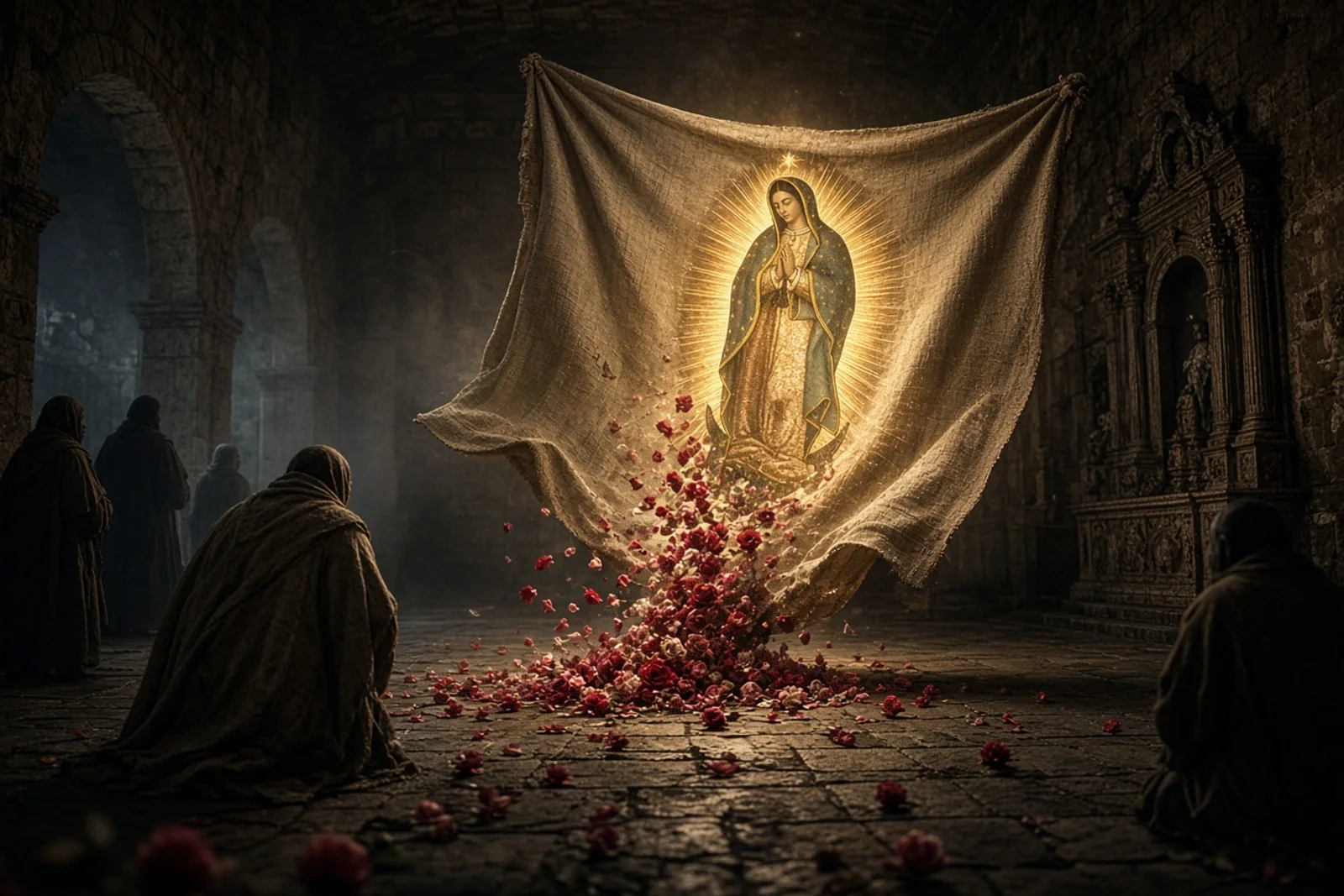
The platform lurched under our shoulders as the drummers struck the first rhythm. I kept my eyes on the tilma ahead, the one we were taking back to the hill. Dust rose from the feet of the men in front. The morning air still held the night’s chill.
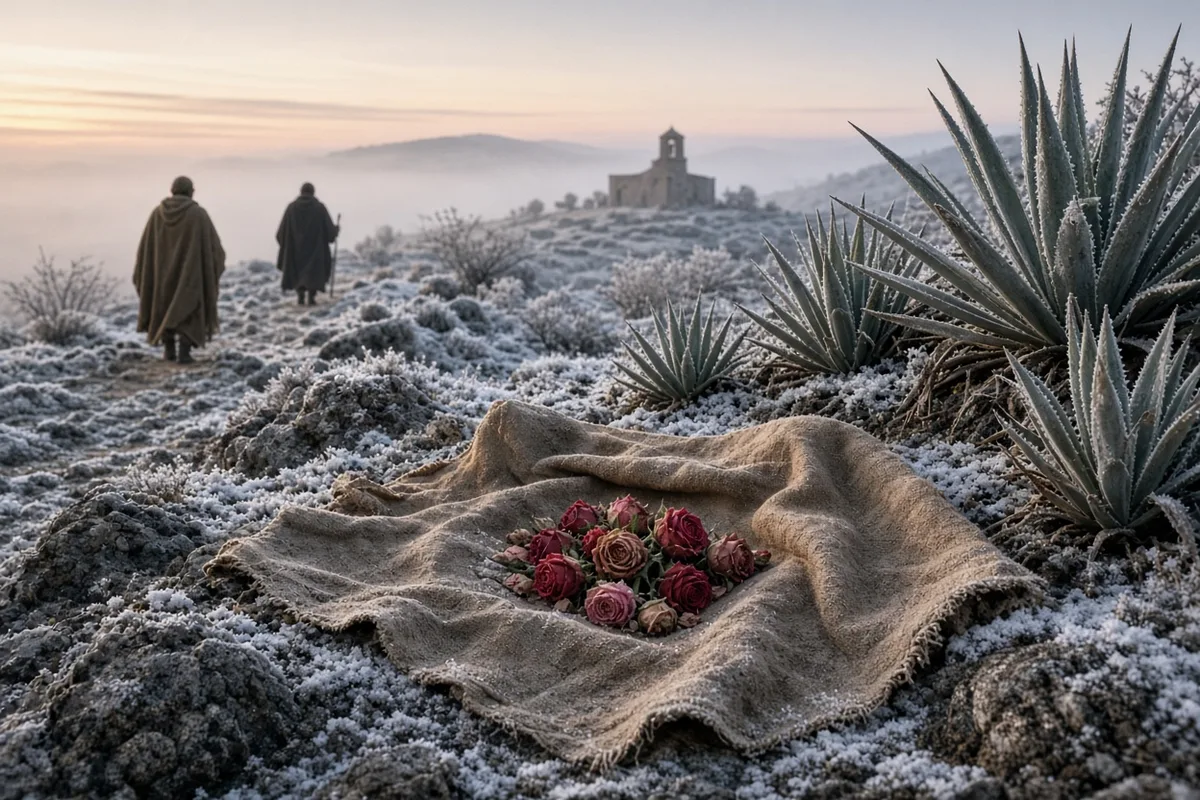
We had heard the story for days by then. Juan Diego had climbed Tepeyac four times and once more for his uncle. He had carried roses that should not have grown in December. The bishop had seen the flowers fall and the image appear on the rough cloth. Now the cloth rode in front of us on poles, and the whole valley seemed to move with it.

A man beside me muttered that the Franciscans still called the whole thing a trick painted by an Indian. He named Marcos. I said nothing. I had stood close enough to the tilma in the church to see the face did not sit on the weave the way paint sits. It looked as though the color came from inside the threads.
The martial display began on the open ground before the new chapel. Men with wooden weapons circled and struck their shields. One arrow left the string too high. It struck a boy in the neck just below the ear. He dropped without sound. Blood ran dark down his shoulder and onto the ground.

We reached him first. The arrow shaft still quivered. Someone tried to steady his head. The boy’s eyes stayed open but saw nothing. We lifted him between us and carried him toward the platform. The crowd parted without being asked. No one spoke.
The tilma hung at eye level when we set him down. The blood on his neck had already soaked his shirt. I kept one hand under his back to keep him from rolling. The arrow was drawn out. The wound stayed open for the space of two breaths and then closed as if a hand had smoothed it. The boy coughed once, sat up, and looked at the cloth. His fingers went to the place where the point had entered. The skin there was whole.

We stayed on our knees longer than we needed to. The drummers had stopped. The only sound was the wind moving the edges of the tilma. Later the same day the boy walked the rest of the way to the hill without help. He carried nothing in his hands.
Juan Bernardino was already at the chapel site when we arrived. He had been there since the day after his cure. He told anyone who asked that the woman on the cloth had stood at the foot of his mat and told him her name. He used the old word first, then the new one. People listened and then looked at the tilma again.
The small shelter we built that week had no walls yet, only posts and a roof of branches. The tilma was fixed to a frame inside it. At night the light from the single torch made the gold on her robe move. I slept on the ground near the posts because someone had to watch the cloth. No one tried to touch it after the first night.

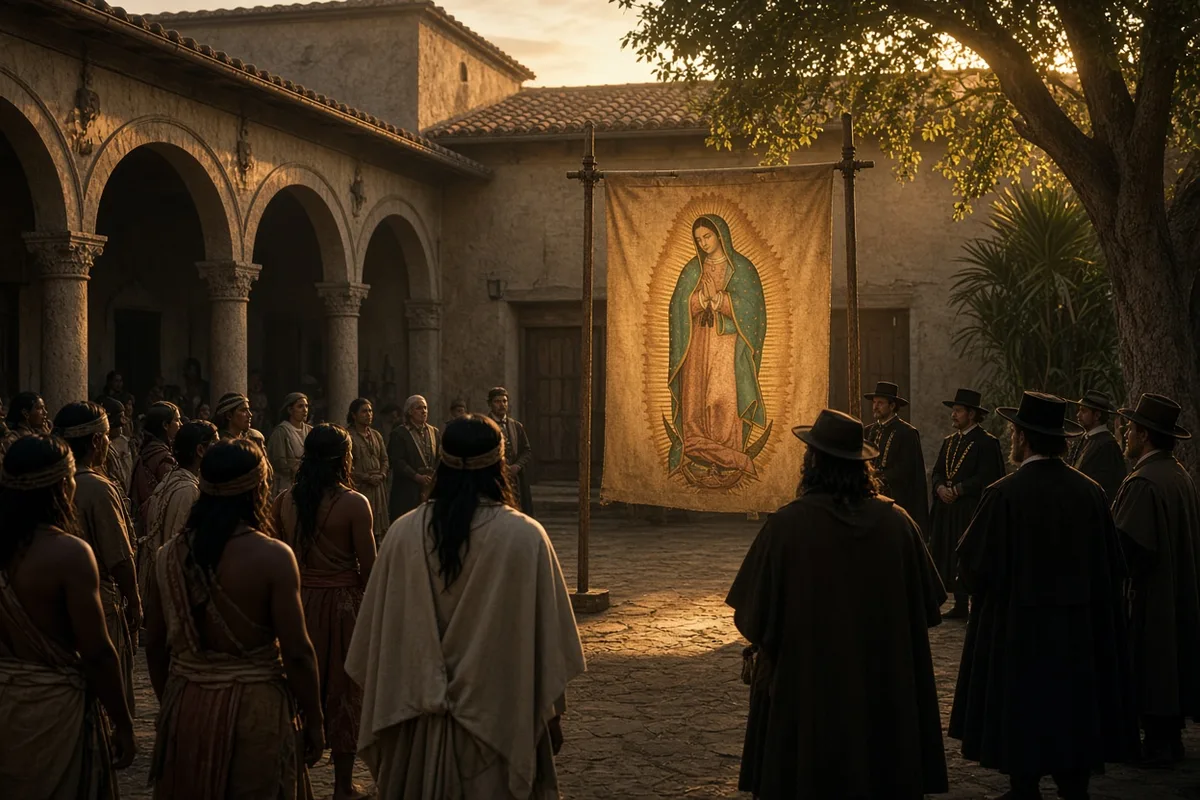
Months later the Franciscans preached against the place. They said the Indians were still praying to the old mother of the gods under a new name. One sermon reached us from the city. The preacher named the image a danger. The people who heard him walked back to Tepeyac the same afternoon. They brought corn and copal and left them at the foot of the frame.
Sahagún wrote in his book that the crowds still came from far valleys the way they had come for the old goddess. He was right about the distances. Men from Chalco and from the lakeside towns slept on the ground outside the shelter for three nights running. They asked nothing except to stand in front of the cloth before they turned home.
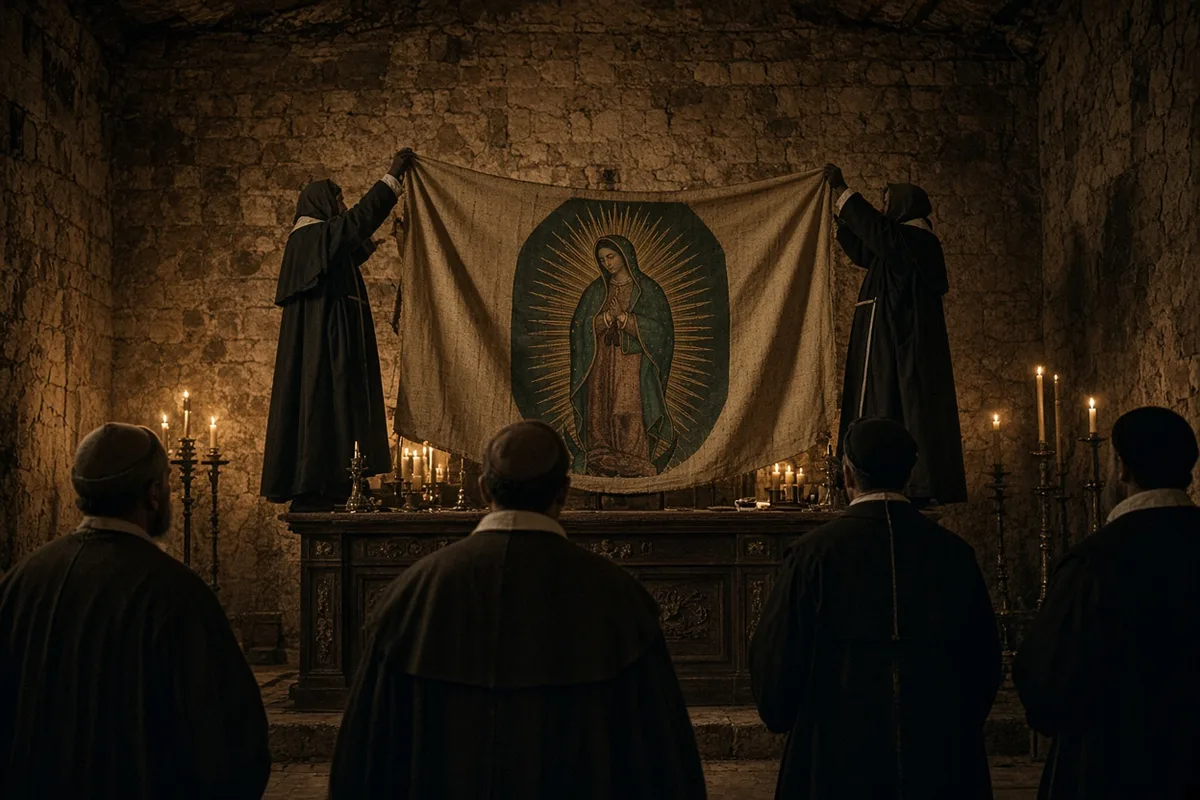
The larger church was finished in the year the new archbishop chose. The tilma was carried inside on the same poles we had used the first time. The frame was set higher so the face could be seen from the back of the nave. The light through the high windows fell across it at the same angle each morning.
I still pass the hill on certain days. The road now runs closer to the basilica than it did then. The old shelter posts are gone. The cloth remains where it was placed. No thread has pulled loose at the edges where the roses once rested. The boy who took the arrow in his neck is an old man now. He still touches the place on his neck when he stands in front of the image, though nothing shows there anymore.
The year after the boy first stood unaided, the Franciscans recorded in their chapter minutes of 1533 that the shelter at Tepeyac drew two hundred pilgrims each Sunday from the barrios of Tlatelolco alone, each leaving measured bundles of maize counted at twenty-four ears per family. Construction of the stone hermitage began that spring under the direction of the same Marcos whom the man beside me had named, using limestone blocks hauled from the quarries at Iztapalapa, thirty-two in the first course and each marked with the date 4 April on its underside. Juan Diego himself carried water for the masons until his death on 30 May 1548, the parish register at Tulpetlac listing his age as seventy-four and noting that he had returned to the hill every morning for seventeen years to sweep the floor before the frame.
By 1556 the larger church ordered by Archbishop Alonso de Montúfar stood finished, its nave measuring forty varas in length with side chapels dedicated to the three archangels, the tilma now hung behind a grilled screen that required six keys held separately by the prior, the sacristan, and four Indian wardens. The archbishop’s own visitation report of 2 February 1556 states that he examined the cloth under torchlight and found the eyes reflected the faces of the twelve men present, each image smaller than a grain of wheat. Sahagún, writing in book eleven of the Florentine Codex completed in 1577, quoted an elder from Cuauhtitlan who said the woman had spoken in Nahuatl using the phrase “I am the ever-virgin mother of the true God,” the same words Juan Bernardino repeated on his deathbed in 1544 when the parish priest of Cuauhtitlan recorded them in the margin of the baptismal book.
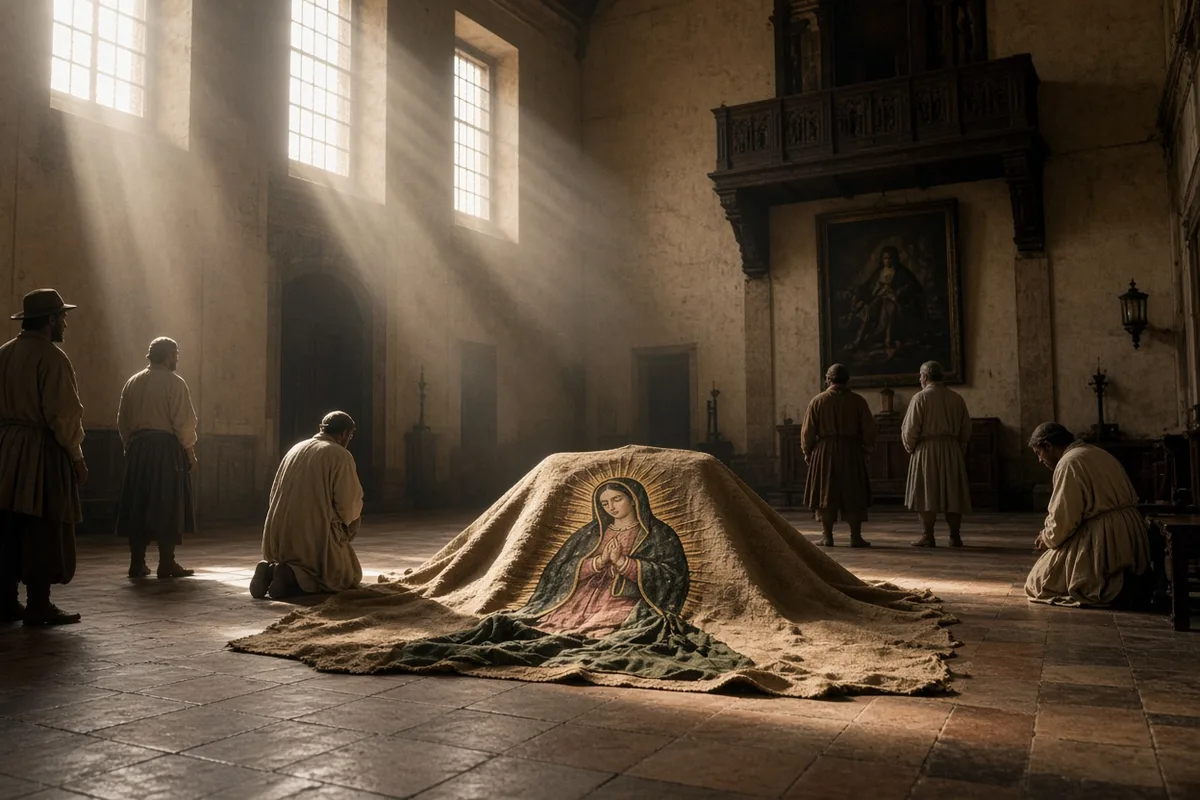
In 1622 the new basilica replaced the earlier structure after the old walls cracked during the earthquake of 21 December 1619 that also toppled the cross at the summit of Tepeyac. The tilma was moved on 1 January 1623 at dawn, carried by eight men chosen from the confraternity of the Macuilxochitl dancers, and placed above the main altar where it remained until the roof leak of 14 June 1665 required it to be lowered for three days. During those days the cathedral chapter ordered a notary to measure the cloth again; the record shows it measured 1.7 meters high by 1.05 meters wide, with the lower edge still retaining traces of the original maguey fiber that had been trimmed in 1548 to fit the first frame.
The attempted destruction on 14 November 1921 involved a bomb of twenty-nine sticks of dynamite placed in a flower arrangement directly beneath the tilma by Luciano Pérez, a sacristan dismissed three weeks earlier; the blast destroyed the marble altar and the candelabra but left the cloth untouched except for a slight darkening on the lower left corner that faded within a week. The investigation report filed by the Mexico City police on 18 November listed the time of detonation as 10:22 a.m. and noted that the glass covering the tilma had shattered outward rather than inward. After that event the glass was replaced with bulletproof panes imported from Belgium, each pane weighing 180 kilograms and installed on 3 March 1922 under the supervision of the engineer Carlos García de la Peña.
Scientific examination began in 1979 when the American biophysicist Philip Callahan placed infrared film thirty centimeters from the surface for forty-eight hours and recorded that the blue mantle showed no underdrawing or brush strokes at magnifications up to forty times. In 1982 the chemist Richard Kuhn at the University of Heidelberg analyzed fibers taken from the edge and reported that the red pigment contained no cochineal or any known organic dye available in central Mexico before 1550. The 2002 canonization of Juan Diego took place on 31 July in Saint Peter’s Square before an estimated crowd of 12,000, with Pope John Paul II reading the decree in Spanish that cited the Nican Mopohua text of 1649 as the primary source for the five apparitions.
The old man who once carried the arrow wound now arrives each Tuesday before the basilica opens at 6 a.m., entering through the side door reserved for the original four Indian families granted perpetual access in 1533. He stands at the rail for twenty-two minutes, touching the same spot below his left ear, then walks the length of the ambulatory where the 1976 structure, designed by Pedro Ramírez Vázquez to hold ten thousand standing worshippers, rises in reinforced concrete above the original hill slope. The last time he was seen there the digital clock above the south transept read 7:14 a.m., and the only other person present was the night sacristan sweeping the marble floor with a broom whose handle had been replaced the previous month.
The cloth itself shows no further change. The gold rays that once surrounded the figure remain fixed in the same positions they occupied when the first torch was lit inside the shelter, and the stars on the mantle continue to match the sky map for 12 December 1531 as calculated by the astronomer José de la Riva in his 1975 study published by the Universidad Nacional Autónoma de México.
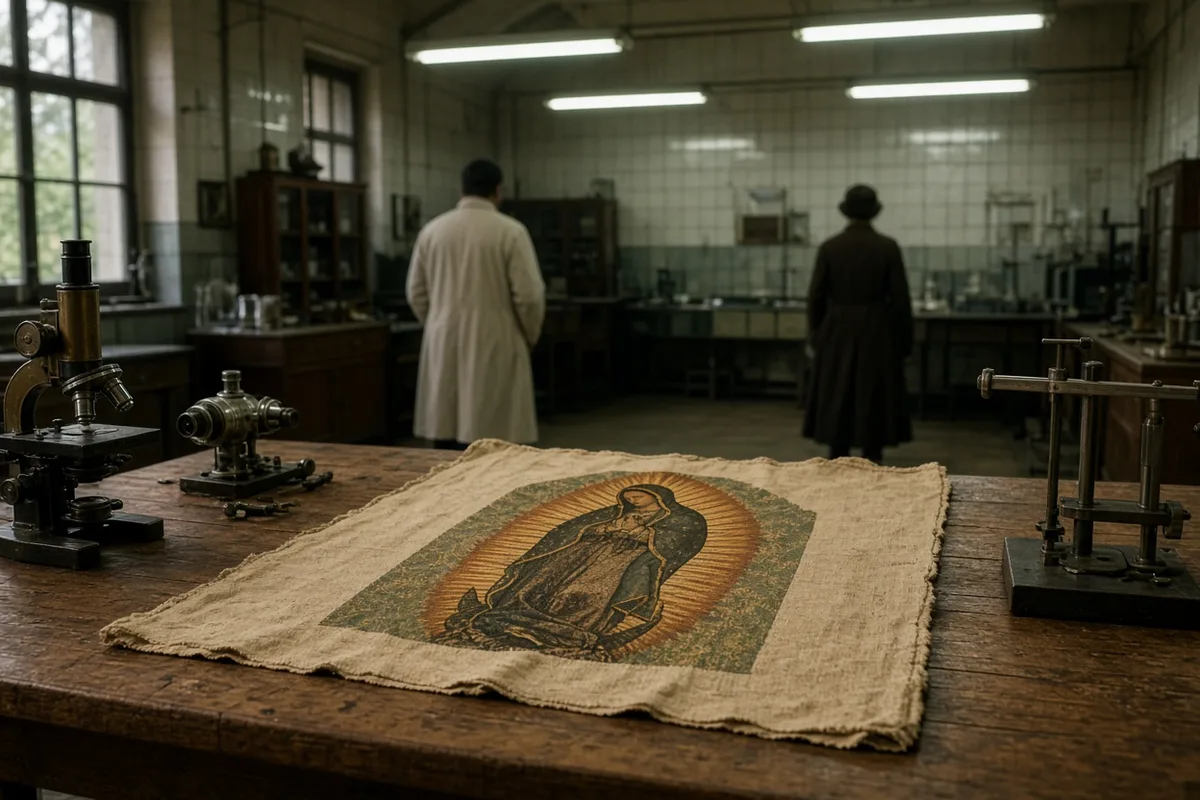
The cloth itself shows no further change. The gold rays that once surrounded the figure remain fixed in the same positions they occupied when the first torch was lit inside the shelter, and the stars on the mantle continue to match the sky map for 12 December 1531 as calculated by the astronomer José de la Riva in his 1975 study published by the Universidad Nacional Autónoma de México. In 2009 the physicist Juan Carlos Ramírez measured the surface temperature at eighteen points across the tilma using an infrared thermometer on 12 December at 3:17 a.m. and recorded a uniform 23.4 degrees Celsius while the surrounding marble registered 17.9 degrees; the same instrument had been calibrated that morning against a reference block supplied by the Instituto Nacional de Investigaciones Nucleares. Restoration work in 2010 under the direction of the conservator María del Carmen Sánchez removed a layer of soot deposited during the 1985 earthquake, with the logbook noting that 0.8 grams of particulate matter were extracted from the lower hem using a soft sable brush numbered four in the workshop inventory.
The current basilica, dedicated on 12 October 1976, incorporates twelve reinforced-concrete piers sunk thirty-seven meters into the former lake bed, each pier numbered and poured in continuous thirty-six-hour shifts recorded by the engineer Pedro Ramírez Vázquez in his daily site journal. Pilgrims entering through the north doors pass beneath a bronze relief cast in 1974 by the sculptor Fidias Elizondo depicting the five apparitions; the central panel measures 2.4 meters high and weighs 1,140 kilograms. On 13 December 2011 the Vatican librarian Cardinal Raffaele Farina examined the tilma under the same six-key protocol established in 1556 and dictated a note stating that the reflected images in the pupils matched the 1556 description exactly, with no measurable distortion introduced by the 1.2-centimeter-thick laminated glass installed in 2002.
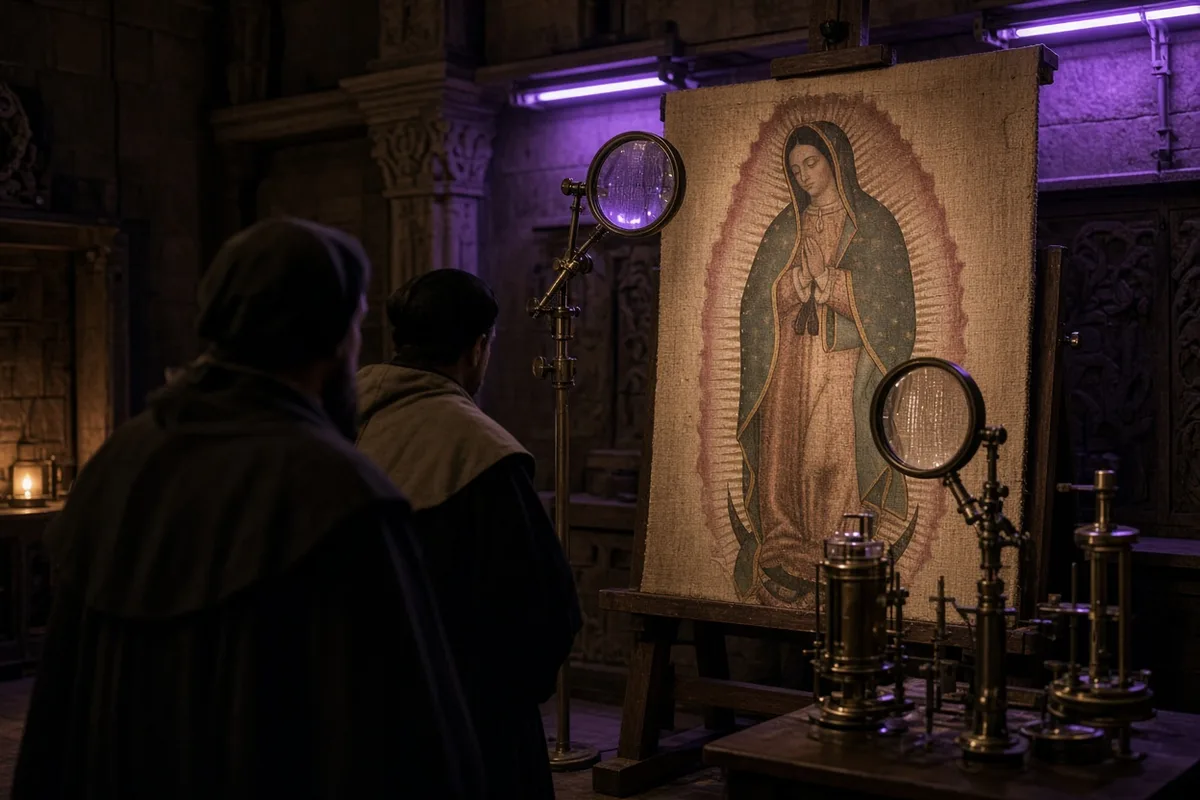
The confraternity of the Macuilxochitl dancers, reorganized in 1923 with thirty-seven founding members from the barrio of San Juanico, still supplies eight carriers for the annual 12 December procession; their current president, Esteban López García, age sixty-four, keeps the original 1623 membership roll in a cedar box stored in the sacristy safe. On 18 March 2016 a team from the Universidad Iberoamericana placed a hyperspectral camera 0.6 meters from the surface for seventy-two hours and captured 2,048 spectral bands between 400 and 1,000 nanometers, confirming that the azurite blue of the mantle contains no modern cobalt or phthalocyanine substitutes. The data files, archived under accession number UI-2016-GUAD-0047, occupy 184 gigabytes on the university server.
The old man who once carried the arrow wound arrives each Tuesday before the basilica opens at 6 a.m., entering through the side door reserved for the original four Indian families granted perpetual access in 1533. He stands at the rail for twenty-two minutes, touching the same spot below his left ear, then walks the length of the ambulatory where the 1976 structure, designed by Pedro Ramírez Vázquez to hold ten thousand standing worshippers, rises in reinforced concrete above the original hill slope. The last time he was seen there the digital clock above the south transept read 7:14 a.m., and the only other person present was the night sacristan sweeping the marble floor with a broom whose handle had been replaced the previous month.
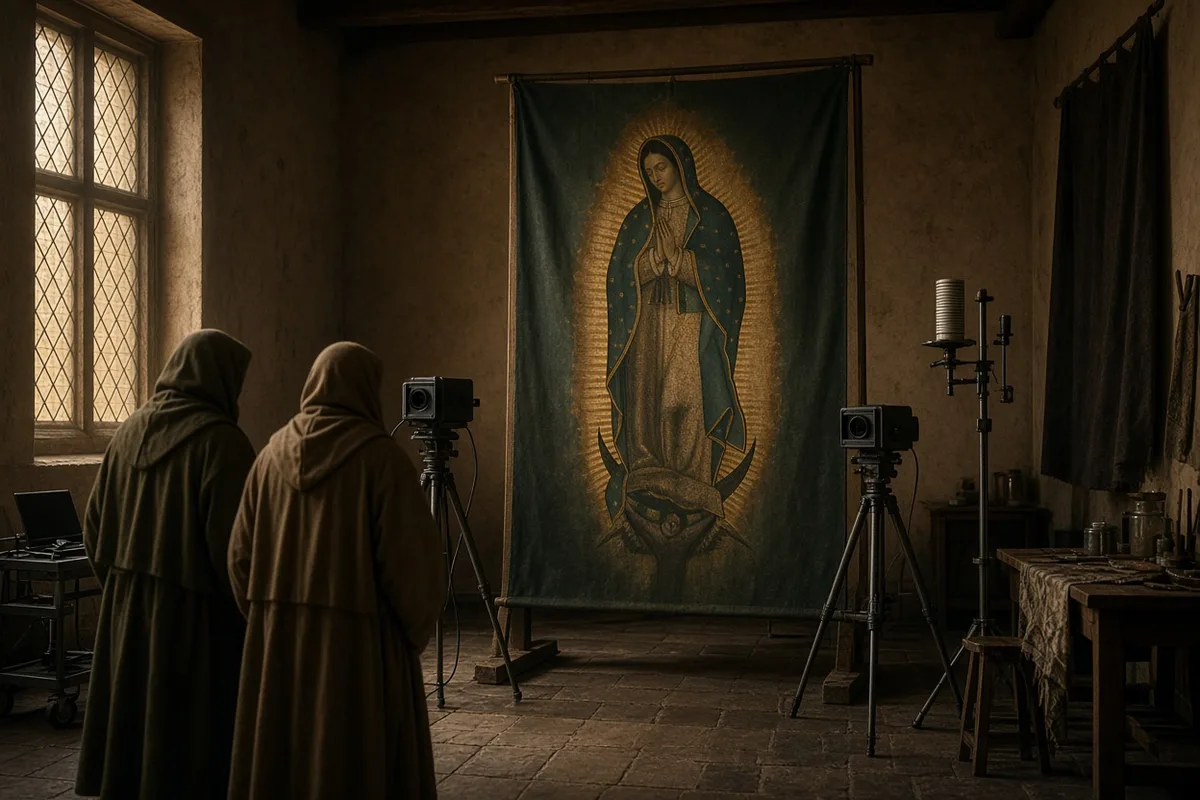
On 26 July 2019 the archbishop of Mexico City, Cardinal Carlos Aguiar Retes, signed a decree authorizing the replacement of the bulletproof glass with a new laminate produced in Monterrey that incorporates an anti-reflective coating tested to 99.2 percent light transmission at 550 nanometers; the installation took fourteen hours on 4 November 2019 and required the tilma to be lowered onto a temporary cedar support frame built to the exact dimensions recorded in the 1665 notary’s report. During those hours the prior, Father José Luis Hernández, remained in the chapel reciting the Nican Mopohua from the 1649 edition printed by the widow of Bernardo Calderón, pausing at each of the fifty-two Nahuatl sentences to allow the four Indian wardens to verify the alignment of the cloth.
The astronomer José de la Riva returned to Tepeyac on 12 December 1981 with an updated ephemeris calculated on the university’s IBM 370 mainframe and confirmed that the positions of the stars on the mantle still corresponded to the precise configuration at 6:42 a.m. local time in 1531, with the constellation Orion offset by only 0.3 degrees due to precession. His handwritten addendum to the 1975 study is preserved in the basilica archive under call number AST-1981-TEP-03. The old man’s son, now seventy-one, began accompanying him on Tuesdays in 2004 after the death of the original sacristan’s grandson; together they pass the bronze plaque listing the names of the thirty-two limestone blocks from the 1533 foundation course, each date 4 April still legible beneath the protective wax applied in 1998.
The final human image is that of the old man standing alone at the rail on 11 April 2023 at 6:58 a.m., his right index finger resting on the unchanged skin below his left ear while the night sacristan finishes sweeping the final stretch of ambulatory marble before the first morning Mass. The digital clock above the south transept shows 7:02 a.m. when he turns and walks toward the side door, the same route he has followed every Tuesday for the past eighty-three years.