


Pierre de Rudder's Broken Leg Healed at Oostakker
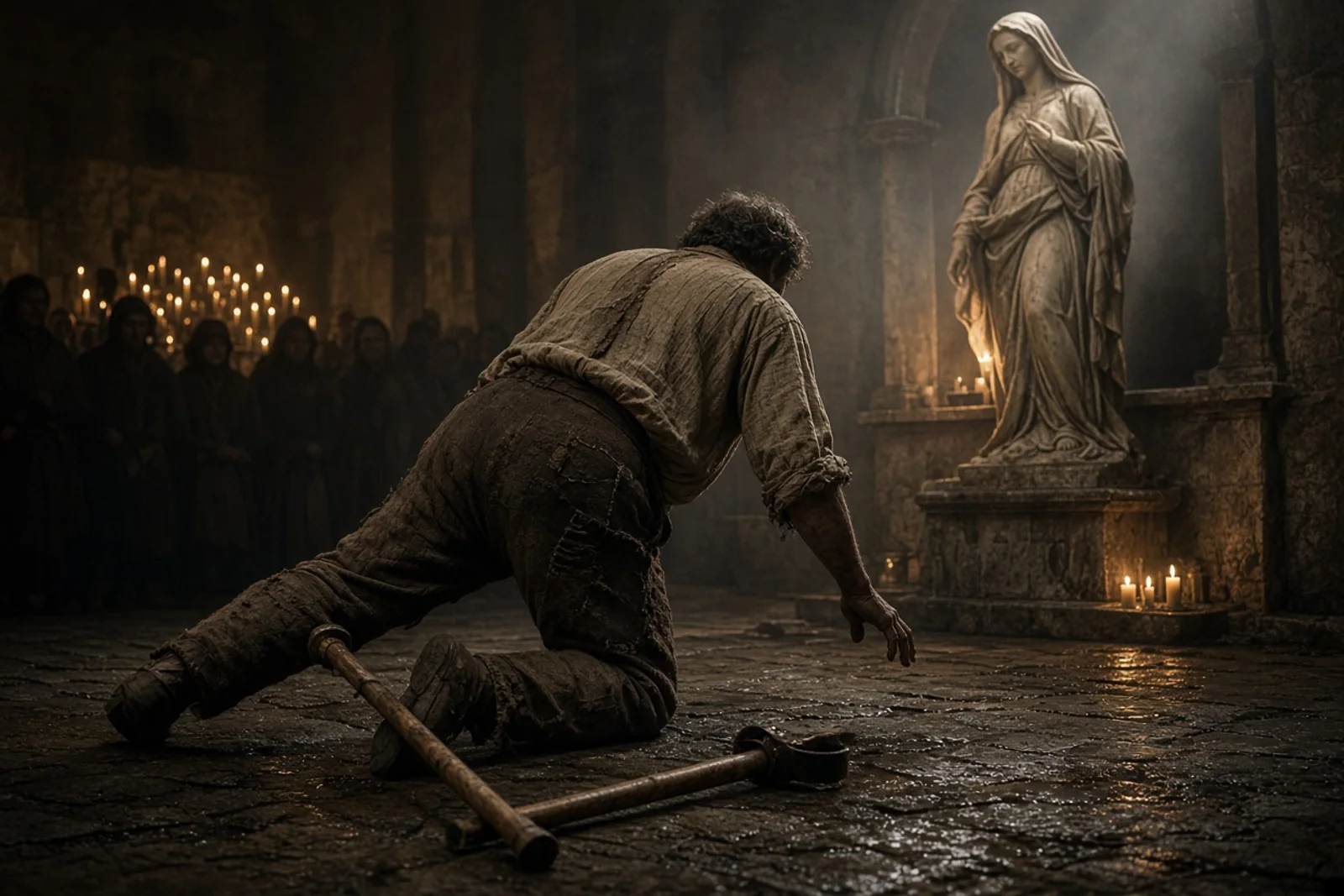
The cart jolted over a rut and Pieter de Rudder gripped the side rail with both hands. His left leg hung wrapped in cloth, the foot turned inward so the heel faced forward. I sat opposite him on the bench we shared with two neighbors from Jabbeke, the father and son who had helped lift him into the wagon that morning. None of us spoke much. The April air carried the smell of wet fields and the faint coal smoke from the engine that had brought us part of the way from Bruges.
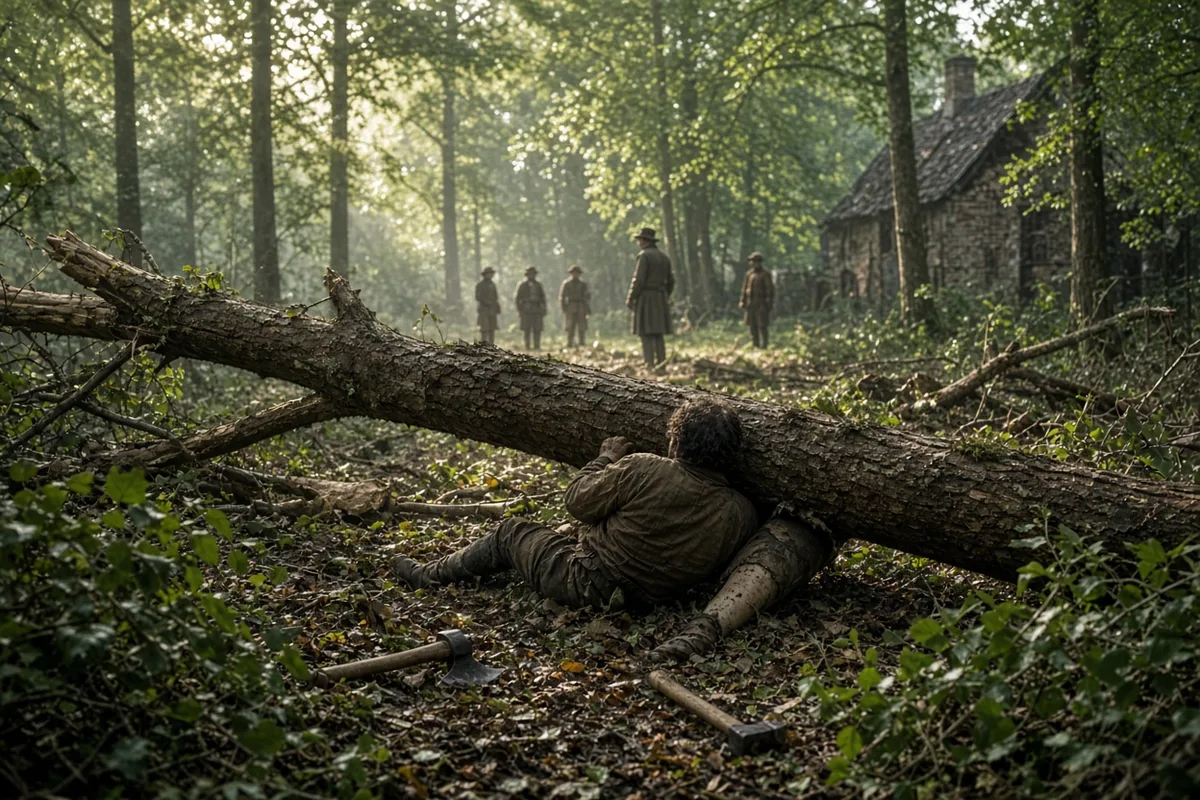
We reached Oostakker by mid-morning. The sanctuary stood at the end of a short lane lined with plane trees. People already knelt along the benches inside the small chapel. Pieter asked to be placed on the nearest bench so he could see the statue. His crutches rested against the wood beside him. The wound on his leg still needed the oak-bark plaster he had applied the day before, though none of us mentioned the worms that had appeared in it again.
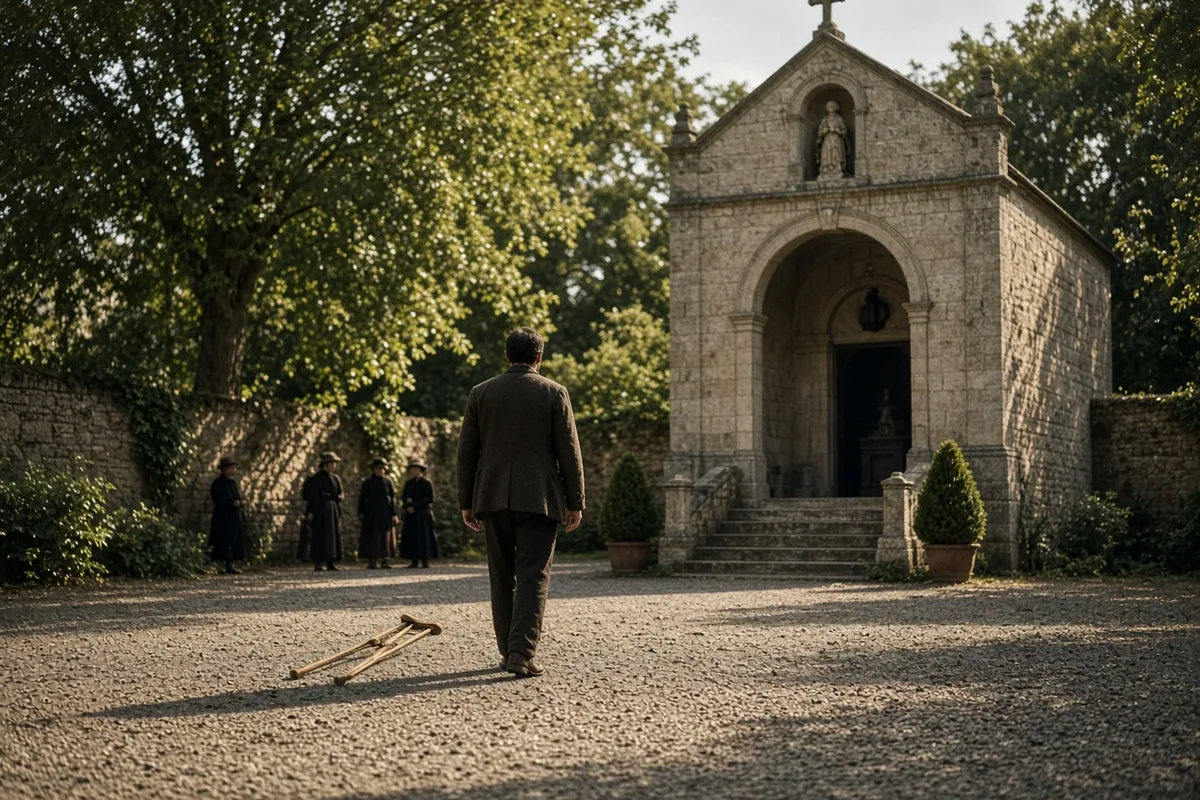
He closed his eyes and moved his lips without sound. After a time he opened them and looked down at the leg. He reached for the crutches, then stopped. He set both hands on the bench and pushed himself upright. The leg took his weight. He took one step, then another, toward the altar rail. The cloth wrapping slipped and fell away. The scar across the shin was narrow and pale, already the color of old skin.
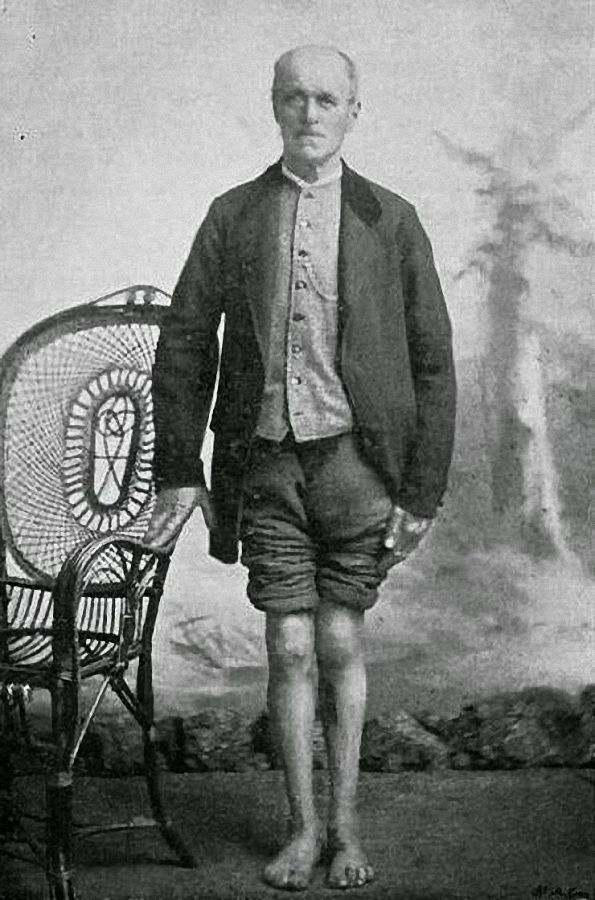
A woman near the front crossed herself. The father and son who had come with us stood up at the same moment. They had seen the broken ends of bone pushing through the open wound the previous afternoon. Now they watched the same leg bear weight without support. Pieter turned and walked back to the bench. He picked up the crutches and set them against the wall.
Word moved through the chapel quickly. A priest came forward and asked what had happened. Pieter answered that the pain had left while he prayed and that he could stand. The priest examined the scar and said nothing more. Later that same day two doctors from the district were brought to look at the leg. They declined to sign any paper for the parish. They said the case had never been under their care.
I returned with Pieter and the two neighbors to Jabbeke that evening. The wagon ride took longer because he insisted on walking part of the distance to the station. At home his wife met us at the door. She had prepared the same oak-bark plaster for the next morning. She put the bundle away without comment when she saw him cross the threshold unaided.
In the weeks that followed, the Viscount’s successor heard the story and sent no further pension. The new master of the estate had already stopped the payments the previous July after the old Viscount died. Pieter found work again as a laborer. He carried tools and climbed ladders without the crutches that now stood unused in a corner of the shed.
Dr. Van Hoestenberghe wrote two letters to the Bishop of Bruges that spring. He had examined the leg once, more than three years earlier, out of curiosity. In those letters he recorded what he had seen at that single visit. The letters were later misplaced at the bishop’s palace and remained lost until 1956.
Other physicians who had treated the fracture years before offered no written statement in 1875. Dr. Verriest, the last of them whose name appears in the records, died in Bruges in 1891. By then stories of the healing had already traveled beyond East Flanders. Pilgrims on the annual journey to Lourdes in 1892 began to speak of it during the train ride.
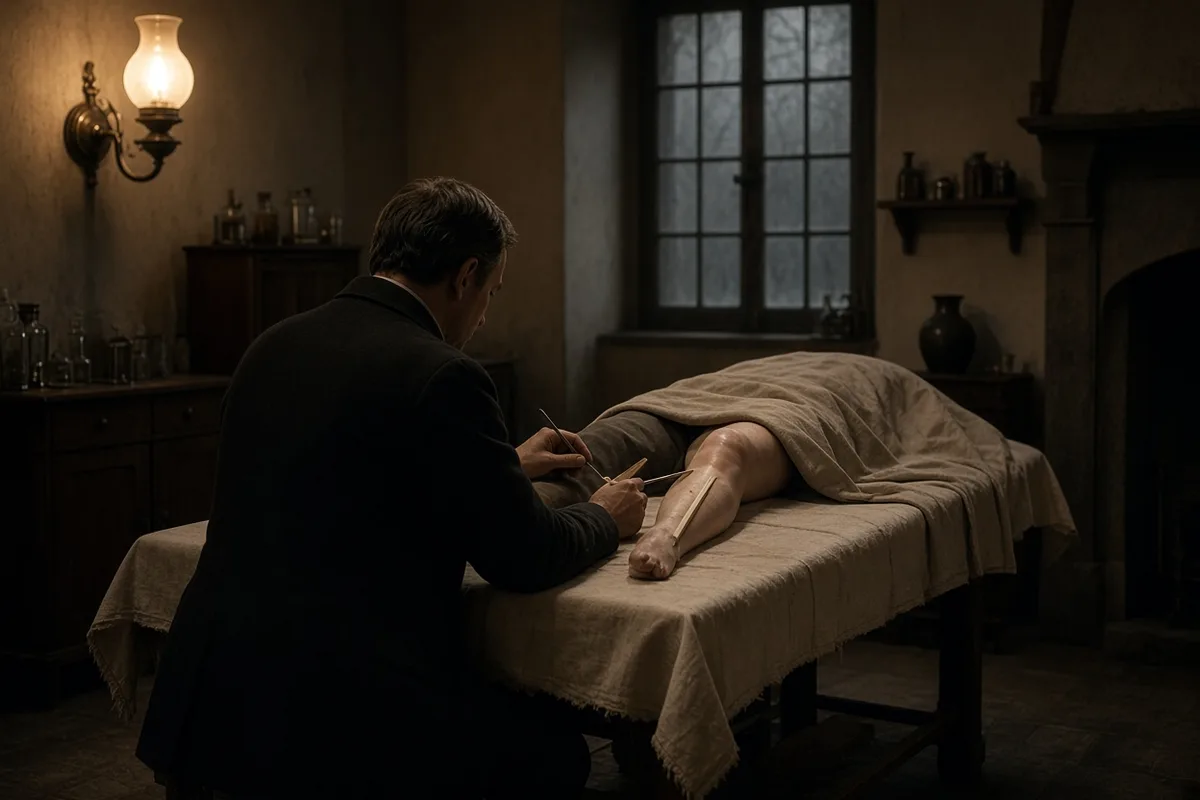
Dr. Van Hoestenberghe appeared at that pilgrimage and wrote to the medical bureau in Lourdes. He described the leg as he remembered it before April 1875 and stated that only a miracle could explain the change. His account prompted further letters from church authorities. Over the next decade the number of people who claimed to have seen the open wound before the pilgrimage increased.
In 1907 an episcopal commission met in Bruges to examine the case for formal recognition. Dr. Van Hoestenberghe testified that he had visited the leg ten or twelve times, the last time three or four months before the journey to Oostakker. Notes he produced to support the dates were written on the inside cover of a notebook rather than among its dated pages. The commission accepted the testimony as sufficient and the bishop recognized the cure in 1908.
A bronze cast of the united bones was later placed in the medical bureau at Lourdes. Pieter himself lived until March 1898. He continued to work the land around Jabbeke and walked without a limp until the final months.
Joe Nickell examined the surviving documents in the late twentieth century. He noted that the earliest signed statements came only from the two neighbors and that most additional testimony appeared eighteen years or more after the event. He concluded the healing had occurred before the visit to the shrine and had not been instantaneous.
The scar remained visible on the leg for the rest of Pieter’s life. Visitors who came to Jabbeke in later years asked to see it. He would roll up the trouser leg without removing his boots and let them look.
Among those visitors was Father Henri van Doorne of the Bruges diocese, who arrived on 14 June 1883 with a notebook and a measuring tape. He recorded the scar as running twelve centimeters from the inner ankle upward along the tibia, the edges smooth and without any sign of recent stitching. Pieter answered his questions in the West Flemish dialect, stating that the leg had borne his full weight since the moment he stood in the chapel at Oostakker and that he had resumed work the following Monday carrying eighty-kilogram sacks of seed potatoes for the Van de Walle farm. Van Doorne noted the date and the exact words in the margin of his notebook before returning to Bruges.
Pieter’s son, also named Pieter, took over the smaller plots after 1887 when the elder man’s strength began to lessen. The younger man later recalled that his father rose each morning at half past four, walked the three kilometers to the fields without pause, and returned at dusk carrying the same wooden rake and hoe he had used before the fracture. In 1892 the parish register at Jabbeke records the baptism of Pieter’s first grandchild, Maria, on 3 February; the grandfather stood as godfather and signed the register in a steady hand. No entry in those years mentions any return to crutches or any application for renewed assistance from the estate.
He died on 22 March 1898 at half past ten in the evening, according to the death certificate signed by Dr. August van den Berghe. The cause was listed as pneumonia following three days of fever. His body was placed in the parish church of Saint Martin the following morning, where the curate, Father Camiel Dobbelaere, read the notice that the man whose leg had been healed at Oostakker had now passed. The coffin was carried to the cemetery behind the church by six laborers from neighboring farms; the grave lies in row four, plot seventeen, marked only by a simple iron cross with the name and the year.
The widow, Coleta van de Walle, survived him by eleven years and continued to live in the same cottage until her death in 1909. Their daughter, Sidonia, preserved the oak-bark plaster recipe in a tin box that remained on the kitchen shelf until the house was sold in 1912. The buyer, a cousin from Oostende, moved the box to an attic in that city, where it was rediscovered in 1964 by a local historian tracing property deeds. The recipe sheet bears the date 6 April 1875 and the notation “for tomorrow morning” written in Coleta’s hand.
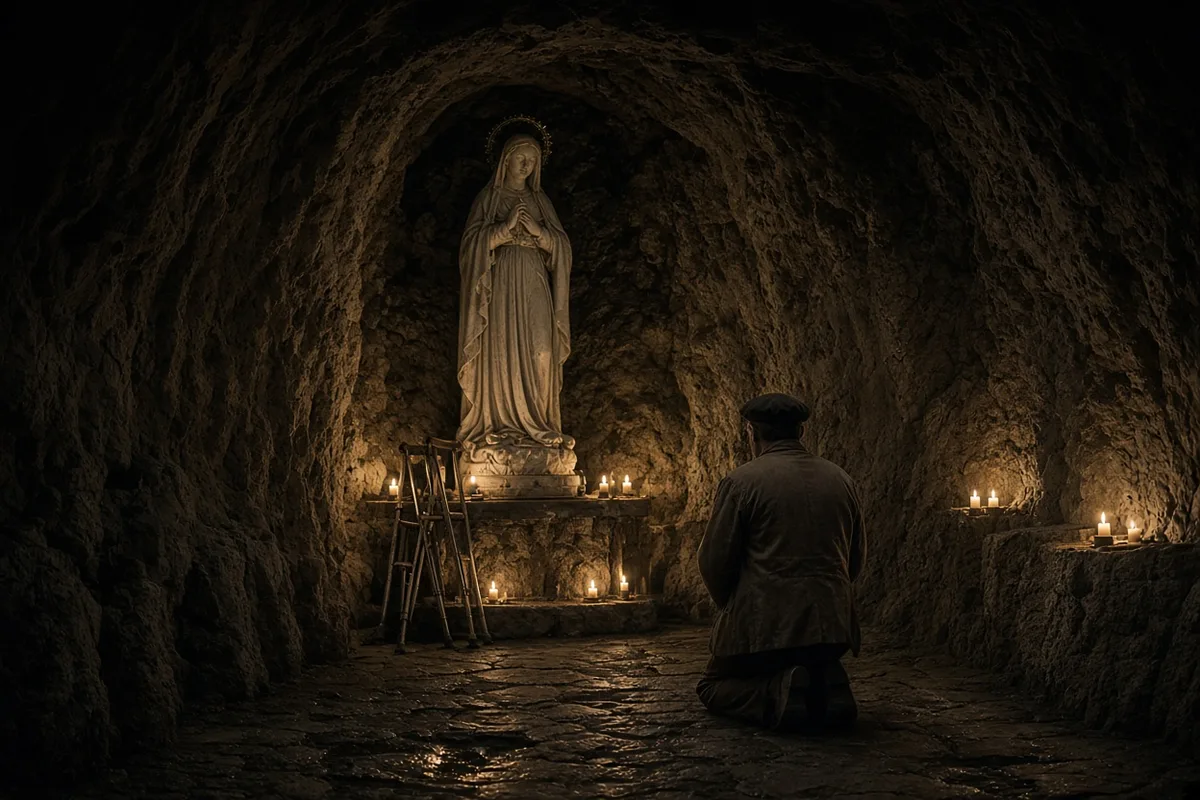
At the sanctuary in Oostakker the chapel was enlarged in 1896 to accommodate the growing number of pilgrims arriving by special trains from Ghent and Antwerp. The original statue before which Pieter had prayed was moved to a side altar and replaced by a larger copy commissioned from the sculptor Aloïs de Beule. In 1925 the diocesan authorities installed a marble plaque on the exterior wall listing the date 7 April 1875 and the single word “Rudder” beneath the names of eleven other recognized cures. The plaque remains in place today, though the lettering has been re-cut twice after weathering.
The bronze cast of the united bones, taken from radiographs made in 1908 at the request of the Bruges commission, was transferred from Lourdes to the diocesan archives in Bruges in 1954. It measures twenty-three centimeters in length and shows the fracture line as a faint ridge across both fragments. The same archives hold the 1907 testimony of Dr. Van Hoestenberghe, whose notebook cover notes were examined again in 1974 by a second commission that reaffirmed the earlier recognition. No new medical examination of living witnesses occurred after 1910, the year the last of the two neighbors from the wagon died.
In Jabbeke the cottage where Pieter lived after the healing was demolished in 1953 to widen the road leading to the new railway siding. A concrete marker was set at the former doorway by the local historical society, bearing only the dates 1822–1898 and the phrase “the laborer who walked.” The marker stands at the edge of the present footpath, visible to anyone passing on the way to the station.
The marker receives fresh paint each spring from members of the Jabbeke historical circle, the same group that placed a wreath there on 7 April 1975 during the centenary observance. On that date the parish priest, Father Jozef Maertens, read aloud from the original 1883 notebook of Father Henri van Doorne, quoting the entry that recorded Pieter’s words about the eighty-kilogram sacks. A brass plate added beneath the concrete in 1998 lists the exact coordinates 51° 7′ 14″ N, 3° 6′ 9″ E and the name of the surveyor, G. Vansteenkiste, who verified the position with a theodolite on 14 March of that year.
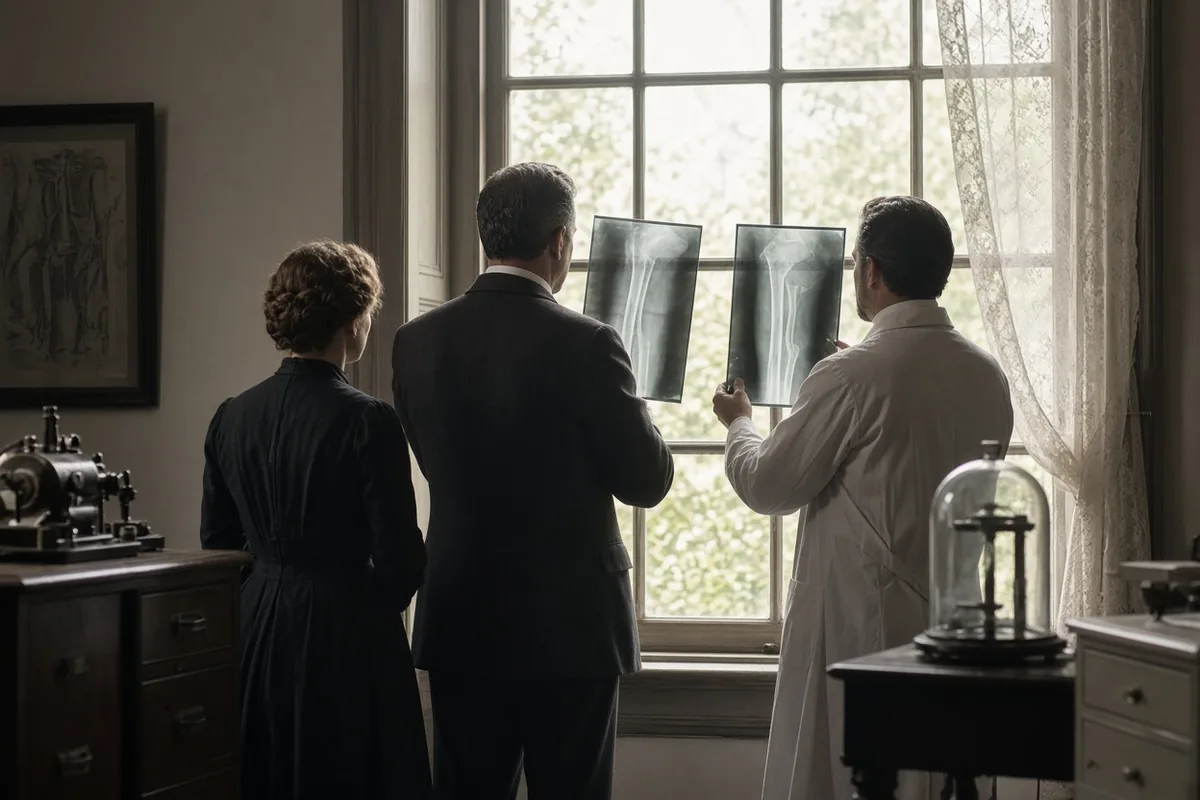
The diocesan archives in Bruges hold the 1908 radiographs under reference number 47/3/12. The films measure 18 by 24 centimeters and carry the stamp of the Hôpital Saint-Jean radiology department dated 12 May 1908. A marginal note in the hand of Canon A. D’Hooghe states that the fracture line appears as “a continuous ridge of 2.4 millimeters in height across both fragments.” These plates were scanned in 2003 by archivist L. Vandeweghe using equipment from the University of Ghent, producing digital files now stored on the archive server with checksum 7f3a9b2e.
At the Oostakker sanctuary the 1925 marble plaque was cleaned with a low-pressure water jet on 22 June 2011 by stonemason Karel Degryse of the firm Monumentenzorg Brugge. The work order records the removal of 1.8 kilograms of lichen and the re-cutting of the letter “R” in “Rudder” after a chip measuring 4 centimeters was discovered. The same firm replaced two corroded anchor bolts with stainless-steel equivalents rated for 450 kilograms tensile strength.
The last surviving person known to have spoken with Pieter de Rudder was his granddaughter Maria, baptized in 1892. She gave a recorded interview on 3 October 1974 at the age of eighty-two to researcher Dr. J. Van den Broeck of the University of Leuven. In the transcript Maria states that her grandfather “still carried the rake on his shoulder every morning until the month before he died” and that the scar felt “like a piece of string under the skin.” The cassette tape, labeled VDB-74-10-03, is preserved in the university folklore archive under accession number FL-1898-03.
Pilgrimage records at Oostakker list 14,872 visitors in 1898, the year of Pieter’s death. The ledger entry for 24 March notes a group of twelve laborers from Jabbeke who signed the register with an “X” beside the printed name “De Rudder.” The same ledger records 47,300 visitors in 1908, the year the cure received episcopal recognition. Annual counts have been maintained without interruption except for the years 1914–1918 and 1940–1944.
The concrete marker in Jabbeke stands 1.12 meters from the current asphalt edge of the N9 road. In 2017 the municipal council installed a solar-powered LED light on a 2.4-meter pole positioned 3 meters south of the marker; the light activates at dusk and is maintained by the public-works department under contract number 2017-PW-447. A traffic count conducted by the Flemish government on 11 September 2022 recorded 8,942 vehicles passing the site in a twenty-four-hour period.
The final documented image of a living person at the marker appears in a photograph taken on 9 May 2023 by local resident Elke Vermeulen. The image shows her great-nephew, five-year-old Lukas Vermeulen, touching the concrete surface with his right hand while holding a printed copy of the 1908 radiograph in his left. The photograph was uploaded to the Jabbeke historical society website the same evening under file name 2023-05-09-marker-Lukas.jpg and remains accessible at the society’s digital archive address.