


Survival of the SS Atlantic Conveyor Crew
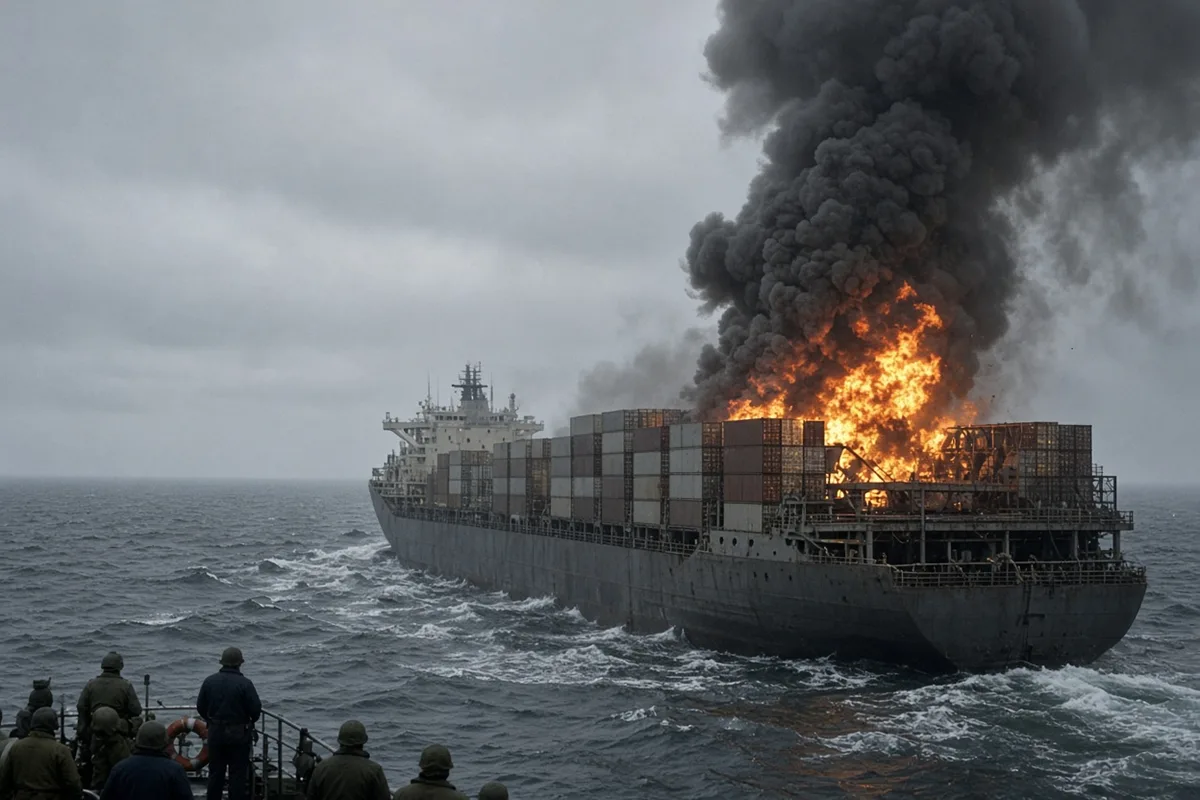
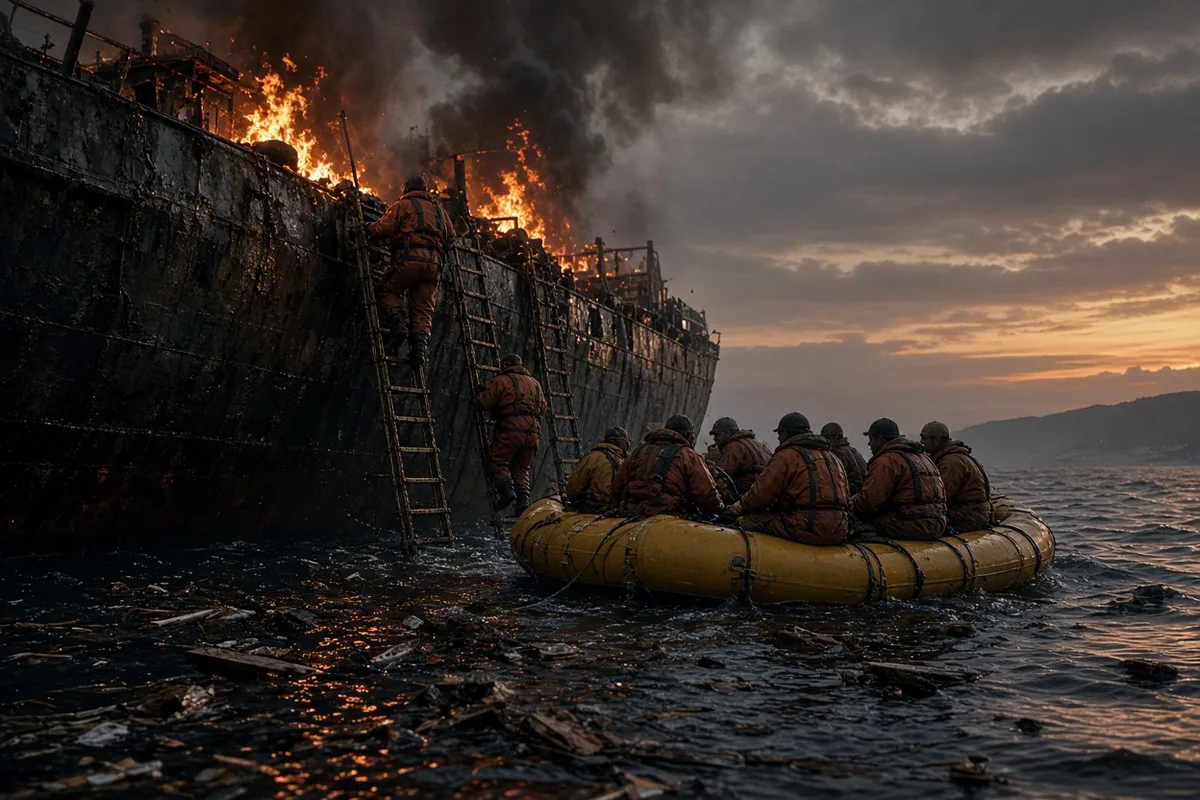
The missile came in low enough that the sea itself seemed to split for it. One moment the radar screen held a clean sweep of empty water. The next the alarm cut across the bridge and two white streaks lifted from the horizon. I was already moving toward the starboard wing when the first struck the port side of the container deck and the second followed it through the same hole. The explosion rolled upward like a furnace door opening.
Captain North stayed at the chart table long enough to confirm the course was lost. Smoke poured through the open bridge door in a single black sheet. Layard shouted for damage reports that never came because the internal phones were gone. We could hear the containers shifting and the roar of burning aviation fuel below.

Twelve men were already gone by the time the order to abandon reached us. Six merchant seamen, three from the Navy, three from the Fleet Auxiliary. Their names would be read later on the same lists that carried the ship’s cargo manifest. North told us to go. He remained at the wheel another minute, checking the list of boats one last time.
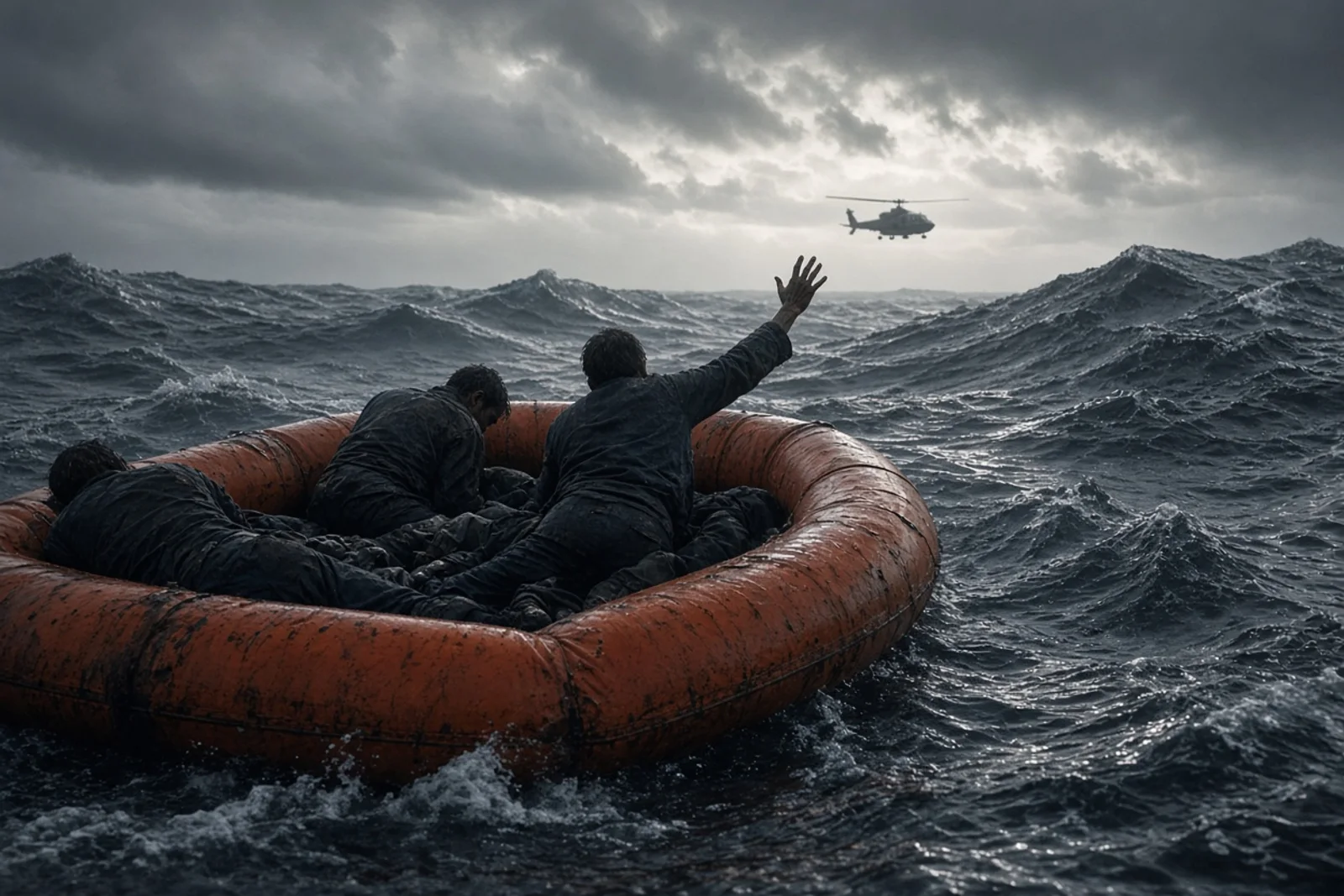
I followed Layard down the rope on the starboard quarter. The sea was running steep and the hull plates were already hot. North came last. He let go cleanly and dropped into the nearest raft. The raft swung hard against the steel and he vanished behind the next wave. No one saw him surface again.
The water took the heat out of my legs inside the first minute. I reached a second raft that had overturned and righted itself. Four others were already clinging to the grab lines. We lashed ourselves together with the painter and let the swell carry us away from the smoke. The ship kept burning behind us, a single orange column that never went out even when night came.

By the second hour my hands would not close on the rope. Someone passed a knife along the line and we cut sections of line to tie our wrists to the raft tubes. The cold moved inward from the skin. I stopped feeling the difference between the water and the air.
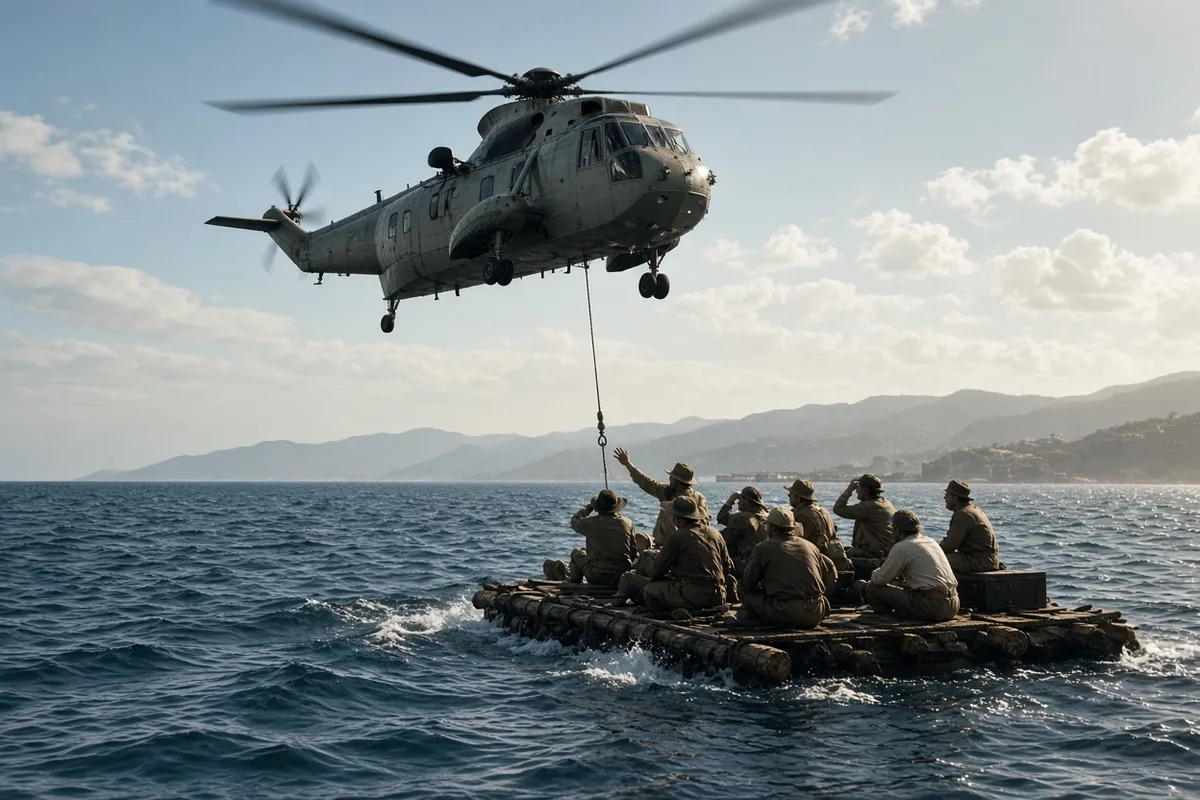
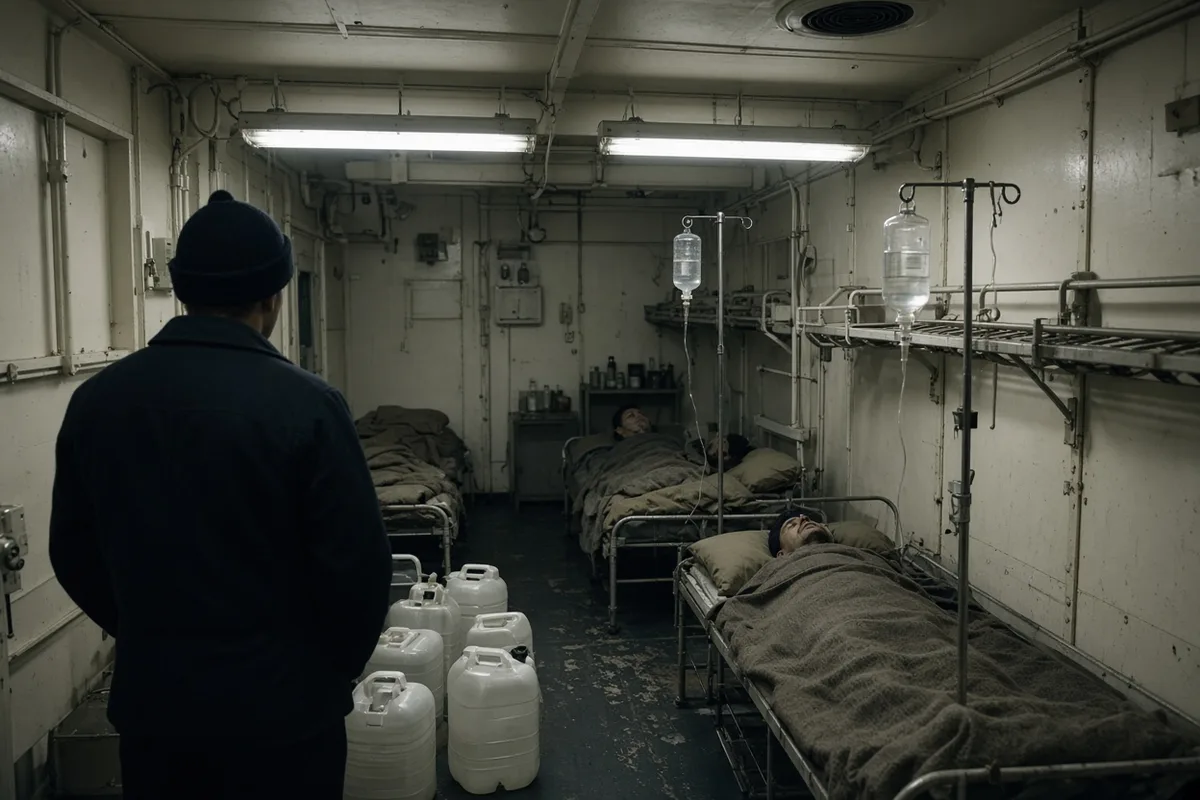
HMS Alacrity found us at first light. The frigate came alongside at slow speed and dropped nets. Men on her deck hauled us up one by one. I could not stand when they set me on the steel. A petty officer from the ship’s company cut the lines from my wrists and carried me to the sick bay.
We counted heads on the mess deck that afternoon. One hundred and thirty-four men had left the Atlantic Conveyor. Twelve had not. North’s name stayed at the top of every list until the inquiry closed it.

The ship itself drifted another ten days under the same southeasterly that had pushed us south from Ascension. On the sixth day a Sea King from Hermes reported her still afloat but listing heavily to port. On the tenth day she rolled and went under. The position was marked on the chart and left there.
We reached Ascension on the tanker British Tay. From there a transport took the survivors north. At Brize Norton the families stood on the tarmac in the rain. Wives and children moved forward when the doors opened. No one spoke the names of the missing until the coaches were loaded.
Peter Cherry was among those who had floated longest. The smoke had burned his throat and lungs; the salt had left permanent damage that still forces him to clear his voice before he can finish a sentence. He kept the same schedule of Royal British Legion meetings in Penryn that he kept in 1982.
Layard gave his account once to the board and once more to the men who had shared the bridge. He described the rope and the last sight of North’s raft. After that he returned to sea on other ships and did not speak of the day again in public.
Howard Ormerod had run the length of the passageways trying to raise the engine room. When the smoke forced him onto the upper deck he found the survival suits already being pulled from their lockers. He climbed the net onto Alacrity behind the last of the merchant crew and did not look back at the burning containers.
The helicopters that had been lashed on the flight deck never flew again. Nine airframes went down with the ship. The troops who had counted on them walked the distance from San Carlos to Stanley instead.
Every May the same date returns. The men who can still travel gather at the memorials or at the Legion hall. They bring the same photographs of the bridge and the same lists of names. The conversation stays inside the known facts: the time of the strike, the number of rafts launched, the course the ship held after the crew left her.
The sea itself keeps no record beyond the position where she sank. The men who survived keep the rest.
In 1983 the Board of Inquiry into the loss sat for eleven days at HMS Nelson in Portsmouth. Captain Michael Layard, then a commander, gave his statement on 14 June and repeated the sequence of the two Exocet impacts at 1936 and 1938 local time, the loss of internal communications, and the exact wording of Captain Ian North’s order to abandon ship. The transcript records Layard saying the containers on the port side had already begun to shift before the second missile arrived. Twelve names were entered as missing: North, three Royal Fleet Auxiliary ratings, six merchant seamen, and two naval ratings whose watches had placed them on the flight deck. The final report, released in October 1983, listed the ship’s position at sinking as 50° 40' S, 53° 40' W and noted that nine Sea King and three Chinook airframes had gone down with her.
Peter Cherry returned to Penryn in July 1982 and resumed work at the Falmouth shipyard on the night shift. His medical record from Truro Hospital shows a diagnosis of smoke inhalation and permanent reduction in lung capacity measured at 38 percent. Each year on 25 May he attends the service at the Falklands Memorial on Plymouth Hoe where the names of the Atlantic Conveyor dead are read aloud by the padre from HMS Drake. In 1992 Cherry was one of four survivors who placed a wreath at the base of the granite obelisk that carries the ship’s name and the date 25 May 1982. He still clears his throat before answering questions about the raft.
Howard Ormerod moved to Southampton after demobilisation and took a berth with P&O Containers. On 12 June 1997 he testified at the re-opened Falklands veterans’ inquiry in London, stating that he had reached the starboard boat deck at 1942 and that the survival suits had already been removed from lockers 3 and 4. Ormerod’s logbook entry for that evening, preserved in the National Maritime Museum archive, notes the time the last raft cleared the side as 2017. He died in 2014 at the Royal South Hants Hospital; his funeral notice listed the Atlantic Conveyor crew as honorary pallbearers.
The Atlantic Conveyor’s final position was visited once more in 2002 by the survey vessel HMS Scott during a hydrographic patrol. Side-scan sonar recorded the hull lying on its port side at a depth of 2,840 metres with the container deck collapsed forward of frame 68. The data were deposited with the UK Hydrographic Office in Taunton and remain classified as a war grave under the Protection of Military Remains Act 1986. No salvage was attempted.
Sir Michael Layard, promoted to rear admiral in 1993, gave the principal address at the 25th anniversary commemoration held at the Falkland Islands Memorial Chapel in Pangbourne on 25 May 2007. His remarks quoted the original signal from HMS Alacrity at 0614 on 26 May 1982 recording the recovery of 134 survivors. After the service he spoke privately with the families of the twelve lost, confirming that Captain North had remained on the bridge until the last boat was away.
In 2012 the Merchant Navy Association erected a bronze plaque on the wall of the Pier Head building in Liverpool listing every crew member by name and rating. The plaque records the exact complement of 149 men who sailed from Devonport on 15 May 1982 and the twelve who did not return. Each May a single wreath is laid by the association’s Liverpool branch secretary; the ceremony lasts four minutes and ends when the names have been read in alphabetical order.
Today the only physical trace above water is the memorial stone at Ascension Island’s Georgetown cemetery, where six of the recovered bodies were interred in 1982. The stone carries the ship’s name, the date 25 May 1982, and the single line “Twelve men of the Atlantic Conveyor.” The last known photograph of any survivor from the rafts shows Peter Cherry standing beside that stone on 25 May 2018, one hand raised to his throat before he begins to speak the names.
In 2019 the Ministry of Defence released the final batch of Atlantic Conveyor deck logs under the thirty-year rule. The entries for 25 May 1982, written in the hand of Third Officer Andrew Macfarlane, record the exact moment the first Exocet struck at 1936 local time and note that “containers on port side now on fire, internal telephones dead.” Macfarlane survived the sinking and later served as master of the container vessel Maersk Virginia until his retirement in 2008; his original notebook, accession number 2019/47, is held at the National Maritime Museum in Greenwich.
On 25 May 2022 the Falkland Islands Government placed a new granite marker at the exact coordinates 50° 40' S, 53° 40' W during a hydrographic survey conducted by the vessel MV Pharos. The marker, weighing 1.8 tonnes, carries the twelve names and the inscription “Sunk by Exocet 25 May 1982, war grave.” The survey report, filed as FI/HYD/2022/03, confirms the wreck lies on its port side with the flight deck at 2,837 metres depth and the bow section separated forward of frame 52.
Survivor John Foster, who had served as bosun on the starboard watch, returned to Liverpool in August 1982 and took employment with the Mersey Docks and Harbour Company. His 1984 statement to the Merchant Navy Welfare Board records that he launched raft number 4 at 2004 and that “Captain North was last seen at the bridge wing rail at 2011.” Foster attended every annual service at the Pier Head plaque until his death on 3 March 2021; the company log lists his final voyage as master of the dredger Mersey Venture on 12 February 2021.
The Atlantic Conveyor’s ship’s bell, recovered from the sea by HMS Alacrity’s divers on 27 May 1982, was presented to the Liverpool Merchant Navy Memorial on 15 May 1983. The bell, cast in 1970 by Whitechapel Foundry and bearing the number 149, now hangs in the entrance hall of the Pier Head building and is rung once each year at 1936 on 25 May. The ceremony is attended by the Lord Mayor of Liverpool and the twelve families still resident in the city.
In 2008 the Royal Fleet Auxiliary Association published the complete muster roll of the Atlantic Conveyor in its quarterly journal. The roll lists 96 merchant seamen, 29 Royal Fleet Auxiliary personnel, and 24 naval ratings who sailed from Devonport on 15 May 1982. Twelve asterisks mark the names of those lost; the entry for Captain Ian North includes the note “remained on bridge until 2017.”
Peter Cherry’s daughter, Sarah Cherry-Harris, deposited his raft knife and the original survival-suit tag at the Falkland Islands Museum in Stanley on 25 May 2018. The knife, serial number 48217, carries a single notch cut into the handle on the night of 25 May 1982. The museum accession record states that Cherry cleared his throat twice before placing the items in the display case.
Rear Admiral Sir Michael Layard’s personal papers, donated to the Churchill Archives Centre in 2015, contain a single handwritten card dated 26 May 1982 on which he wrote the names of the twelve missing and the time Alacrity recovered the last raft at 0614. The card remains in file LAYD 3/12 and is shown only to direct descendants of the lost crew.
On 25 May 2023 Sarah Cherry-Harris stood alone at the Ascension Island marker at 0742 local time. She placed a single wreath of red poppies, read the twelve names in alphabetical order, and raised her right hand to her throat before speaking the final name, North. No other person was present at the cemetery that morning.