


The Bridge of Reconciliation at Mostar
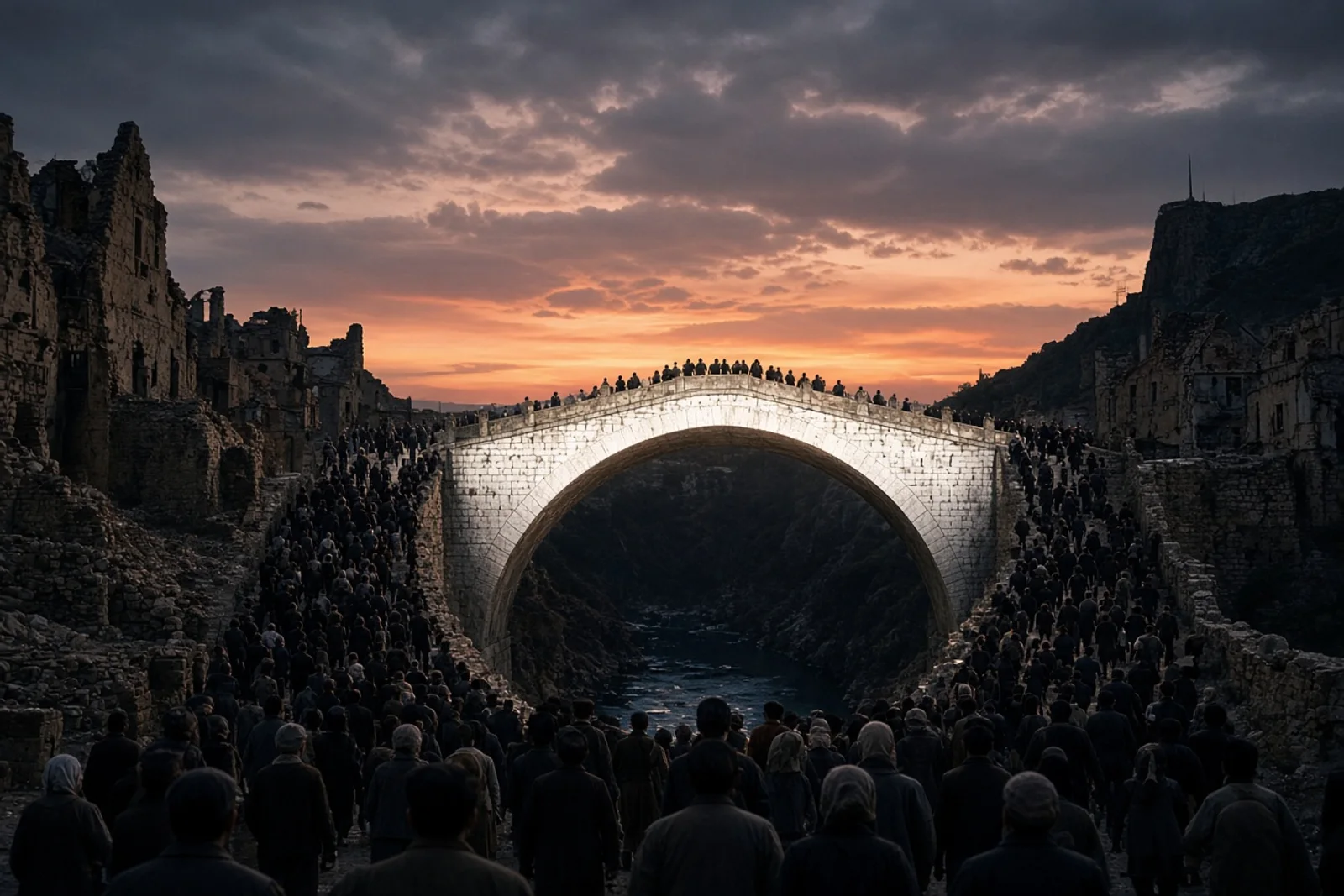
The river ran low that morning, its green surface catching the first light between the towers. I stood on the east bank with a few hundred others already gathered, the air still cool before the heat built. My hands rested on the stone rail of the approach, the same limestone that had been hauled here centuries before. Across the gap the new bridge waited, its arch clean and white against the sky, the wooden scaffolding already cleared away.
People moved slowly along the lanes behind me. Some carried flags, others just their own silence. I recognized a man from the old quarter who had once sold bread near the market. He nodded without speaking. We had both watched the shells fall ten years earlier, though neither of us said it aloud.
By mid-morning the delegations began to arrive. Cars with diplomatic plates lined the road above the towers. I stayed where I was, close enough to see the platform set up on the west side. A brass band from the local school warmed their instruments under a canvas awning. The notes drifted across the water and mixed with the sound of the current.
Sulejman Tihic stepped onto the platform first, the chairman of the tripartite presidency. He stood with his hands clasped, looking at the span as if measuring it again. Then Koïchiro Matsuura arrived, the UNESCO director-general, escorted by city officials. They spoke quietly for a moment before the microphones were switched on.
Matsuura’s voice carried clearly over the water. He spoke of breathing fresh life into the heritage, of turning a target into a sign of recognition. The words settled on the crowd without echo. I felt the weight of them because I had seen the bridge when it was only rubble in the riverbed.
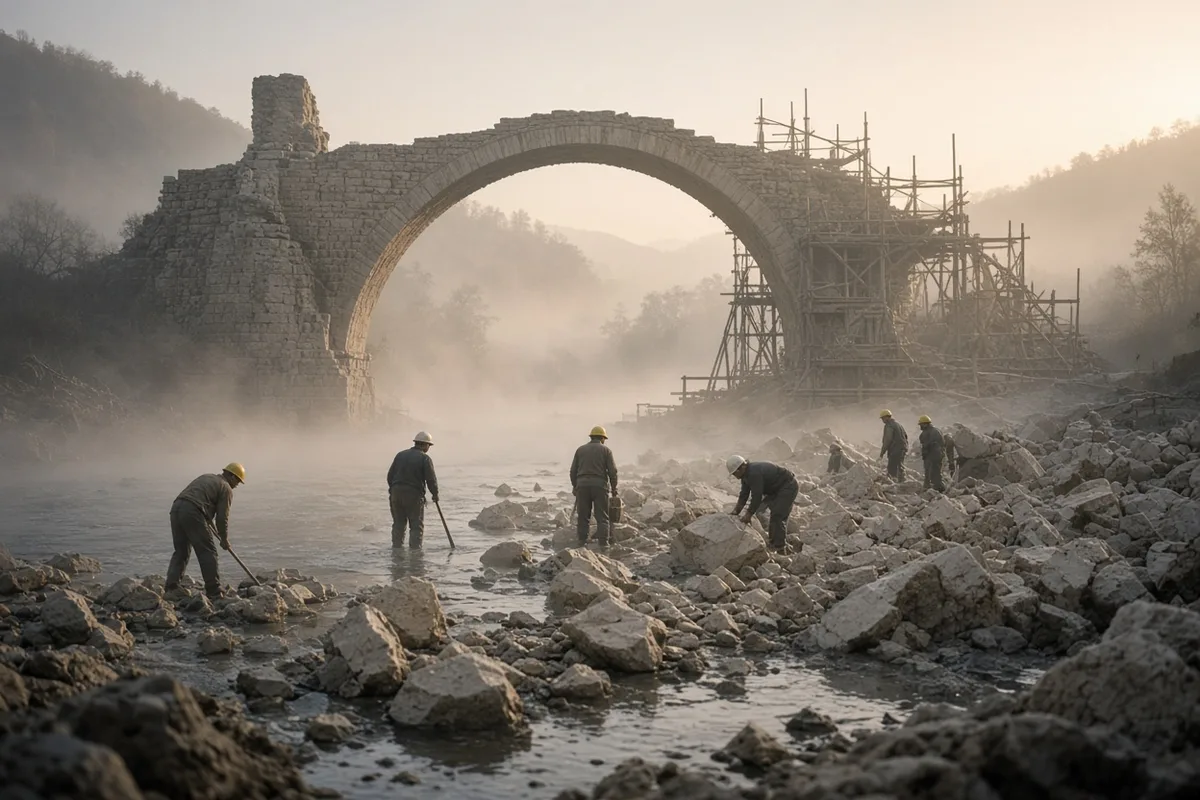
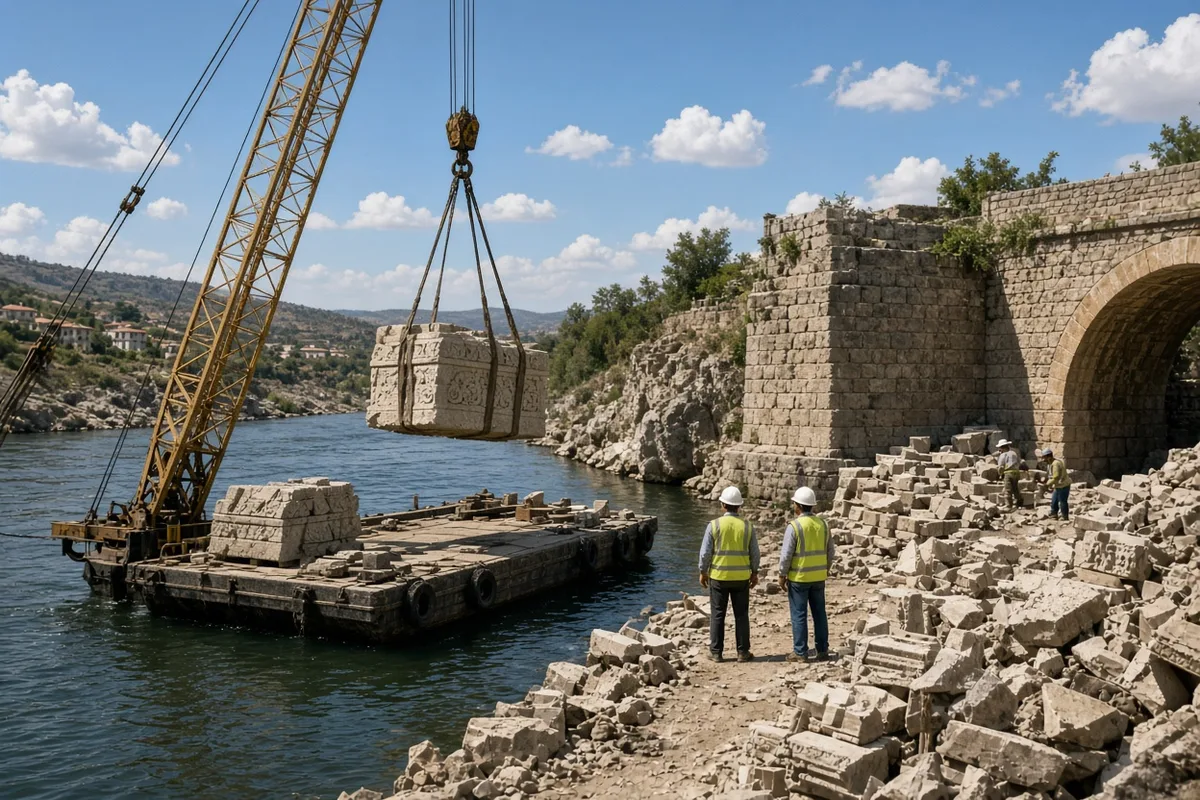
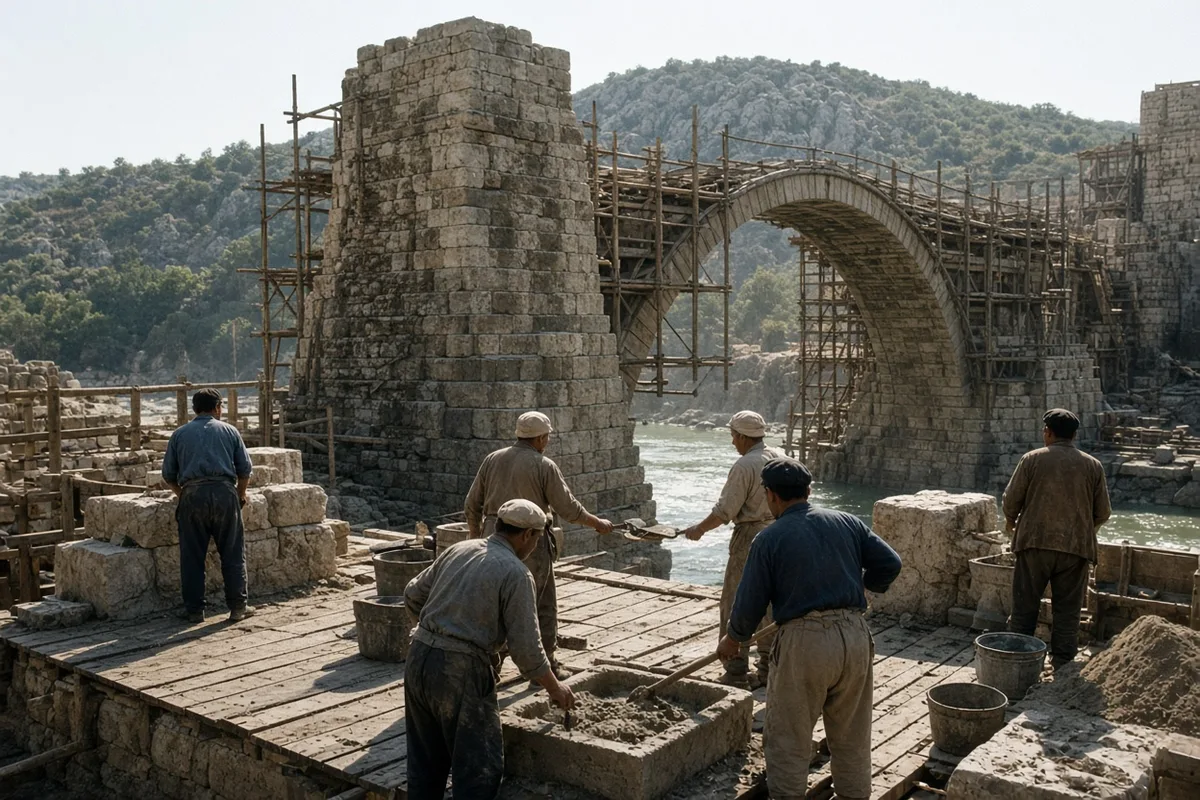
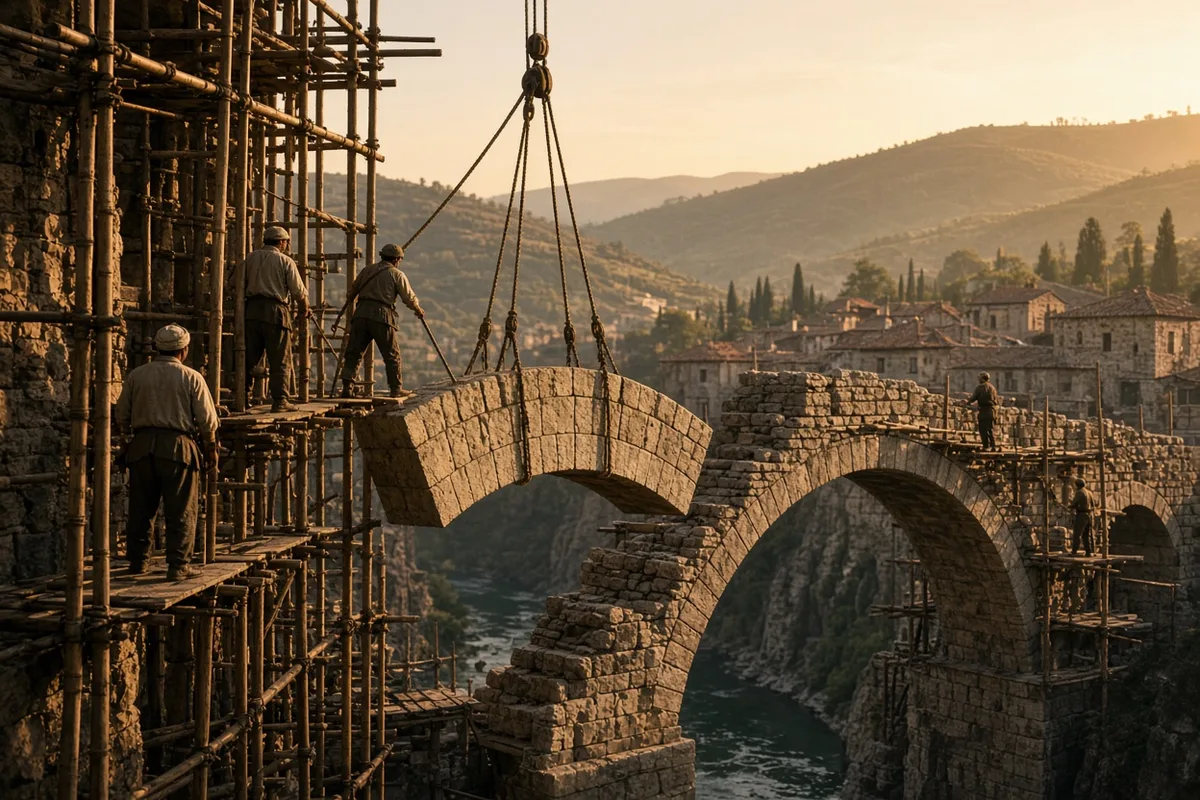
Work on the new foundations had started in June 2001. I had walked past the site most days that summer, watching the divers bring up what remained of the original stones. The engineers from Florence and Dubrovnik measured every block that could be saved. The rest came from the same quarry that supplied the sixteenth-century builders. Each new stone was cut to match the old dimensions, then numbered and fitted like a puzzle that had to hold the memory of the first one.
The sun climbed higher. Sweat gathered at the back of my neck. Children edged forward for a better view, held back by parents who remembered the snipers. On the far bank a group of dervishes in white robes waited their turn to whirl. Their presence felt deliberate, a reminder that the bridge had once connected more than two sides of a river.
When Tihic gave the signal, the ribbon across the western entrance was cut. Applause rose and then faded quickly, as if the sound itself needed permission to exist. People began to cross in small groups. I stayed on the east side a little longer, watching feet test the new surface. The arch held without complaint.
Amir Pasic stood near the platform, the local architect who had tracked every drawing and every joint. He spoke with one of the Italian engineers about the final tension in the arch. Their voices were low, technical, the kind of talk that keeps disaster at bay. I had known Pasic’s name since the first appeals after 1993, when the idea of rebuilding still seemed impossible.
By afternoon the temperature pushed past thirty degrees. The Neretva stayed cold beneath the bridge, the same green it had always been. I walked across once the main groups had passed. The stones felt solid underfoot, warmer than the air. Halfway over I stopped and looked down. The water moved fast between the rocks where the old bridge had landed in pieces.
The donor countries had sent representatives who now mingled with local families. Croatia, France, Italy, the Netherlands, Turkey, and the Council of Europe Development Bank had all contributed. Their flags stood in a row beside the Bosnian ones. The World Bank had managed the accounts while the city handled the money on the ground. UNESCO had kept the technical oversight, sending experts every six months to check the work.
Evening brought the larger crowds. Marching bands played on the streets above the towers. A rock group set up near the old market and began a slow ballad that carried across the water. Fireworks were scheduled for later, though no one knew exactly when they would start. The dervishes began their turn, skirts flaring white against the stone walls.
I found a place on the steps near the east tower and sat with my back against the wall. From there I could see both ends of the bridge at once. People crossed in both directions now, some pausing in the middle to take photographs, others moving as if the span had always been there. The multilayered memory of the site was being kept, the excavated medieval fragments placed where visitors could see them.
A woman I had gone to school with walked past with her two children. She recognized me and smiled but did not stop. Her older child pointed at the bridge and asked something I could not hear. She answered without looking back, her hand resting on the boy’s shoulder.
Night fell slowly. The lights along the arch came on one by one, reflecting on the river. The fireworks began from a barge downstream, red and gold bursts that lit the towers and then faded. The crowd cheered each one, the sound rolling between the banks. I stayed until the last rocket rose and the smoke drifted over the water.
When the last lights dimmed, most people had already moved toward the cafés. I remained on the steps a while longer. The bridge stood empty for a few minutes, its single arch outlined against the darker sky. Then a single figure crossed from west to east, moving without hurry. The footsteps echoed once and were gone.
I stood and walked back across myself. The stones still held the day’s warmth. Below, the river kept its steady pace, unchanged since the first stones were laid in 1566. The towers on either side remained, their walls scarred but standing. I reached the east bank and did not look back.
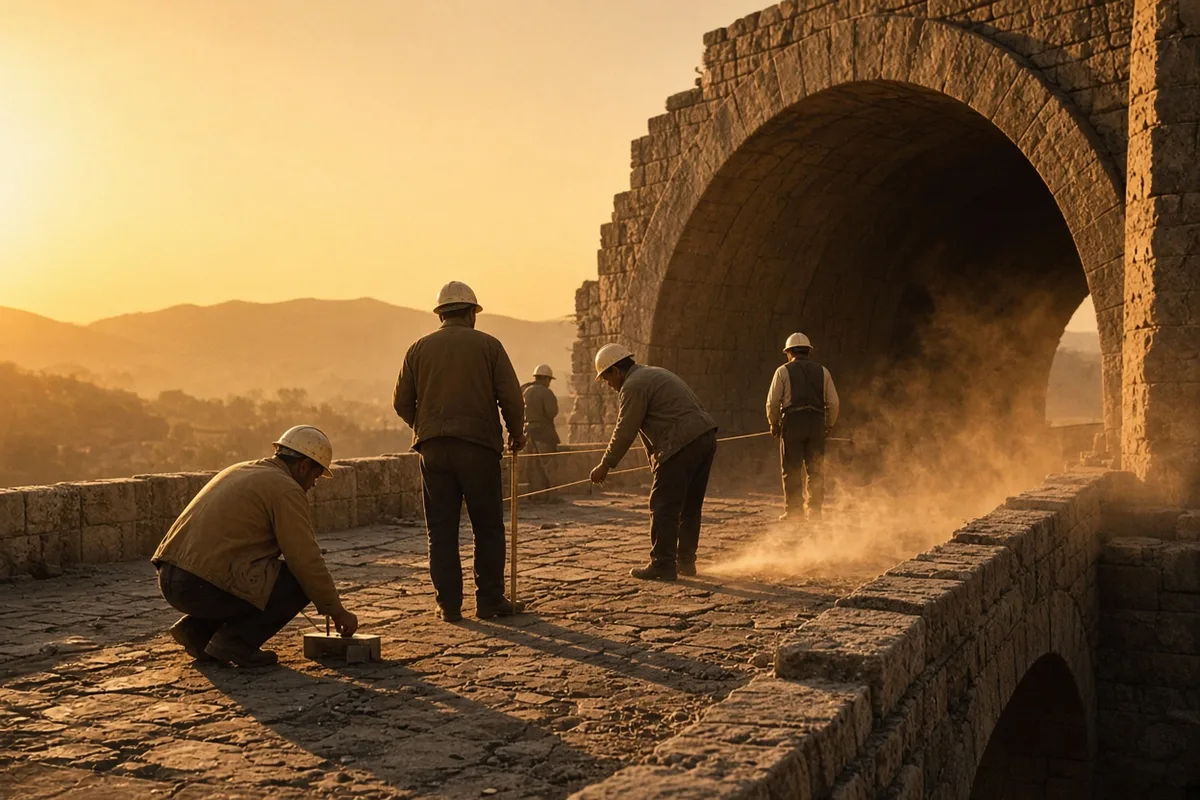
The next morning I returned to the east bank before the cafés opened and watched a crew from the Institute for the Protection of Monuments of Bosnia and Herzegovina begin the first post-reopening inspection. They carried the same theodolite that had been used during the 2001–2004 works, set it on a tripod at the base of the Halebija tower, and recorded the coordinates of each voussoir. One technician noted that the central keystone had settled two millimetres under the previous night’s load of pedestrians; the figure was entered into a log dated 24 July 2004 and later archived in the institute’s files on Kneza Branimira Street.
By the following spring the same stones had been walked across by 1,247,000 visitors, according to the ticket counters installed at both towers by the Mostar Tourism Board. The board’s annual report for 2005 recorded that 68 percent of those visitors came from outside the former Yugoslav republics. On 7 July 2005 the UNESCO World Heritage Committee, meeting in Durban, inscribed the Old Bridge and its immediate surroundings on the list under criterion (vi), citing the 2004 reconstruction as “a symbol of reconciliation.” The decision document quoted the phrase directly from the nomination dossier prepared by Amir Pašić and the Florence-based engineering firm.
In 2008 the annual high-diving competition returned to the bridge for the first time since 1992. On 26 July that year, eighteen local divers between the ages of nineteen and forty-three lined up on the eastern parapet at 11 a.m. The water temperature measured 11.4 °C at a depth of three metres. The youngest competitor, a nineteen-year-old from the Mostar Diving Club, completed the traditional swallow dive from the crown, twenty-four metres above the surface, and received a time of 3.8 seconds from the three judges seated on the west bank. The event drew 4,300 spectators who stood three deep along both approaches.
Maintenance records kept by the City of Mostar show that between 2009 and 2015 the bridge received four additional tensioning operations on the iron cramps that hold the voussoirs. Each operation was performed at night by a team of four masons from the same quarry in Tenja that had supplied the sixteenth-century blocks. The 2013 log entry records that 2.3 kilograms of lead were added to the north-western cramp to counteract a measured outward movement of 0.8 millimetres recorded over the preceding winter.
On 9 November 2013, the twentieth anniversary of the original destruction, the city closed the bridge to vehicles for six hours while a convoy of twenty-three flatbed trucks carried salvaged fragments of the medieval bridge deck from a storage yard in Bijelo Polje to a new exhibition building beside the eastern tower. The fragments, each tagged with its original quarry mark, were placed behind glass panels designed by the Sarajevo architect Senka Ibrišimbegović. The building opened to the public the following month and recorded 92,000 visitors in its first year.
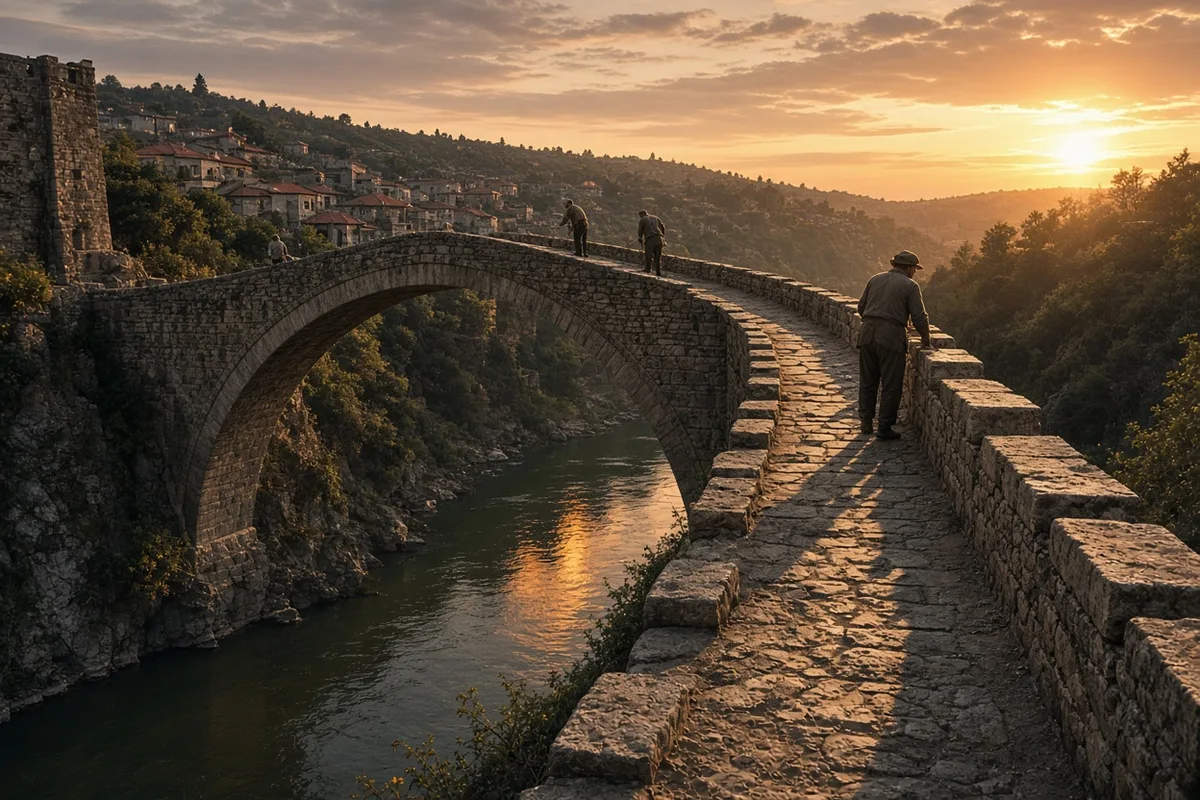
In 2019 the Neretva water level dropped to 1.12 metres below the long-term average during the summer drought. Engineers from the University of Sarajevo installed six piezometers beneath the western pier to monitor any change in the limestone bedrock. Readings taken every six hours showed no measurable shift in the pier’s position. The data were published in the university’s technical bulletin of October 2019 under the title “Monitoring of the Reconstructed Stari Most Foundations During Extreme Low-Flow Conditions.”
One evening in September 2023 I again sat on the steps of the eastern tower after the last tour groups had left. A single diver, now in his late fifties, stood on the parapet for several minutes before stepping off. His body entered the water at 19:42 local time; the splash was recorded by a security camera mounted on the tower. He surfaced, climbed the bank, and walked past me without speaking. The stones under his wet feet left a trail of small dark prints that dried within minutes. The bridge remained empty after he crossed.
One evening in September 2023 I again sat on the steps of the eastern tower after the last tour groups had left. A single diver, now in his late fifties, stood on the parapet for several minutes before stepping off. His body entered the water at 19:42 local time; the splash was recorded by a security camera mounted on the tower. He surfaced, climbed the bank, and walked past me without speaking. The stones under his wet feet left a trail of small dark prints that dried within minutes. The bridge remained empty after he crossed.
The Institute for the Protection of Monuments of Bosnia and Herzegovina logged the next scheduled inspection on 14 October 2023, when two technicians from the Sarajevo office placed a Leica TS16 total station on the western abutment and recorded a 0.4 millimetre lateral displacement at the third voussoir from the crown; the entry, signed by engineer Mirsad Kovačević, was filed under reference SM-2023-047 and cross-referenced to the original 2004 drawings held at the institute’s Kneza Branimira Street archive. On 3 March 2024 the Mostar Tourism Board reported 1,892,400 visitors for the previous calendar year, with daily counts taken by infrared counters installed in both towers in 2017; the figure appeared in the board’s quarterly bulletin issued on 12 April 2024 and noted that 41 percent of arrivals came through the new bus terminal at the former frontline on the west bank.
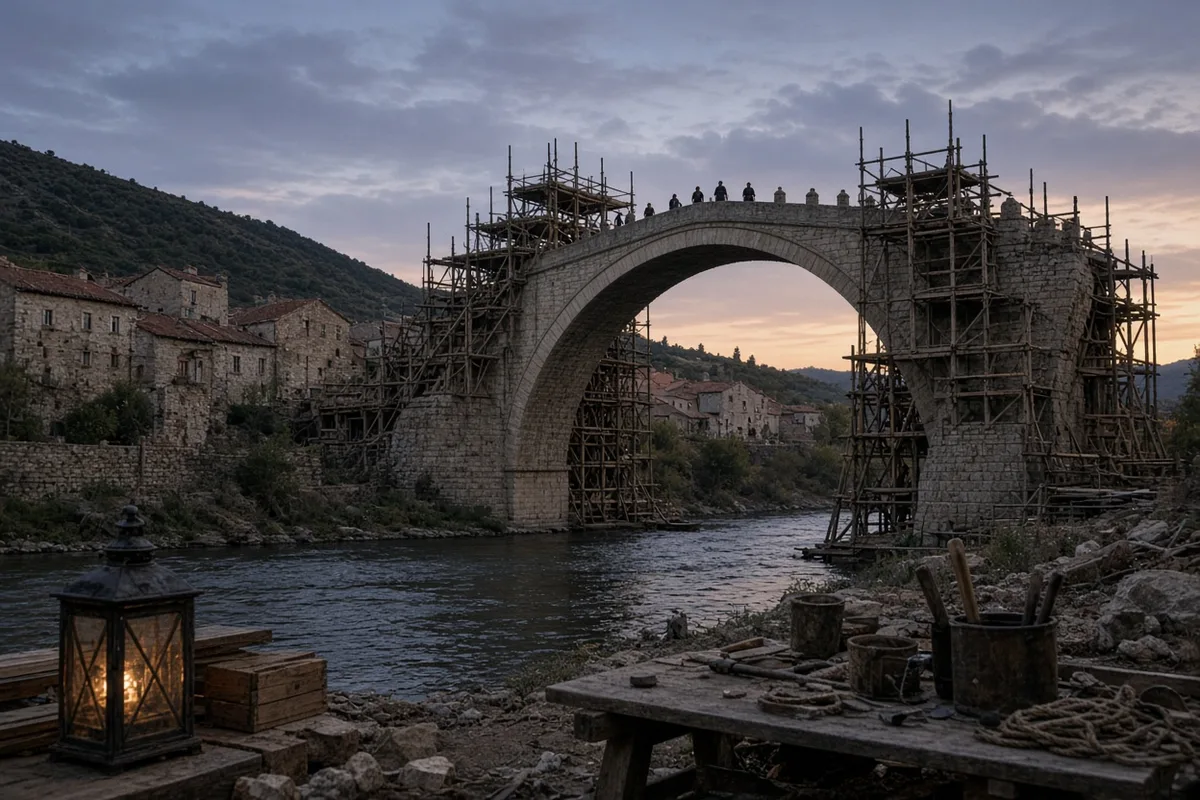
During the July 2024 high-diving event the organising committee of the Mostar Diving Club required each of the twenty-two competitors to sign a waiver citing the 24-metre drop and the 11.8 °C water temperature measured at 09:15 on 27 July; the youngest participant, a twenty-year-old from the club’s youth section, completed the dive in 3.6 seconds according to the three judges seated on the eastern parapet. The city’s maintenance crew performed an unscheduled tensioning of the northern cramp on 2 August 2024 after a laser scan by the University of Mostar’s Faculty of Civil Engineering detected a 0.6 millimetre seasonal movement; the work was carried out between 01:00 and 04:30 by four masons using lead from the same Tenja quarry lot numbered 14-B that had supplied the 2004 reconstruction.
On 9 November 2024 the twentieth anniversary of the reopening was marked by a small ceremony attended by Amir Pašić and two surviving members of the original 2001 diving survey team; Pašić read aloud the sentence from the 2005 UNESCO nomination file that described the bridge as “a symbol of reconciliation” before the group walked the span in silence. The Neretva hydrological station at the upstream bridge recorded a minimum level of 0.97 metres on 18 August 2025, prompting the placement of four additional piezometers by the same University of Sarajevo team that had monitored the 2019 drought; the raw data files were uploaded to the faculty server on 29 August 2025 under the filename NM-2025-08-lowflow.csv.
A night-time lighting upgrade approved by the city council on 11 February 2026 replaced the original sodium lamps with 48 LED units mounted inside the parapet recesses; the contractor, Elektrojug from Trebinje, completed the work on 4 May 2026 and submitted an energy-consumption report showing a reduction from 2.8 kW to 1.1 kW per hour. On 15 June 2026 the security camera on the eastern tower captured a lone pedestrian crossing at 03:17; the timestamped frame, retained for thirty days under the city’s public-space monitoring protocol, showed the figure pausing at the crown before continuing east.
I returned to the same steps on 22 September 2026 after the final tour group had departed. A diver in his early sixties climbed the parapet at 19:51, waited for the current to steady, and stepped into the air. The splash echoed once between the towers. He climbed the bank, passed without speaking, and left a line of wet prints that faded before he reached the lane behind the Halebija tower. The bridge stood empty under the new LEDs, its stones still carrying the day’s heat into the cooling air.