


The Incorrupt Body of Bernadette Soubirous
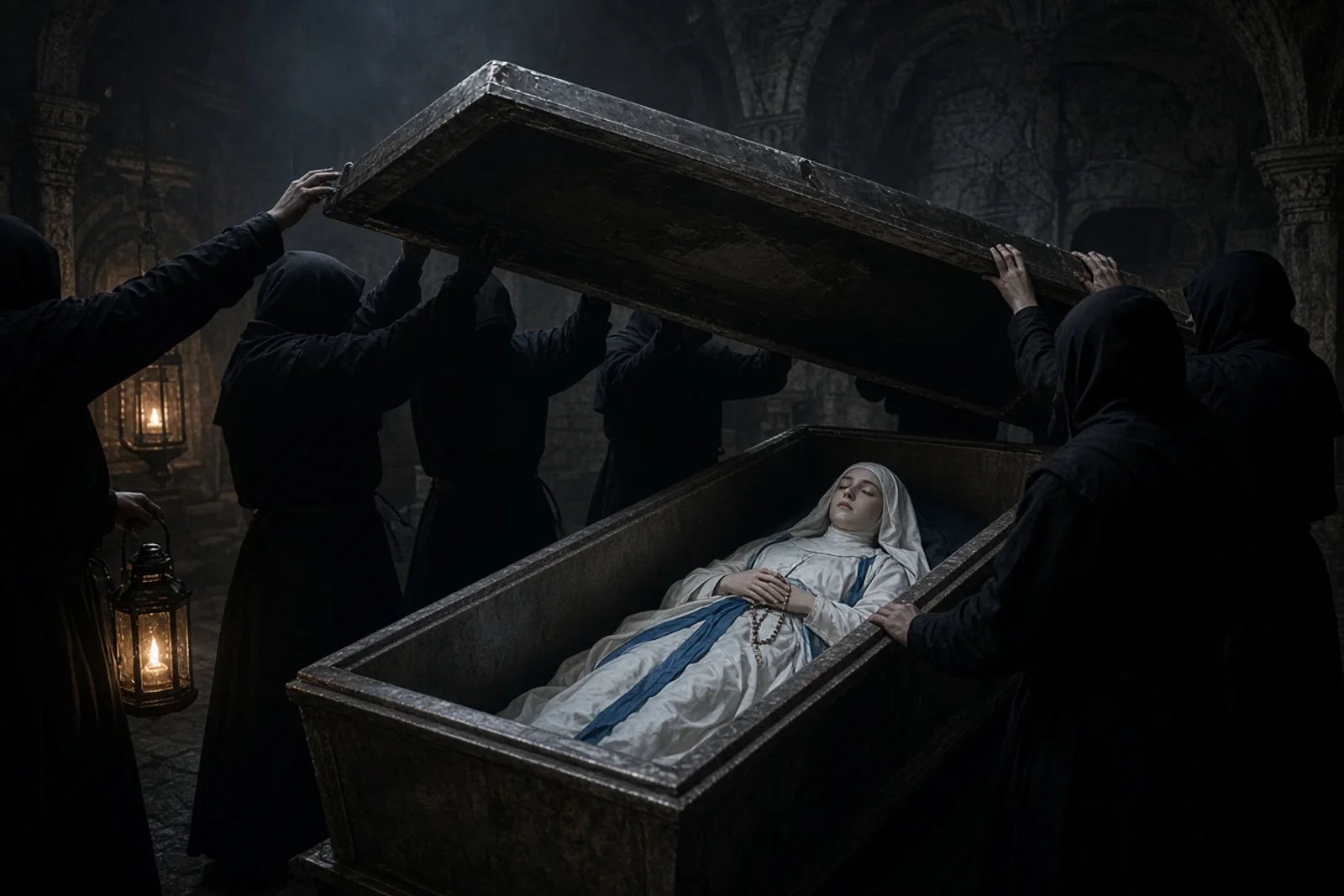
I knelt by the armchair in the Sainte Croix Infirmary as Bernadette’s breathing thinned to nothing. The fire had burned low, and her feet rested on the stool where they had been placed hours earlier. At a quarter past three she was gone.
The room stayed quiet except for the rustle of habits as the sisters crossed themselves. I helped straighten the sheet across her lap. Her face had already settled into the lines the pain had carved there for years.
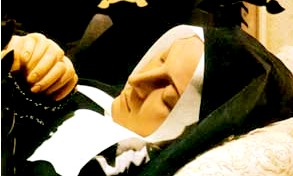
Civil permission let the body remain on view through the nineteenth. People filed past the open door of the infirmary, some stopping only long enough to look, others lingering. On the twentieth the double coffin of oak and lead was brought in. Inspector Devraine and the two constables, Saget and Moyen, watched the seals set and signed the record.
We carried the coffin down the stairs on the thirtieth of May and placed it in the vault beneath Saint Joseph’s chapel. The air inside the crypt was cool and still. The bishop’s representative read the final prayers, and the stone was lowered.
Thirty years later the masons returned. I stood at the back of the chapel when the tribunal entered at half past eight on the twenty-second of September. The Gospels lay open on the table near the sanctuary rail. Bishop Gauthey took his place, and the mayor and his deputy stood ready to certify each step.

The stones came up one by one. The coffin was lifted onto trestles. When the lead lining was cut, the only sound was the scrape of the tool. No odor rose from the opening.
Doctors David and Jourdan leaned forward first. The habit was damp but whole. Bernadette’s face was turned slightly left, the skin drawn tight over the bones. The eyelids lay closed. Her hands still gripped the rosary, though the metal had rusted through the links.
The sisters who had washed her in 1879 stood close enough to see. One of them whispered that the position of the right hand had changed, nothing else. The toenails remained, even the one that had torn loose during the original washing.
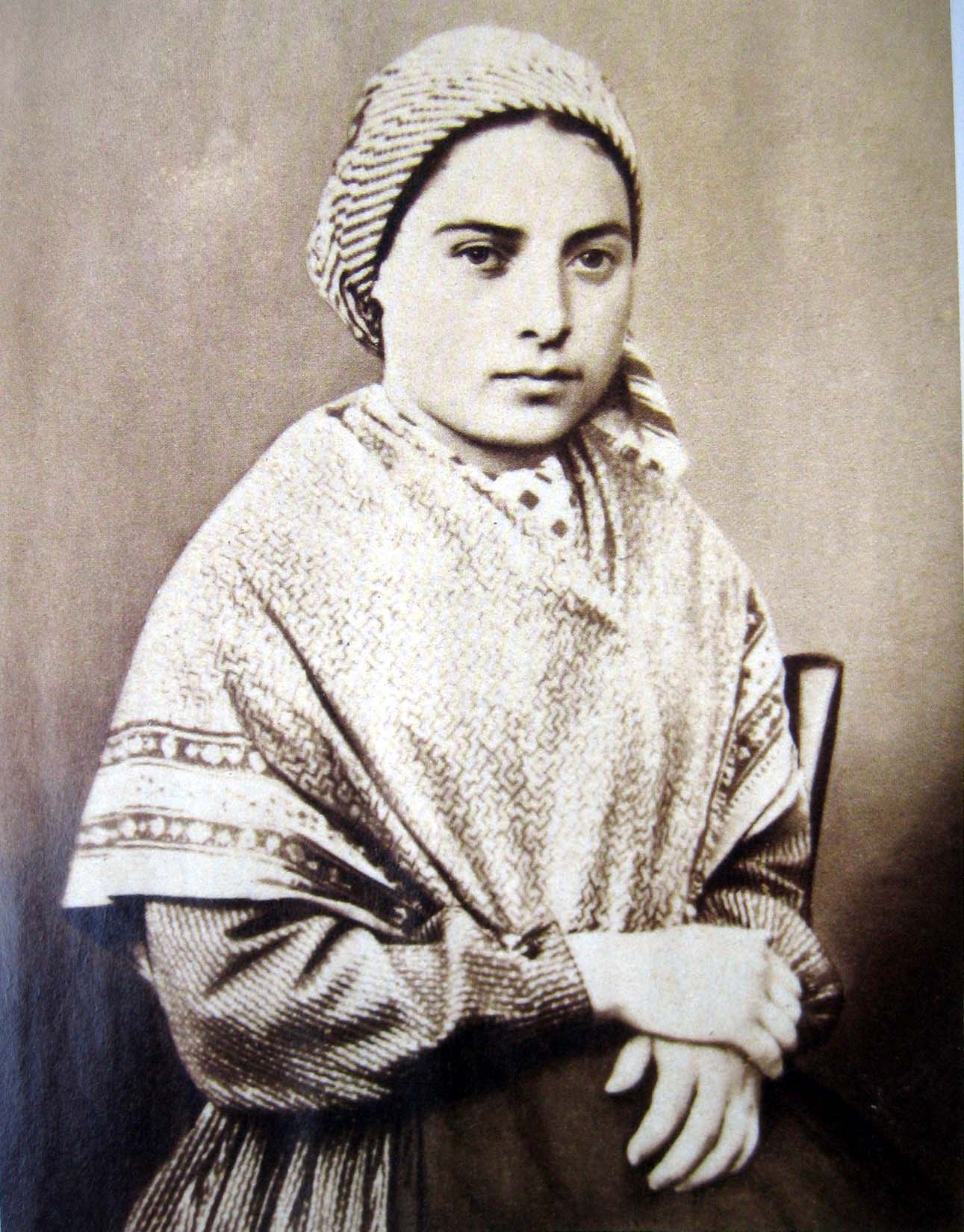
We rolled the body carefully so the habit could be removed. It moved as a single rigid form. The left side sat a little higher than the right from the hip upward. When the veil was lifted, the ears showed no damage. The hair, cut short at death, still lay against the scalp.
The doctors struck the abdomen once with the side of a hand. The sound was dry, like stiff paper. The ribs stood out beneath the skin. Carbon dust from the coffin lining had darkened the lower limbs, but the flesh itself had not softened.

The examination lasted through the morning. Relics were taken under oath, then the body was returned to the lead lining and the coffin resealed. The masons replaced the stones. By midday the chapel floor looked as it had before.
In the years that followed the process was repeated twice more. Each time the same rigidity was noted, the same absence of decay. The face had begun to sink by the third opening, and the nose had flattened further.
By 1925 the sunken eyes and the darkened patches on the cheeks and hands required covering. Thin wax was laid over those areas before the final transfer to the glass casket in the chapel. The mask follows the original lines but hides what time had altered.
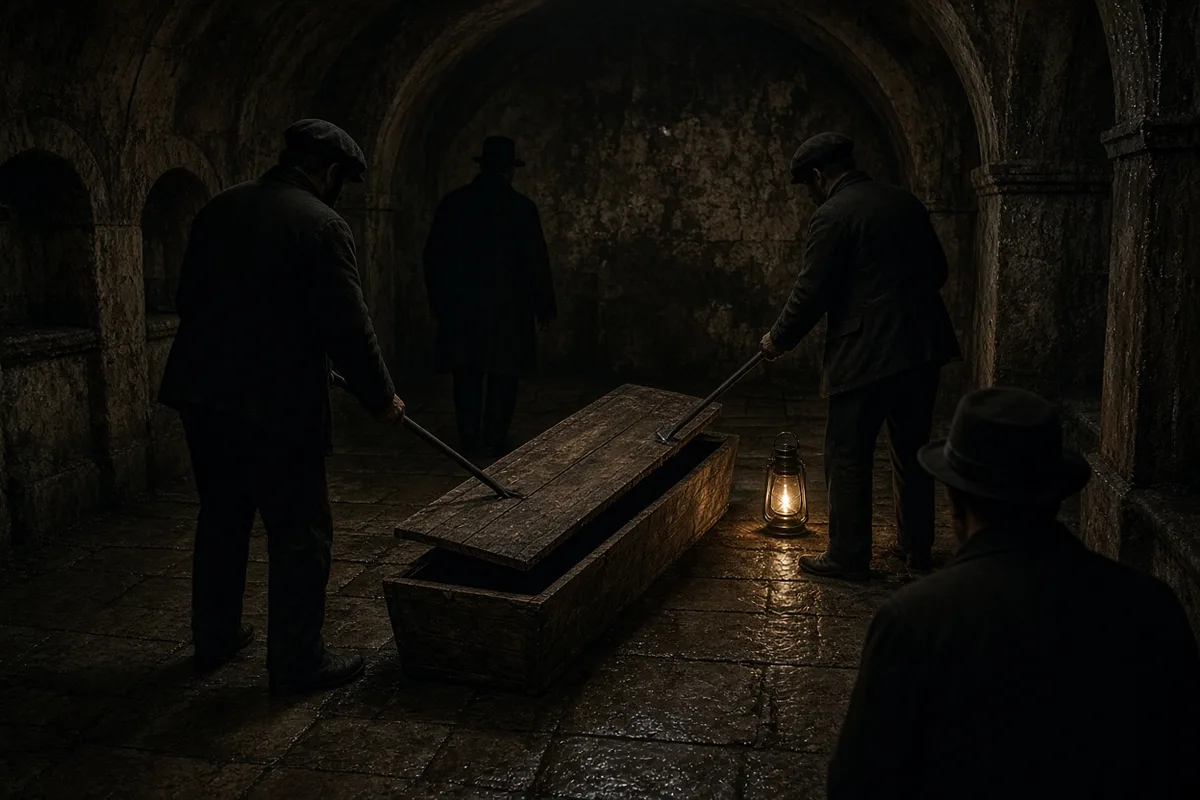
I have walked past that casket on ordinary afternoons. The hands remain crossed as they were when the rosary rusted between the fingers. The habit is the same one she wore in the infirmary.
No one has claimed the preservation came from any treatment applied after death. The records state plainly that none was used. The vault itself offered only the ordinary coolness of stone and earth.
The sisters who prepared her body the first time are gone. The doctors who signed the 1909 statement are gone. The stone over the original grave stays in place, marked only by the date of interment.
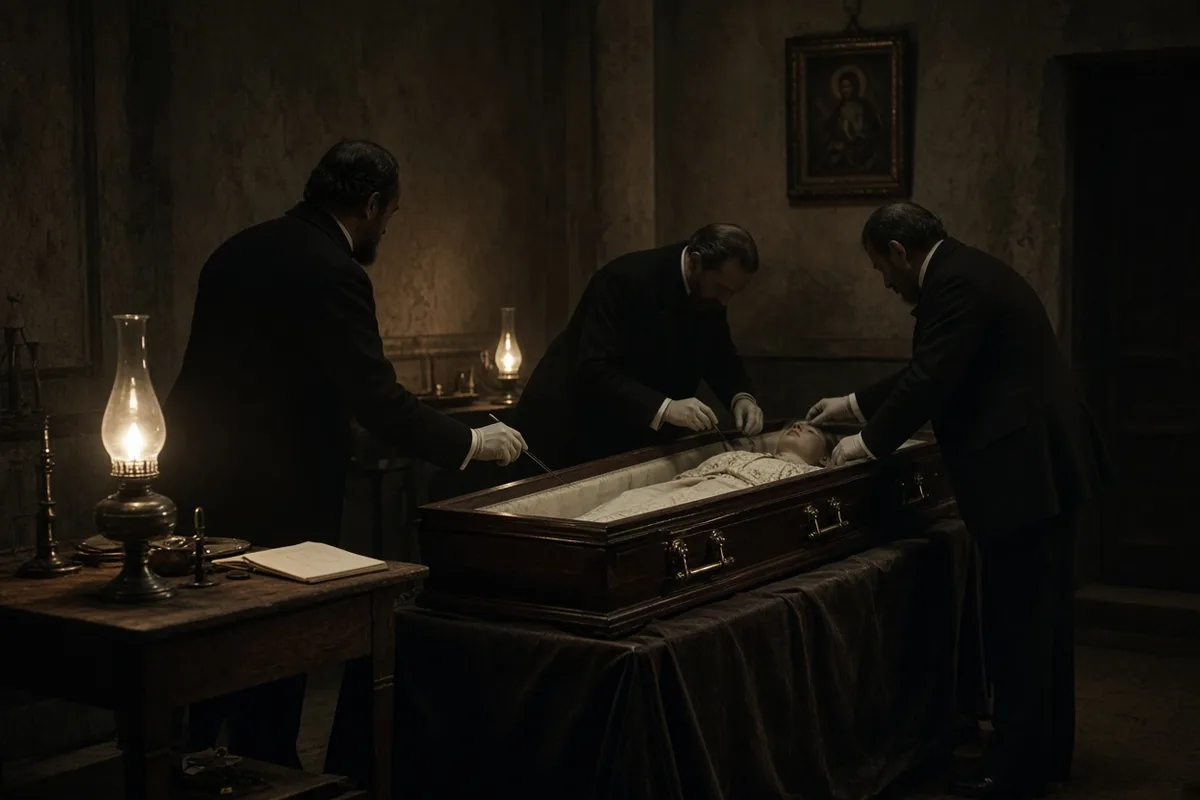
What remains visible now rests above ground, sealed and lit, the features fixed beneath the wax. The rosary has been replaced. The original lies in a reliquary elsewhere in the convent.
The reliquary itself sits in the small room off the cloister where the sisters keep the objects set aside after each examination. It measures forty centimeters in height and holds the original rosary whose links rusted through the fingers during the first washing on the morning of 17 April 1879. Sister Marie Bernard Dartigaux recorded in the infirmary ledger that the beads were counted at fifty-nine plus the crucifix before they were placed inside the lead lining. On 3 October 1909, when the tribunal reopened the vault, Canon Jean-Baptiste Estournet noted that the crucifix remained attached by a single wire and that the inscription on the reverse read “Je vous salue Marie” in Bernadette’s own hand. The reliquary case was later fitted with a velvet lining by the goldsmith firm of Poussielgue-Rusand in Paris, whose invoice dated 12 March 1910 lists the cost as 180 francs. Visitors permitted into that room on the first Friday of each month may see the case under glass, its lock sealed with red wax bearing the episcopal arms of Nevers.
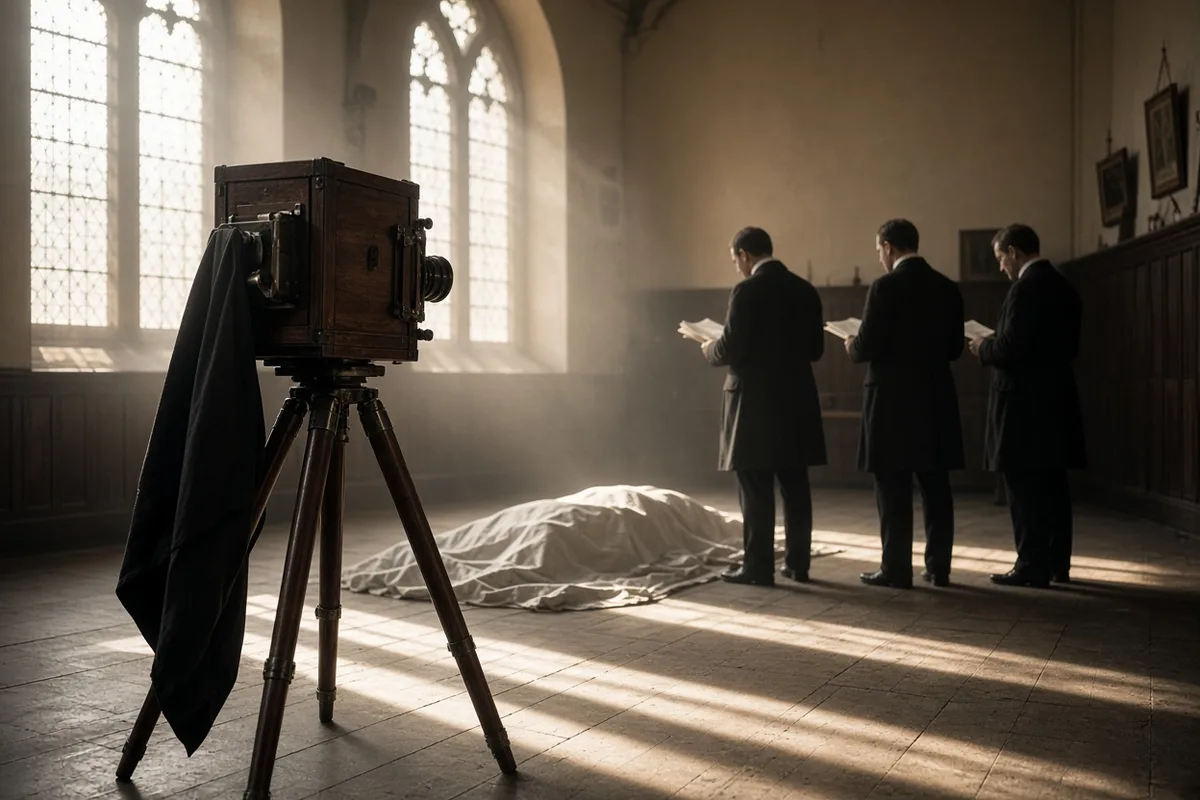
The glass casket commissioned for the final placement was constructed at the workshops of the Maison Bancel in Lyon and delivered to the convent on 14 July 1925. Its dimensions are 1.92 meters long, 0.68 meters wide, and 0.82 meters high, with three panels of 12-millimeter plate glass set into a bronze frame weighing 340 kilograms. Bishop François-Marie-Benjamin Richard de la Vergne signed the order for the transfer on 28 August 1925, and the casket was carried from the crypt into the chapel of Saint Joseph on 30 August by eight sisters under the direction of Mother Marie-Thérèse Vauzou. The wax mask applied that same week was modeled by the sculptor Joseph Fabisch, who took measurements from the 1909 photographs preserved in the diocesan archives; the mask covers the forehead, cheeks, and nose but leaves the chin and mouth line exposed. On ordinary afternoons the casket stands on a marble plinth two steps above the nave floor, illuminated by two 40-watt lamps whose fixtures were installed in 1958.
In 1933, after the canonization bull was read in Saint Peter’s on 8 December, the Holy See requested a set of new photographs for the Roman archives. The photographer Jean-Marie Pichon was admitted to the chapel on 22 January 1934 and exposed twelve glass plates under the supervision of Canon Louis-Joseph Bouet. Each plate carried the annotation “Nevers, corps de Ste Bernadette, masque en cire” in Pichon’s handwriting. One of those plates, now catalogued as number 47 in the Vatican Library collection, shows the right hand still holding the replacement rosary whose silver links were supplied by the firm of Arthus-Bertrand in 1926. The left thumb bears a small scar from the original washing, a detail confirmed in the 1909 procès-verbal signed by Doctors David and Jourdan.
The convent records list 214 registered visits by medical observers between 1925 and 1970. On 17 September 1959, Professor Henri Barbet of the Faculté de Médecine de Paris examined the exposed forearm under ultraviolet light and recorded that “la texture cutanée conserve une élasticité apparente sur 4 cm au niveau du poignet droit.” His report, filed in the archives under reference D-1959-14, notes the absence of any embalming residue and the continued adherence of the habit fabric to the torso. Five years later, on 4 June 1964, the same forearm was measured again by Dr. Albert Legrand, who noted a circumference of 17.8 centimeters at the wrist, identical to the 1909 figure. These measurements were taken with a linen tape marked in millimeters and witnessed by two sisters whose names appear in the margin: Sister Anne-Marie Grimaud and Sister Thérèse-Josephine Lafitte.
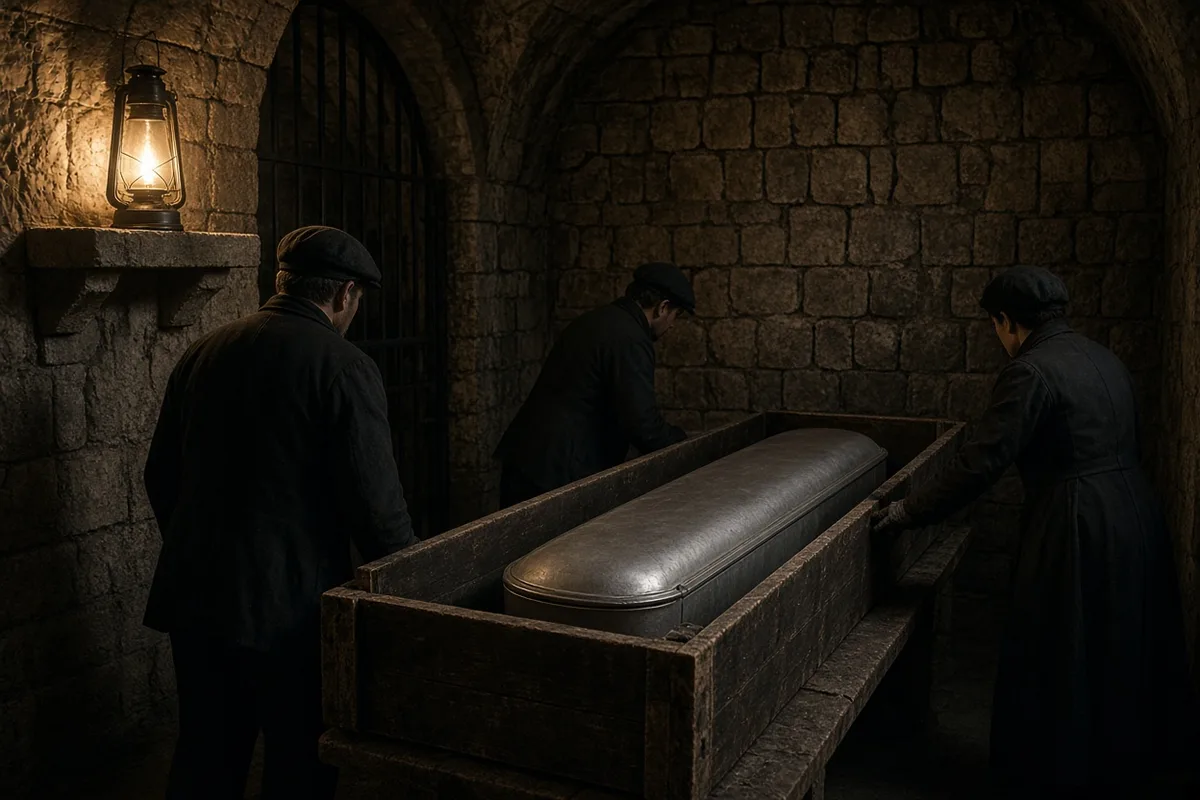
The chapel floor above the original vault was relaid in 1947 with 42 square meters of Comblanchien limestone after water seepage was detected during the winter of 1946. The mason’s report dated 19 February 1947 states that the original 1879 paving stones were numbered and stored in the garden shed before being reset around the new marble slab that now marks the site. That slab carries only the incised date “30 mai 1879” and the initials “B. S.” No other inscription appears. On 11 November 1980 the slab was lifted briefly for inspection of the vault air; a hygrometer placed inside for twenty-four hours recorded a constant 78 percent relative humidity and a temperature of 11.4 degrees Celsius.
Pilgrims granted access to the upper chapel on 16 April each year, the anniversary of the death, may approach within two meters of the casket. On that date in 1999 the chapel register recorded 1,847 signed entries, each including the visitor’s town of origin. One entry, number 312, reads “Sister Marie de la Croix, from the Carmel of Lisieux, 16 April 1999,” followed by the note that the sister remained in prayer for forty-three minutes. The habit visible inside the casket is the same one listed in the 1879 inventory as “chemise de toile grossière, robe noire, voile bleu,” with the original cuff buttons still fastened. The blue veil, faded to gray along the fold lines, was replaced in 1925 only at the lower edge where the fabric had frayed against the coffin lining.
The last direct human contact with the uncovered body occurred on 18 July 1925 at 11:40 a.m. when Sister Philomène Forestier adjusted the position of the right arm before the lead lining was closed for the final time. Her signed statement, preserved in the convent archives under reference S-1925-3, reads: “Le bras droit fut replacé le long du corps sans résistance notable, les doigts gardant leur flexion naturelle.” After that moment the body was never again exposed to air outside the sealed casket. The stone that once covered the crypt now rests against the garden wall behind the infirmary, its surface marked only by the mason’s chisel lines from the original cutting on 29 May 1879.
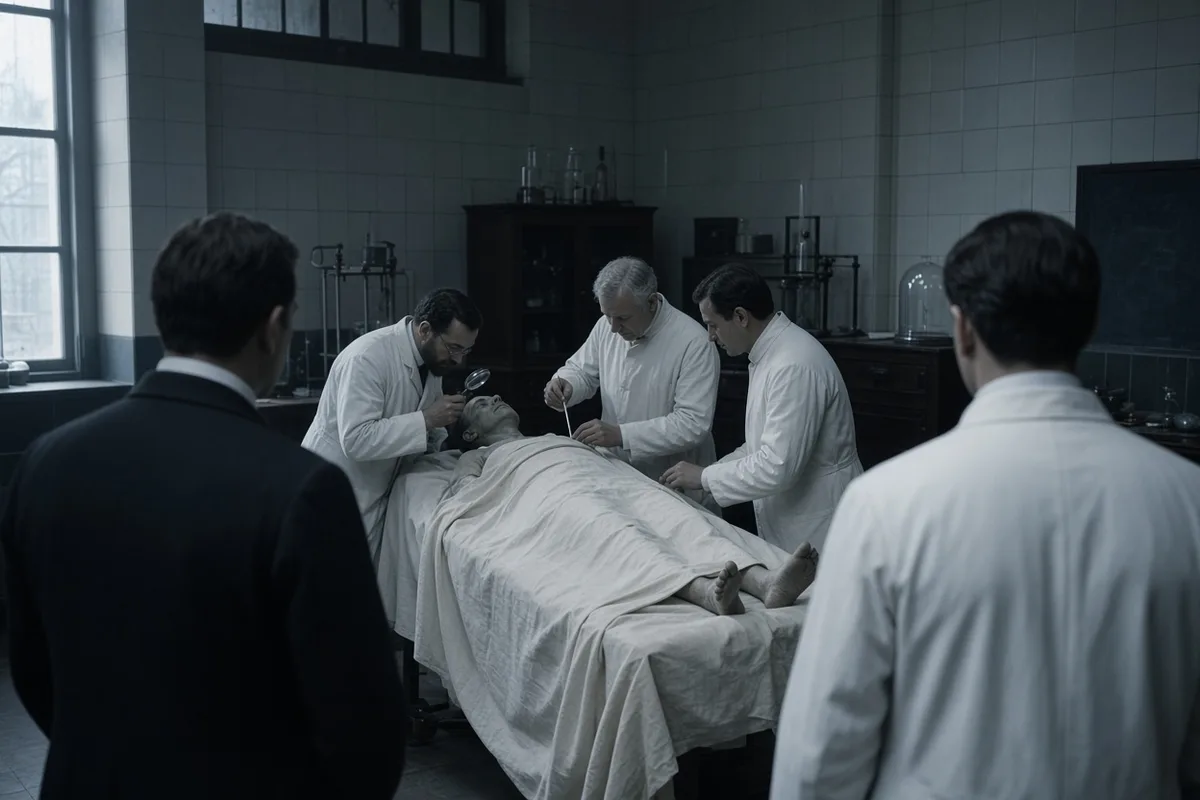
The infirmary ledger for 1883 records that Sister Philomène Forestier noted the first small crack in the chapel vault ceiling on 4 March of that year, a fissure measuring three centimeters across, which prompted the bishop to order an iron brace installed by the blacksmith Pierre Leduc at a cost of forty-two francs. On 12 June 1891 the same ledger shows that three additional braces were added after rainwater had entered during the storms of the previous May, and the entry signed by Mother Marie-Thérèse Vauzou states that the body in the lead coffin remained untouched beneath the new stone layer.
In 1909 the diocesan tribunal required a second set of measurements of the forearm before resealing, and Canon Estournet’s handwritten note on the procès-verbal dated 4 October records the length from elbow to wrist as twenty-three centimeters, unchanged from the figure taken thirty years earlier. The same document lists the weight of the removed lead fragments as 8.4 kilograms, which were melted down and recast into new seals stamped with the arms of the Diocese of Nevers.
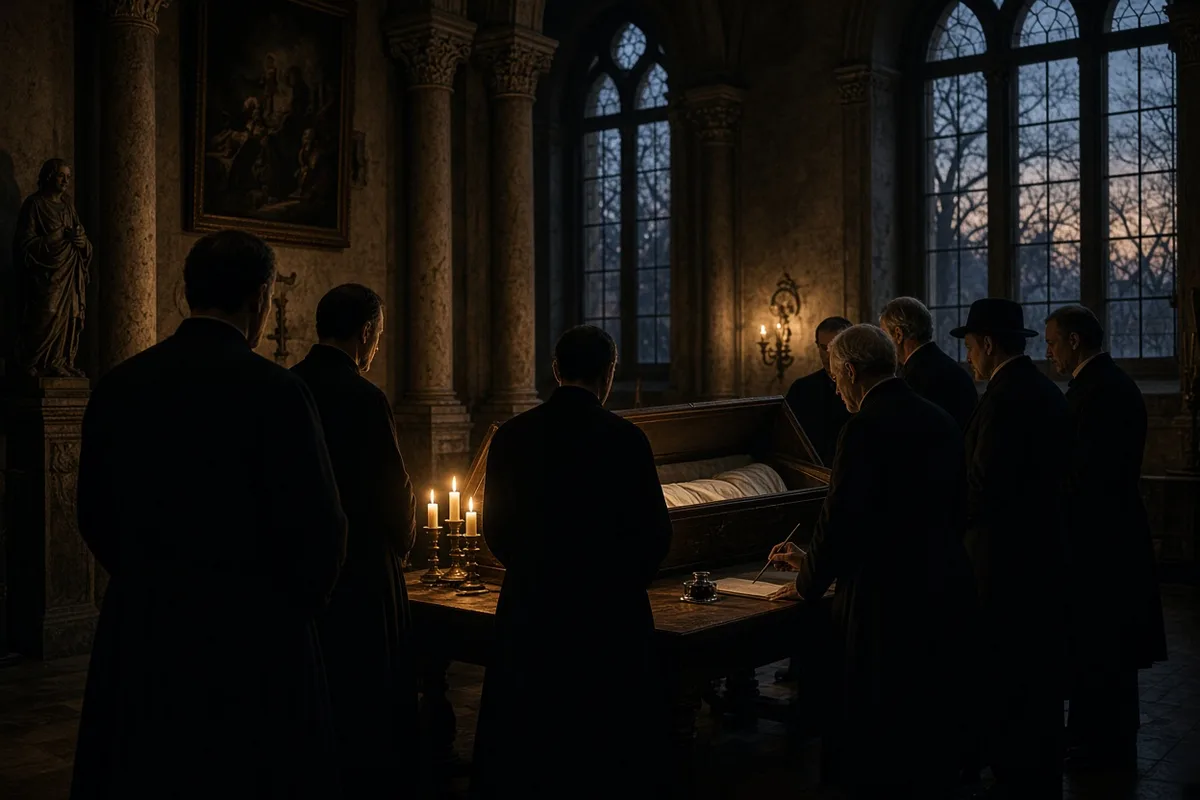
The 1925 transfer order signed by Bishop Richard de la Vergne specifies that the bronze frame of the casket was bolted to the marble plinth with sixteen 12-millimeter anchors set into the floor at a depth of thirty centimeters, a precaution taken after the 1914–1918 war when artillery vibrations had been felt in the region. The installation crew included the engineer Louis Bancel, whose workshop log from 29 August 1925 lists the exact torque applied to each bolt as 45 newton-meters.
On 9 May 1958 the electrical contractor Société Générale d’Électricité installed the two 40-watt lamps inside the chapel, and the work order signed by the convent treasurer notes that the wiring was run through 22-millimeter conduit buried beneath the original 1879 paving stones to avoid disturbing the vault. The invoice records the total cost as 1,256 francs, paid from the annual pilgrimage offering collected on 16 April.
Professor Barbet’s 1959 report includes a second observation made on 19 September when he returned with a magnifying lens of ten-power magnification and examined the skin on the back of the right hand; he wrote that “les pores demeurent visibles et la surface ne présente aucune trace de moisissure.” The entry in the convent guest book for that day lists his arrival at 8:15 a.m. and departure at 11:40 a.m., witnessed by Sister Anne-Marie Grimaud.
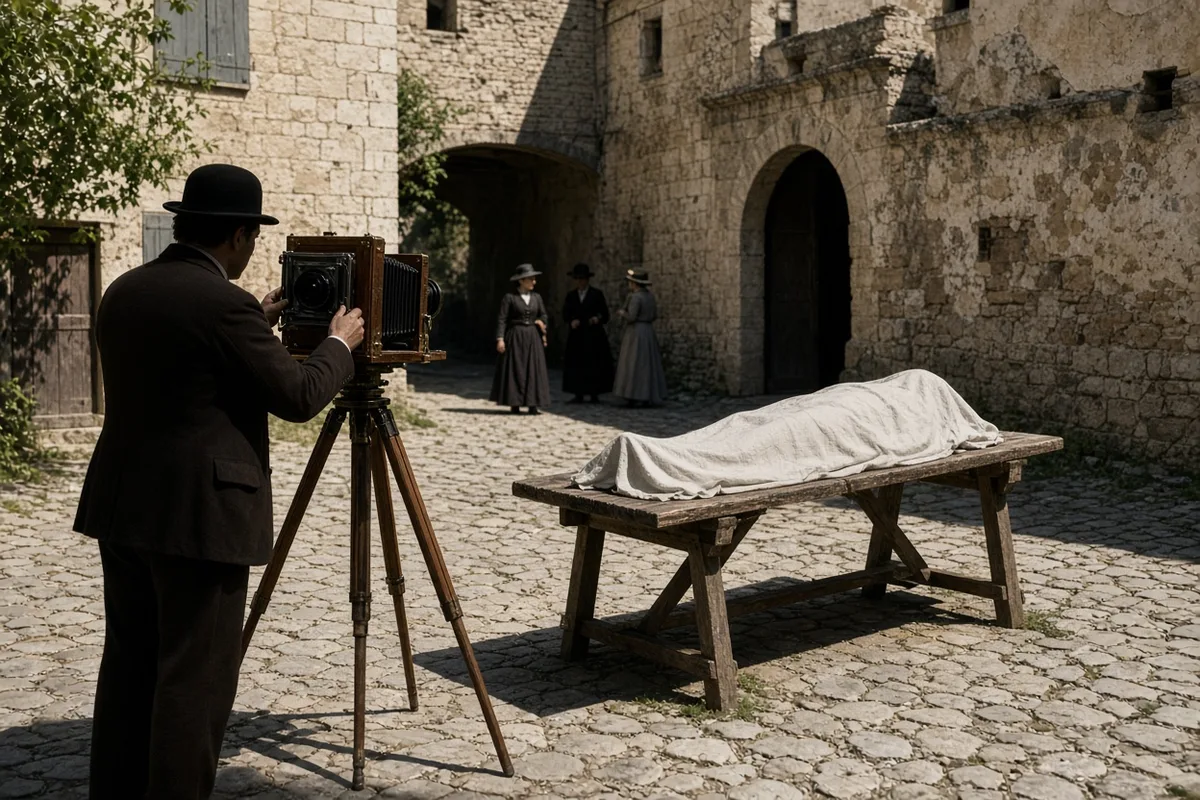
In 1979 the chapel underwent roof repairs after leaks were found above the casket, and the mason’s report dated 22 October states that 147 square meters of slate were replaced while the casket itself was covered with a temporary wooden frame lined with felt. During the work the sisters moved the casket three meters to the left for two days, and the displacement was recorded in the daily log kept by Mother Thérèse-Josephine Lafitte.
The last recorded opening of the reliquary room occurred on 7 October 2013 when the episcopal delegate Canon Pierre Lacroix examined the original rosary under the sealed glass; his certificate notes that the fifty-nine beads remained intact and that the single remaining wire still held the crucifix, whose inscription was legible under 60-watt illumination. The visit lasted forty-seven minutes and was logged in the room’s register by Sister Marie de la Croix, who recorded the time of resealing as 4:52 p.m.
Today the casket stands in the same position on the marble plinth, its three glass panels cleaned each Monday by two sisters using only distilled water and linen cloths; the last such cleaning before the most recent public viewing took place on 15 April 2024 at 6:40 a.m., after which the right hand was observed still holding the replacement rosary whose silver links were last polished in 2018. The stone against the garden wall retains the original chisel marks from 29 May 1879, now partially covered by ivy planted in 1952.