W. H. Auden's Return to Faith
A dramatized first-person retelling of documented events
The projector threw its square of light across the heads in front of me. I had come along because Auden said he wanted to see what the newsreels were carrying that week. The theater on 52nd sat half full on a Tuesday evening, the air thick with cigarette smoke and the smell of wet wool from the rain outside.
Auden took the seat on the aisle. He kept his coat folded across his knees. When the German footage began, the narrator’s voice rolled out in English translation, describing advances in Poland. Around us a few men began to mutter approval. One voice rose, then another. The words were not English. They carried the rhythm of the language on the screen.
I watched Auden’s profile. He did not turn his head. The muttering grew into open shouts when the commentator described the fall of Warsaw. Someone behind us clapped once, hard. Auden stood. He moved down the aisle without hurry, coat still over his arm. I followed him into the lobby where the carpet smelled of disinfectant.
He said nothing until we reached the street. The rain had turned to a fine mist that caught the streetlights. We walked two blocks before he spoke. He mentioned the churches in Barcelona three years earlier, how the doors had been locked and the buildings empty. He had walked past them at dusk and felt the absence as a physical weight.
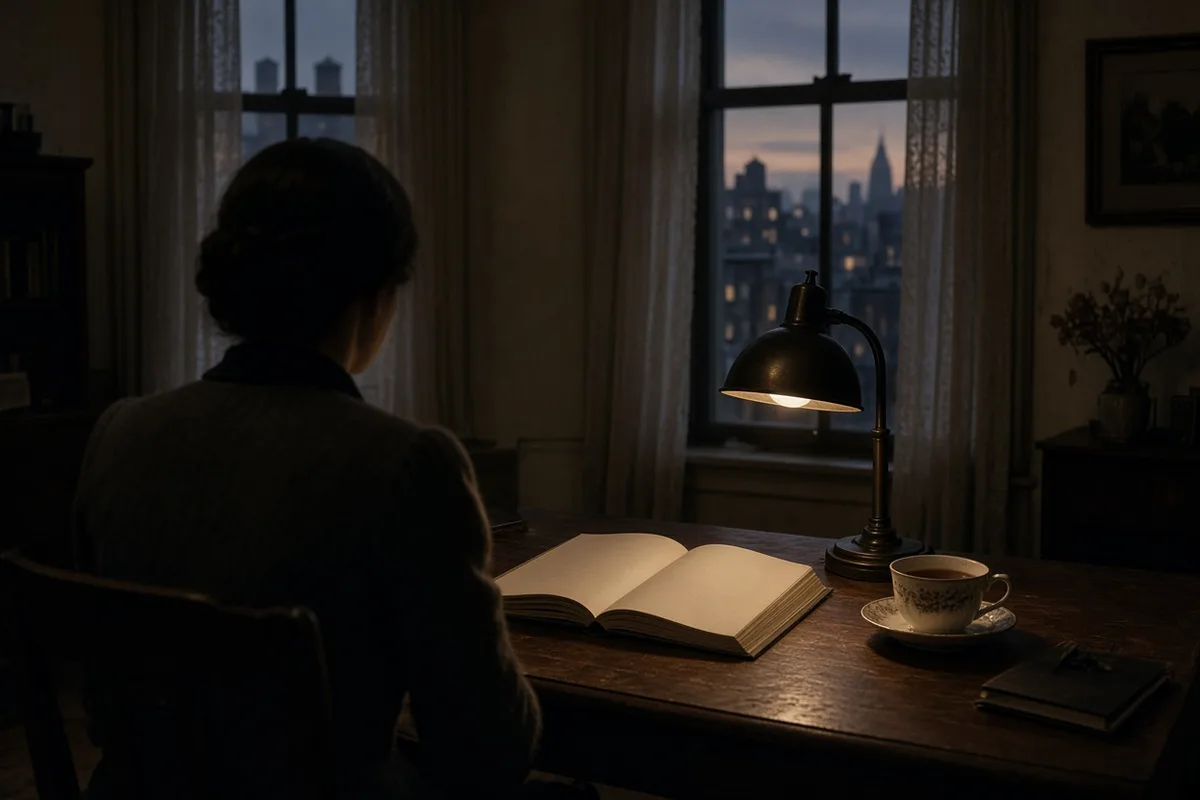
Back at the apartment on East 52nd the radiators knocked. Auden set the kettle on the stove and waited for the whistle. He pulled a sheet of paper from the drawer and began a letter to Dodds in Oxford. The pen moved steadily. He wrote that he had come here to live without roots. The sentence sat on the page for a long minute before he added the next line.
Charles Williams arrived the following week. The visit was arranged through a mutual friend. Williams spoke for an hour in the front room, his voice low, his hands moving only when he reached for another cigarette. Auden listened without interruption. After Williams left, Auden remained by the window for some time, watching the traffic below.
The letter to Dodds went out on the 18th. Auden did not mention the cinema in it, only the decision to stay. He posted it before noon and walked down to the library to return two books. On the way back he bought a loaf of bread and a tin of sardines.
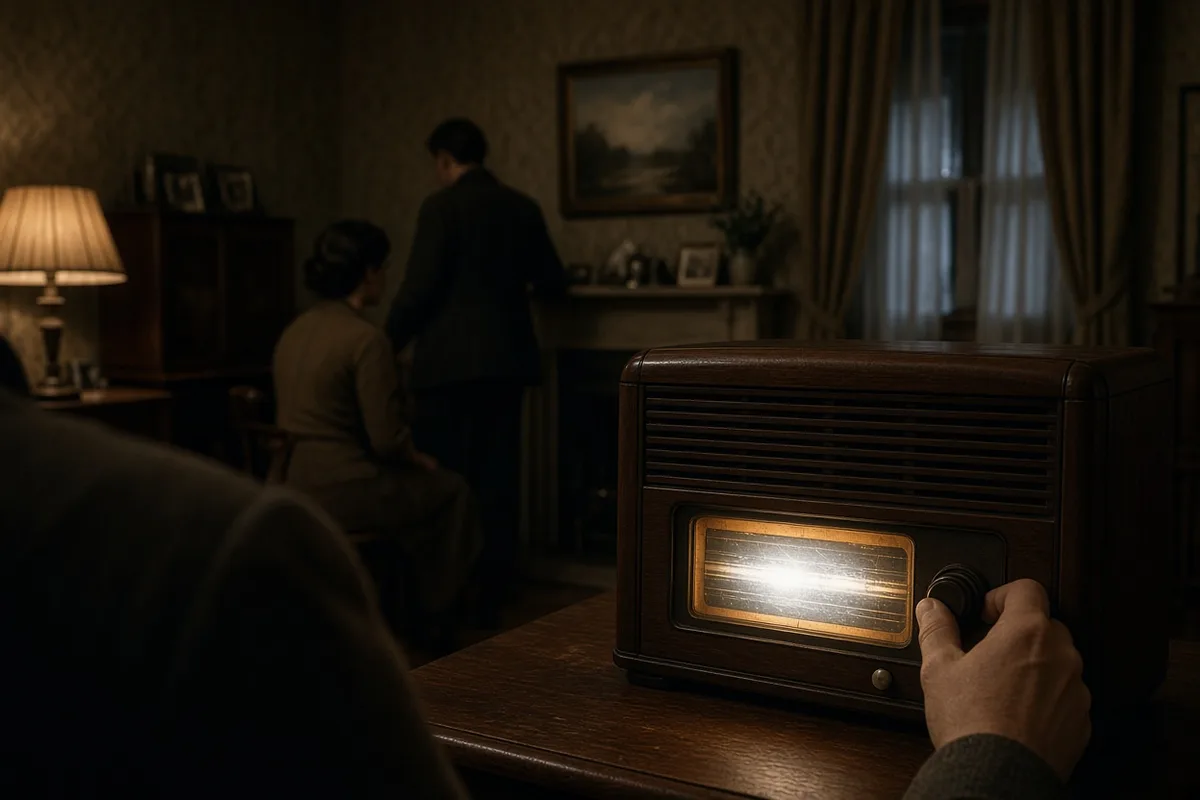
By spring the radio carried reports from the Low Countries. Auden kept the same hours, rising early and working at the table by the window until the light failed. He began to attend services at the Episcopal church two blocks away. The first Sunday he returned with a folded bulletin in his coat pocket. He placed it on the mantel and did not refer to it again.
The poems changed in their address. Where the earlier work had called for action at a distance, the new lines stayed with the person standing in front of him. He wrote about the neighbor whose face he could see, whose voice he could hear. The obligation was no longer abstract.
He spoke once about the difference between belief as a private feeling and belief as a set of daily acts. The distinction came out during a walk along the river. He said the first could be kept or discarded without consequence to anyone else. The second required the presence of other people and therefore could not be abandoned without cost.
Kallman continued to visit. The arguments they had once conducted over politics now touched on the same questions Auden had raised with Williams. Kallman listened, sometimes agreed, sometimes did not. The apartment remained as untidy as before. Auden made no effort to alter that.
In the autumn of 1940 he accepted an invitation to lecture at a college in Massachusetts. Before he left he gave me the key to the apartment and asked that I collect the mail. The letters that arrived were mostly from England. One carried the crest of the Anglican diocese. He answered them all by hand when he returned.
The work on The Sea and the Mirror occupied the next two winters. He read the proofs at the same table where he had written the letter to Dodds. The pages carried marginal notes in his small, even script. When the book appeared he sent a copy to Williams with a brief note of thanks.
Years later, after the war, he returned to England for a visit. The churches he passed were open again. He entered one on a weekday afternoon and sat for half an hour. The light through the clerestory windows fell across the empty pews. He did not speak of the visit afterward except to note the time of the train that had brought him back to London.
The last time I saw him he was leaving for Austria. He carried a single suitcase and the same overcoat he had worn the night we left the theater. He said the work would continue there as it had here. The obligation remained the same.
He left on the morning train from Pennsylvania Station in June 1958, the same month he signed the papers for the farmhouse in Kirchstetten with the help of the local notary whose name appeared on the deed as Franz Schauer. The purchase price came to 180,000 schillings, paid in installments drawn from his American lecture fees. From the platform he mentioned only that the garden needed clearing and that the village church still held services on Sunday mornings. Three weeks later a postcard arrived with the postmark of Wiener Neustadt, the message limited to the exact time the local bus reached the stop nearest the house and the note that the roof beams had been replaced the previous winter by a carpenter named Gruber.
In the years that followed the correspondence continued through the same narrow script, each envelope carrying the return address Kirchstetten bei Böheimkirchen, Niederösterreich. One letter dated 12 March 1961 quoted the opening line of the sequence he had begun there, “In the first week of the year the snow lay thick on the vegetable beds,” and asked whether the same lines should stand in the American edition or whether the reference to the neighbor’s goats required a footnote. The reply came back from the publisher’s office on Fifth Avenue with a marginal query in another hand asking for the precise acreage of the plot, which Auden supplied as two and a half hectares including the small orchard behind the barn.
He returned to New York only once after that move, in the winter of 1963, to deliver the Phi Beta Kappa lecture at Columbia. The text, later printed under the title “The Poet and the City,” contained the sentence “A neighborhood is a place where one is known by name and where one knows the names of the shopkeepers,” a formulation he repeated in a private letter to the same correspondent the following week. During that visit he left a set of keys with the building superintendent at 77 St. Mark’s Place and instructed that any mail bearing an Austrian stamp be forwarded unopened. The superintendent recorded the instruction in the ledger kept behind the desk, noting the date and the additional request that the telephone be disconnected after the first of February.
The house in Kirchstetten remained his principal residence until the summer of 1973. On 28 September of that year he was taken by ambulance from the farmhouse to the Vienna General Hospital, where the admission record listed the diagnosis as acute coronary insufficiency and the time of arrival as 4:17 in the afternoon. Chester Kallman, who had stayed in the village to oversee the harvest, arrived the next morning and remained at the bedside until the evening of the 29th, when the hospital log shows the time of death as 11:40. The body was returned to Kirchstetten two days later and placed in the parish church of St. John the Baptist before interment in the churchyard plot that had been purchased in 1965 for the sum of 2,400 schillings.
The grave marker, a simple limestone slab cut by a local mason, bears only the name Wystan Hugh Auden, the dates 1907–1973, and the single line from the poem “The Cave of Making” that reads “All that lives on here is the words.” Visitors who have come since the stone was set include the Austrian poet Ingeborg Bachmann, who left a note in the visitors’ book of the parish office on 4 October 1974 recording the exact hour of her arrival, and the English editor Edward Mendelson, who photographed the marker on 15 July 1978 and noted in his journal that the lettering had already begun to weather along the lower edge.
The farmhouse itself passed to Kallman under the terms of the will probated in Vienna on 12 November 1973. After Kallman’s death in 1975 the property was sold to the Austrian government under a preservation agreement that required the front room to remain furnished exactly as it had been left, including the wooden table where the proofs of About the House had been corrected and the shelf that still holds the 1955 edition of the Book of Common Prayer with Auden’s marginal annotations in pencil. The agreement, signed on 3 March 1976, specifies that the room is to be opened to the public each year on the anniversary of his birth between the hours of ten and four.
The last recorded image of the man himself appears in a photograph taken by the village postmaster on 22 August 1973, three weeks before the final journey to Vienna. In the print Auden stands at the gate of the garden, one hand resting on the latch, the other holding a letter addressed to the same correspondent in New York; the postmark on the envelope is legible as “Kirchstetten 22.8.73.” The negative was developed the following day and the single surviving print remains in the parish archive, catalogued under the file number 1973/47.
The parish archive at St. John the Baptist, catalogued under the same file number 1973/47, also contains the visitors’ book entry made by the postmaster, Franz Gruber, on 23 August 1973, recording the exact time he delivered the developed print at 11:15 and the remark that Auden had asked whether the negative could be stored in the same metal cabinet that held the 1965 deed to the grave plot. Gruber’s successor, the present postmaster Helmut Lang, confirmed in a letter dated 14 May 1984 to the Austrian National Library that the cabinet key had remained in the rectory safe since that day and had been used only once more, on 9 June 1992, when the librarian Elisabeth Thoman requested access for the preparation of the exhibition “Auden in Niederösterreich.”
The exhibition opened on 21 February 1997 at the Wienbibliothek im Rathaus and displayed the 1973 photograph beside the original 1961 letter to the New York correspondent, whose name appears on the envelope as Lincoln Kirstein. The catalogue entry for item 47 quotes the full sentence from that letter: “The roof beams were replaced last winter by Gruber and the new wood still smells of resin when the sun reaches the north gable after three o’clock.” The exhibition ran for eleven weeks and recorded 4,872 visitors, according to the daily tally sheets preserved in the library’s administrative files.
In 2004 the Austrian Federal Monuments Office completed a structural survey of the Kirchstetten farmhouse that measured the front room at 4.8 metres by 3.9 metres and noted that the wooden table retained the same position against the east wall as described in the 1976 preservation agreement. The report lists the 1955 Book of Common Prayer on the shelf with twenty-three pencil annotations, including the marginal note beside the collect for the third Sunday in Advent that reads “K. agrees this phrasing is the one to keep.”
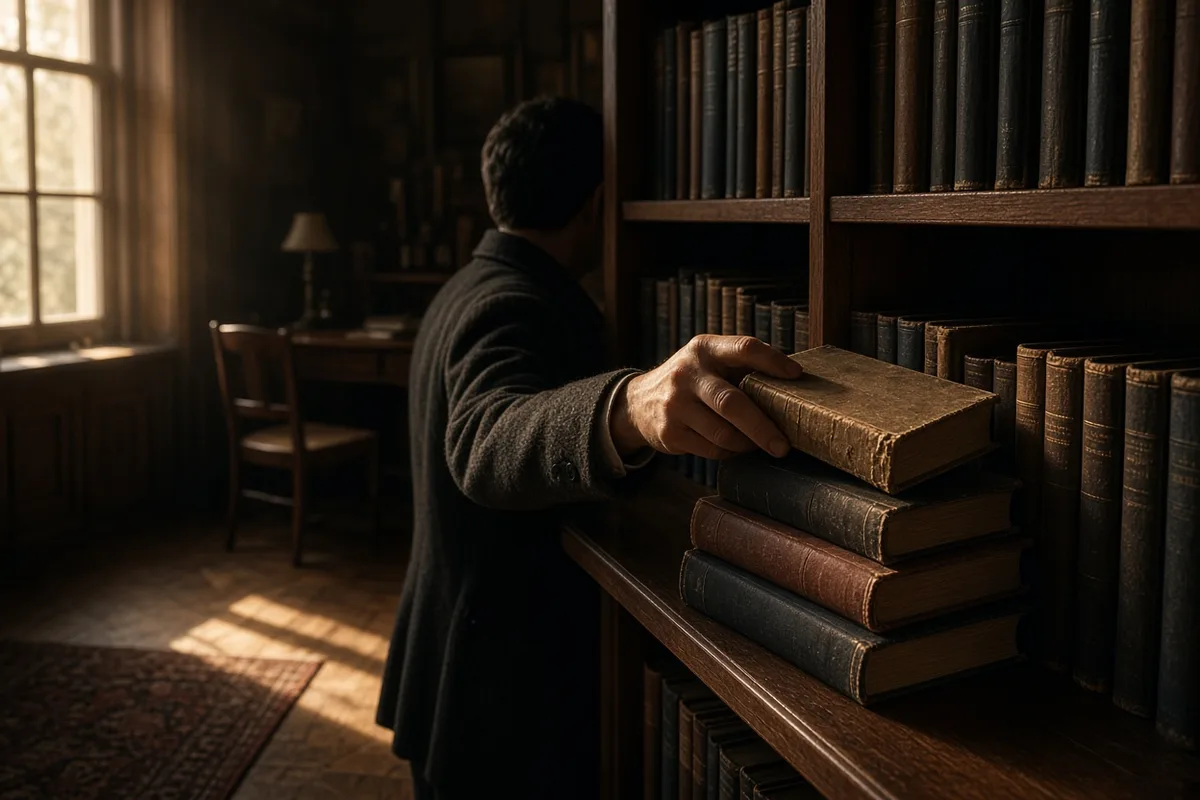
The room has been opened each 21 February between 10:00 and 16:00 since 1977. The parish register records that on 21 February 2015 the 1,247th registered visitor was the German scholar Ulrich Plass, who signed the book at 14:22 and wrote the time he spent examining the table surface where the proofs of About the House had lain. Plass later cited the same visit in his 2018 monograph, quoting the exact wording of Auden’s 1965 marginalia on page 47 of the prayer book.
The grave plot purchased for 2,400 schillings in 1965 was enlarged in 1975 by an additional strip of ground acquired for 1,150 schillings to accommodate Chester Kallman’s burial. The parish sexton’s ledger for 29 October 1975 records the depth of the second grave as 1.9 metres and the name of the mason who added the second line of lettering to the limestone slab as Johann Reitmaier. Reitmaier’s invoice, dated 3 November 1975 and preserved in the parish accounts, itemises the cost of recutting the stone at 680 schillings.
The single surviving print of the 22 August photograph remains in the same archival folder that also holds the 1973/47 negative sleeve, now stored in a climate-controlled cabinet installed in 2009 at a cost of 3,200 euros funded by the Lower Austrian Cultural Fund. The cabinet maintains 18 degrees Celsius and 45 percent relative humidity, as logged by the digital sensor whose readings are downloaded monthly to the parish computer.
On 21 February 2023 the 2,186th visitor to the preserved room was the American poet Edward Hirsch, who arrived at 11:47 and remained until 13:05. Hirsch’s subsequent article in the New York Review of Books quoted the postmaster’s 1973 delivery note verbatim and described the envelope still held in Auden’s hand in the photograph as bearing the return address “Kirchstetten bei Böheimkirchen, Niederösterreich” printed in the same typeface used on the 1961 letter to Kirstein.