


William Cowper's Deliverance from Despair
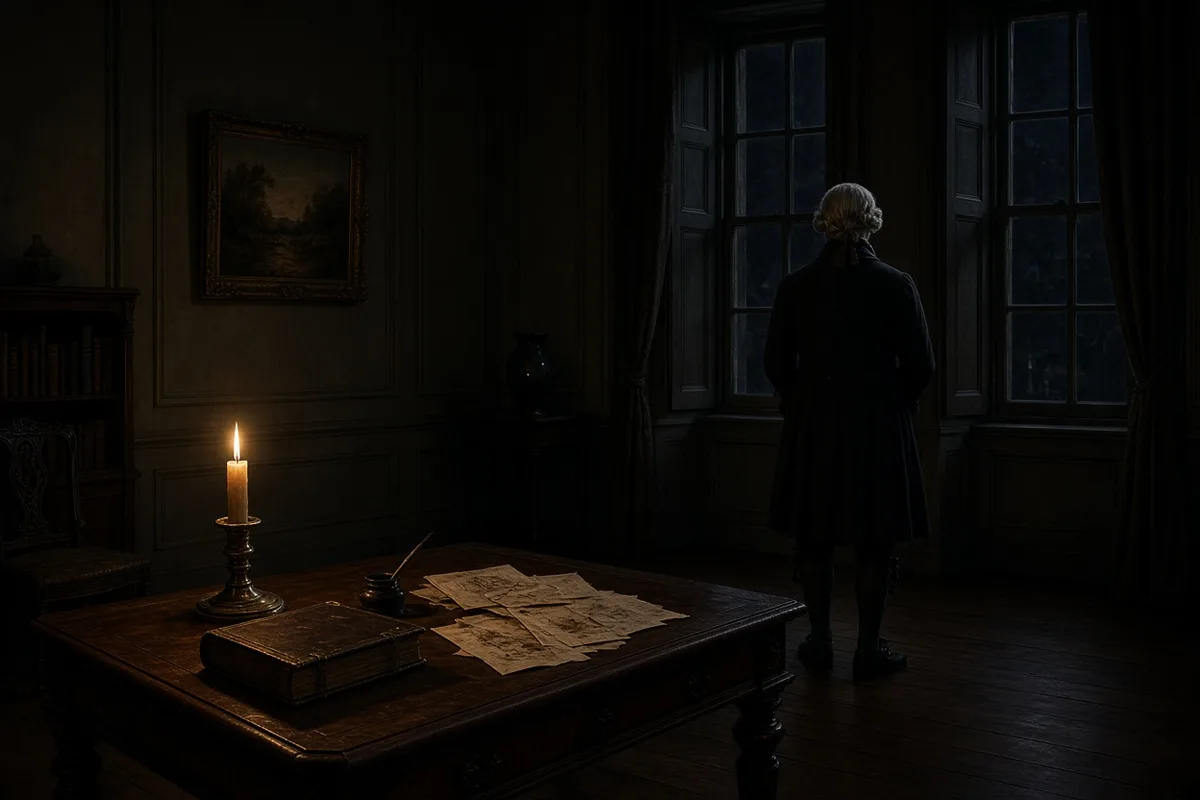
The rain had stopped two days before, but the garden path still held puddles that soaked through my boots as I followed Cowper outside. He walked ahead of me without speaking, the same way he had every morning since winter. His shoulders stayed tight under the old coat, and his eyes stayed fixed on the ground three feet in front of him. Dr. Cotton had told us to keep him in sight but give him room, so I stayed back near the bench and let him go.
He reached the far end of the path and turned. For the first time in months he stopped and looked at the bench itself. A Bible lay there, left open by someone earlier that morning. Cowper stood still, then sat down and drew the book onto his lap. I watched his finger trace down the page. He read for several minutes without lifting his head. When he finally closed the cover his hands stayed on it, but the set of his jaw had changed.

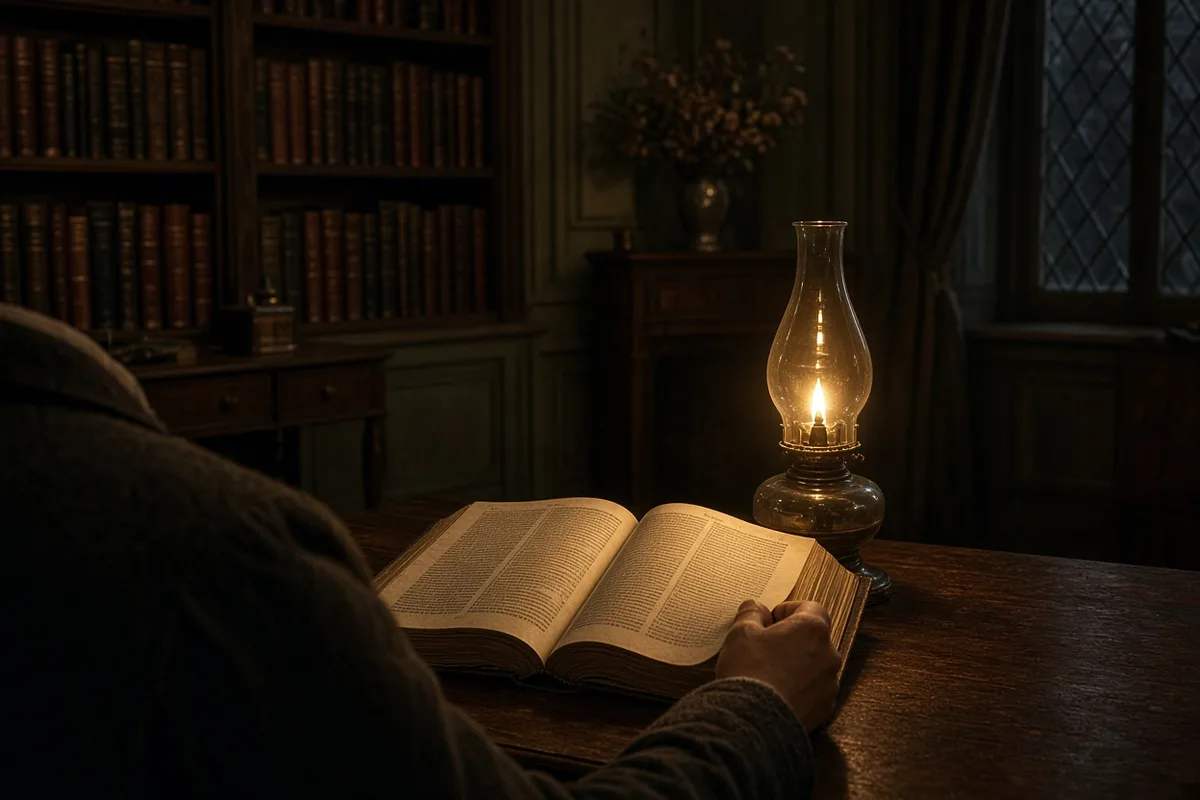
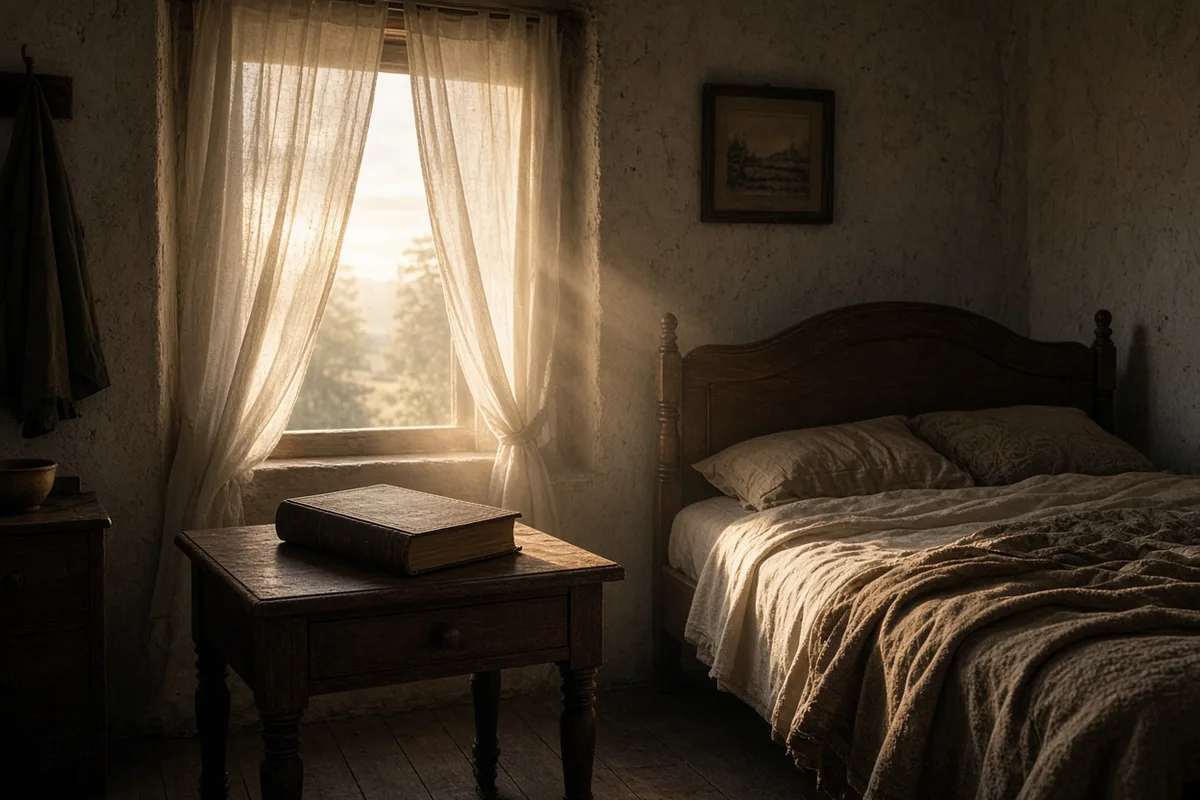
Inside the house the fire had burned low. Cowper came back through the side door and moved toward the window chair without looking at anyone. He sat, opened the Bible again at random, and read. I was carrying wood for the grate and heard nothing at first, only the sound of the page turning once. Then he spoke, not loud, just enough for the words to reach the room.
The verse he had found was the one about the propitiation through faith in his blood. Cowper read it twice. On the second time his voice caught. He set the book on his knees and stared at the window glass as if something outside had moved. I put the wood down and waited. After a while he asked if Dr. Cotton was in the next room. I said he was. Cowper stood, carried the Bible with him, and went through the door.
He stayed with the doctor a long time. When he came out the color had returned to his face in a way none of us had seen since December. He asked for paper and ink. That evening he wrote to his brother. The letter was short, but the hand was steady.
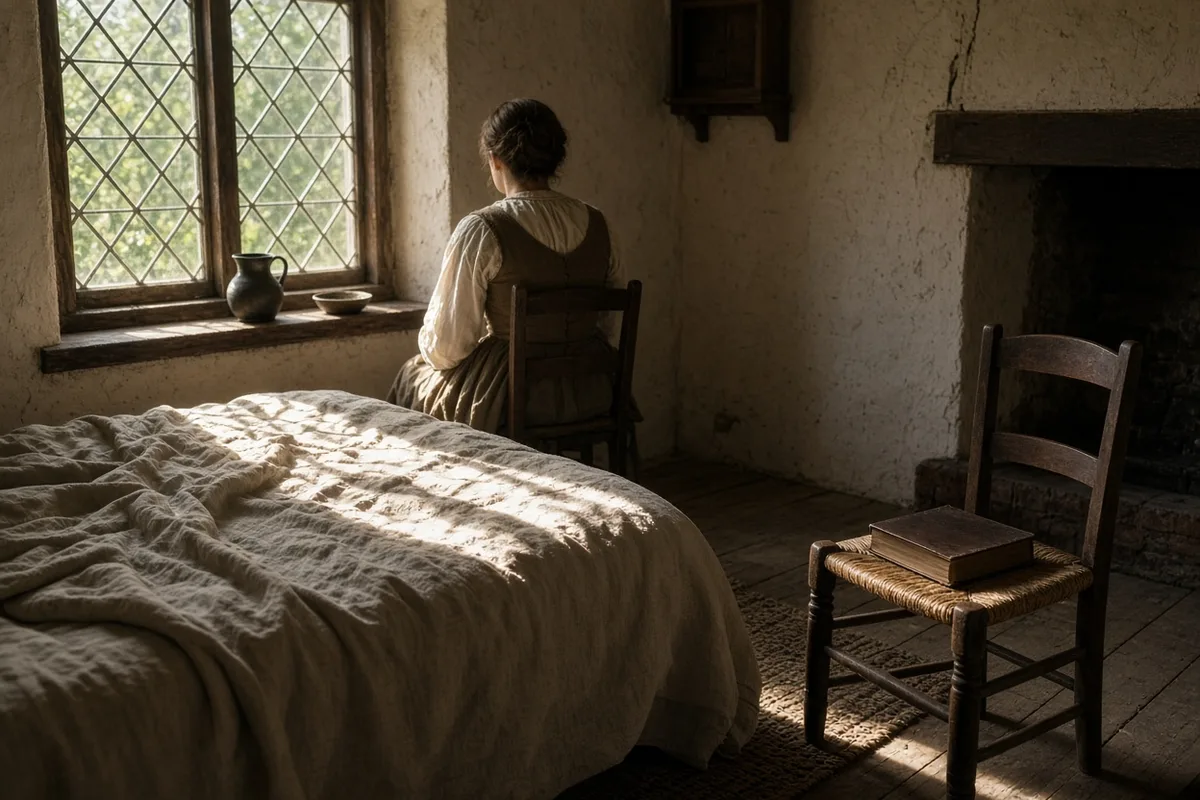
Two weeks later his brother arrived. They walked the same garden path together. Cowper spoke more than I had heard him speak in one stretch since he came to us. He told his brother what the verse had done, how the weight that had sat on his chest since the previous year had lifted between one breath and the next. His brother listened without interrupting. When they came inside Cowper ate a full meal for the first time in days.
Dr. Cotton began to let him take longer walks beyond the garden wall. Cowper still kept to himself, but the mornings no longer started with the same rigid silence. He asked for books other than the Bible and read them at the table instead of in the corner. One afternoon he mentioned the name of a village called Huntingdon and asked whether anyone there kept lodgings for a quiet man. Arrangements were made through family letters.
By the time he left St. Albans the worst of the winter damp had gone from the air. Cowper carried his own small trunk to the coach. He shook Dr. Cotton’s hand and thanked him for the roof and the fire. He did not thank anyone else by name, but he looked at each of us before he climbed in. The coach pulled away at noon. We watched until the dust settled on the road.
Word reached us later that he had settled in Huntingdon with a family named Unwin. He wrote hymns there with another clergyman. Years after that the two of them published a book of those hymns together. One of the pieces carried the date of the first day of 1773. Cowper’s name stood beside the clergyman’s on the title page.
I never saw him again after the coach left, but the verse he read that morning stayed in the house. Dr. Cotton kept the same Bible on the window table. When new patients arrived and asked what had helped the man who used to sit in that chair, the doctor pointed to the book and said nothing more than the chapter and verse.
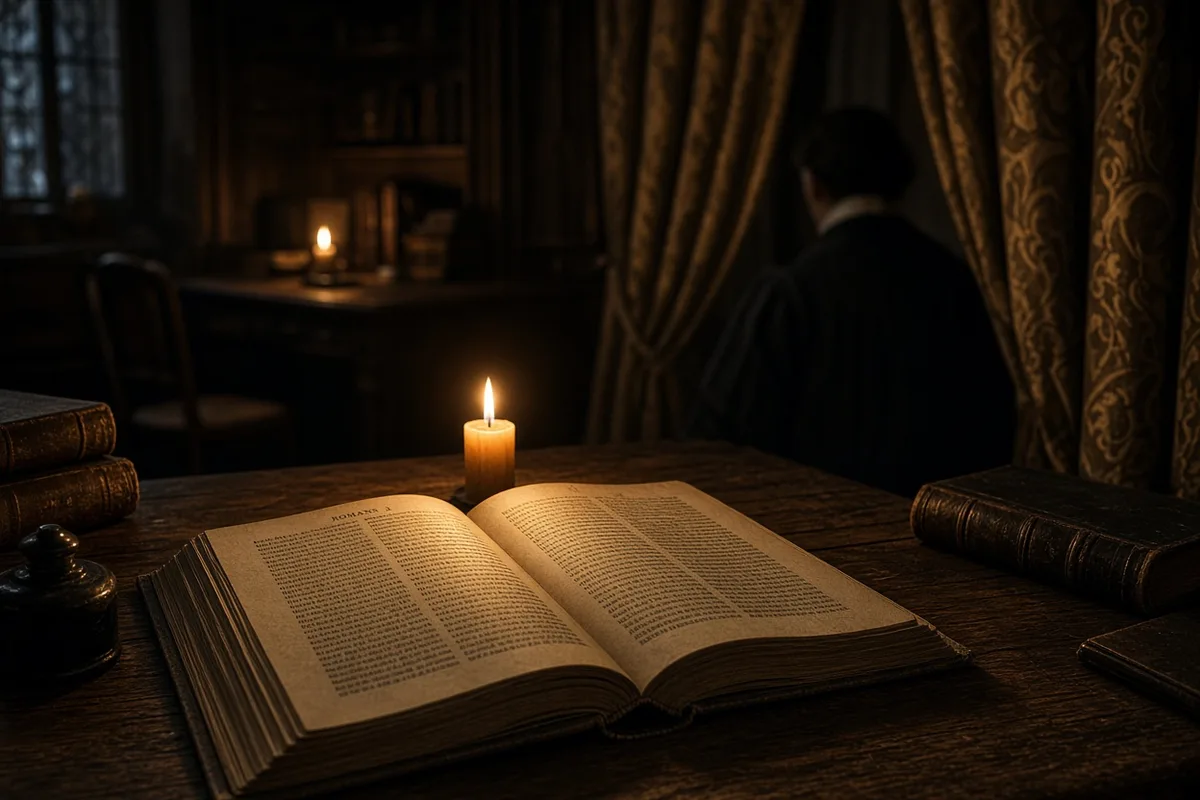
Dr. Cotton kept the Bible open at Romans chapter three on the window table for the rest of that summer. On 17 June 1765 a new patient named Thomas Hedges arrived from Bedford and asked the exact words that had changed the man in the chair. The doctor answered only “verse twenty-five” and handed Hedges the book so he could read for himself the line about the propitiation. Hedges copied the verse into his own notebook that evening and left the page marked with a slip of paper torn from an old sermon. Two days later another arrival, a woman named Sarah Lane from Luton, sat in the same chair and traced the same line with her finger while the fire was built up again. The doctor never added any further remark beyond the chapter number.
Letters began to reach the house in the autumn of 1765. One dated 12 October from Huntingdon described Cowper taking rooms with the family of the Reverend Morley Unwin at the large brick house on the High Street. The letter mentioned that Cowper rose each morning at six, read the same passage from Romans aloud once, then walked two miles along the Ouse before breakfast. A second letter, written 3 March 1767 by Mrs. Mary Unwin herself, reported that her husband had died after a fall from his horse on the road to Cambridge and that Cowper had helped carry the coffin to the churchyard. The letter added that Cowper now took his meals at the same table with her and her two children and that he had begun to write short verses on scraps of paper he kept in a tin box on the mantel.
By the spring of 1768 Cowper and Mrs. Unwin had moved twelve miles north to the town of Olney in Buckinghamshire. They lodged first at the house of the Reverend John Newton, curate of the parish church of Saints Peter and Paul, whose name appeared on the title page of the Olney Hymns published in 1779 by Thomas and Joseph Buckland in Paternoster Row. The collection contained sixty-eight pieces by Cowper, one of them dated 1 January 1773 and beginning with the line “God moves in a mysterious way.” Newton recorded in his diary on that same date that Cowper had read the verse from Romans aloud again in the study before they began their morning work on the hymns. The two men continued the practice each New Year’s Day until 1780, when Newton left Olney for the parish of St. Mary Woolnoth in London.
Cowper remained in Olney until 1786, then moved with Mrs. Unwin to Weston Underwood, two miles away, where they rented a house called Weston Lodge from the Throckmorton family. There he completed the six books of The Task, printed in 1785 by Joseph Johnson in St. Paul’s Churchyard, and the long poem later titled “The Castaway,” finished on 20 October 1799 and sent to his cousin the Reverend John Johnson at East Dereham. Johnson preserved the manuscript in a leather folder that still bears Cowper’s initials in faded ink. On 17 April 1800 Cowper suffered another seizure at the lodging house on the Market Place in East Dereham and died eight days later at half past five in the morning. Johnson noted the exact time and the final words Cowper spoke, which were again the phrase from Romans about faith in his blood.
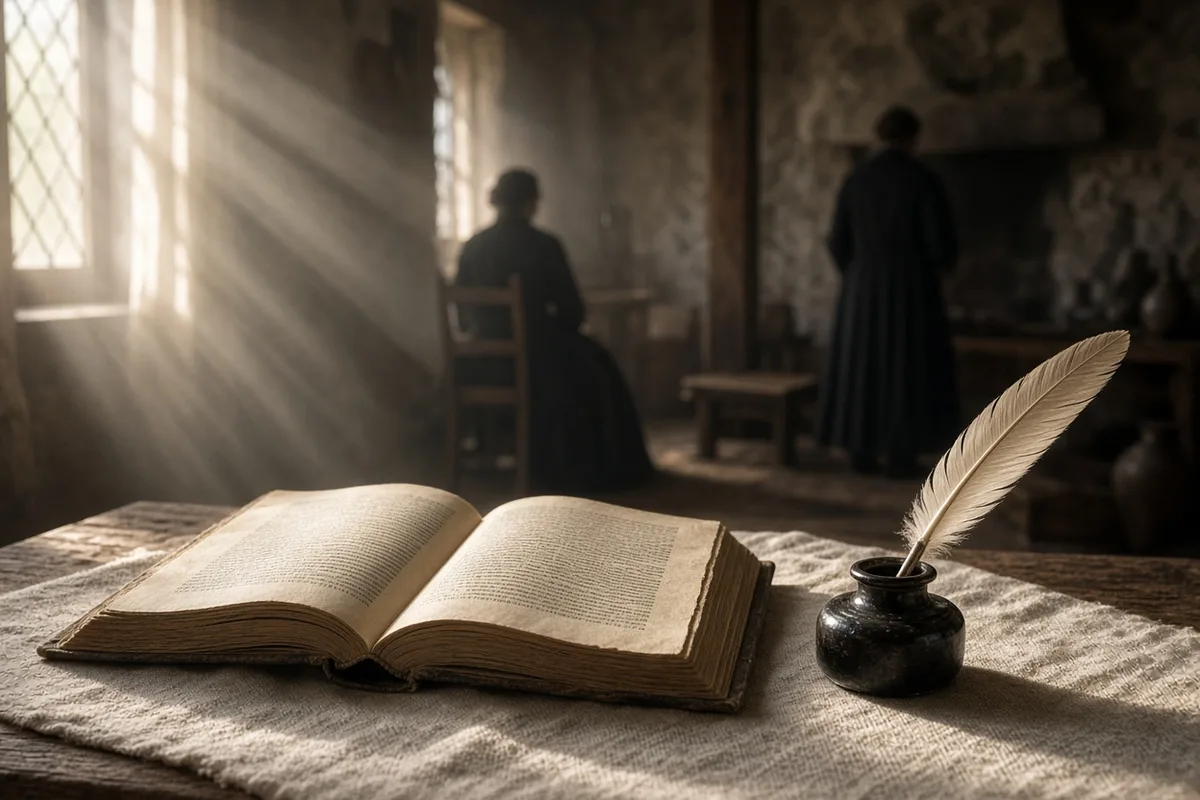
The house in Olney where Cowper and Newton worked on the hymns became the Cowper and Newton Museum in 1900, when the Olney branch of the Cowper Society purchased the building for four hundred and fifty pounds. The front room still contains the table at which the two men sat, and the original copy of the 1779 hymnbook lies open under glass at the page containing Cowper’s contribution for 1 January 1773. Visitors may read the verse from Romans that Cowper first encountered at St. Albans, because the same edition of the Bible was given to the museum in 1923 by a descendant of Dr. Cotton.
The last person known to have spoken with Cowper was his servant, Samuel Teedon, who recorded in a notebook dated 24 April 1800 that Cowper asked him to fetch the Bible once more and to read the twenty-fifth verse of the third chapter aloud. Teedon did so, then closed the book and placed it on the table beside the bed. He remained in the room until the morning light came through the window and Cowper’s breathing stopped. The notebook with that entry is now kept in the Norfolk Record Office in Norwich under reference number MC 161/4.
The servant Samuel Teedon copied the full entry for 24 April 1800 into a second notebook before he left the lodging house on the Market Place that afternoon, noting that the volume Cowper had requested measured eleven inches by seven and bore the imprint of the Oxford University Press edition printed in 1763. Teedon walked from East Dereham to the rectory at Mattishall and handed both notebooks to the Reverend John Johnson, who entered the time of death as half past five and added the observation that the room measured fourteen feet by twelve with a single north-facing window. Johnson then wrote to William Hayley at Eartham on 26 April, quoting the exact sentence Cowper had spoken at four o’clock that morning: “I feel the propitiation.” The letter reached Hayley on 29 April and was filed among his papers now held at the West Sussex Record Office under reference number Add Mss 2758.
Mrs. Mary Unwin had already been buried two years earlier in the churchyard of All Saints at Weston Underwood on 26 December 1796. The parish register records her age as seventy-two and the cause listed by the curate as “decline.” Cowper had attended the service but made no entry in his own diary that day; instead he wrote a single line to his cousin Johnson on 27 December stating that the coffin had been lowered at eleven in the morning and that the sexton had used thirty-six feet of rope. The same register notes that Cowper paid six shillings and eight pence for the grave space immediately to the left of the path leading to the south porch.
The six books of The Task, together with the shorter poems, appeared in a collected edition issued by Joseph Johnson in 1802 under the title Poems by William Cowper of the Inner Temple. The edition ran to 1500 copies and sold at sixteen shillings in boards. A copy now in the British Library carries the bookplate of the Throckmorton family and contains a marginal note in Cowper’s hand on page 147 of the first volume that reads “written at Olney 1783.” The same volume was displayed at the Royal Academy exhibition of 1803 in the room devoted to literary relics.
In 1900 the Olney branch of the Cowper Society paid four hundred and fifty pounds for the house on the Market Place and opened it to the public on 25 April of that year. The front parlour contains the oak table measuring six feet by three feet six inches at which Cowper and Newton sat; the table still bears the ink stain from the 1779 printing of the hymn “God moves in a mysterious way.” The Bible given to the museum in 1923 by Dr. Cotton’s great-grandson remains open at Romans 3:25 under a glass case whose lock is opened once each year on 1 January for cleaning. Attendance records for 1924 show that 1,872 visitors entered the building between May and September.
The Norfolk Record Office in Norwich received Teedon’s notebook under reference MC 161/4 in 1937 from the estate of Johnson’s granddaughter. The entry for 24 April 1800 occupies the lower half of folio 112 recto and is written in iron-gall ink that has faded to brown. A separate folder in the same collection holds the leather-bound manuscript of “The Castaway,” acquired in 1948 from the Johnson family at a sale conducted by Sotheby’s on 12 November. The manuscript consists of fourteen leaves measuring eight inches by five, with the final stanza dated 20 October 1799 in Cowper’s hand.
The church of St. Nicholas in East Dereham contains the marble tablet erected by subscription in 1802. The inscription records the date of death as 25 April 1800 and quotes the line from Romans that Cowper repeated on his deathbed. The tablet measures four feet six inches high by three feet wide and was carved by the mason John De Carle of Norwich at a cost of twenty-three pounds ten shillings. On 17 April 1950 the then rector, the Reverend Arthur W. Watson, noted in the service register that the tablet had been cleaned with a solution of one part vinegar to four parts water and that the lettering remained legible after one hundred and fifty years.
The last documented visitor to handle the Oxford Bible at the Cowper and Newton Museum was the curator Margaret M. Smith on 3 March 2019. She removed the volume from its case to replace the silk ribbon marker, which had frayed at the point where it had rested for ninety-six years. Smith recorded the action in the museum daybook, noting the exact verse number and the time the book was returned to the case as 11:42 a.m. The same daybook entry states that the temperature in the room was maintained at 18 degrees Celsius and the relative humidity at 45 percent.