




Apollo 13 Comes Home
'Houston, we've had a problem' became the greatest successful failure ever — three men brought home alive by duct tape, slide rules, and refusal to quit.
FaithTap · Oct 2, 2026 · 10 min read
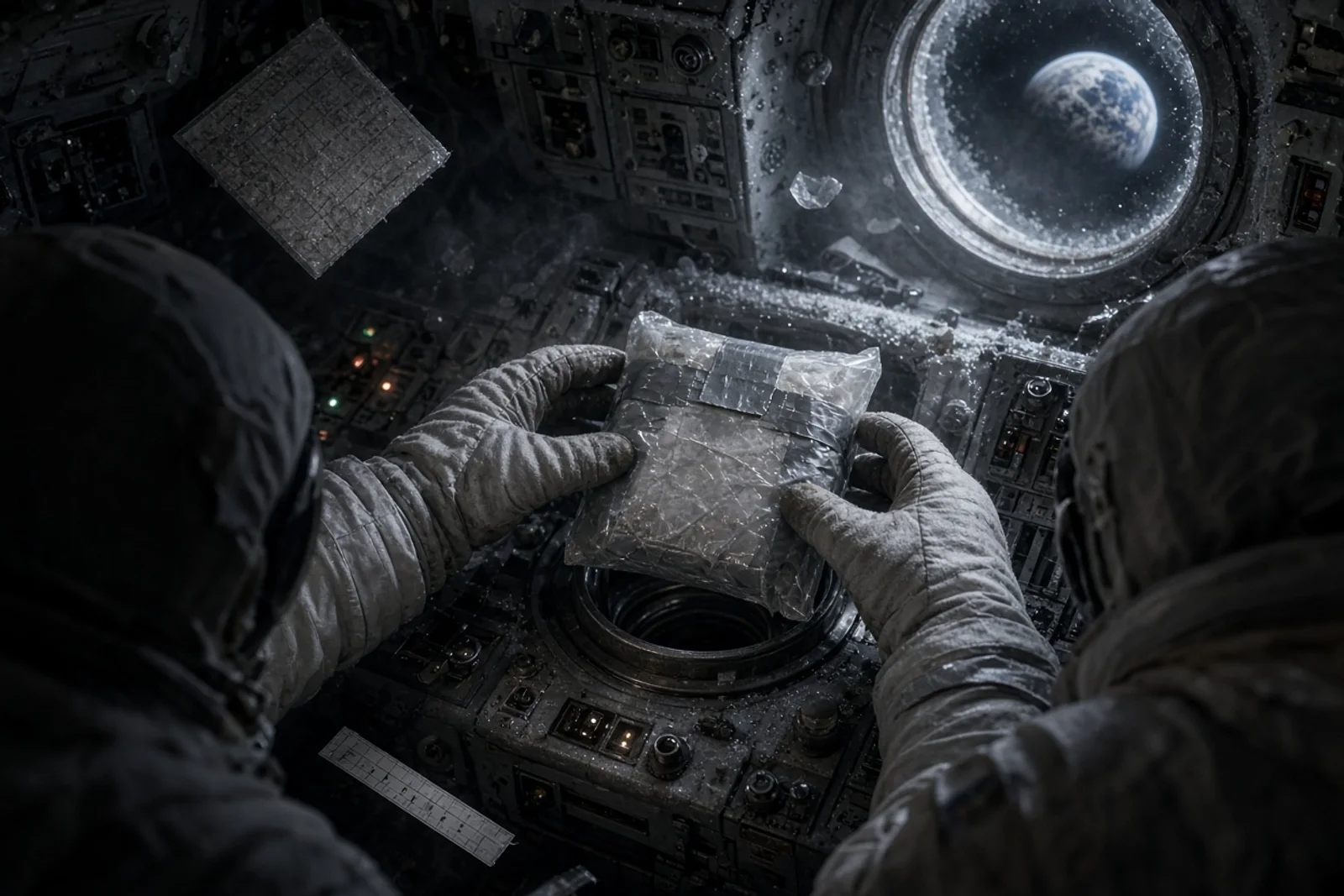
The call came across the loop like nothing at all — stir the cryo tanks, Swigert, routine as flipping a light switch on a wall you've flipped a thousand times. I had my headset on, my console cold under my palms, half my mind already on the coffee going stale in a styrofoam cup at my elbow. Two hundred thousand miles out. Third trip to the Moon in a year. We were bored, and we said so out loud, and thirteen minutes later the room stopped breathing.
The telemetry jumped like a struck nerve. Master alarm lights flared across board after board, and in my ear a voice — flat, controlled, fighter-pilot flat — said the words that would outlive every one of us in that room. Houston, we've had a problem. I remember looking at the number on my screen and thinking it had to be a bad sensor, a glitch, the kind of thing you chase down with a raised eyebrow and a checklist. Nothing in any simulation we'd ever run looked like this. Gene Kranz stood at his station with his hands flat on the console, and I watched him do the thing he always did, which was get quieter instead of louder.
Lovell was the one who told us what we didn't want to hear. He said he could see something venting outside the spacecraft, streaming off into the dark, catching the sunlight like a small silver cloud that didn't belong there. It was oxygen. It was the ship bleeding out in vacuum, and there was no way to stop it, and every one of us doing the math in our heads arrived at the same ugly number — the fuel cells were dying, and the fuel cells were the marrow of that ship.
Within the hour we understood the shape of it. Tank two had blown, and in blowing it had torn something in tank one as well, and between the two of them they were the reason those three men had power, water, oxygen to breathe. The Moon was still ahead of them, close enough that Lovell and Haise should have been strapping into a lunar module named Aquarius to set it down in the Fra Mauro highlands. That plan was gone in the time it takes a valve to fail. Nobody said the word abort out loud right away. Somebody didn't have to. We all felt the mission tilt underneath us like a deck at sea.
The decision that saved them was so simple it barely qualifies as brilliant, except that nobody in that room had ever rehearsed it for real. Aquarius still had her own oxygen, full and untouched, and her own engine, meant only to kiss the lunar surface and later lift off it. Command module Odyssey was dying around them. So the crew climbed through the tunnel into the lander and turned it into something it was never built to be — a lifeboat, built for two men for two days, now carrying three men for four.
I remember Fred Haise sleeping with his head against the ascent engine cover because there was nowhere else to put a body, and Swigert curled on the floor plating, and how the numbers we watched for power and water started behaving like rationed bread. The temperature inside dropped into the fifties in Aquarius and into the forties in the dead command module. The men put on their lunar overshoes just to keep their feet from going numb, and pulled on a second pair of underwear beneath their suits, and none of it looked like the space program anybody had sold to the public eighteen months before.
Carbon dioxide became its own quiet emergency, the kind that kills you without any drama at all if you let it. The lunar module's canisters were round. The command module had plenty of the square lithium hydroxide canisters, but they didn't fit the fittings built for round ones, and three men breathing into a sealed can for four days will poison their own air with their own lungs if nobody solves that shape problem. Down in Houston a team of engineers took exactly what the astronauts had on board — tape, a sock, cardboard from a checklist cover, a plastic bag — and built a way to jam a square peg into a round hole hard enough to keep three men alive. When Lovell read the instructions up and matched them piece by piece against what was floating around the cabin, I watched grown men on the console exhale like they'd been holding it for an hour.
Every burn after that was a decision made twice — once with a slide rule, once with a prayer nobody said aloud. There was no computer horsepower to spare, no room for the kind of guidance systems the mission had trained on for years, so the crew and the ground did trajectory work with pencils and paper and the LM's engine, meant to land on the Moon, doing the job of getting them home instead. They looped around the far side, out of every radio's reach for a handful of minutes that stretched like hours for everyone sitting in that room in Houston, and when the signal came back, it was still Lovell's voice, still steady.
He looked back at the Moon going away behind them, close enough to touch by any ordinary measure, and knew he was never landing on it. I've turned that thought over more times than I can count in the years since — a man circling the one thing he'd trained a decade to walk on, watching it recede, and saying nothing about it over the air that anyone remembers as complaint. There wasn't time for grief. There was a return trajectory to fly and a spacecraft with barely enough power to blink.