




Eucharistic Miracle of Buenos Aires
Host bleeds and becomes tissue
FaithTap · Oct 2, 2026 · 10 min read
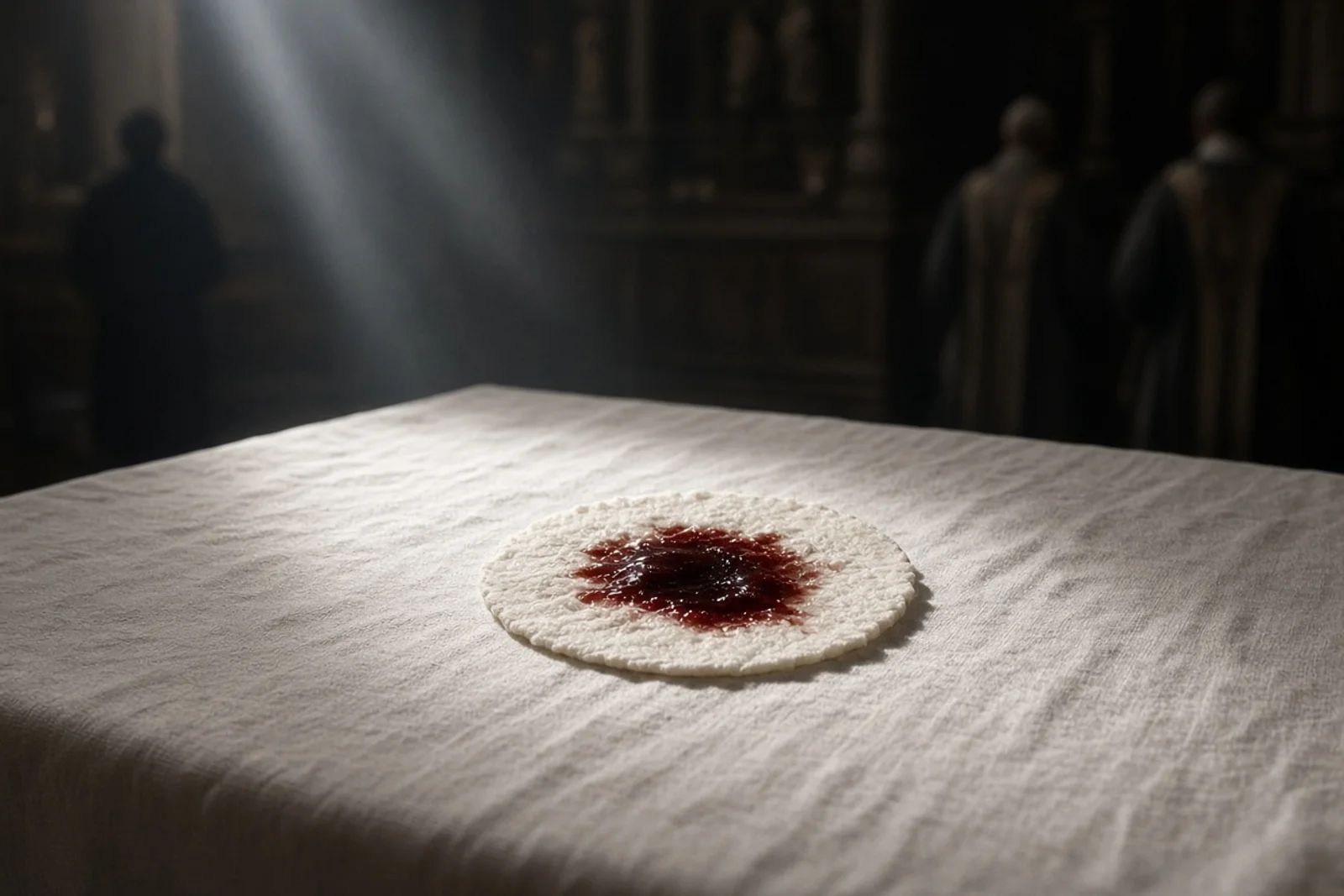
The candleholder stood at the far end of the pew, half hidden by the shadow of the last column. I had come early to straighten the kneelers before evening Mass, and the glint of something pale against the brass caught my eye first. A woman in a dark coat was already there, bent low. She straightened when she saw me and pointed without speaking.
Father Pezet listened in the sacristy doorway, one hand still on the doorframe. The host lay exactly where she had said, flat on the metal rim, the edge already softening from the warmth of the flame below. He wrapped it in a clean cloth and carried it straight to the tabernacle. The glass of water he poured was ordinary, the kind we kept for the flowers on the side altar. He lowered the cloth in, closed the door, and turned the key.
Three days later the key turned again under his hand. I stood a step behind him, holding the ledger we used for the tabernacle inventory. The water had gone faintly pink. The host itself had thickened and darkened at one end, the way bread does when it has soaked too long, except the color was wrong. Father Pezet said nothing. He locked the door again and told me to keep the sacristy quiet that week.
On the twenty-sixth the tissue had risen above the surface. It was no longer white. The surface looked raw, the way meat does after the outer layer has been peeled. Father Pezet sent word to the archbishop’s office before noon. Archbishop Bergoglio answered that the object should stay where it was and that photographs would be arranged. No announcement was made to the parish.
I began to check the tabernacle each morning before the first Mass. The tissue did not shrink. It did not cloud or separate. The water stayed clear except for a thin line of sediment along the bottom of the glass. By the end of September the color had deepened to the shade of dried blood along the edges. The center remained darker, almost black in certain light.
The photographer arrived on the sixth of September with a large camera and a tripod that had to be steadied against the altar rail. He worked quickly, never asking what he was recording. The prints came back two days later. Archbishop Bergoglio kept one set. The others stayed in the sacristy drawer. We continued to unlock the tabernacle only for the daily check and for the occasional visit from the archbishop’s representative.
Three full years passed that way. The glass never moved from its shelf. No preservative was added. The church heating stayed on through the winters and the humidity rose in the summers. Each time the door opened, the tissue looked the same. The water level had dropped only a fraction.
In the autumn of 1999 Archbishop Bergoglio decided the time had come for examination. Dr. Ricardo Castañon Gomez arrived with two assistants on the fifth of October. They brought a small case of instruments and a set of sealed containers. The transfer from the tabernacle to the case took less than three minutes. Dr. Castañon Gomez signed the logbook himself. The sample left the church that afternoon on a commercial flight to New York.
The laboratory in New York received the fragment without any history attached. Five scientists worked on separate portions. Dr. Frederic Zugibe received one slide. He examined it under ordinary light first, then under higher magnification. His report described striated cardiac muscle taken from the wall of the left ventricle, near the valves. He noted the presence of numerous white blood cells still intact inside the tissue. White blood cells, he wrote, do not survive long once removed from a living body. Their continued presence meant the sample had been taken from living heart muscle under stress.