




Fanny Crosby Trusts Christ at the Revival
Blind hymn writer Fanny Crosby responds to an altar call and begins composing thousands of gospel songs.
FaithTap · Sep 23, 2026 · 11 min read
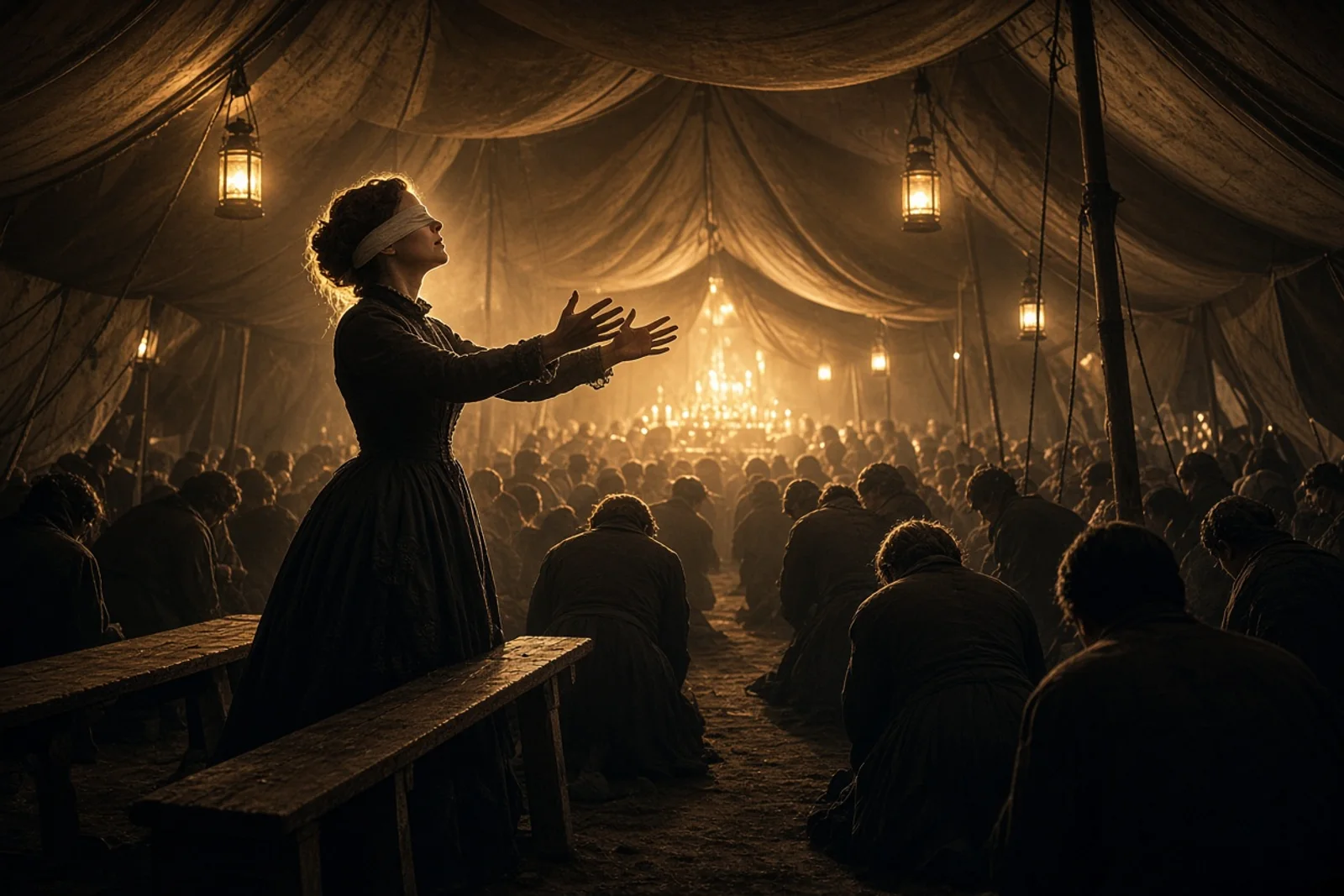
The gas lamps along Thirtieth Street threw long shadows across the wet pavement as we walked from the Asylum. Fanny kept her hand on my elbow the way she always did when the street felt unfamiliar. Her step was sure enough, but the air carried the weight of something she had not named yet. We had come every night that week. Two times already she had left her seat and moved toward the front when the preacher gave the call. Both times she returned with the same quiet set to her mouth.
The Tabernacle was already full when we reached the doors. The smell of damp wool and lamp oil met us inside. We found places on the left side, near enough to hear the preacher clearly but far enough back that the press of people did not crowd her. Fanny sat still through the singing. Her fingers traced the edge of the bench in small, steady lines.
On the third night she went forward again. I stayed where I was and watched her move between the rows. She knelt at the rail with perhaps a dozen others. The preacher spoke over them, but the words blurred under the low murmur of the congregation. When the meeting closed she stood, found my arm again, and said nothing on the walk back. Her silence was not the silence of peace.
By the middle of the month the nights had turned colder. We left earlier each evening so the streets would still be lit. Fanny spoke less on these walks. Once she asked whether the words of a hymn could carry a person where their own prayers had not. I had no answer that satisfied either of us.
On the twentieth the wind came off the river and cut through our coats. The Tabernacle felt warmer than the street, but only by a little. We took the same bench. Fanny’s hands stayed folded in her lap through the first part of the service. When the invitation was given she rose without a word and went alone.
She reached the altar rail and knelt. The singing began almost at once. It was Watts’s old hymn, the one about the Savior’s blood. The voices filled the room slowly at first, then steadied into the familiar lines. I could see Fanny’s shoulders from where I sat. They did not move with the rhythm of the others.
The fourth verse came. The line “Here, Lord, I give myself away” rose above the rest. Fanny’s head lifted. For a moment she stayed perfectly still. Then she stood so quickly the bench in front of her shook. Her voice cut through the singing, clear and sudden: “Hallelujah!”
The sound stopped the hymn. People turned. Fanny remained on her feet, one hand still on the rail, the other raised as though she had caught hold of something no one else in the room could see. The preacher stepped toward her, but she did not wait for him. She turned and came back down the aisle, moving faster than she usually did when she could not see the way. When she reached me she took my arm again, but her grip was different, tighter, almost laughing.
We left the building together. Outside the wind still blew, yet she did not pull her coat closer. She walked as though the pavement had changed under her feet. At the Asylum gate she paused only long enough to thank me for coming with her all those nights. Then she went inside alone.