




Graham Greene Conversion While Traveling
Novelist enters Catholic Church
FaithTap · Sep 24, 2026 · 12 min read
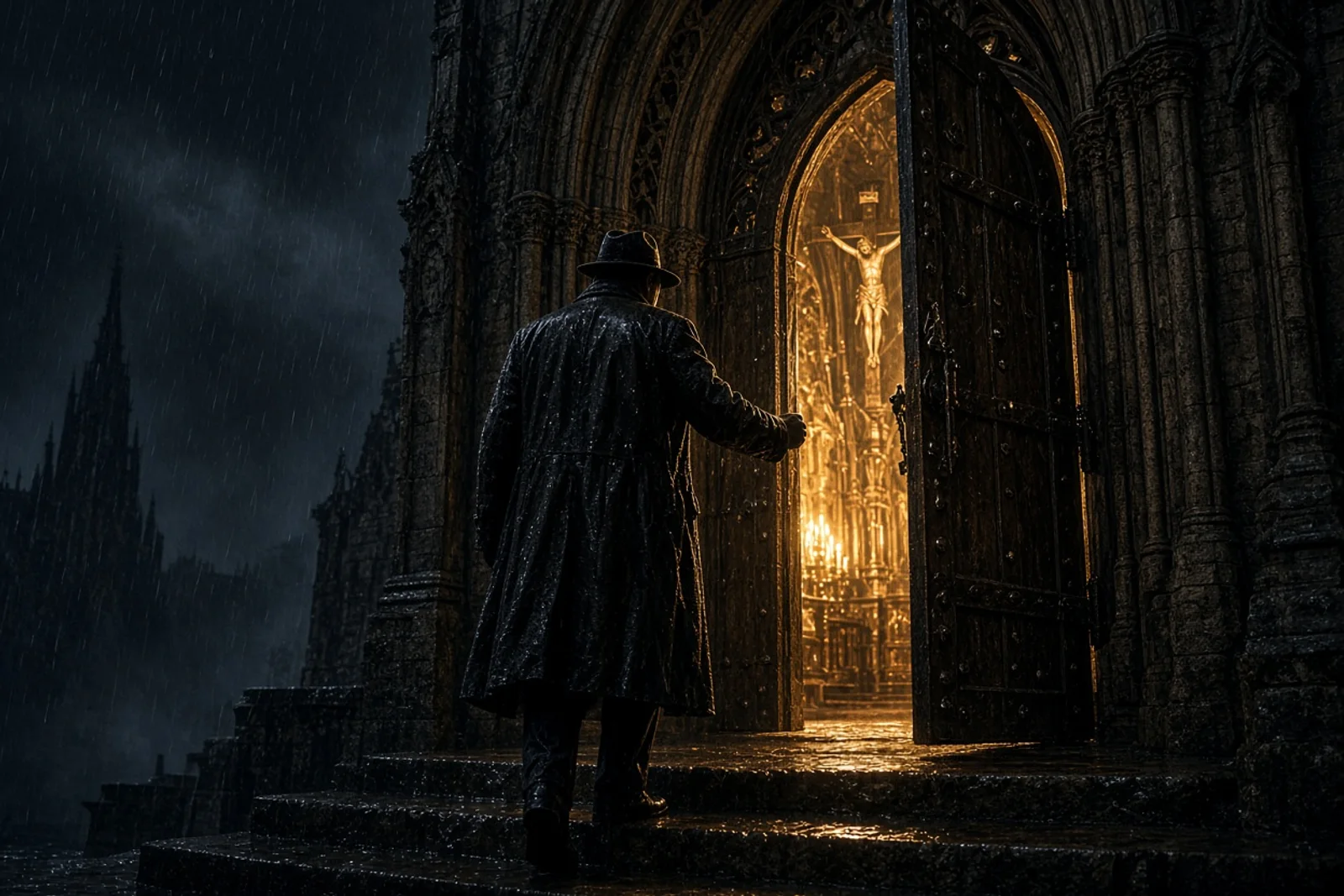
The train from London rattled through the late afternoon light, wheels biting the rails with a steady scrape that set my teeth on edge. I sat opposite Greene in the compartment, both of us bound for a short reporting assignment on the coast, our notebooks already half-filled with notes on dockside wages. He had said little since we left, only that his parents would expect a letter on his return. His father still ran the school at Berkhamsted with the same measured calm that had marked every conversation at their table, and his mother still spoke of religious matters as if they belonged to someone else’s household.
He carried a small volume of verse he had published the year before, three hundred copies printed and already hard to find. When I asked about it he shrugged, the gesture quick and almost embarrassed, then turned to watch the fields slide past. The faith he had grown up with, he told me once before, had stayed at the level of school hymns and the expected confirmation. No deeper root had taken hold. His grandfather’s departure from the pulpit after some private reckoning had left the family wary of strong feeling on such subjects.
We changed trains at a junction where the platform smelled of coal dust and damp wool. Greene bought a cup of tea from a stall and stood holding it without drinking while the station clock ticked above us. A woman in the crowd carried a rosary looped over her wrist; the beads caught the light as she moved. He watched the movement longer than necessary, then set the untouched tea down and walked to our platform without comment. That night, in the small hotel near the harbor, he asked the landlord whether a priest came through the town on Sundays. The landlord nodded and named the hour.
The next morning Greene walked out alone before breakfast. I saw him return two hours later with his collar turned against the wind, his face set in the same expression he wore when reading proofs. He spoke little of what had passed, only that instruction would begin when we returned to London. The decision, he said, was required if he meant to marry the woman he had met the previous year. No further explanation followed. We finished the assignment, filed the copy, and rode back on the same line. The compartment was colder this time, the windows streaked with early rain.
In the months that followed I saw him at intervals in the city. He attended the classes with the same steady attention he gave to revising a paragraph. His father’s letters continued to arrive, full of practical questions about work and health. Greene answered them promptly and said nothing of the other matter. His mother remained as she had always been, uninterested in the details of doctrine and content to leave such questions to those who claimed them. The change in him showed itself only in small habits: a refusal of certain engagements on Sunday mornings, a new care in how he spoke of the poor in the districts we covered together.
By the time his first novel appeared he had already been received. The reviews spoke of promise and of a young writer finding his subject. Greene read them once, folded the papers, and placed them in a drawer. He continued to write each day, the same hours he had kept before, but the sentences now carried a different weight. He no longer described human nature as a matter of progress or simple improvement. The characters he set down bore the marks of failure and of something that survived failure. He told me once, on another journey, that the older view of the world had left him nothing to measure against his own actions.
We traveled together again two years later, this time farther north. The train passed through stations where the names on the platforms meant nothing to either of us. Greene looked out at the passing sidings and said the instruction had been the simplest part. Living with what followed was the work that did not end. He kept no record of the day he entered the church, only the date of the marriage that came after. When I asked whether he still felt the same distance from the religion of his boyhood, he answered that distance was no longer the question. The question was what remained once the distance closed.
In later years the books continued to appear, each one carrying the same pressure of attention to the gap between what people claimed and what they did. He never spoke of the conversion as a finished event. It stayed with him as the ground on which the later work rested, visible only when the light fell a certain way. On the last journey we took together he carried a worn missal in his coat pocket and removed it only when the conductor checked tickets. The beads of another traveler’s rosary caught the light once more as the train slowed into the station, and Greene watched them the way a man watches something he has learned not to look away from.
The station platform at Crewe held the same coal smell as the earlier junction, and Greene stepped down first, his hand already reaching for the timetable pinned under glass. He had arranged to meet Father Trollope again on the following Tuesday at St Dominic’s Priory in Hampstead, the instruction sessions now fixed for six o’clock each week. The register later recorded his reception on 28 February 1926, the same month his first signed review appeared in The Times Literary Supplement under the heading “The New Poetry.” Vivien Dayrell-Browning’s letters from that period, preserved in the Bodleian, mention the exact train times he kept to avoid missing the classes. He bought a missal at Burns & Oates on the way back from the priory, the edition priced at three shillings and sixpence, and carried it inside the same coat pocket that had once held only the thin volume of verse.