




Mary Slessor Stops the Killing of Twins
A Dundee millworker sailed to Calabar, moved in where no European would live, and ended the abandonment of twin babies — dozens of whom she raised herself.
FaithTap · Sep 25, 2026 · 9 min read
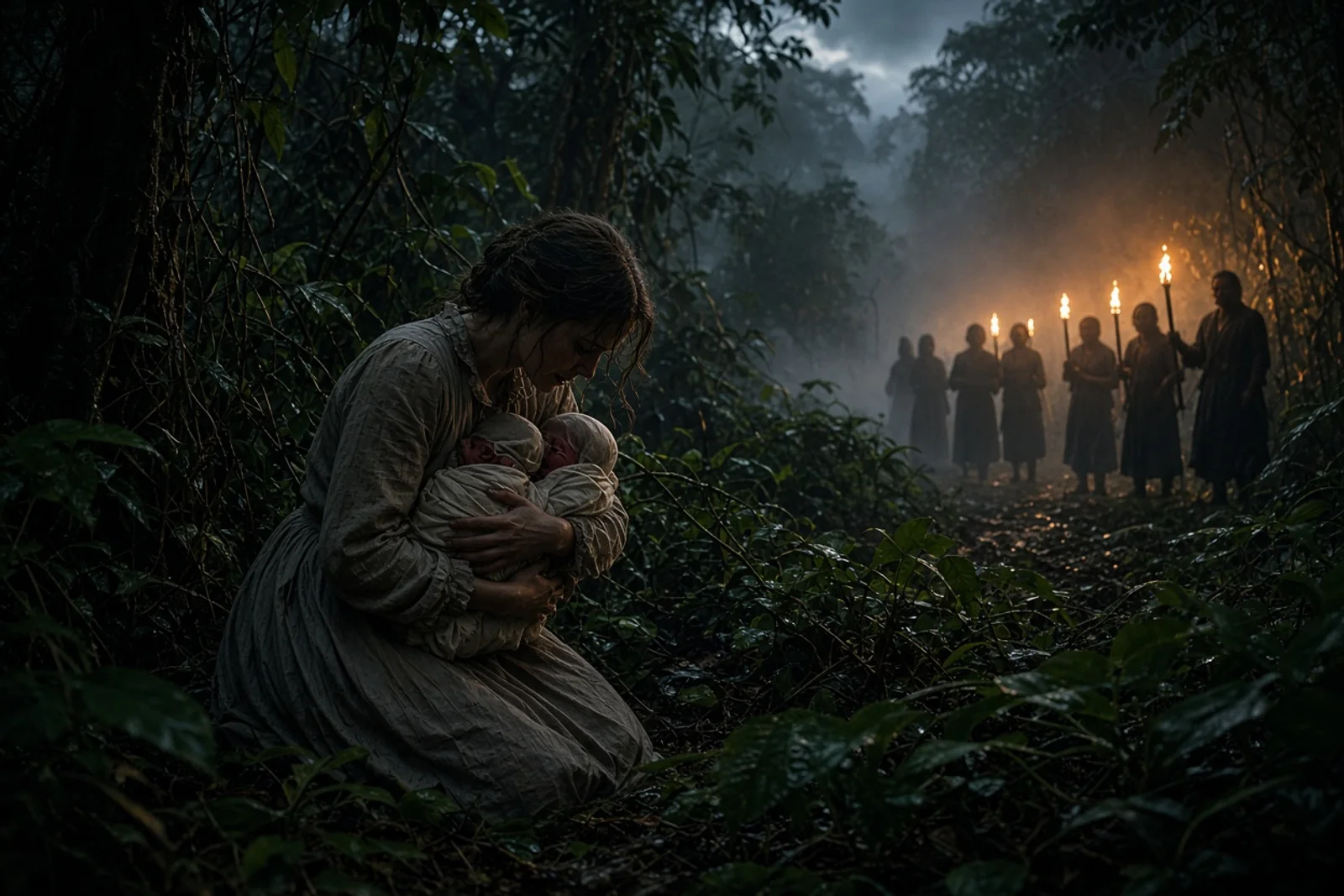
I ran because Ma ran, and when Ma ran through the bush at Okoyong there was no keeping up with her by walking. Mud sucked at my ankles. Ferns whipped my arms. Somewhere ahead of me her red hair had come loose from its pins, and I could track her by that alone, a rust-colored flash between the palms, moving toward a compound where a woman had just given birth to two children instead of one.
I had heard the wailing before I saw the huts. Not the wailing of grief exactly. Something else. Fear has its own pitch, and the people of that compound were making it, gathered at a careful distance from a hut as if the air near the door might poison them.
We had grown up knowing what twins meant. One of the two children was fathered by an evil spirit, the elders said, though nobody could say which one, and so both were guilty by default, and the mother was guilty too, marked as a woman who had let something unclean pass through her body into the world. A birth like that was not a joy in Efik country. It was a catastrophe waiting to happen to everyone nearby unless it was stopped, and stopping it meant the bush, meant a broken pot for a coffin, meant leaving the small bodies out where the ants and the leopards would finish what the fear had started.
This was not new in the year Ma came among us, and it did not end with her arrival either, whatever the stories later told in Scotland liked to claim. Long before I was born, a British consul named Beecroft had struck a bargain with King Eyo the Second and King Archibong the First, back in 1849, promising an end to the killing. The chiefs agreed, then the agreement crumbled, the way promises do when no one is watching, and by 1855 Beecroft came back with soldiers and pulled down part of a town to make his point stick. That same year another consul, Hutchinson, wrung a fresh promise out of King Duke Ephraim and the assembled chiefs. And a missionary named Edgerley, with his wife, had already gone out into the bush in 1852 and carried back living twins with his own arms, the first time anyone in the mission records could say for certain that it had been done and word had gotten around. Twenty-one years of agreements and threats and rescues had passed by the time Ma Slessor's ship dropped anchor. I want that remembered, because it is true, and because it does not make what I watched her do in Okoyong any smaller.
She had not been born to any of this. She had been born in Aberdeen and raised in Dundee, in a house where her father drank himself toward an early grave and her mother held to the kirk like a rope in deep water. Mary went into the jute mills as a girl, twelve hours at the frame, and she gave nearly everything she earned to keep her brothers and sisters fed. She used to say she wanted to go where David Livingstone had gone, out to the unmapped places, and in 1876, twenty-eight years old, she sailed for Calabar on a ship called the Ethiopia, carrying almost nothing and expecting, I think, that God would supply the rest.
At first she lived the way missionaries were supposed to live, inside the compound walls with the other Europeans, learning the Efik tongue from a patient old teacher named Hugh Goldie, keeping her Sundays and her linen proper. But something in her would not stay inside those walls. She started eating what we ate, going hungry sometimes because she had posted her wages home to Dundee and had nothing left for herself. She learned to speak the way we spoke, not the missionary version but the market version, the version with jokes in it. Her hair gave her away everywhere she went, that red under the sun like a coal that would not go out, and her eyes were pale as rainwater, and children stared, and old women reached out to touch her sleeve just to see if a white woman's skin felt like anything at all.
So when word came that a birth had gone wrong in a compound not far from her house, she did not send a boy to fetch the elders and wait politely for permission. She went herself, and those of us who had learned to follow her went with her, because we had already seen what happened when nobody came in time.
We reached the hut and the smell told me before my eyes did. Somebody had wanted this over with quickly. A woman crouched near the doorway, and I remember her hands, how she kept them pressed flat against her own knees as if to stop them from moving toward the babies lying just inside on the packed dirt floor. Two of them. Small enough to fit both inside the crook of one arm. Nobody in that compound would touch them, not the mother, not the aunts standing back near the cooking fire, not the men who had already gone for a broken pot big enough to serve as a grave.
Ma did not shout. That was the strange thing about her, that she never seemed to need to shout. She dropped to her knees on that dirt floor as if it were a church floor, and she gathered up both children against her chest, one against each shoulder, and I heard her murmur something low in Efik that I was too far back to catch. The men with the pot stopped where they stood. Nobody moved to take the babies from her. I do not think anybody there had ever seen a person, black or white, walk directly toward a curse without flinching.