




Maximilian Kolbe Takes a Stranger's Place
When a prisoner was condemned to die at Auschwitz, a Polish priest stepped forward: 'Take me instead.'
FaithTap · Sep 22, 2026 · 9 min read
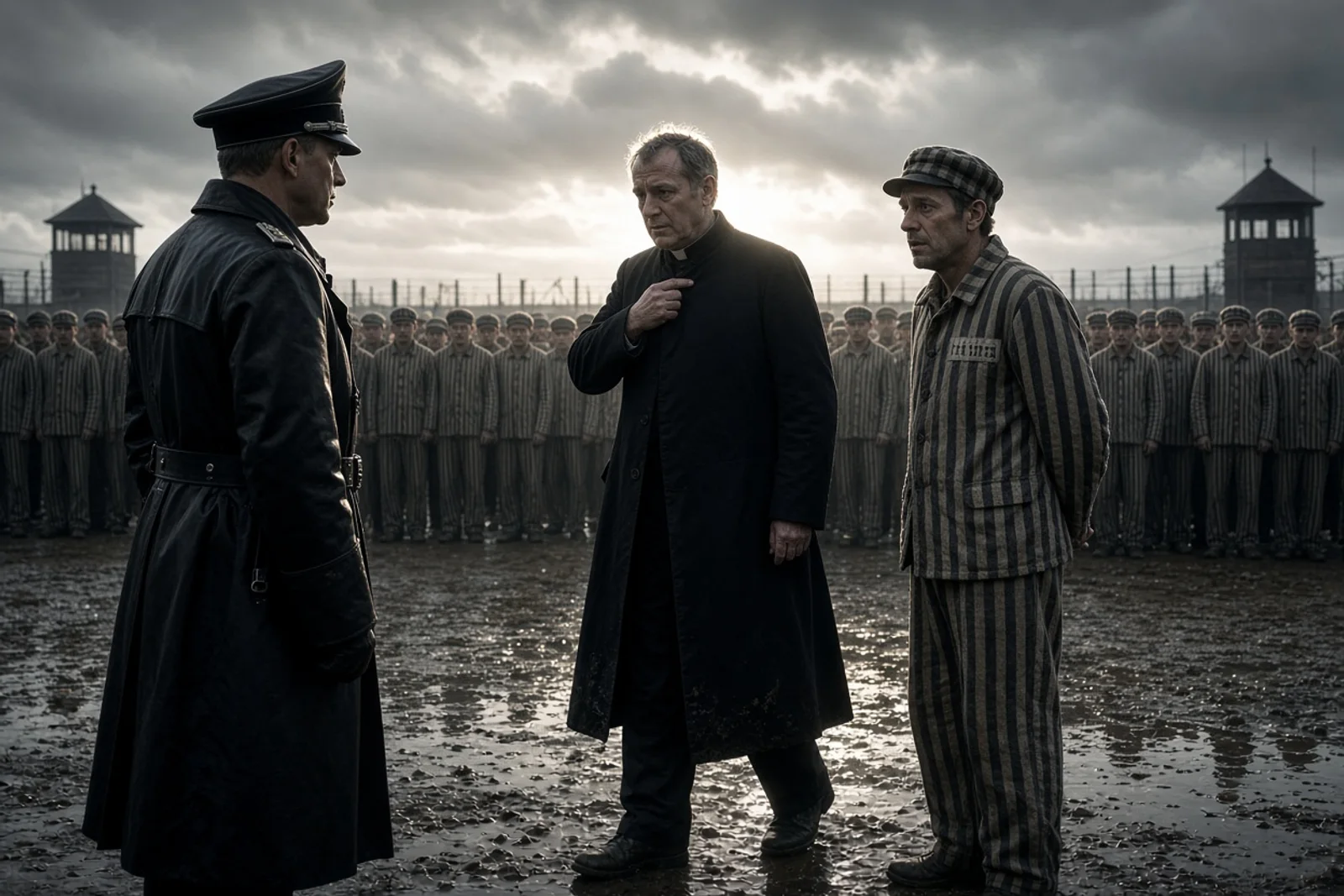
The whistle came at five, same as every morning, and my feet were already raw inside my clogs before we reached the gate. Block 14 stood in the gray light like all the others, a long brick shape with nothing behind its windows. I had been at Auschwitz since the spring, long enough to know the sound of boots that meant nothing and the sound of boots that meant everything. That July morning, after the evening roll call three days before, we all understood what was coming. A man from our block had gone missing. The camp did not use the word escape carefully. It used it like a match to dry grass.
We stood in the yard for hours, rows of us in striped cloth gone thin at the knees, while Karl Fritzsch walked the lines. He was the deputy commandant, and he had a way of looking at a man that made the man feel already dead. Word passed low along the ranks before he even opened his mouth — ten for one, they always take ten for one, the ratio was as fixed as the layout of the barracks. We watched him move down the row of faces, counting nothing but making us feel counted, and every one of us tried to become smaller, tried to become someone his eyes would slide past.
He stopped in front of a man near me, a sergeant from the reserves named Franciszek Gajowniczek, prisoner number 5659. Fritzsch pointed. That was all it took, a finger, and Gajowniczek's face did something I still see when I close my eyes — not fear exactly, past fear, into the place where a man's whole life rushes up behind his eyes at once. He cried out. He said he had a wife. He said he had two sons who would have no father. It was not begging so much as a kind of drowning, a man going under and reaching for anything.
Nothing reached back. Ten men had been chosen and Fritzsch did not unchoose them. That was the shape of the camp — decisions did not bend, they only broke people who stood in front of them. I remember the stillness that followed Gajowniczek's outburst, the particular silence of hundreds of men agreeing without a word to look at the ground, because looking up cost something none of us could spare.
Then a man stepped out of the ranks. I did not know his name yet, only that he was older than most of us, gaunt in the way of men who had already been fasting long before the camp started starving them for him, with round spectacles and the calm of someone who had decided something before his feet ever moved. He walked toward Fritzsch the way you would walk toward a superior you were not afraid of, which in that place was its own kind of miracle, because fear was the only weather we had.
He said he was a Catholic priest from Poland. He said he had no wife, no children, and that the other man did. He asked to be taken instead.
Fritzsch did not answer him at once. There was a pause that felt longer than it could have been, the whole yard holding its breath in a way you could almost hear, hundreds of men who had learned not to want anything now wanting, silently, furiously, for this one strange request to be granted. Fritzsch asked him something — who he was, what he was — and the man repeated it, priest, missionary, no family. Something in that answer seemed to satisfy the deputy commandant in a way nothing else could have. He nodded. He said the substitution would be permitted.
I did not know his name then. I would learn it later the way we learned everything in that place, in fragments passed hand to hand at the wire, at the soup line, in the dark: Maximilian Kolbe, prisoner 16670, a friar from a monastery outside Warsaw called Niepokalanów, arrested that February with four of his brothers, brought to Auschwitz at the end of May on a transport of over three hundred men from the Pawiak prison in the city. None of that meant anything to me in the yard that morning. What meant something was simpler. A man had traded his life for a stranger's, in the open, in front of guards who killed for entertainment, and the guards had let it happen.
Gajowniczek did not move for a moment, as if his body had not caught up to what his ears had heard. Then he was pulled back into the ranks of the living, and the ten condemned men, Kolbe among them now instead of him, were marched away toward Block 11.