




Robert Raikes Starts Sunday School Movement
Journalist teaches prisoners' children
FaithTap · Sep 24, 2026 · 11 min read
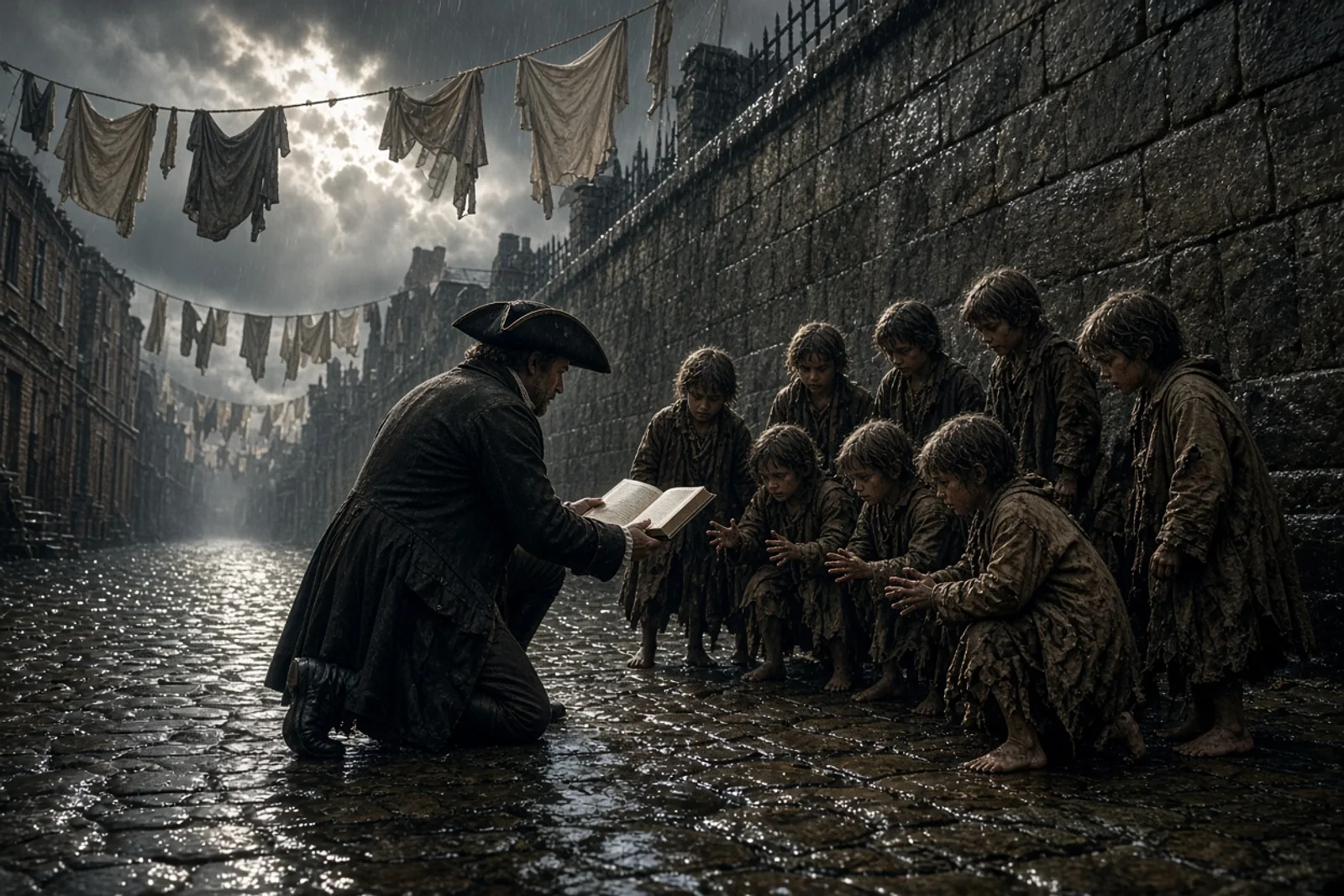
The children tore past the pump at the end of my lane, bare feet slapping the cobbles, one of them swinging a dead rat by the tail. Sunday meant nothing to them except an empty stretch of hours. I had just set a bucket down when Robert Raikes came round the corner with his hat pulled low against the drizzle. He stopped and watched them disappear toward the meadows.
He had been writing about the gaol for years by then. Men and women locked together, children born on the straw, no food unless the felons shared their own crusts. Raikes paid for some of those crusts himself. When he turned from the lane I followed at a distance, curious what had pulled him out on a damp afternoon.
We reached the edge of St Catherine’s meadows. A woman stood there with a basket of washing, her arms red from the stream. Raikes spoke to her. She pointed at the figures already kicking up mud and shouting across the grass. I heard only fragments, something about their mothers working the pin factories and no one to keep them from the river or the alehouse doors. Raikes nodded, wrote a note in a small book, and walked back toward the city.
A week later he found Thomas Stock, the curate, outside St Mary le Crypt. They stood under the porch while rain ran off the roof. Stock had already tried a few children at Ashbury on Sundays. Raikes offered to pay most of the teacher’s wage if Stock would draw the rules. Stock agreed. They hired a woman from the next parish for one shilling from Raikes and sixpence from Stock. The room they rented smelled of damp plaster and old hymnbooks.
On the first morning the children arrived in twos and threes, some barefoot, some in shirts stiff with river mud. I stood across the lane with a basket of mending and watched them file in. One boy tried to bolt. Raikes caught him gently by the shoulder and spoke low until the boy came back inside. The teacher began with the alphabet on a board. By midday the noise had dropped to a steady murmur of repeating letters.
Raikes came every Sunday after that. He would stand at the back, hands clasped behind him, listening. When a child stumbled over the Lord’s Prayer he would step forward and say the line once, then wait for the repetition. Stock visited less often, busy with his own parish, but the rules he had written stayed pinned to the wall. No swearing, no fighting, shoes wiped on the mat. The children tested every line at first. One afternoon two boys fought over a slate until Raikes separated them and made them sit on opposite benches for the rest of the hour.
By the second month the street outside the room grew quieter on Sundays. Neighbours noticed. A woman whose boy had once thrown stones at her windows stopped me at the pump and asked whether the school would take her daughter as well. Raikes agreed without extra charge. He paid the teacher from his own pocket for three more children that week.
Word travelled to other parishes. A man from Painswick walked over one Sunday to see the room for himself. He left with a copy of the rules in his coat. Within a month a similar school opened there, using the same payment split between two local men. Raikes printed nothing about his own part. He only mentioned the children learning to read and sit still.
In November 1783 he slipped a short notice into the Gloucester Journal. It said the experiment in St Mary le Crypt had kept twenty-three children off the streets for several months and that they could now repeat the catechism. He signed no name. Letters began arriving from Sheffield and Leeds. One came from Colonel Townley asking for details. Raikes answered at length, describing the cost of the teacher, the hours from eight until noon, the value of starting with the youngest. The letter found its way into the Gentleman’s Magazine the next year.