




Simone Weil's Encounter with Christ
Philosopher Simone Weil experiences a profound encounter with Christ while reciting poetry.
FaithTap · Sep 24, 2026 · 10 min read
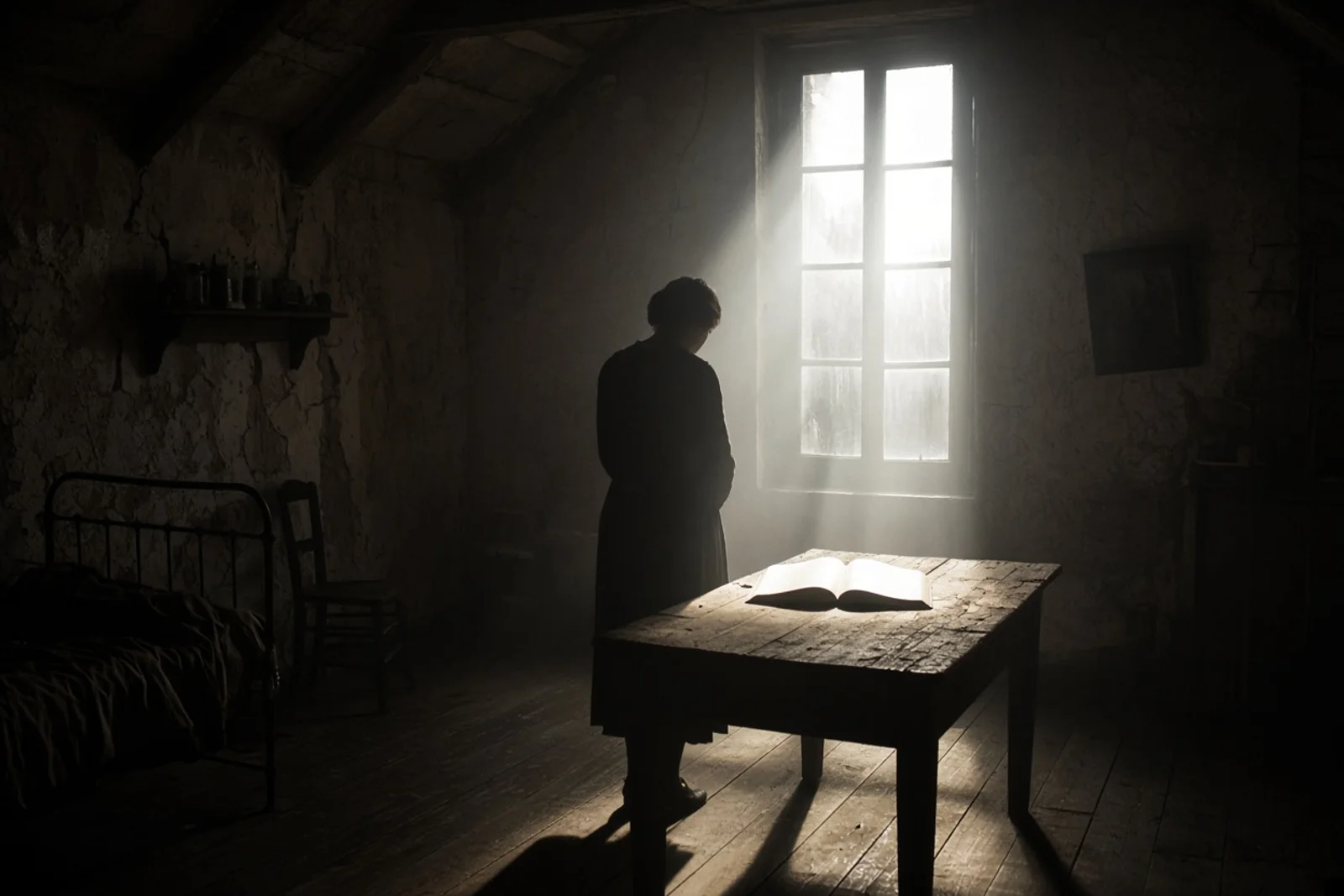
The abbey bells had already begun when I reached the cloister gate. Cold spring light slanted across the stones. Inside, the chanting had started without us. I slipped through the side door and found a place near the pillar where the sound carried clearest. Simone Weil sat three rows ahead, shoulders rigid, one hand pressed flat against the wood of the bench. She did not turn.
Her migraines had followed her from Paris. She had told the Englishman about them the day before, in the courtyard after Terce. He listened without offering remedies. Later he mentioned the seventeenth-century poets, and she asked for the name of one poem in particular. He wrote it on the back of a service leaflet. That evening she copied the lines into her notebook while the rest of us walked the garden paths.
By Wednesday the headaches grew worse. During the long responsories she kept her eyes shut and her mouth barely moving. When the sound of the organ swelled she would lean forward until her forehead touched the bench in front. I watched the muscles along her neck tighten and release with each breath. She never left her place.
The Englishman received communion on Holy Thursday. When he returned to his seat his face looked different, as though the light in the nave had shifted only around him. Weil noticed. She asked him afterward what had happened. He answered simply that the sacrament carried its own strength. She wrote that down as well.
On Good Friday the nave was colder. Rain had started outside and the stone held the damp. Weil stayed through the entire reproaches. At one point her breathing changed; I thought she might faint. Instead she straightened, opened her eyes, and followed the text in the book as though nothing had interrupted her. After the service she asked the Englishman for the full text of the poem he had mentioned. He gave her his own copy.
She learned it that same night in her room. I heard the low repetition through the thin partition. She stopped only when the words tangled with the pain. By Saturday she could recite the whole piece without the page. She tested herself during the Vigil, lips moving between the louder passages of chant.
Easter morning the abbey filled early. Weil arrived before most of us. She took the same place. When the Gloria began she closed her eyes again, but this time her hands stayed still in her lap. The headache arrived midway through the sequence. I saw her shoulders draw inward. She began the poem under her breath, the same lines, over and over, each syllable measured against the next wave of pain.
Her face changed first around the mouth. The tension did not leave, yet something else entered it. She stopped reciting. For several minutes she sat without moving while the liturgy continued around her. When the final blessing was given she remained seated until the nave emptied. The Englishman passed her on his way out. He did not speak. She nodded once.
She left Solesmes on Tuesday with the poem still in her notebook. In the following weeks she sent copies to her brother in prison and to the poet Joe Bosquet, whose paralysis kept him in bed. She told them the lines had worked on her without her permission. The same year she began writing about affliction and the love that meets it inside the suffering itself.