




St. Anselm Writes Cur Deus Homo in Exile
Anselm pens his classic defense of the atonement while banished.
FaithTap · Sep 26, 2026 · 11 min read
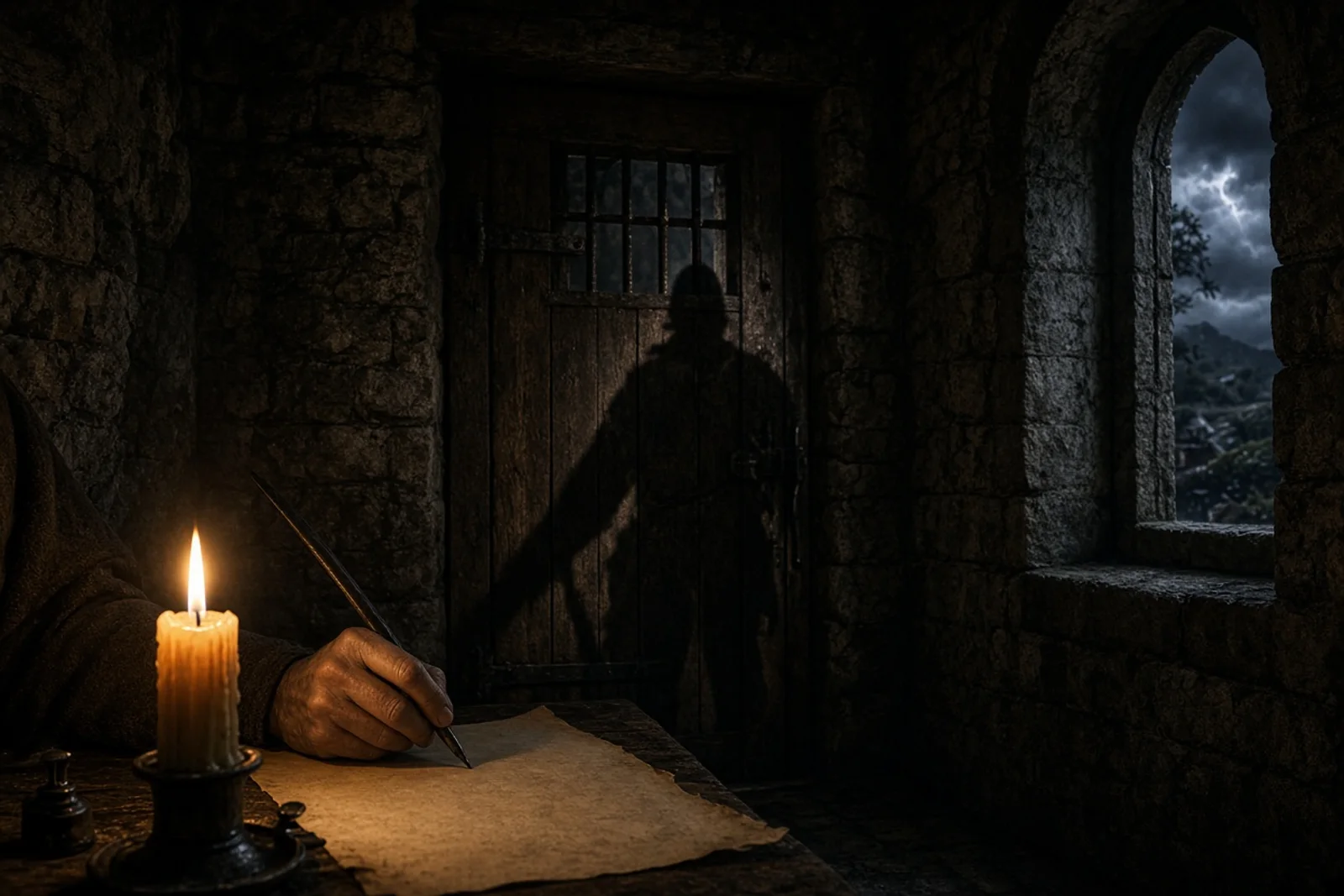
The path into Sclavia narrowed between two rock walls that still held the night's cold. My mule balked at every loose stone, and I kept one hand on the lead rope while the other gripped the strap of the satchel that held our ink and spare quills. Anselm rode in front without looking back. He had said little since we left the coast road three days earlier. The village appeared suddenly, a scatter of low stone houses and one larger building with a tiled roof that caught the late sun.
We were given two rooms above the refectory. The smaller one held a table and a bench set under a narrow window that looked toward the sea. Anselm set his travel chest against the wall and asked for parchment. By the next morning the first sheets were already ruled and the first lines set down in his small, even hand. He worked from first light until the heat pressed through the shutters. Then he would walk the single street of the village, head bent, hands clasped behind his back, until the air cooled enough to return.
Eadmer arrived a week later with two more monks from Normandy. He brought news that the king still refused Anselm's return and that letters from Canterbury had been intercepted. Anselm listened, nodded once, and went back to the table. Eadmer took the bench opposite and began copying the pages as they were finished so that another set could travel north when the chance came.
The arguments grew longer each day. Anselm would stop in the middle of a sentence, stare at the wall, then scratch out a line and begin again. Sometimes he dictated while Eadmer wrote. The words came slowly at first, then faster, as if the question itself pulled them forward. Why had God become man? The answer had to stand without the king's favor or the pope's immediate help. It had to stand on the page alone.
One afternoon a messenger from the local count appeared at the door. Anselm rose, spoke with him briefly in the yard, then returned and asked for the latest sheet. He read what he had written the day before, crossed out two sentences, and continued. The count's man left without an answer. That evening Anselm ate little and went back to the table by lamplight.
The heat of July settled over the mountains. Flies gathered on the inkhorn. We kept a cloth over it between dips. Anselm's fingers grew stained to the second knuckle. He never complained of the discomfort. When the light failed he would sit with his eyes closed for a long time before allowing the lamp to be lit again.
Eadmer asked once whether the work should wait until they were back in a place of safety. Anselm answered that safety was not promised and the question would not wait. He resumed writing before Eadmer could reply. The pages accumulated in a neat stack at the corner of the table, each one numbered in the margin so that the copies could be matched later.
A fever took one of the younger monks who had traveled with us. Anselm left the table for half a day to sit with him, then returned and picked up the sentence where he had stopped. The monk recovered enough to sit outside, but the work did not slow. By the middle of August the last section was under way. Anselm wrote the closing argument in a single sitting that lasted past midnight. When he set the quill down he flexed his hand open and closed several times before standing.
The completed manuscript was placed in a leather wrapper and tied with cord. Eadmer made arrangements for two copies to be carried separately, one toward Rome and one toward Normandy. Anselm kept the original with him. He did not speak of what would happen to it next. He only said that the question had been answered as far as one man could answer it.