




St. Columbanus Founds Luxeuil Abbey
Irish monk plants monasteries across Europe.
FaithTap · Oct 5, 2026 · 11 min read
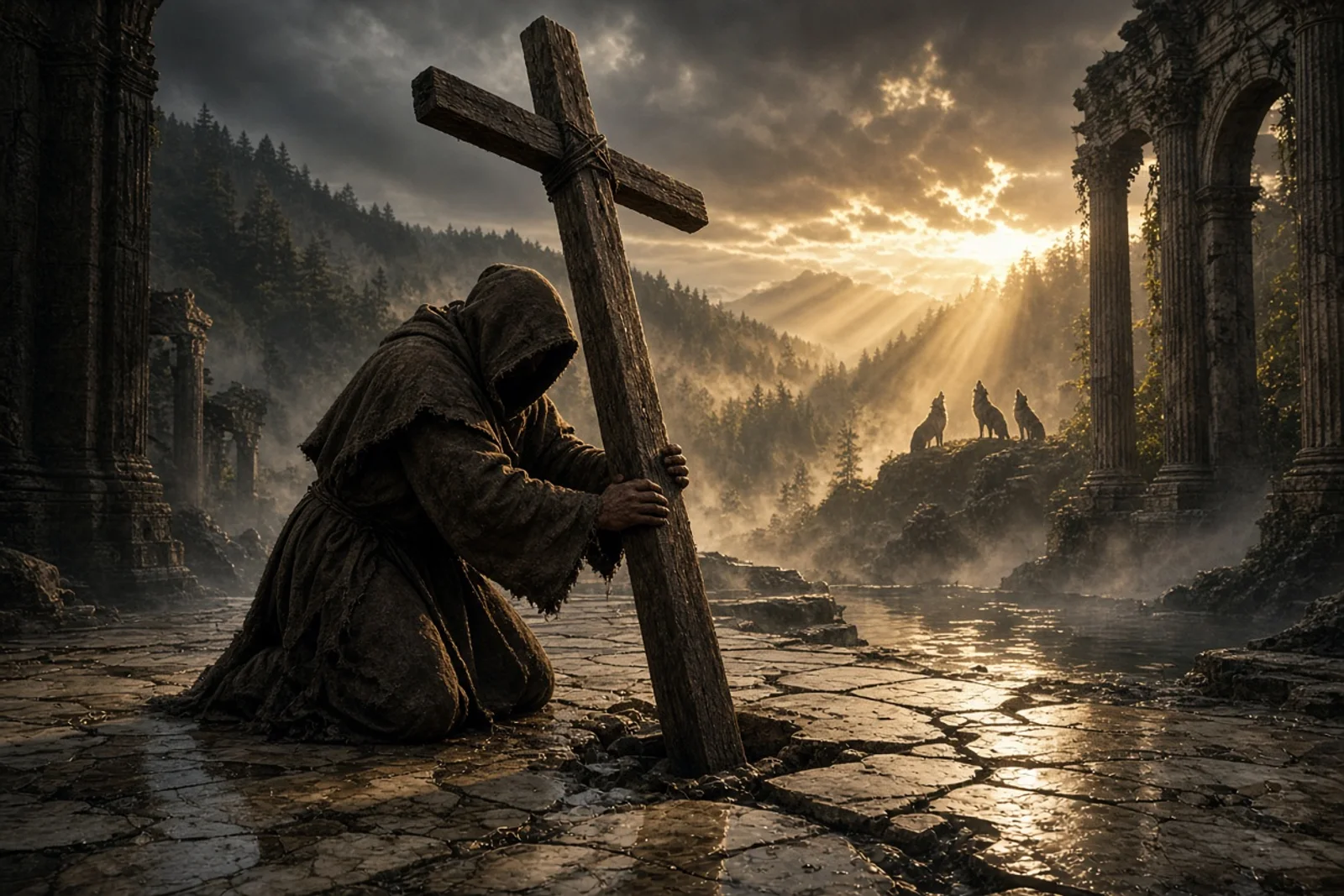
The path from Annegray climbed through beech and pine, and my feet knew every root. I had carried messages between the half-fallen fort and the king’s hall for three winters, and when the monks asked for a guide who could find dry ground after rain I went with them. Columbanus walked at the front, his staff tapping stone. Gall followed three paces behind, carrying the heaviest satchel of books. The others strung out in a line that never broke, even when the slope turned steep.
We reached the old baths at midday. Steam still rose from the cracked basins where the Romans had piped hot water. Vines had split the mosaic floors. A single standing wall showed a faded hunting scene, hounds chasing a stag whose antlers were now only faint lines. Columbanus stopped at the edge of the largest pool and set his staff down. He did not speak at once. He looked at the water, then at the broken columns, then at the ring of us waiting.
Sigisbert and Waldoleno began clearing leaves from the nearest channel. The water ran clearer once the debris was gone. Attala knelt and tasted it, nodded, and passed the cup to Columbanus. The abbot drank, then handed the cup to me. I had tasted that water before, alone, when fever drove me to the springs. It tasted the same, sharp and warm.
By the second day we had roofed three rooms with new thatch cut from the slope above. The monks worked without pause, yet they paused whenever a villager appeared on the path. They offered bread and asked the visitor’s name. Most came only to stare. A few stayed to lift stones.
On the fifth morning a messenger from Gontram arrived on a tired horse. He carried a sealed letter and a small chest of coins. Columbanus read the letter aloud to the community after supper. The king granted the land and the springs, with the condition that the monks pray for his house. No one cheered. Columbanus folded the parchment and placed it inside one of the books Gall had carried.
I watched the first sick person arrive two weeks later, a woman whose joints had locked. She came leaning on her son. Columbanus met her at the gate, listened to her story, then sent her to the warmest basin with instructions to stay until the water cooled. Gall prepared a simple draught from herbs gathered that morning. She left at dusk able to open her hands. Word spread faster than the monks could build beds.
The nights grew colder. We slept in shifts so the fire in the main hall never died. Columbanus often stayed awake longest, copying lines from the books onto new parchment by the light of a single rush. Once I asked him why he wrote again what was already written. He answered that every copy was a new voice in a new place. Then he returned to the page.
By the first frost the enclosure held twenty men who had not come from Ireland. Some were hunters who knew the forest paths. Others had worked the old Roman fields before the land went wild. Columbanus gave each the same rule: private confession, fixed penance, labor shared. He spoke the rule in Latin, then in the tongue of the valley so no one would mistake it.
One evening a man arrived carrying a carved stone head, the last remnant of the old spring shrine. He set it at Columbanus’s feet without a word. The abbot lifted it, turned it once in his hands, and carried it inside. I never saw it again. The next morning the same man began mixing mortar for the new chapel wall.