




St. Patrick Returns to Ireland as Missionary
Former slave Patrick brings the gospel back to his captors.
FaithTap · Sep 23, 2026 · 12 min read
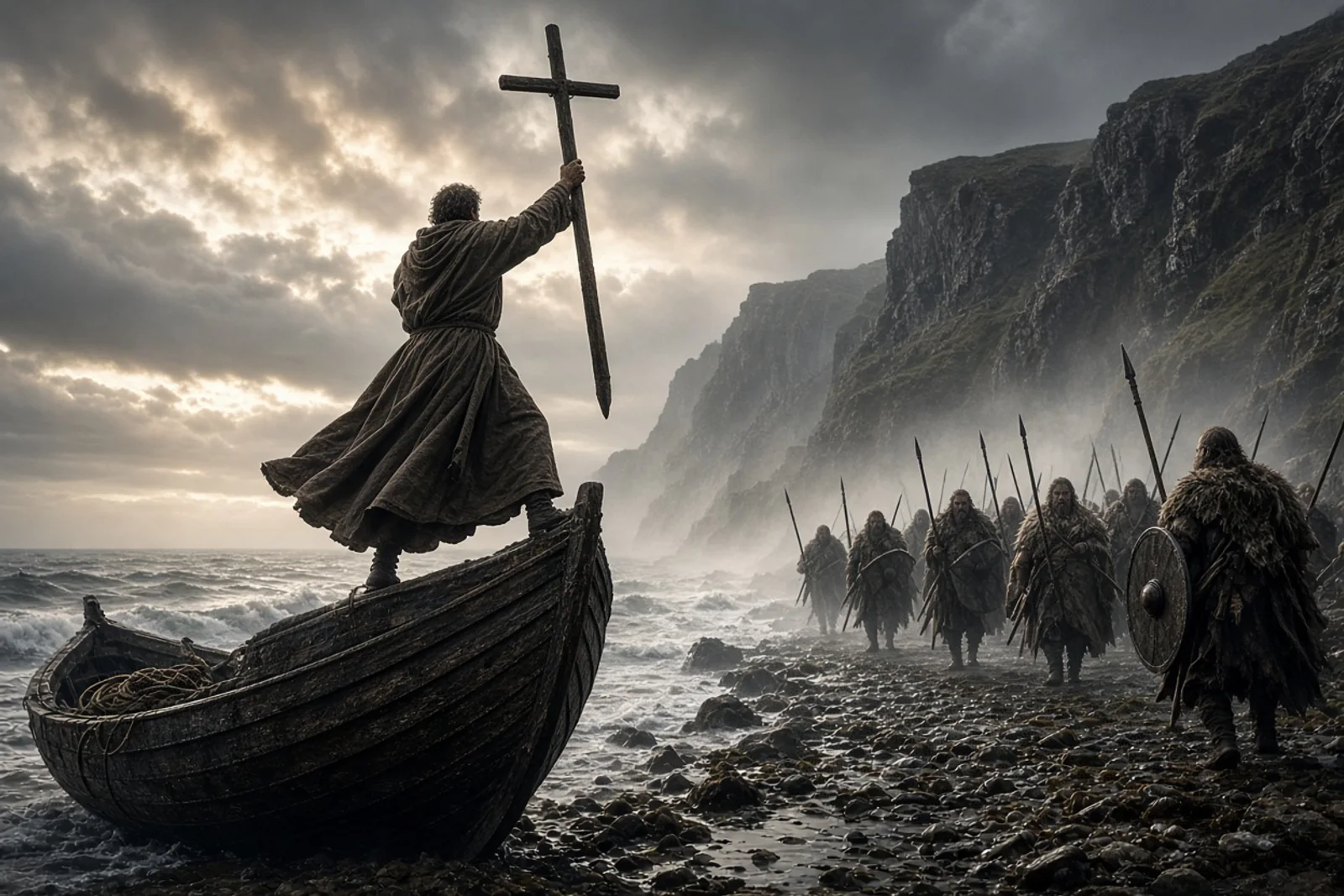
The oars bit the water in short strokes as the boat nosed into the cove. Salt stung my eyes and the wind cut through the cloak I had wrapped twice around my shoulders. We had left Britain three days earlier with no clear plan beyond the voice Patrick kept repeating in his sleep. I rowed because the others were older and because I wanted to see what a man looked like who had once herded sheep on these same hills and now meant to speak to the men who had owned him.
Patrick stood in the bow, one hand on the mast, the other clutching a wooden staff taller than himself. He had not spoken since the first light. His hair was white at the temples though he could not have seen fifty winters. When the keel scraped sand he stepped over the side without waiting for help and waded the last few yards. Water darkened the hem of his robe. He did not look back at the rest of us.
I followed with the small chest that held the books and the small silver cup he used for the blessing. The sand gave under my feet and the cold climbed my legs. Two men waited on the shingle, one with a spear, the other with a coil of rope across his shoulder. They watched the way men watch a stray dog that might still bite.
Patrick raised his right hand and spoke the name of Christ in the Irish tongue. The words came slowly, as if he had to pull each one from a place deeper than memory. The man with the spear lowered the point but did not set it down. Patrick kept walking until he stood an arm’s length from them. He asked for the name of the nearest household that would give strangers a night under its roof. The man with the rope answered that the king’s steward lived two valleys inland and might or might not open his door.
We walked single file along a track that climbed between gorse and blackthorn. Patrick carried the staff in his left hand now and used it to test the ground before each step. He stopped once at a spring that bubbled out of the rock and drank without cupping his hands. The water ran down his beard and onto the front of his robe. He said nothing about thirst or the length of the day.
By the time the steward’s roundhouse came into sight the light had gone gray. Dogs barked from the far side of the cattle pen. A woman came to the door with a child on her hip. She looked at Patrick’s staff and at the small group behind him and asked what business brought Britons across the water. Patrick answered that he had come to speak of a God who had once been a slave and was now free. The woman studied his face for a long moment, then stepped aside.
Inside, the fire smoked because the wind had shifted. Men sat on low stools around the central post. The steward himself was not present. His wife served us barley broth in wooden bowls and watched Patrick eat. When the bowls were empty she asked whether the God he served would protect her sons if they listened. Patrick said the God he served had already protected a boy who once tended sheep on these hills through six winters of snow and rain. He did not say the boy had been himself.
That night I slept on the packed earth near the door. Patrick remained awake. I heard the low sound of his voice against the wall as he prayed in Latin and then in Irish, the words overlapping until I could no longer separate them. Once he rose and went outside. I followed far enough to see him standing with his back to the house, arms at his sides, face lifted toward the stars that showed between the clouds.
In the morning the steward returned. He was a thick man with a scar across one cheek and a torque of twisted bronze at his throat. He listened while Patrick explained that he had been given authority by the bishops in Gaul to preach and to baptize. The steward asked what payment the new God required. Patrick answered that no payment was asked except the turning of the heart. The steward laughed once, short and without warmth, then told his wife to give us food for the road.