




The Candy Bomber of the Berlin Airlift
An American pilot began wiggling his wings and dropping candy on tiny parachutes to Berlin's children — and an airlift grew wings of its own.
FaithTap · Sep 27, 2026 · 10 min read
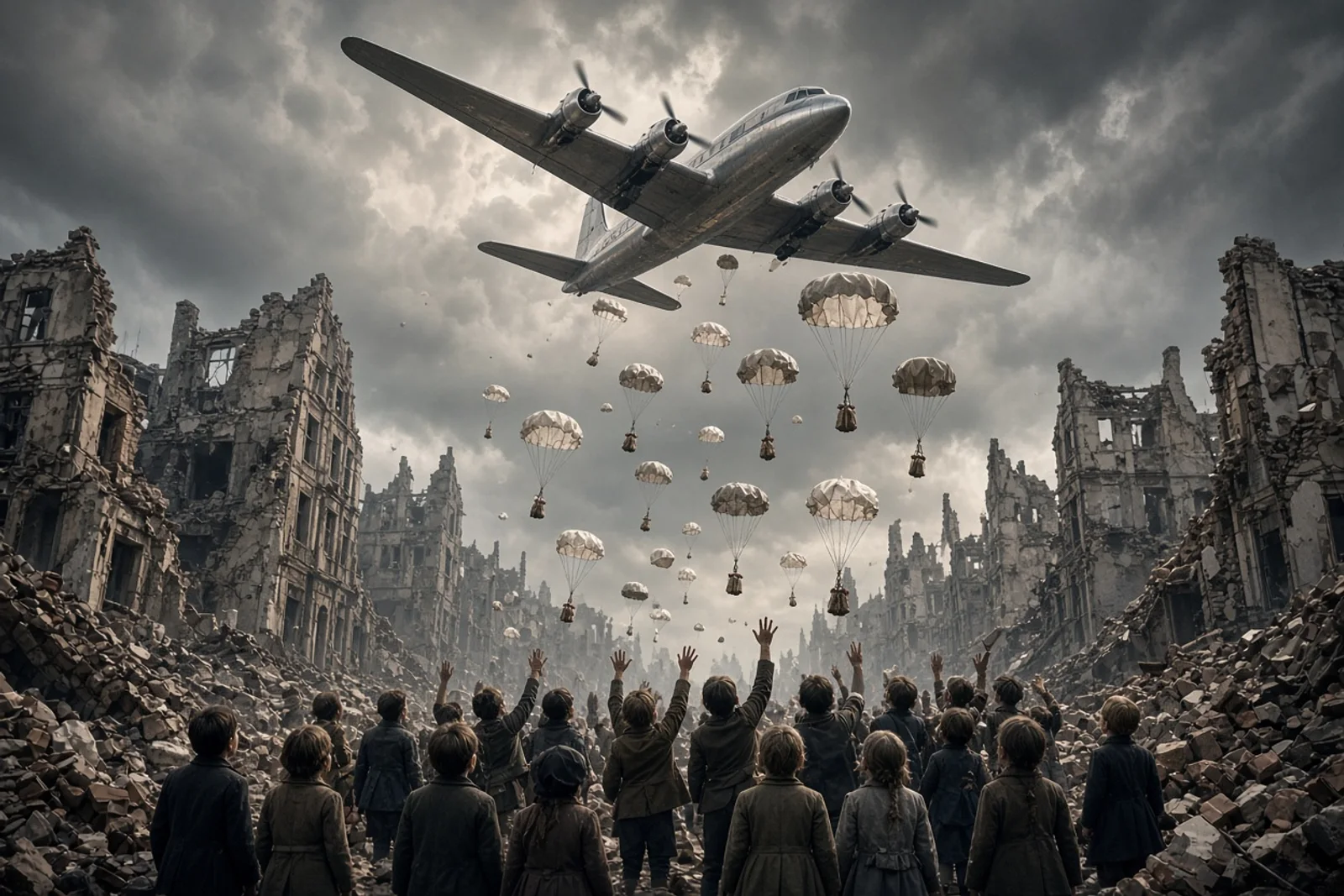
I felt the flour dust before I heard the engines, a fine white grit that got into everything — my collar, my coffee, the crease of my knuckles. We loaded sacks by hand onto pallets at Rhein-Main that summer of 1948, and by the time a C-54 taxied out you could see a man's handprints on the fuselage like he'd been kneading bread instead of stacking cargo. Berlin needed everything: flour, coal, dried milk, medicine. The Russians had shut every road and rail line into the city that June, cut the barges on the canals too, and told the world that two and a half million people in the western sectors could just do without. Nobody in Washington or London believed we could feed a city from the air. We were about to find out.
I was ground crew, later worked cargo runs myself, based first at Rhein-Main and then up at Wiesbaden and out to the little strip at Zeppelinheim where a lot of us bunked in whatever was standing — tar paper shacks the Germans had built for forced laborers under Hitler, and one pilot I knew slept in the attic of an old farmer's barn because there wasn't a bed to be had anywhere else. We flew and worked in shifts that didn't know day from night. Three round trips to Berlin in twenty-four hours was normal, then seven hours to sleep if the weather let you, then back into it. Ice on the wings in October. Fog so thick a man swore he could feel it inside the cockpit glass. We were feeding a city that not three years before had been the capital of the country trying to kill us, and there wasn't much time to think about the strangeness of that, not with the flour sacks stacking up and the engines never really going cold.
Halvorsen came through in early July, one more transport pilot among hundreds, a lieutenant who'd left a new red Chevrolet parked under a tree back at his base in Mobile, Alabama, with less than an hour's notice to report. He told it later like a joke — how he figured he'd be back in a couple of weeks, how he never even sent for the car, how it just sat there under those Alabama trees until somebody else's problem. He'd grown up on a farm in Utah watching yellow training planes pass overhead and wanting up there with them, got his pilot's license before the war, trained fighters with the RAF, then got shuffled into transports when the fighter slots filled up. By the time the Berlin call came he'd flown supply routes over half the world and settled into believing his flying days would be routine from here on. Nothing about routine was waiting for him in Germany.