




The Eucharistic Miracle of Sokolka
Host transforms into heart tissue
FaithTap · Sep 29, 2026 · 11 min read
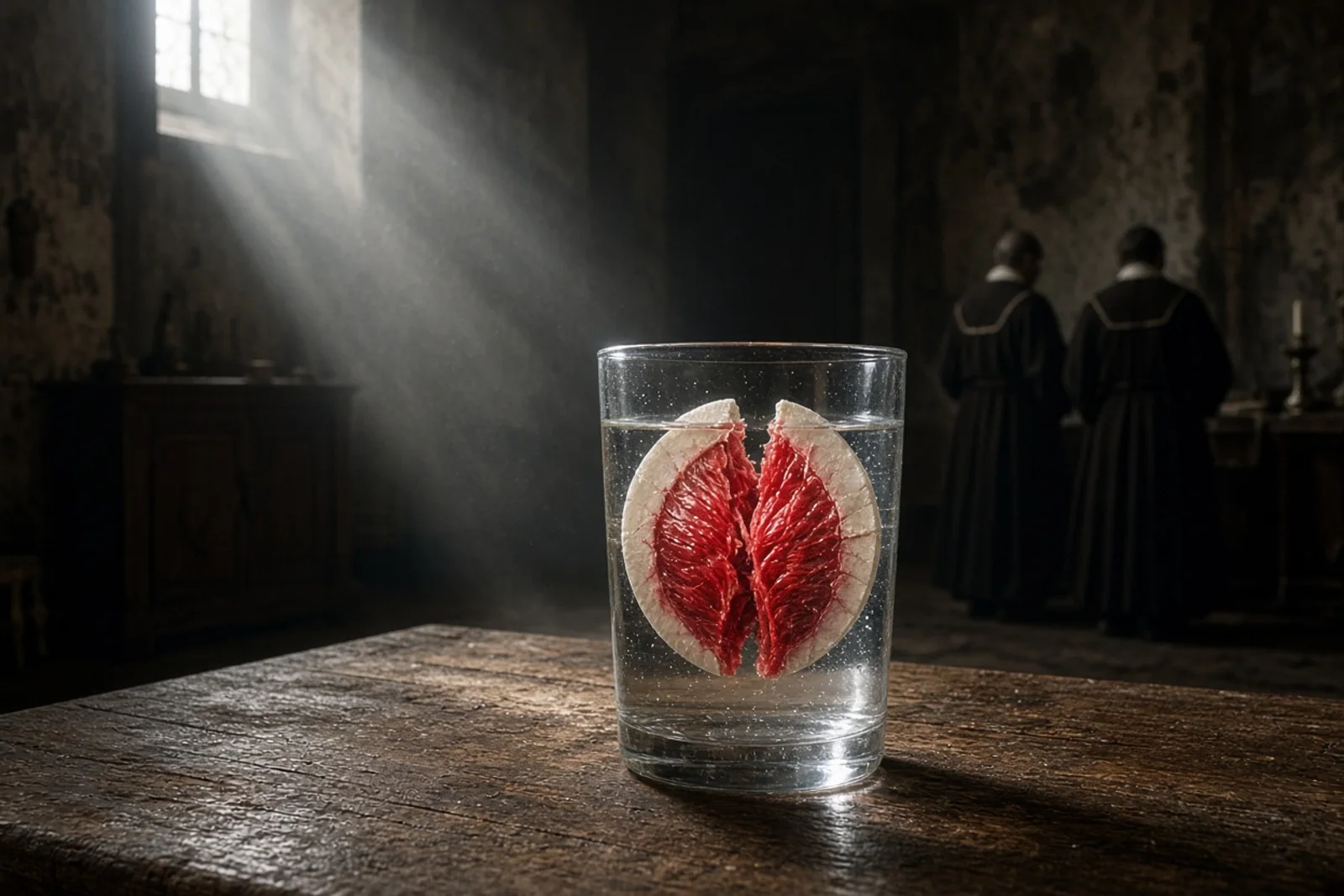
The host slipped between the priest’s fingers right as the woman in front of me opened her mouth. I saw it fall, white against the dark tile, and I stayed on my knees because I did not know what else to do. Jacek Ingielewicz froze for a second, then bent and lifted it with the tips of his fingers. He carried it to the side table where the silver vasculum stood and dropped it into the water already there. The mass continued around us. People still came forward. When it ended, Julia Dubowska, the sacristan, took the vessel and carried it away without speaking to anyone.
I helped her clear the altar linens that morning. She told me the pastor, Stanisław Gniedziejko, had said the host should stay in water until it dissolved. She poured everything into a second glass container and locked it inside the safe in the sacristy. Only she and the pastor had keys. The safe smelled of old wood and metal polish. We left it there and went to prepare coffee for the missionaries who had come for Mission Sunday.
A week later she opened the safe again. I was in the corridor outside the sacristy when she called for the pastor. Her voice was low but sharp. When I stepped inside she held the container toward the light. The host had mostly disappeared, yet a red mark, the size of a small coin, sat in the center of what remained. It looked wet. The water around it stayed clear. Gniedziejko looked once and went to the telephone.
Edward Ozorowski, the auxiliary bishop, arrived two days later with Andrzej Kakareko, the chancellor. They stood in the sacristy in their black coats and examined the container without touching it. No one raised their voices. The bishop asked that everything stay as it was and said he would give instructions. On the twenty-ninth of October the vessel was moved to the rectory chapel and placed in the tabernacle there. The next morning Gniedziejko lifted the remaining fragment and the red mark out of the water with a small spoon and set them on a corporal embroidered with a red cross. He closed the tabernacle door again.
January brought two professors from the Medical University of Białystok. Maria Sobaniec-Łotowska and Stanisław Sulkowski came on a weekday afternoon when the church was empty. They took a small sample from the corporal under the bishop’s written permission and carried it away in a sealed box. Three weeks later their report reached the curia. The tissue, they wrote, most resembled cardiac muscle from a living person. They added that the fibers appeared to be in a state of agony. The curia filed the pages without releasing them.
An ecclesiastical commission was named on the thirtieth of March. It interviewed every priest who had been present, the sacristan, and the two professors. The members examined the corporal, the tabernacle lock, and the safe. They found no sign that anyone had added material or altered the host after it left the altar. Their work finished in October. The files went to the Apostolic Nunciature in Warsaw.
On the fourteenth of October 2009 the curia announced the findings to the public. The statement said the event did not contradict the faith but confirmed it. Within days the Medical University issued its own statement that no official study had been commissioned and that the professors had worked privately. One spokesman noted the researchers were experienced pathologists yet described their approach as emotional. A newspaper asked why further DNA testing had been declined. Another scientist suggested the red pigment could have come from Serratia marcescens, a bacterium known to grow on starch and produce a blood-like color. The police received a complaint asking whether human tissue on a consecrated host constituted a crime; they declined to open a case.
The corporal stayed in the rectory tabernacle for three years. In 2011 it was carried in procession to the Chapel of Our Lady of the Rosary inside the collegiate church. A glass case was prepared so visitors could see the fragment without touching it. On the first of October each year since then, pilgrims arrive before dawn. They fill the square and the side streets. Some come from Białystok, others from farther villages. Local people keep a book of written testimonies near the chapel door. They record healings they attribute to the host, though the commission never investigated those claims.
I still attend the eight-thirty mass when I can. The corporal remains behind glass, darker now at the edges, the red mark dried to a deeper shade. The fibers and the bread are said to be joined in a way no one has reproduced by ordinary means. People stand in line to look, then move on. Outside, the square empties by late afternoon. The lights in the chapel stay lit until the last visitor leaves.