




The Healing of Marie Lemarchand at Lourdes
Advanced tuberculosis cured
FaithTap · Sep 27, 2026 · 11 min read
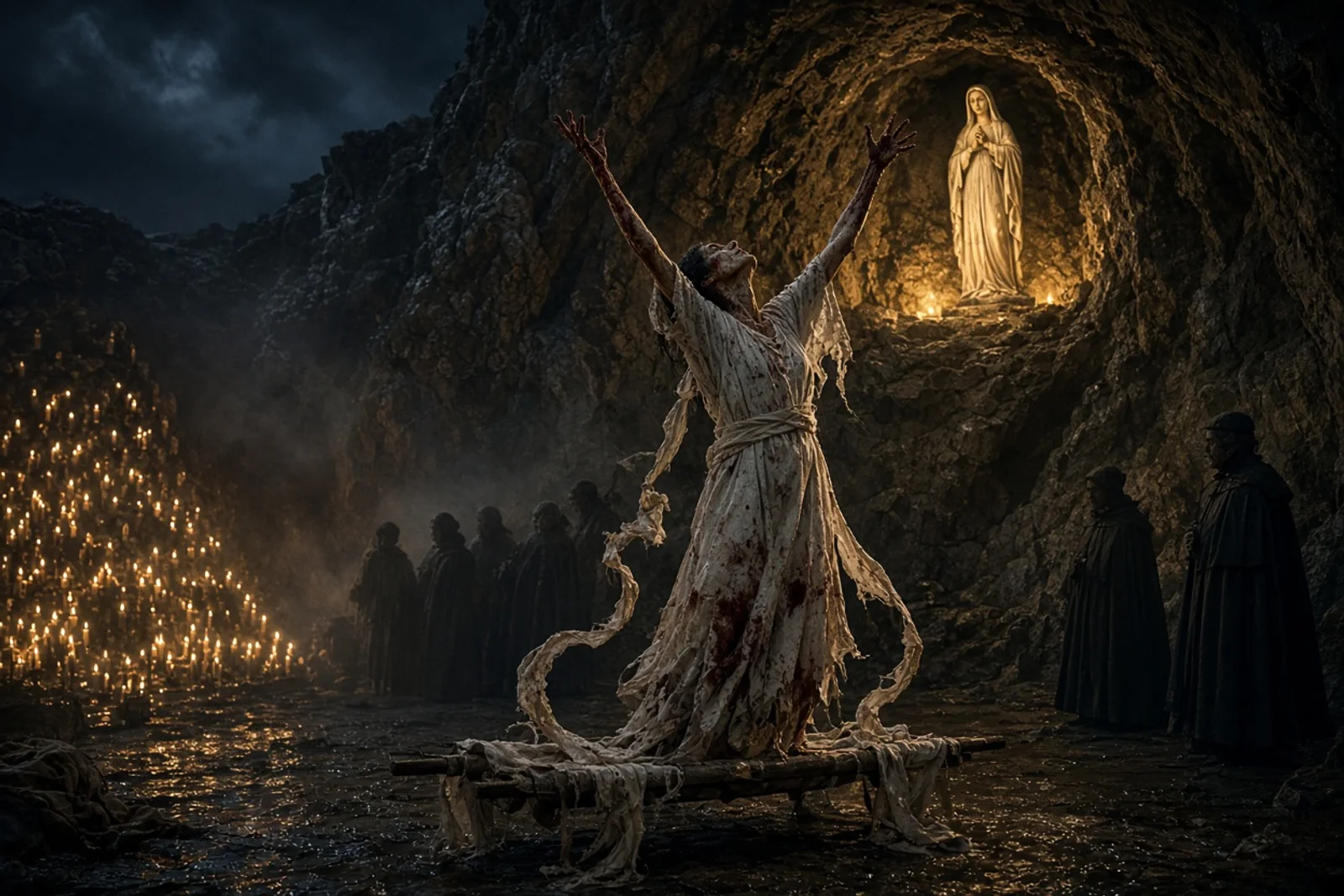
The water in the piscina still held the chill of the mountain night when they brought her down. I had come with the Paris train as one of the men who carried the stretchers, and my shoulders ached from the weight of others before her. The August sun already pressed on the roof of the bathhouse. Inside, the air smelled of wet stone and the iodine the sisters used on open wounds.
Marie Lemarchand lay on the canvas. Her face was no longer recognisable as a face. The upper lip had swollen until it pulled the mouth sideways, and the cartilage that once shaped the nose was gone. What remained was a raw surface that wept and crusted over again each hour. She weighed so little that two of us could lift her without strain. When we lowered her into the pool she did not cry out; the cold simply took her breath for a moment and then she lay still.
Zola had walked the length of the train platform the day before. He stopped at each stretcher, notebook open, asking the names and the length of illness. When he reached Marie he looked once and turned away, though he wrote something down. Later I heard him tell the priest who accompanied us that he wanted only to see a cut finger close before his eyes. Anything less would not move him.
We left her in the water for the usual time. The attendant kept one hand under her head so she would not slip. When we raised her out the linen cloths were soaked with fresh discharge. We wrapped her quickly and carried her to the side room where the doctors waited. One of them, a man from the Paris faculty, had already examined her that morning. He had measured the extent of the ulceration and noted the absence of cartilage. He said nothing now, only watched while the sisters dried her.
She asked for a mirror. Someone handed her a small square of glass. She held it at arm’s length, then brought it closer. The surface that had been open and bleeding was covered with new skin, pink and tight but whole. The distortion of the mouth had eased. She touched the place where the nose had been and found only smooth tissue. She set the mirror down and asked whether the train would still leave that evening.
Zola was brought into the room half an hour later. He stood in the doorway and did not come closer. The same doctor who had measured the lesions asked him to look. Zola shook his head once. He said he did not want to see her again. Then he left. That evening he told another pilgrim that even if every sick person in Lourdes rose and walked, he would still not accept a miracle.
Marie remained in the hospice that night. By morning she could sit without support. The sisters gave her bread and broth; she kept both down. Two days later she walked the short distance to the Grotto without a stick. The same doctor examined her again before the pilgrimage returned to Paris. He wrote that the ulcerations had closed completely and that no trace of the previous suppuration remained.
She returned to her work in a laundry outside the city. Over the next years she married and bore eight children. None of them showed signs of the disease that had nearly taken her. She lived until 1920, thirty-eight years after the morning in the bathhouse.
Zola published his account of the journey the following year. In it the woman with the ruined face appears under another name and dies on the return train. The real woman continued to visit Lourdes each August for the rest of her life, always on foot from the station. She never spoke of Zola when she came. The doctors who had seen her before the bath continued to sign the annual reports that recorded her unchanged health.