




The Healing of Rose Verrechia’s Daughter at Lourdes
Child’s heart defect closed.
FaithTap · Sep 25, 2026 · 12 min read
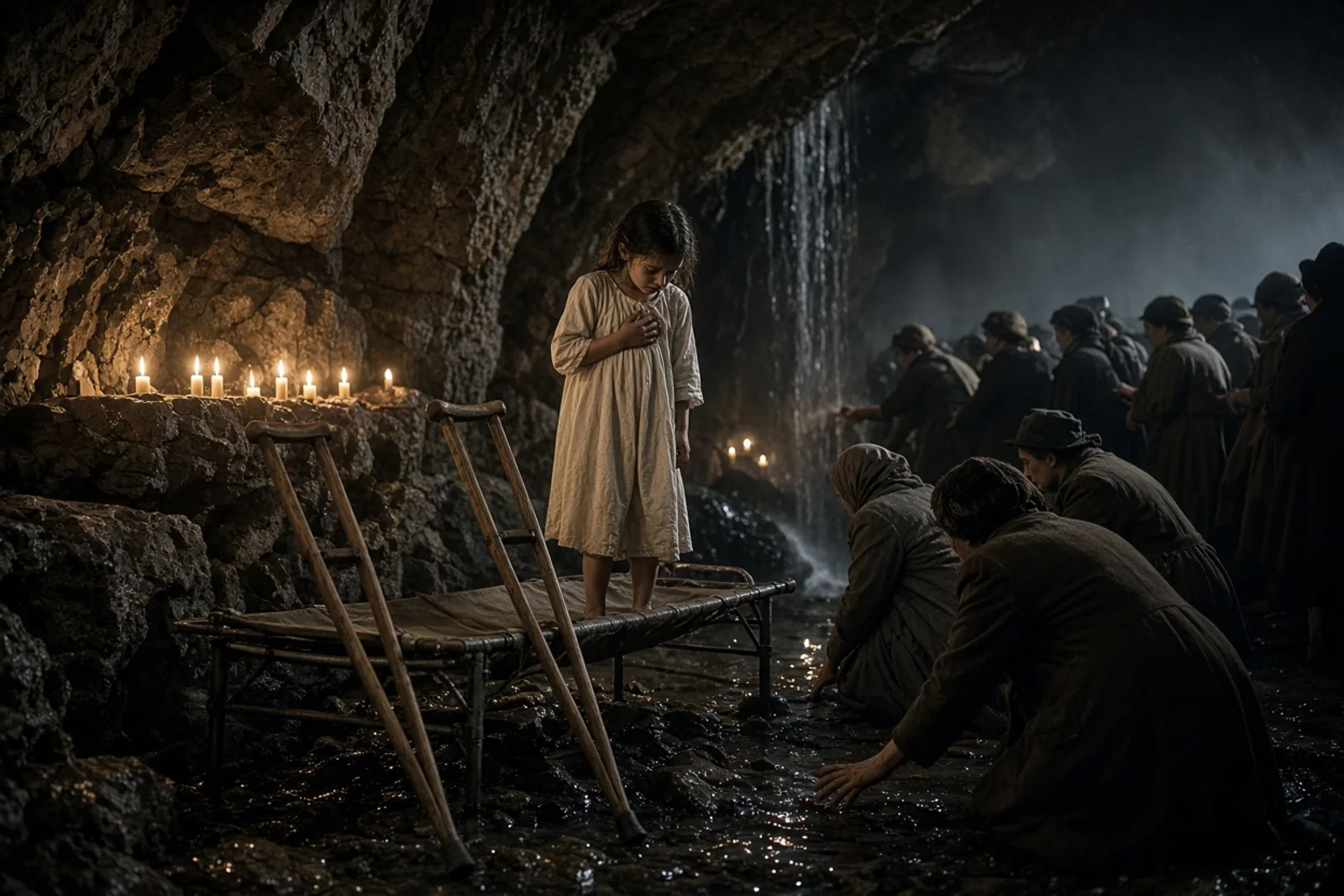
The train from Nice had left us stiff and dust-coated by the time we reached the square at Lourdes. I had come as part of the auxiliary medical staff that year, carrying the old hospital ledgers and the latest X-ray plates for cases the Bureau wanted re-examined. October air carried the smell of wet stone and coal smoke from the engines. We walked past the rows of stretchers already lined along the ramp to the Grotto, attendants checking straps and blankets before the first blessing of the sick.
Inside the small examination room the windows stayed open despite the chill. Doctors from several cities had gathered around the long table. One of them opened the file for Henriette Bressolles. The papers showed the 1918 admission to the army hospital, the diagnosis of Pott’s disease, the plaster collar and corset applied for years, the recorded paralysis of the right leg, the loss of bowel and bladder control that earned her the full pension. Certificates from three separate physicians in Nice, written after September 1924, stated the same thing: movement had returned without pain, continence had resumed, and the change dated from the moment at the Grotto when she felt the sudden crack and sat upright on her own.
We read the 1924 Bureau notes next. On the day after arrival she had been taken to the blessing, then to the spring. The examiners that week found the spine free but the legs still rigid. They chose to wait three months and ask for reports from her own doctors. Those reports arrived and confirmed the functions had stayed restored. No one at the table that afternoon in 1954 disputed the written sequence. What we weighed was whether the original disease had been correctly identified and whether any ordinary recovery could account for the speed.
One surgeon turned the X-ray plates under the lamp. The vertebral destruction shown in the early films had no counterpart in the later ones. Another physician read aloud the repeated episodes of urinary retention and uremia that had occurred every few months before the pilgrimage. Those episodes stopped after the return to Nice. The room stayed quiet while each man checked the dates against his own memory of similar spinal cases.
Outside, pilgrims moved in slow lines toward the baths. I stepped onto the terrace for a moment and watched a woman in a dark coat help her daughter adjust the straps of a brace. The girl’s face was turned toward the water. The mother’s hands worked without hurry. When I went back inside the discussion had reached the question of stability. Thirty years had passed without relapse. The pension board in Nice had never reversed its classification, yet the physical findings recorded in 1924 remained unchanged in every later examination.
The Canonical Commission met later that same week. Their task was to decide whether the cure could be declared miraculous under the rules set down in canon law. The medical file was already complete. The auxiliary bishop who had attended the 1924 thanksgiving service in Nice was now dead, but his written account remained. The Commission reviewed the three physicians’ certificates once more, noted the absence of any contradictory report, and recorded their conclusion on 24 October. The cure stood as complete and lasting from the day at the Grotto.
Word reached the Bureau the following morning. Henriette Bressolles herself was not present; she had remained in Nice. The formal recognition by the bishop would come three years later, but the medical portion of the record closed that week. We packed the plates and the ledgers again. On the return train I kept seeing the same image of the girl on the terrace adjusting her brace while her mother’s hands moved steadily. The case files stayed in their folder. No further cures received certification in the years that followed.
Henriette lived until 1961. The cardiac condition that ended her life had no connection to the spinal disease recorded decades earlier. The Bureau kept the file among the twenty-five cases acknowledged between 1947 and 1976. After that date the registers show no additional entries. The process itself continued, the same questions asked of each new claim, the same requirement for original records and independent confirmation. The square at Lourdes still fills each season with the same lines of stretchers and the same slow movement toward the spring.
The square at Lourdes still fills each season with the same lines of stretchers and the same slow movement toward the spring. In the spring of 1957 the Bureau des Constatations Médicales received a new set of radiographs from the Hôpital Saint-Roch in Nice for a patient named Rose Verrechia, whose daughter had been carried to the piscines on 8 September 1924 at the age of eleven; the earlier films, taken at the Clinique des Alpes-Maritimes on 3 July 1923, showed collapse of the fifth and sixth thoracic vertebrae with a gibbus measuring four centimetres and complete flaccid paralysis below the waist. Dr. Émile Garnier, who examined the girl on the terrace after the blessing that year, wrote in his notebook that the child had cried out “Maman, mes jambes bougent” before standing unassisted, an observation countersigned by two nurses from the Oeuvre des Hospitalières de Lourdes. When the 1957 plates arrived they were compared under the same viewing box used for the Bressolles case three years earlier; the vertebral bodies appeared reconstituted with only a slight anterior wedging at T6, and the girl, now forty-four, walked without support during the follow-up visit recorded on 12 April.