




The Man Who Invented Braille for Music
Braille adapts system for musical notation.
FaithTap · Oct 6, 2026 · 11 min read
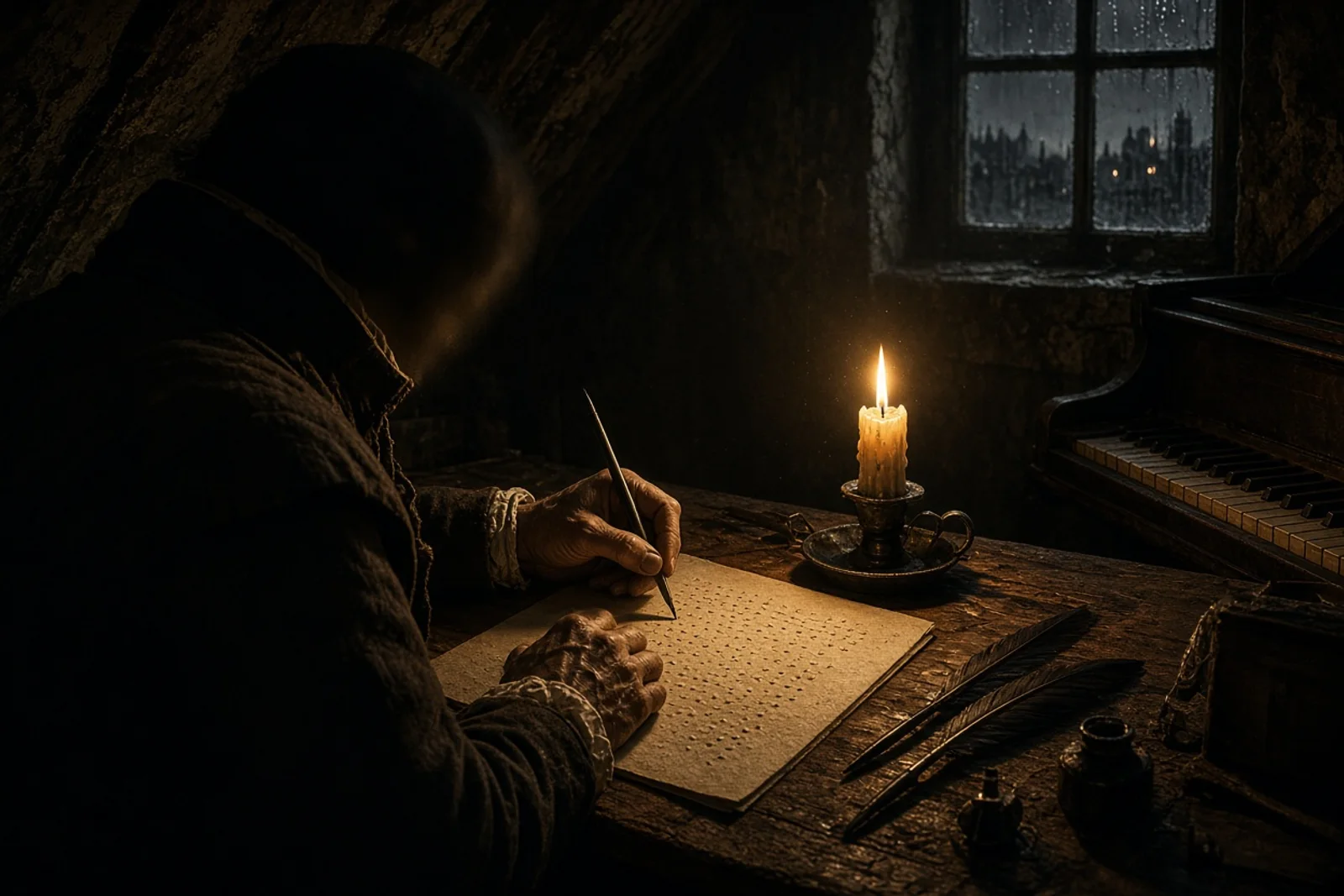
The air in the practice room held the faint smell of resin and old wood. My fingers rested on the cello strings while the others waited. Louis Braille sat at the table with a sheet of thick paper between his hands. He pressed the stylus down once, then again, turning the page to feel what he had made.
We had tried the old way for years. The raised lines of the staves were wide and shallow. A finger had to travel the whole length of a measure before the shape of a note became clear. By then the rhythm was already lost. Most of us memorized what we could or made the rest up. Braille had done both, yet he still wanted something else.
He had shown us the six-dot cell for letters the year before. Now he wanted the same cell to carry music. He placed two cells side by side on the paper and asked me to read them aloud by touch. The first cell told the pitch. The second told the length. When I named them correctly he nodded once and made another mark.
The room stayed quiet except for the scratch of the stylus. Outside, rain moved across the courtyard stones. One of the younger boys shifted on his bench. Braille did not look up. He kept working through the same line, changing only the position of the sixth dot. Each change altered the value of the note without adding more cells.
By the third hour my fingertips had begun to ache from tracing the same patterns. Braille offered the sheet to the boy beside me. The boy read the line without stopping. When he finished he said the rhythm matched what we had played earlier on the piano. Braille asked him to play it again on the instrument. The notes came out even.
Word spread through the corridors that the new music could be carried in a pocket. A girl who studied voice asked to borrow the sheet. She returned it the next morning and said she had practiced the phrase without a teacher present. Braille listened to her sing it once, then corrected only the placement of one accidental.
He began to mark the same cells for organ music. The left hand and right hand needed separate lines, yet the cell stayed the same size. He solved it by adding a single dot at the margin to show which hand the line belonged to. We tested the method on a short voluntary from the church book. No one lost the place when the page turned.
Some of the older teachers still kept the large embossed scores on the shelves. They said the new cells were too small to trust. Braille answered by letting them feel a page he had prepared. Their fingers moved slowly at first, then faster. One of them asked how many measures could fit on a single sheet. Braille told him the number without looking at any list.
The students started copying the method for their own pieces. A violinist brought a short étude he had written out the night before. Braille read it at the table and pointed to two places where the rhythm cell had been written backward. The violinist corrected them and played the piece through without pause.