




The Story of the Man Who Invented Braille for Music
Blind composer creates accessible notation
FaithTap · Oct 2, 2026 · 10 min read
The bow slipped on the string again. I cursed under my breath and set the cello down on the bench, wiping sweat from my fingers so the next note would not skid. The practice room at the Institute held six of us that afternoon, each trying to hold a phrase without the score in front of us. One boy hummed the line he had memorized the night before. Another tapped the rhythm on his knee, counting silently. None of us could check whether we had the accidentals right.
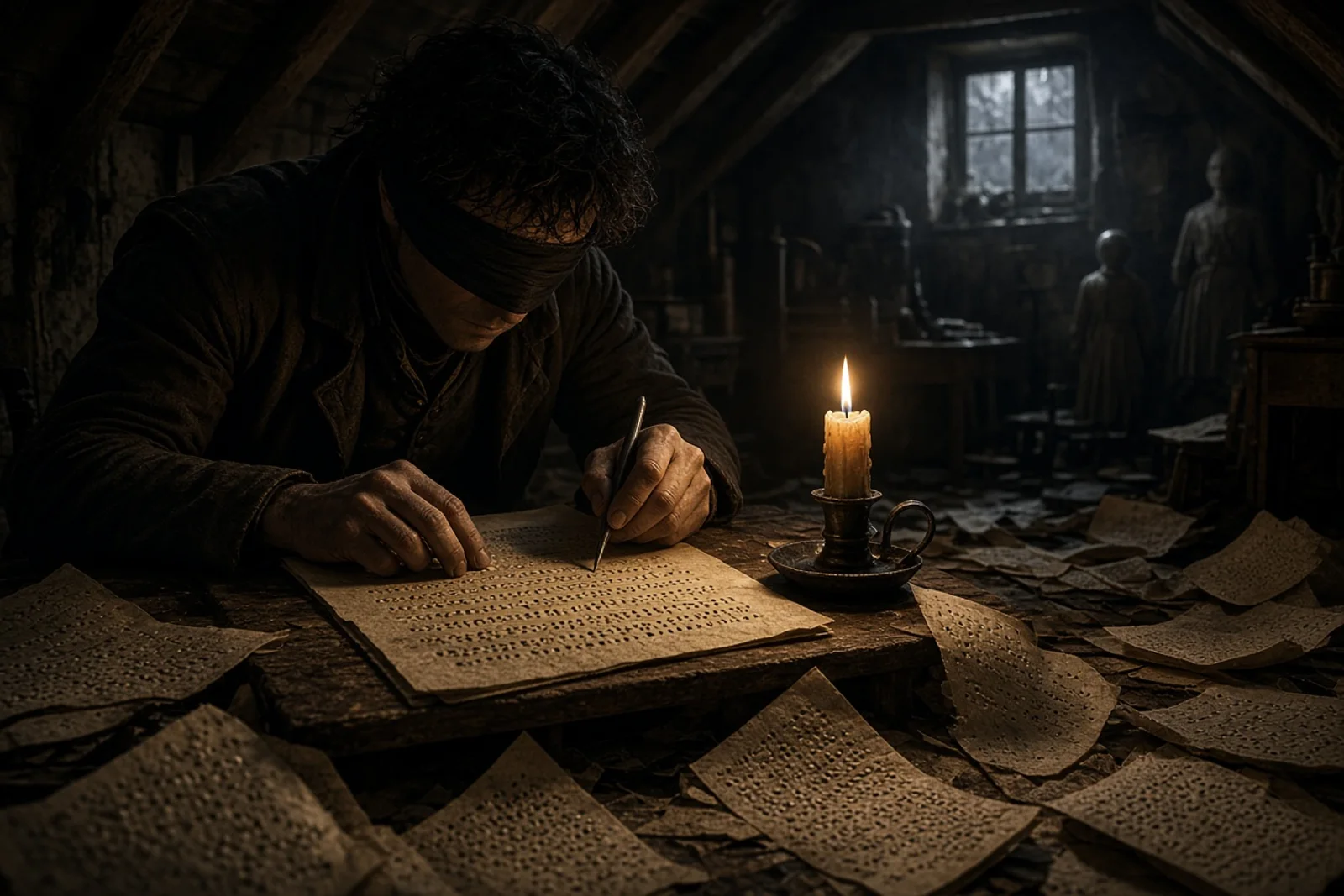
Louis Braille sat at the far table with his back to the window. He had already finished his own lesson for the day. I could hear the faint scrape of his stylus moving across the thick paper. He worked without hurry, pressing the dots into place one cell at a time. Every so often he ran his fingertips over what he had made, checking the spacing.
We had asked him weeks earlier. The raised staves Haüy left behind were too large to read while we played. Rousseau’s method still required us to feel bulky shapes that told us nothing about how long a note should last. Braille had listened, nodded once, and said he would try. Now the paper in front of him carried both letters and something new.
He called me over after the others had gone to supper. The room smelled of resin and old wool. He placed my hand on the page so I could feel the pattern he had set. Six dots arranged in two columns. The top four stood for pitch. The two at the bottom marked duration. A single cell could tell me the note and whether it lasted a quarter or an eighth. I traced it twice. The shape stayed in my fingers after I lifted my hand.
He asked if I could play from it without looking away from the strings. I tried. The first line came haltingly, but the second moved faster because I no longer had to guess the length of each rest. Braille listened without comment. When I stopped he made a small adjustment to one cell, then let me try again.
Outside, the courtyard bells rang for evening prayers. We stayed where we were. He showed me how a chord would sit in three consecutive cells, the fingers reading left to right while the right hand stayed on the keyboard. He had already tested the same idea on the organ at Saint-Nicolas-des-Champs. The organist there let him stay after services to copy the hymns. The dots fit between the stops without crowding the bench.
Word spread through the dormitory. A girl who played violin asked to see the page. Braille gave her one he had prepared the night before. She read the first four measures aloud, naming each note and its value. Her voice carried down the corridor. Someone else asked for a copy of the same piece. By the end of the week three students had asked for their own copies of the cello sonata we had all been struggling to keep in memory.
The director of music came to watch one afternoon. He stood near the door while Braille explained the system to two new arrivals. The director asked whether the code could show dynamics. Braille answered that a separate cell placed before the note could mark forte or piano. He had not yet decided on the exact pattern, but the space existed. The director nodded and left without further questions.
Winter came early that year. The practice rooms stayed cold even with the stoves lit. Braille continued to work at the same table, wearing fingerless gloves so the stylus would not slip. He produced pages for organ voluntaries, for simple songs, for the cello exercises we used every morning. Each page carried the title in ordinary letters above the music line so sighted teachers could still follow along.