
Editor’s note: Big Tent Ideas always aims to provide balancing perspectives on the hottest issues of the day. Below is a column from Paul Cella, where he argues that the Executive Branch has the legitimate warmaking authority. You can find a counterpoint here, where Brandan Buck argues otherwise.
While always a misfortune, war may be necessary and can be just, provided certain criteria are met. It must be waged for a just cause, after exhausting recourse to negotiation; it must have peace as its goal, compassing even the good of the enemy; it must be undertaken with rectitude of intention, holding out a reasonable prospect of success; and it must be declared by legitimate public authority.
The war against Iran falls short of justification on many of these grounds; on the last, however – the criterion of legitimate sovereignty – it has provided a service to the American people by clarifying for us that formal warmaking authority now resides with the President.
Put another way: it is no longer reasonable to suppose that Congress possesses the exclusive constitutional authority to declare war.
This ominous conclusion arises from observing the practice of American military action, carried out under relevant war powers over many decades, of which the war of the past two months forms the unmistakable culmination. It is not a conclusion compassing normative judgment, prescriptive endorsement, much less political triumphalism; but rather a sober analysis of events and the public deliberation that accompanies them.
The brazenness with which the administration launched a major war without even superficial consultation with Congress, and the supine acceptance of the subordinate role by the latter, demonstrates this reality.
America can now look back on over 75 years of military conflict without any formal declaration of war by Congress, and only sporadic inferior acts of authorization for large-scale offensive military operations. While it is true that the line dividing spygame/black ops from true offensive military action will always be murky, many of America’s commitments since the Second World War so far exceed that line as to make it irrelevant to the broader constitutional question.
One might argue that, for example, the JSOC deployments a decade ago, against the Islamic State in Syria and Iraq, remained safely below that line; the absurdity of asserting the same for Vietnam or Afghanistan or today’s war in Iran manifests itself immediately.
It is also true, of course, that many of our past wars received congressional authorization, of a sort, after extensive discussion, concomitant to a wider public debate that frequently grew acrimonious.
What Publius in The Federalist calls “the cool and deliberate sense of the community” (Federalist #63) was very far from being disengaged or isolated from the proposition of war; on the contrary, that proposition commonly engaged the public mind in a sustained manner. Thus the defensible argument that these authorizations, though short of what the Constitution suggests, were nevertheless sufficient to fulfill what it requires.
On this point, precisely, the current war against Iran sets the capstone upon the structural trend of constitutional sovereignty in war powers since the Second World War. For since late February, significant military resources have been committed to major offensive combat operations, without any of these inferior acts of deliberation, in Congress or out there in the wider public, which in their cumulative aspect may be said to comprise authorization by the Legislative Branch.
The overwhelming bulk of deliberation, on the question of war or peace with the Islamic Republic of Iran, was wholly confined within the Executive Branch, to the exclusion of Congress and indeed the American people.
As with the historical quiescence of the Ninth and 10th Amendments under pressure from national legislation and Supreme Court rulings, Americans would be well-advised to recognize the change that has come over their constitutional framework. They would do well to acknowledge that the legitimate warmaking authority in the Republic has passed to the Executive and adjust their constitutional and political concepts accordingly.
Paul J. Cella is a writer in Atlanta.
The views and opinions expressed in this commentary are those of the author and do not reflect the official position of the Daily Caller News Foundation.
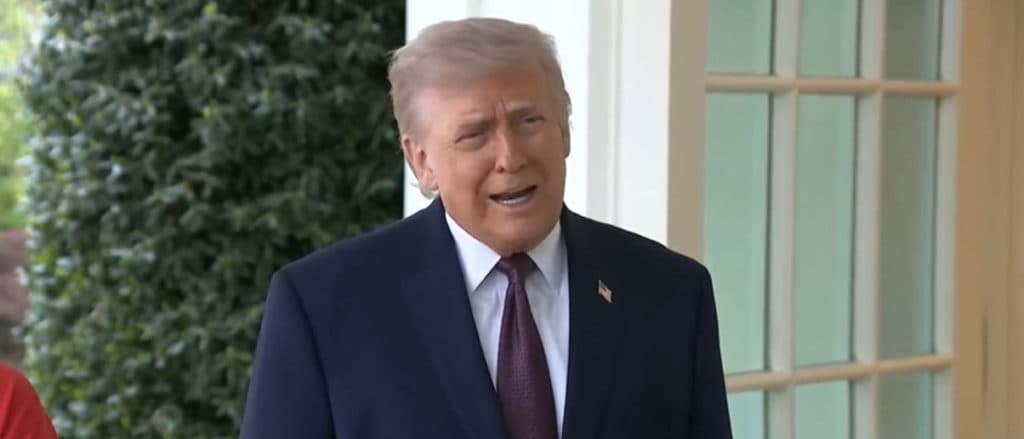
(Featured Image Media Credit: Screenshot / White House / Rumble)
All content created by the Daily Caller News Foundation, an independent and nonpartisan newswire service, is available without charge to any legitimate news publisher that can provide a large audience. All republished articles must include our logo, our reporter’s byline and their DCNF affiliation. For any questions about our guidelines or partnering with us, please contact [email protected].