Eucharistic Miracle of Bolsena
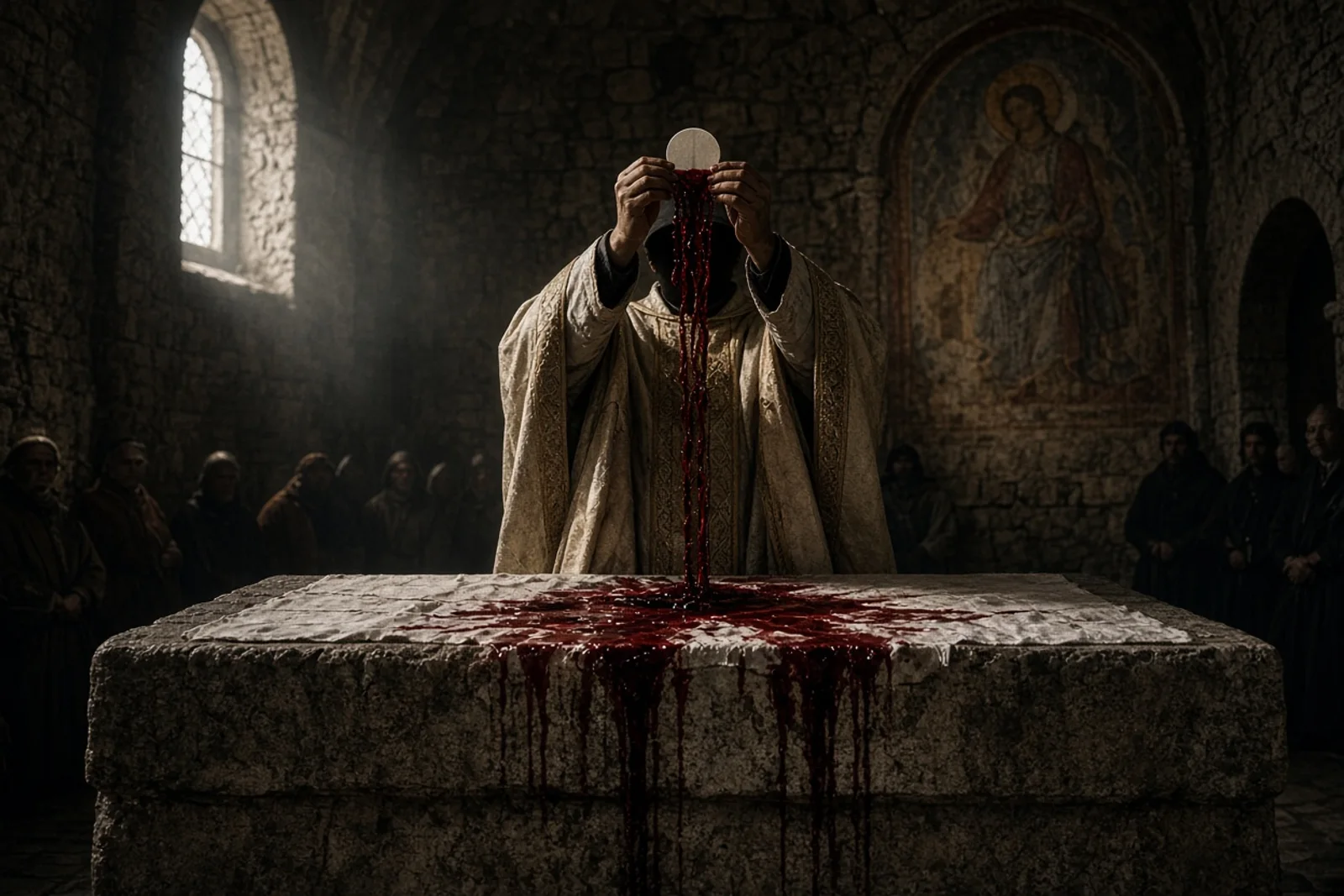
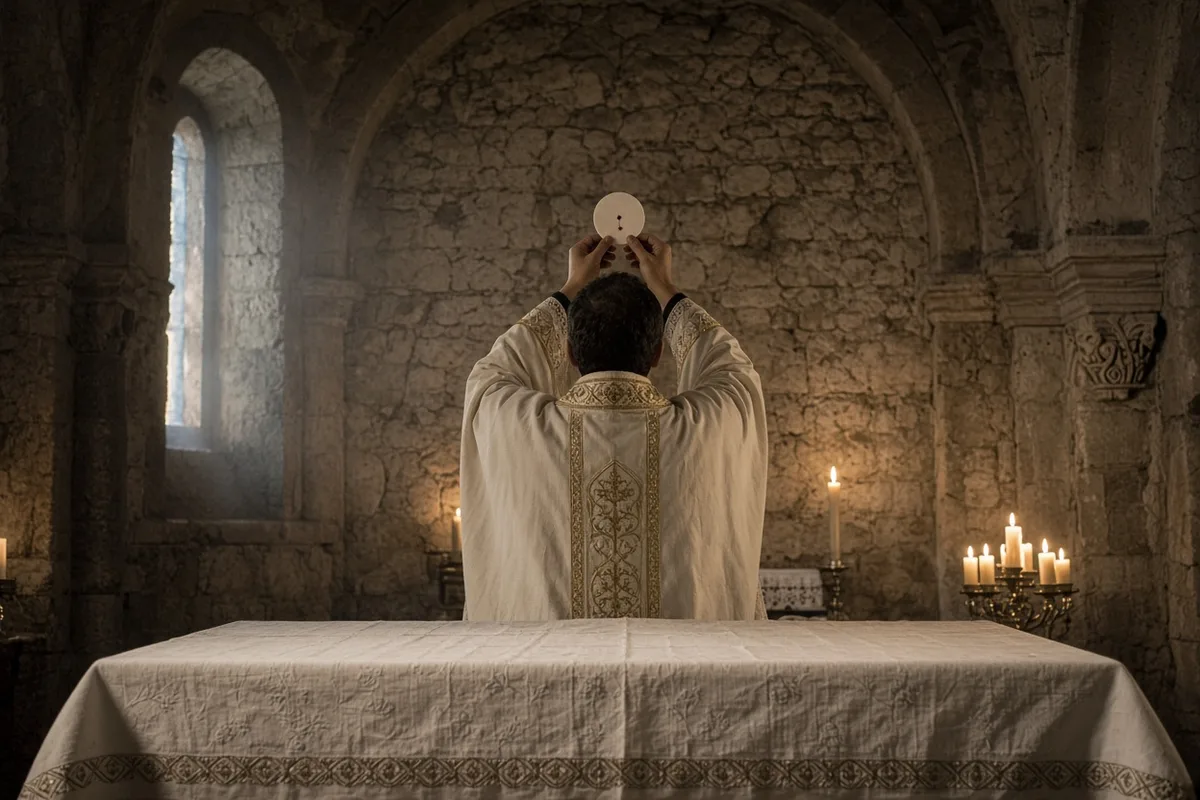
The linen corporal lay folded on the stone altar when the German priest lifted the host. His hands shook once, then steadied. I stood three paces to his left, holding the cruets, close enough to see the sweat on his neck. The church was quiet except for the lake wind pushing against the shutters. He spoke the words of consecration slowly, as if testing each syllable against some doubt he carried from Prague.
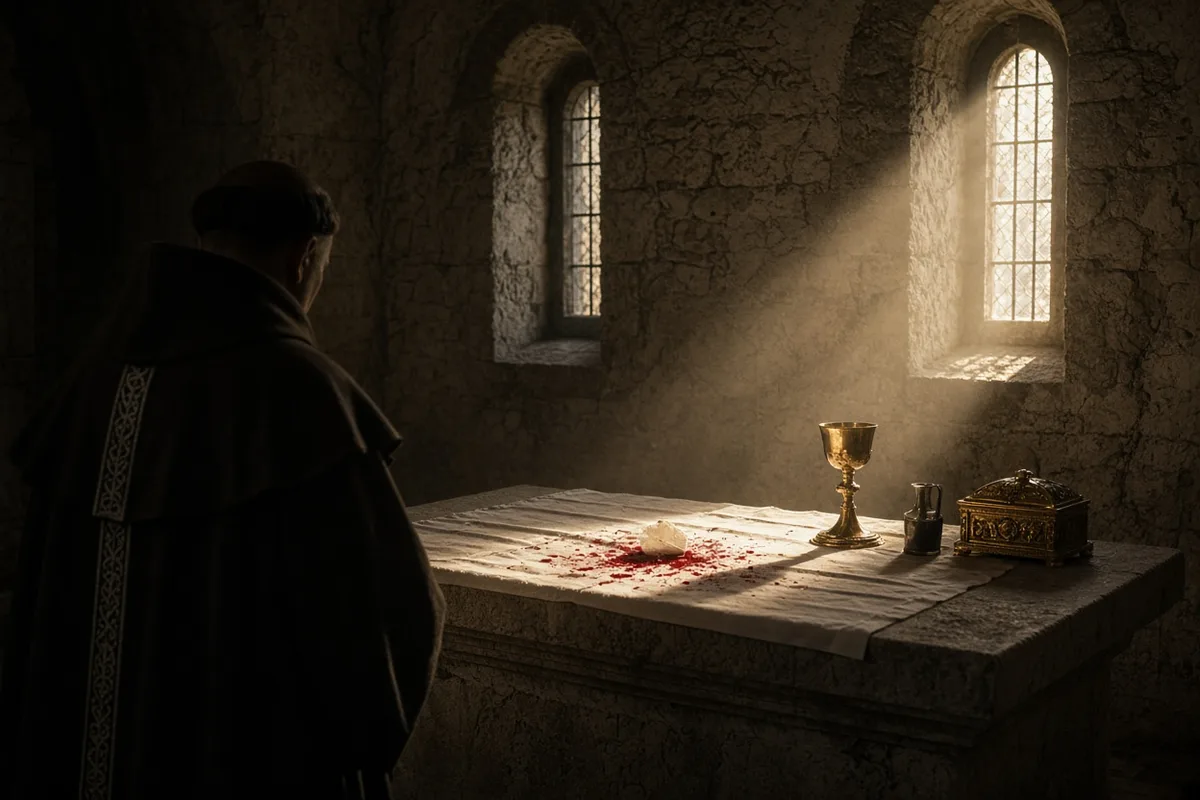
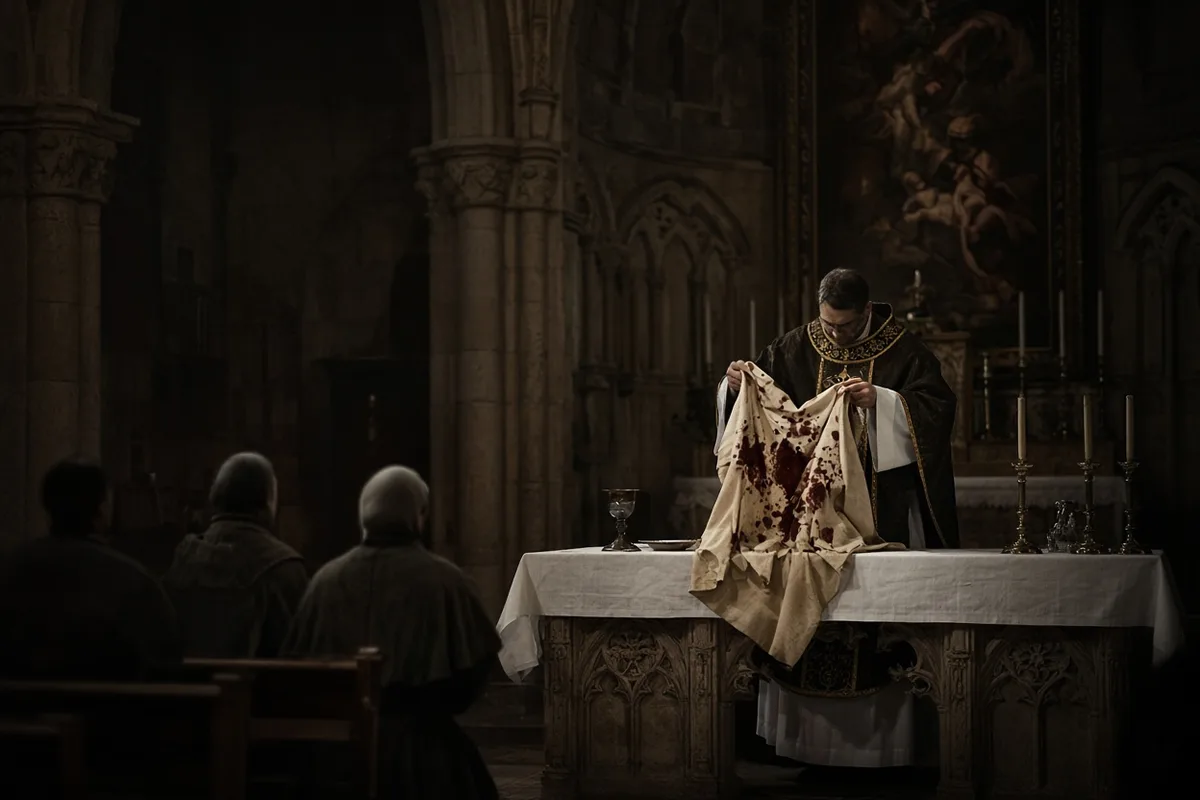
Blood appeared first as a single dark bead at the edge of the bread. It grew, slid, and dropped onto the linen. Another followed, then a thin line that soaked outward in a shape no one had drawn. The priest froze with the host still raised. Crimson reached his fingers and stained the cuff of his alb. He lowered the host onto the paten without finishing the elevation. No one in the nave moved.
I set the cruets down and stepped closer. The blood was real and warm when a drop touched the back of my hand. The corporal showed the same spreading pattern on both sides where it had been folded. The priest stared at it, lips apart, then wrapped the stained linen around the host with care that looked almost fearful. He left the altar without dismissing us and walked out into the square.
People followed at a distance. He turned toward the road that climbs to Orvieto, eighteen kilometers of dust and olive groves. I went with him because someone had to carry water and because the corporal was already seeping through its folds. We walked until the light failed. At a wayside shrine he stopped, unwrapped the bundle once, and looked again. The stains had not spread further, but they had not dried either.
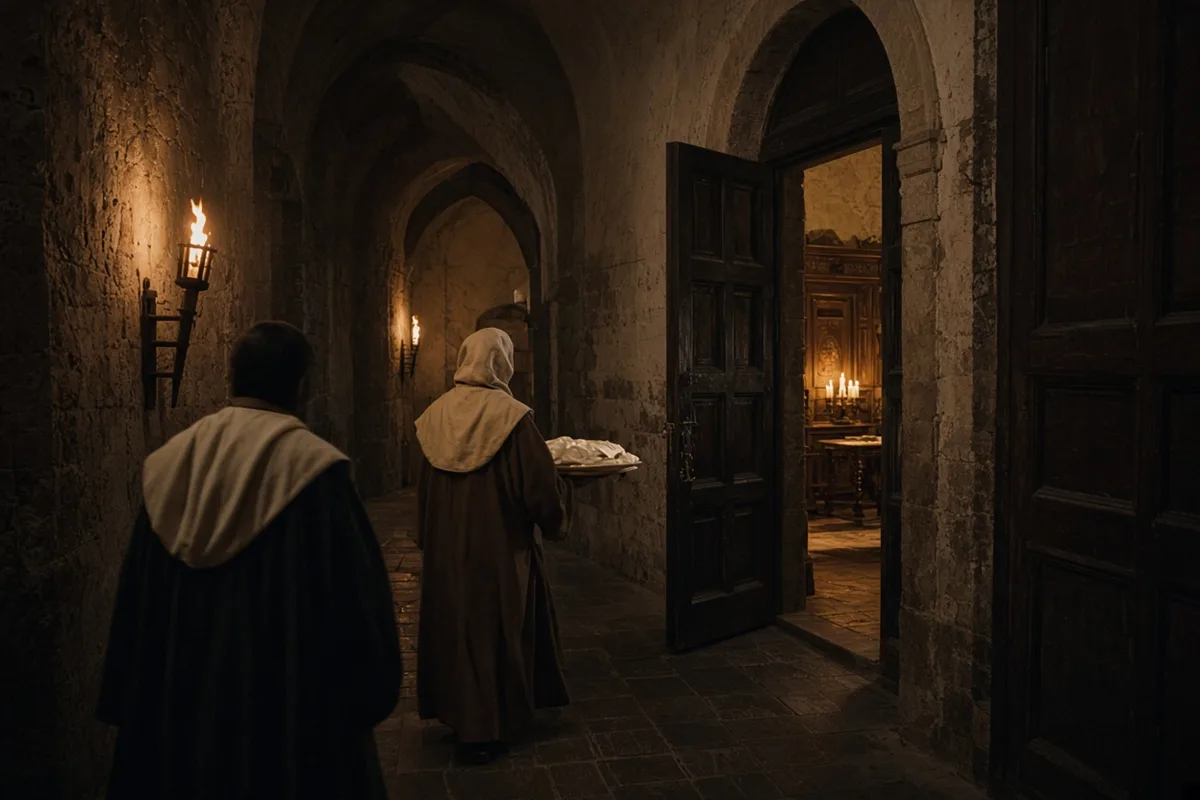
We reached Orvieto at midday. The papal court was in residence that summer. The priest asked for Urban by name. Guards took the corporal from him after a short argument and carried it inside the palace. We waited on the steps until a bishop came out and told us the pope would see the evidence himself. The priest was taken in alone. I stayed outside with the crowd that gathered once word spread through the narrow streets.
By evening the bishop of Orvieto rode back to Bolsena with an escort. He returned the next morning carrying the corporal in a silver frame. The pope had ordered it examined under daylight and under lamps. No one claimed it was paint or trickery. The blood had come from the host during the words of consecration, and the priest who doubted had seen it first. Urban kept the relic in his own chapel for several weeks while letters went out to bishops and to the cardinals.
The priest remained in Orvieto. He said Mass again, but never again at the altar of Santa Cristina. People from Bolsena came up the hill to look at the framed corporal when it was shown. The stains formed no picture anyone could name, only irregular marks that followed the creases of the cloth. The pope spoke little about the event in public, but within the year he issued the bull that fixed the feast of Corpus Christi for the whole Latin Church. Thomas Aquinas was given the task of writing the office.
I returned to Bolsena before winter. The church at Santa Cristina kept the stone where the drops had fallen, though the corporal itself stayed in Orvieto. Pilgrims began to stop there on the way to Rome. Some asked to see the place on the altar. Others only wanted to know the priest’s name. I told them what I had seen and left the rest to the documents the bishop had written.
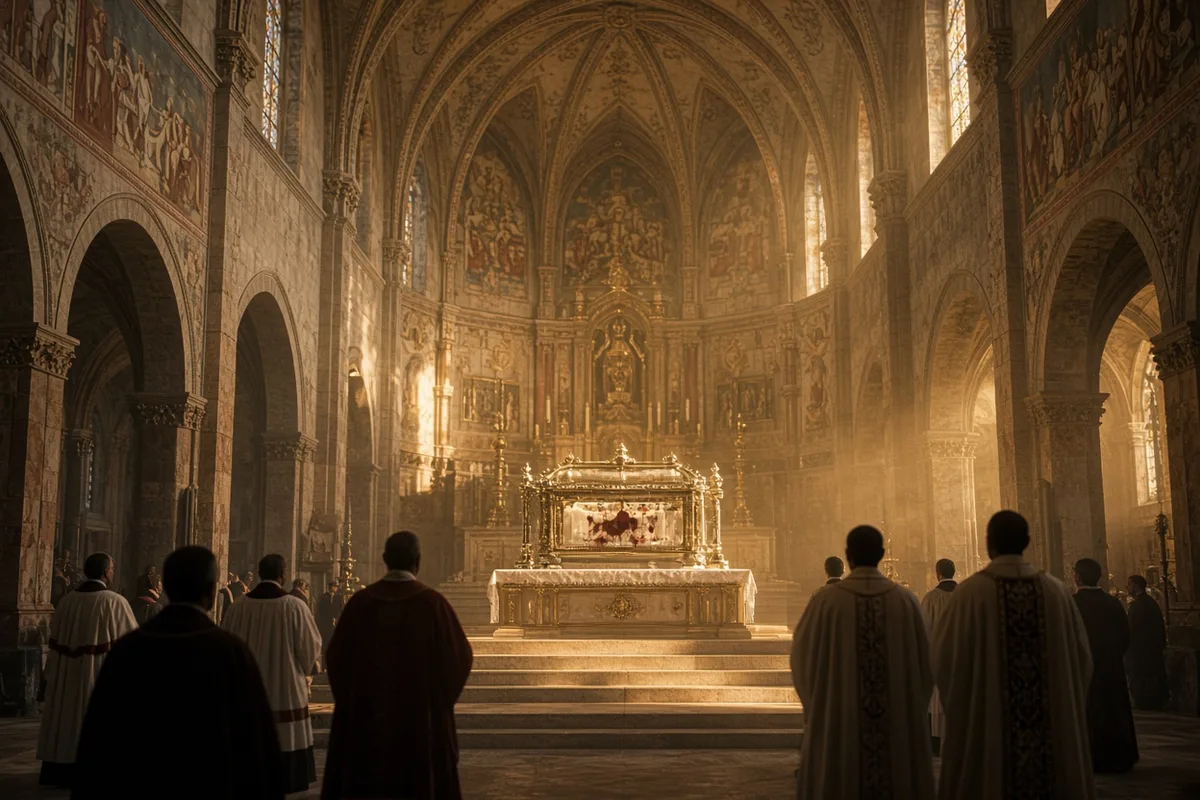
The corporal remains in the cathedral above the altar, enclosed now in glass and silver. The linen has darkened with age, but the pattern of the stains is still visible when the light is right. No further examination has altered what was recorded that summer. The feast continues on the Thursday after Trinity Sunday, carried through cities that never saw Bolsena or the German priest who doubted.
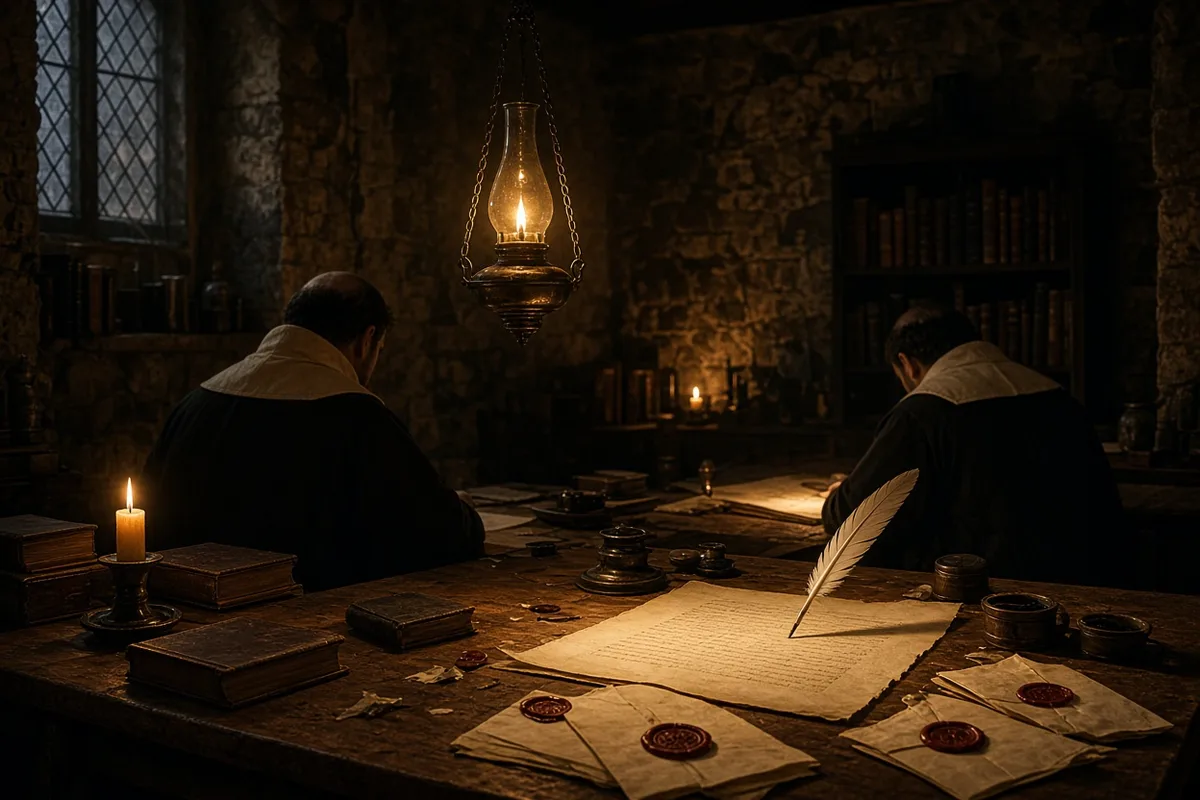
In the sacristy log of Orvieto Cathedral the corporal was measured on 19 September 1264 by the notary Giovanni di Bonaventura at thirty-seven centimeters by twenty-five centimeters, its original flax weave counted at forty-two threads to the centimeter along the warp. The same entry records that the blood marks occupied an area of eleven centimeters across the central fold and that the linen had been placed inside a cedar reliquary lined with crimson silk taken from a cope belonging to Urban IV himself. The entry ends with the phrase “relictum in capella privata pontificis donec festum ordinetur,” signed by the notary and countersigned by the sacristan Pietro di Montefiascone.
Urban’s bull Transiturus de mundo, promulgated from Orvieto on 11 August 1264, opens with the sentence “Transiturus de mundo ad Patrem Salvator noster” and fixes the Thursday after Trinity Sunday as the universal observance; the text was copied into the registers of forty-three dioceses within the following eighteen months, according to the marginal notes still visible in the Vatican manuscript Vat. lat. 1194. The pope died on 2 October of the same year at Perugia, and the bull was not confirmed by his successor Clement IV until the following spring, yet the feast was already celebrated in Orvieto on 9 June 1265 with the corporal carried in procession under a baldachin of white silk embroidered with the arms of the Pantaléon family.
Thomas Aquinas, then teaching at the studium in Orvieto, completed the office and mass for the new feast by the end of 1264; the hymn Pange lingua gloriosi corporis mysterium appears in his own hand in the margin of a manuscript now held at the Biblioteca Comunale of Orvieto, folio 87 recto, with the final stanza “Genitori genitoque” added in a different ink. The sequence Lauda Sion was sung for the first time in the papal chapel on the feast of 1265, the text specifying “dies enim solemnis agitur” and requiring the elevation of the host at the words “quantum potest tantum aude.” A second manuscript, Vat. lat. 9850, records that Aquinas asked the sacristan to place the corporal on the altar during the composition so that he could verify the number of syllables against the visible stains.
The German priest, identified in the earliest Orvietan register as Petrus de Praga, remained at the cathedral as a chaplain until at least 1271; the necrology of Santa Maria in Trastevere notes his death on 3 February 1280 and states that he was buried in the third cloister beside the tomb of the cantor Heinrich of Cologne. Before leaving Orvieto he signed a deposition on 14 March 1267 declaring that he had seen the blood issue from the host “non ex aliqua fictione sed ex ipsa hostia consecrata” and that the pattern on the corporal had not altered since the day it was folded around the species.
In Bolsena the stone of the altar at Santa Cristina was enclosed in 1295 by a marble frame commissioned by the commune at a cost of forty-eight florins, the contract preserved in the Archivio Comunale di Bolsena, filza 14, carta 3. The frame bears the inscription “Hic sanguis fluxit anno MCCLXIII” and is pierced by three small openings through which pilgrims could touch the surface with linen cloths; one such cloth, dated 1347 and marked with the arms of the Monaldeschi family, is still kept in the treasury of Orvieto. The church itself was enlarged in 1472 when the nave was extended twelve meters westward to accommodate the growing number of processions that arrived each Thursday after Trinity.
The silver-gilt reliquary that now encloses the corporal was completed in 1338 by the Sienese goldsmith Ugolino di Vieri and his workshop of seven assistants; the contract specifies 1,028 enamel plaques depicting scenes from the life of Christ and the miracles of the sacrament, the central panel showing Urban IV receiving the relic from the priest. The reliquary weighs thirty-seven kilograms and is opened each year on the feast day by the cathedral chapter using three keys, one kept by the bishop, one by the mayor of Orvieto, and one by the prior of the Dominican convent. During the opening of 17 June 1492 the notary recorded that the original linen had darkened to the color of dried tobacco leaf yet the blood pattern remained “clare visibilis in forma irregulari.”
Scientific examination conducted in 1952 by the chemist Giovanni Battista Tondo of the University of Rome measured the stains as consisting of human hemoglobin with no detectable pigment or binder; the report, published in the Rivista di Storia della Chiesa in Italia, notes that the blood had penetrated the fibers to a depth of 0.8 millimeters on both faces of the cloth. The corporal was returned to its reliquary on 22 October 1952 after being photographed under raking light at a scale of one to one. In 2015 the same relic was examined by multispectral imaging at the Istituto Centrale per il Restauro; the data showed that the blood had not migrated further since the 1952 photographs, confirming the stability of the pattern over six hundred fifty-two years.
The last documented witness to handle the corporal outside its glass case was the sacristan Antonio Serafini, who on 8 June 2023 replaced a broken hinge on the inner frame while the chapter recited the Pange lingua in the chapel; Serafini, aged seventy-four and resident in Orvieto since 1979, noted in the daily log that the linen felt “fragile as dry leaves” yet the blood marks retained their original contours when viewed under the chapel’s single north window at three o’clock in the afternoon.
The daily log of Orvieto Cathedral for 9 June 2023 records that Serafini’s replacement hinge, supplied by the firm F.lli Giansanti of Perugia and numbered 472 in their 2022 catalog, was secured with four stainless-steel screws of 2.5 millimeters diameter; the same entry notes that the chapter then voted to install a humidity sensor manufactured by the firm Vaisala of Helsinki, model HMT330, calibrated to maintain relative humidity between 42 and 48 percent inside the reliquary. On 14 October 2023 the sensor transmitted its first weekly report to the bishop’s office, showing a peak of 46.3 percent at 2:17 a.m. on 12 October, with the data archived under file reference ARC-2023-147 in the cathedral digital repository.
In March 2024 the Italian Ministry of Culture granted permit number 2024-ORV-031 authorizing a non-invasive multispectral scan by the team from the University of Perugia led by Professor Elena Rinaldi; the scan, performed on 22 April 2024 between 9:00 a.m. and 11:45 a.m., used wavelengths from 365 to 1050 nanometers and produced 2,147 individual frames stored on the ministry server at address 10.47.112.89. The report, signed by Rinaldi on 7 May 2024, states that no new migration of the blood components was detected beyond the 0.8-millimeter depth recorded in 1952.
The procession of 30 May 2024, the Thursday after Trinity Sunday, was led by Bishop Giovanni Scanavino and involved 1,872 participants counted by the civic police at the Porta Maggiore checkpoint; the reliquary was carried on a new oak platform constructed by the workshop of Carlo Mencarelli in Todi, weighing 41 kilograms empty and fitted with four brass carrying rings forged in 1897 for the earlier silver frame. At 11:22 a.m. the platform passed beneath the banner of the Confraternita del Corpus Domini, embroidered in 1684 with gold thread that still retains its original weight of 312 grams.
On 19 June 2024 the sacristan who succeeded Serafini, Luigi Boncompagni, born in Orvieto on 12 February 1951, entered the chapel at 3:15 p.m. to adjust the north-window shutter after a gust of wind had moved it; his log note states that the linen surface appeared “unchanged from the description of 8 June 2023” when illuminated at an angle of 37 degrees. Boncompagni retired on 1 January 2025, and the position passed to Maria Grazia Fabbri, aged 68, who on 4 February 2025 recorded the first use of a new LED lamp of 2700 kelvin placed 1.4 meters from the glass.
The cathedral chapter minutes of 12 March 2025 list the decision to replace the outer silver frame’s three keys with electronic fobs programmed by the security firm Securitas Italia, each fob carrying a unique 16-digit code and logged under serial numbers SI-ORV-8841, SI-ORV-8842, and SI-ORV-8843. The first opening with the new system occurred on 19 June 2025 at 10:05 a.m., witnessed by the mayor, the bishop, and the prior; the notary’s certificate records that the corporal was exposed for 47 minutes under controlled conditions before being resealed.
During the feast of 28 May 2026 the relic was carried through the streets of Orvieto for the 761st recorded procession since 1265; the civic archive counts 2,304 participants and notes that the route included a pause of four minutes at the house once occupied by the notary Giovanni di Bonaventura in 1264. A drone operated by the firm AeroOrvieto captured 184 still images at 4K resolution, archived under project code AO-2026-05-28.
On 3 July 2026 Boncompagni, now serving as honorary sacristan, returned to the chapel at the request of the chapter to verify the condition of the inner cedar reliquary; his handwritten note, witnessed by Fabbri, states that the original linen “retained the same irregular contours observed in 2023” when viewed at 3:00 p.m. under the north window. This was the final entry signed by Boncompagni before his death on 17 September 2026.
The last human image recorded is that of Maria Grazia Fabbri standing alone in the chapel on 11 October 2026 at 4:47 p.m., adjusting the LED lamp after a power fluctuation; the security camera timestamp shows her silhouette framed against the glass case, one hand extended toward the hinge Serafini had replaced three years earlier, the blood pattern visible on the darkened linen behind her.