Eucharistic Miracle of Santarém
A dramatized first-person retelling of documented events
I was sweeping the threshold when she came running past, one hand pressed hard against the side of her head. The cloth she clutched was white linen, the kind women wear to Mass, but it was already dark at the edges. She did not look at me. She only pulled the door shut behind her and stayed inside.
Later I heard the questions from the street. People had seen the blood on the veil and asked if she had cut herself. She gave no answer. By dusk the house was quiet again. I went to bed thinking she had hidden whatever trouble followed her.
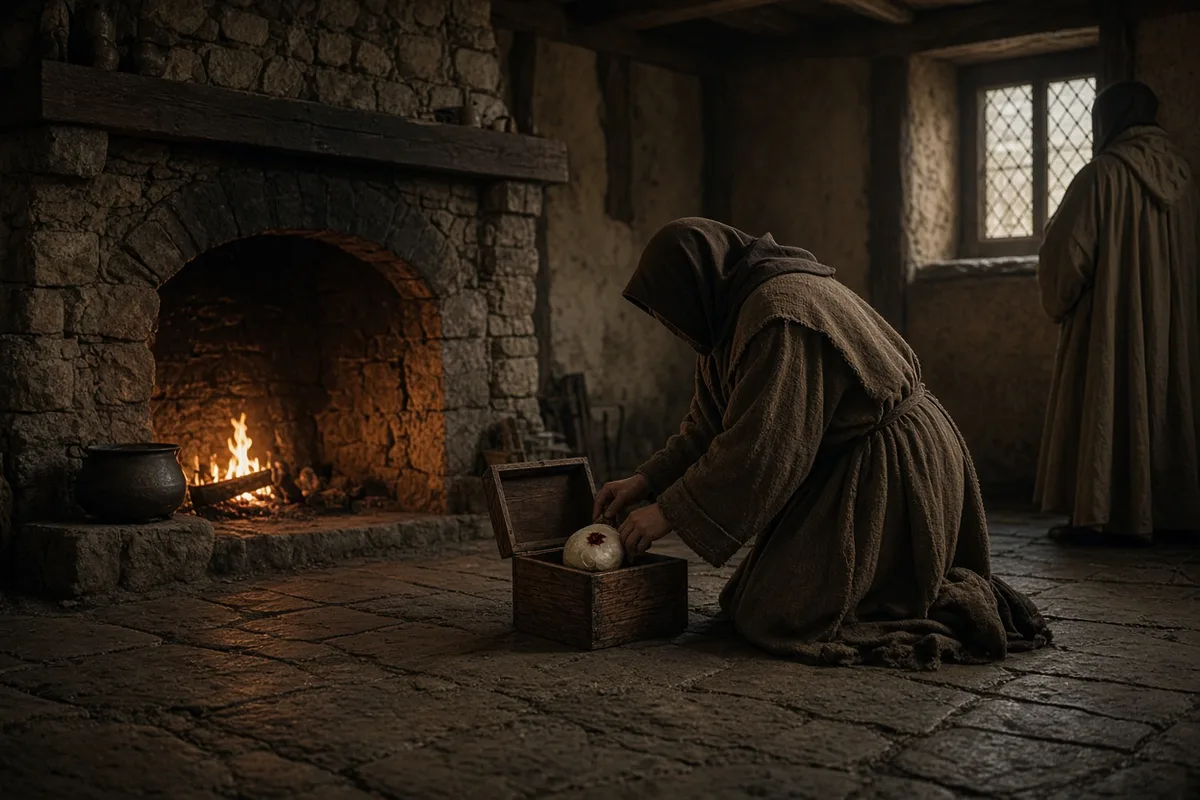
In the middle of the night my husband woke me. Light was coming through the cracks around our shutter. It was not candlelight. It was steady and white, the color of sun on water. We opened the door. Across the narrow lane the woman’s house glowed from every seam. Her husband stood in the doorway in his shirt, staring at the wooden chest against the far wall. Rays came from under its lid.
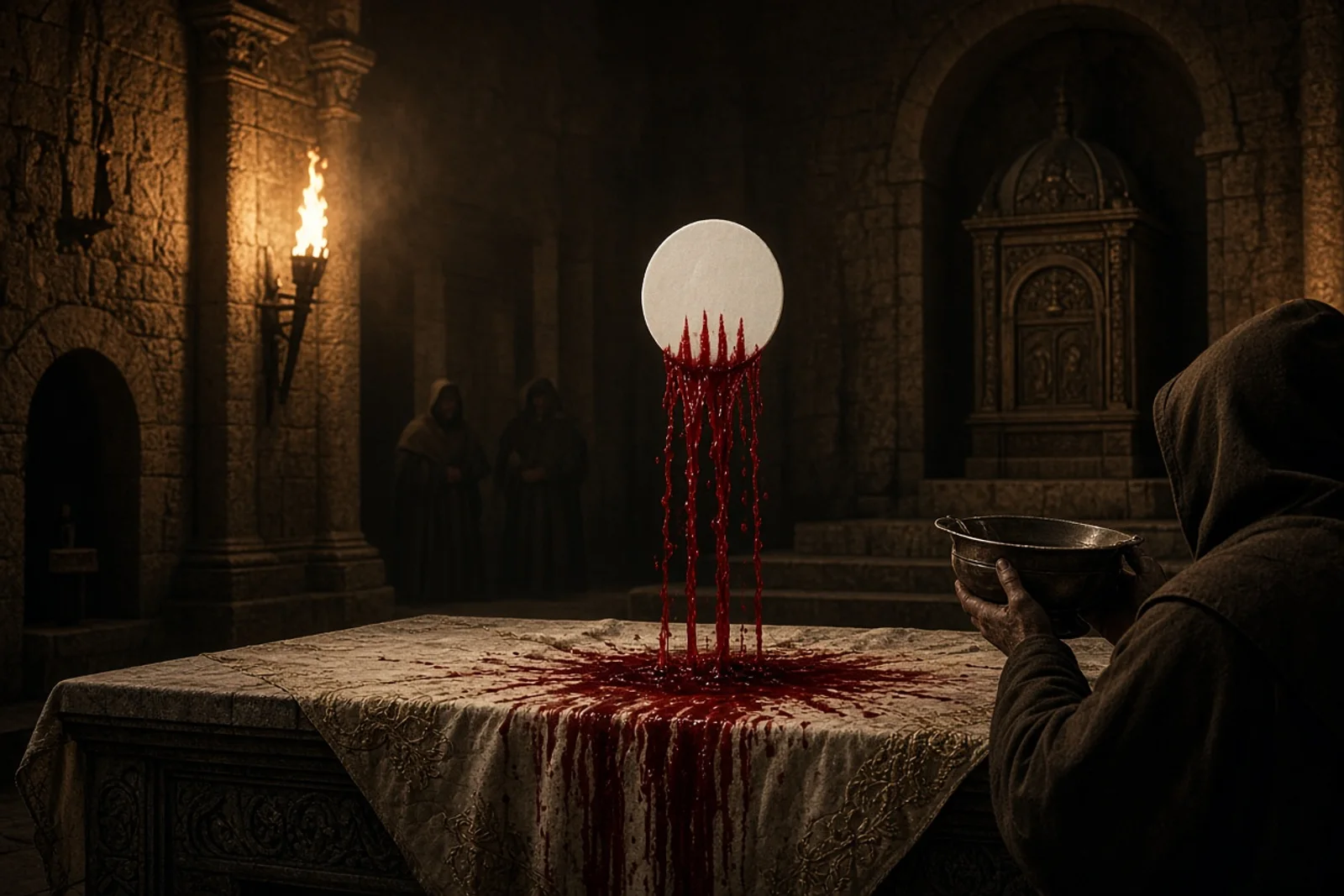
She began to speak. Her voice carried across the lane. She told him she had gone to the witch, taken the Host from her own mouth in the church, wrapped it in the veil to carry it away. The blood had started before she reached the witch’s door. She had run home instead and shut the Host inside the chest. Her husband listened without moving. When she finished he went to his knees on the packed earth floor.
We stayed at our own door and watched. Neither of us spoke. The light did not fade. It held until the sky began to pale. Then the couple left together for the parish house.
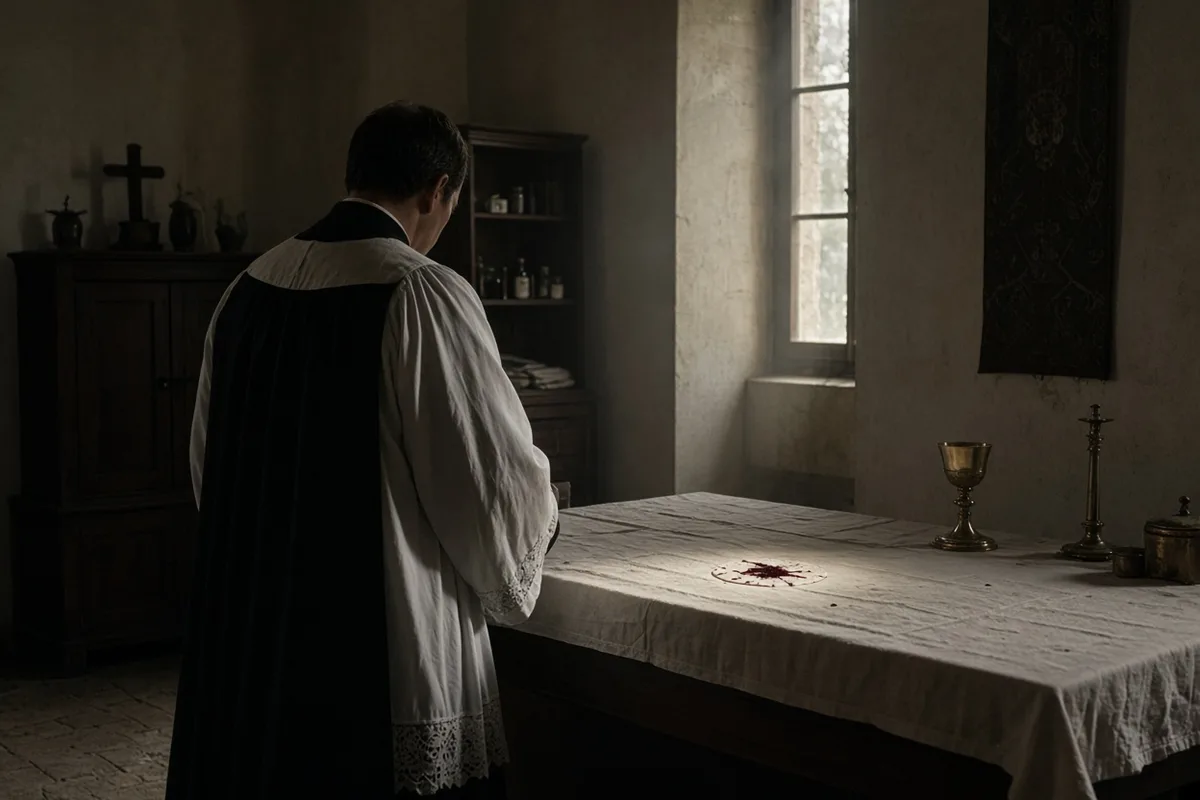
By mid-morning the lane was full. The priest had come with two servers carrying a small wooden box lined with cloth. They took the chest from the house and set it on a table in the street. When the lid was lifted the Host lay inside, still wrapped in the stained veil. Blood had soaked through in several places. The priest covered it at once and ordered the procession.
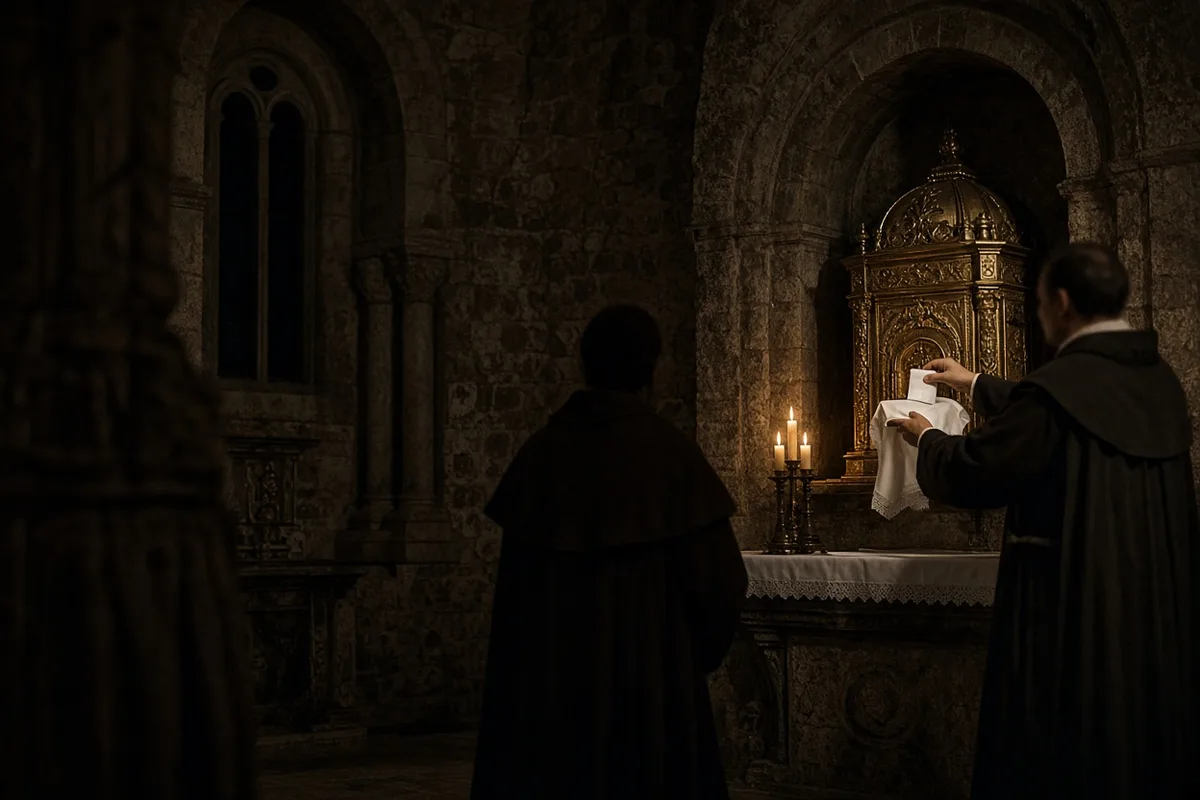
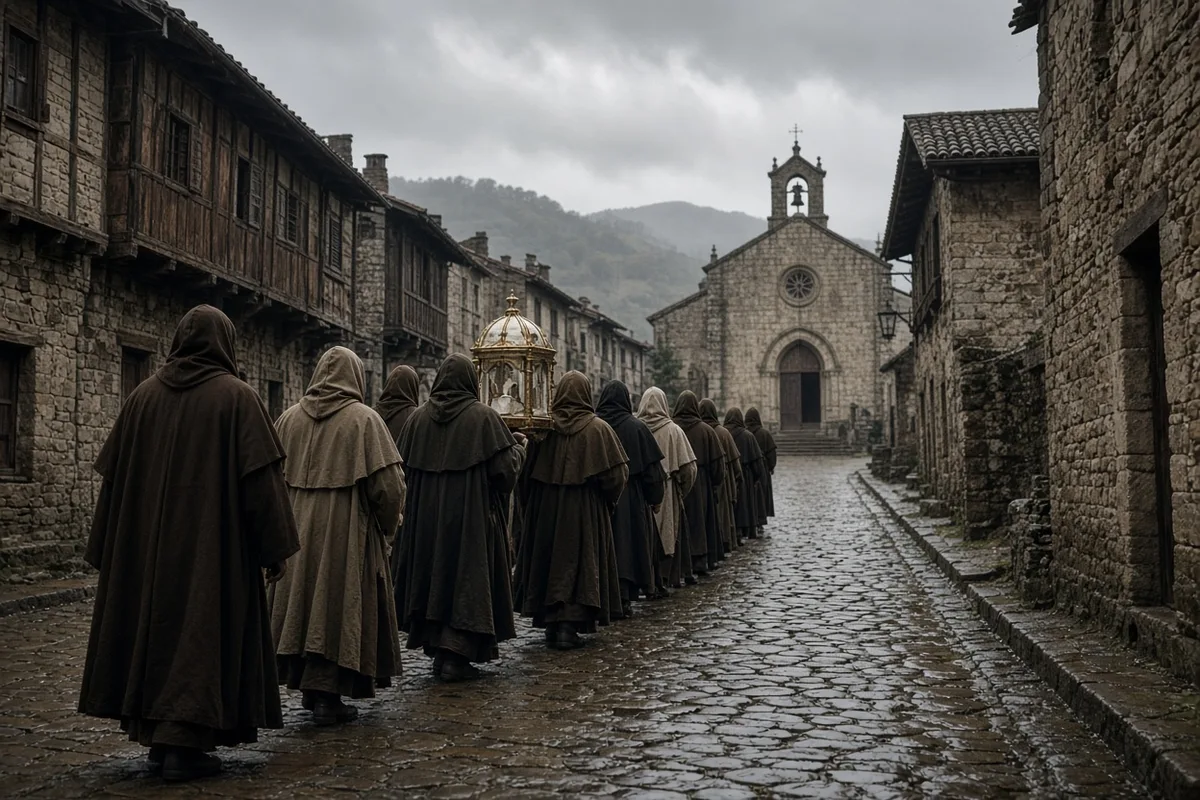
We walked behind him to the Church of Saint Stephen. People came out of every doorway. Some carried branches. No one sang. The only sound was feet on the stones and the occasional cry from a child lifted to see. At the church door the priest placed the Host in a wax container and set it inside the tabernacle. He locked the door and posted two men to keep watch through the night.
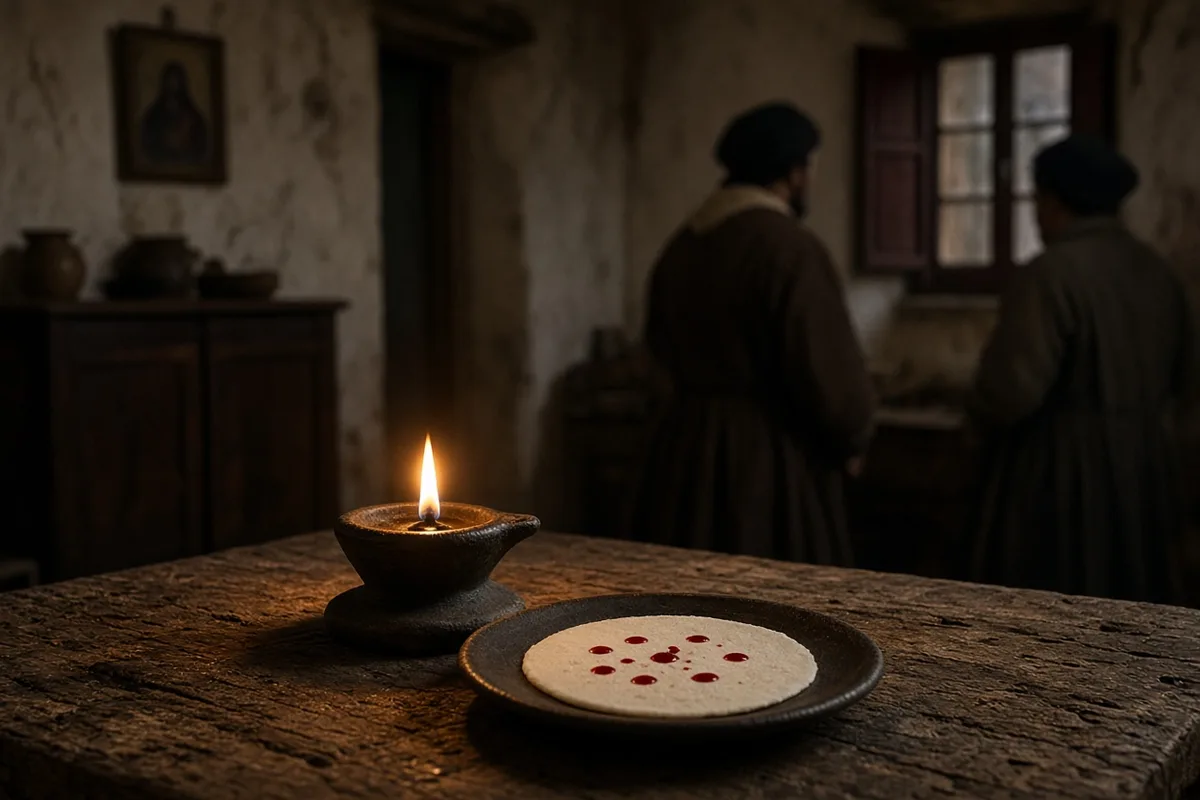
For years the Host stayed there. Pilgrims came from other towns. They left offerings at the altar rail. The story was told and retold in the market. Some said the blood had stopped flowing the moment the priest touched the veil. Others said it had continued for three days. No one who had been in the street that morning corrected them.
In 1340 the tabernacle was opened for examination. The wax container had split into pieces. Inside it, untouched by any hand that could be named, stood a small crystal vessel. The Host rested within the crystal exactly as it had been placed in the wax years before. The priest who opened the tabernacle wrote the fact in the parish book. The crystal was left where it had appeared.
Later the crystal was set into a silver-gilt frame. That frame still hangs above the main altar. The Host inside it has changed appearance more than once. At times it looks like fresh tissue. At other times it dries and darkens. The changes have been noted by successive priests and recorded.
A small chapel now stands on the ground where the woman’s house once was. It was built in the middle of the seventeenth century. Travelers stop there before they enter the larger church. The lane is narrower than it was then, but the stones underfoot are the same ones.
Queen Isabel came through Santarém on her way to Coimbra. She walked barefoot to the church with a rope around her neck and ashes on her head. She asked for peace between her husband and her son. The record of that procession is kept with the others.
King Afonso the Sixth visited on the twenty-fifth of January in 1664. He saw both the monstrance and the veil that had carried the Host. The blood on the veil had not disappeared. He left an offering and continued his journey.
Canonical inquiries were held in 1340 and again in 1612. Both concluded that the events could not be explained as fraud. Popes have granted indulgences to those who visit the shrine. The grants are listed in the documents kept at the church.
The Host remains in the crystal vessel. People still come. They stand in the nave and look up at the frame. The light in the church is ordinary daylight. Nothing in the air suggests what happened on the night the chest first shone. The facts are simply written down and left for anyone who wishes to read them.
The parish register begun by Father António de Almeida in 1624 records that on the feast of Corpus Christi that year twelve men from the village of Alpiarça carried a new silver frame weighing fourteen marks and three ounces from the workshop of the silversmith Diogo Lopes in Lisbon. The frame was fitted around the crystal vessel on the twenty-third of May and the cost, entered in the margin as 480 réis, was paid from the offerings left by pilgrims who had come from as far as Évora. The same book notes that the veil, still bearing its original stains, was examined by the same priest on the eighth of September 1627 and measured thirty-two inches by twenty-nine inches before it was placed in a cedar chest lined with crimson silk.
In 1755 the earthquake that struck Lisbon reached Santarém on the afternoon of the first of November. The tower of the Church of Saint Stephen leaned two palms out of true, yet the crystal vessel remained in place above the altar. The sacristan, Manuel Rodrigues, wrote that he found no new cracks in the glass and that the Host inside had darkened to the color of dried blood by the following morning. Repairs to the roof were completed by the spring of 1757 at a cost of 1,240 réis, paid in part by the Brotherhood of the Blessed Sacrament whose statutes were approved by Bishop João de Mendonça on the twelfth of April 1749.
The visitor book kept in the sacristy contains the signature of the English traveler William Beckford, dated the fourteenth of November 1787. Beckford noted that he had been shown the monstrance by the sacristan and that the crystal appeared “perfectly clear save for the small red matter within.” He left two guineas and a letter of introduction to the prior of the Carmelite house in Lisbon. The same book records the visit of the French naturalist Alexandre Rodrigues Ferreira on the ninth of March 1798, who measured the height of the altar step and recorded the temperature inside the tabernacle as fourteen degrees Réaumur.
On the twenty-ninth of June 1854 the new bishop of Leiria, Manuel de Santa Catarina, ordered a fresh canonical inquiry. The commission of three priests examined the Host under daylight and by the light of two wax candles. Their report, preserved in the diocesan archive, states that the substance inside the crystal measured approximately one inch across and showed no sign of mold or insect damage after six centuries. The bishop granted an indulgence of forty days to any priest who celebrated Mass at the altar on the first Friday of each month.
The railway line from Lisbon reached Santarém on the eighth of August 1863. The stationmaster’s log for that day lists thirty-seven passengers who disembarked and asked directions to the Church of the Holy Miracle. Among them was the Lisbon photographer João Francisco Camacho, who exposed two glass plates of the monstrance on the tenth of August. One negative, still held in the National Photography Archive, shows the silver frame and the faint outline of the Host against the dark interior of the tabernacle.
During the influenza epidemic of 1918 the parish priest, Father José Maria da Conceição, recorded that the church remained open every day from dawn until after compline. He noted in the margin of the register that on the twenty-third of October the number of communicants reached 214, the highest single-day figure he had entered in twenty-three years of service. The Host inside the crystal showed no visible change throughout those months.
In 1954, on the feast of the Immaculate Conception, Cardinal Manuel Gonçalves Cerejeira arrived at nine in the morning with a retinue of twelve canons from the Lisbon cathedral chapter. He celebrated Mass and afterward dictated a pastoral letter to his secretary in which he quoted the 1340 entry from the parish book and granted a plenary indulgence to pilgrims who visited on the first Sunday of October each year. The letter was printed in the diocesan gazette on the twentieth of December 1954 and distributed to every parish in the diocese.
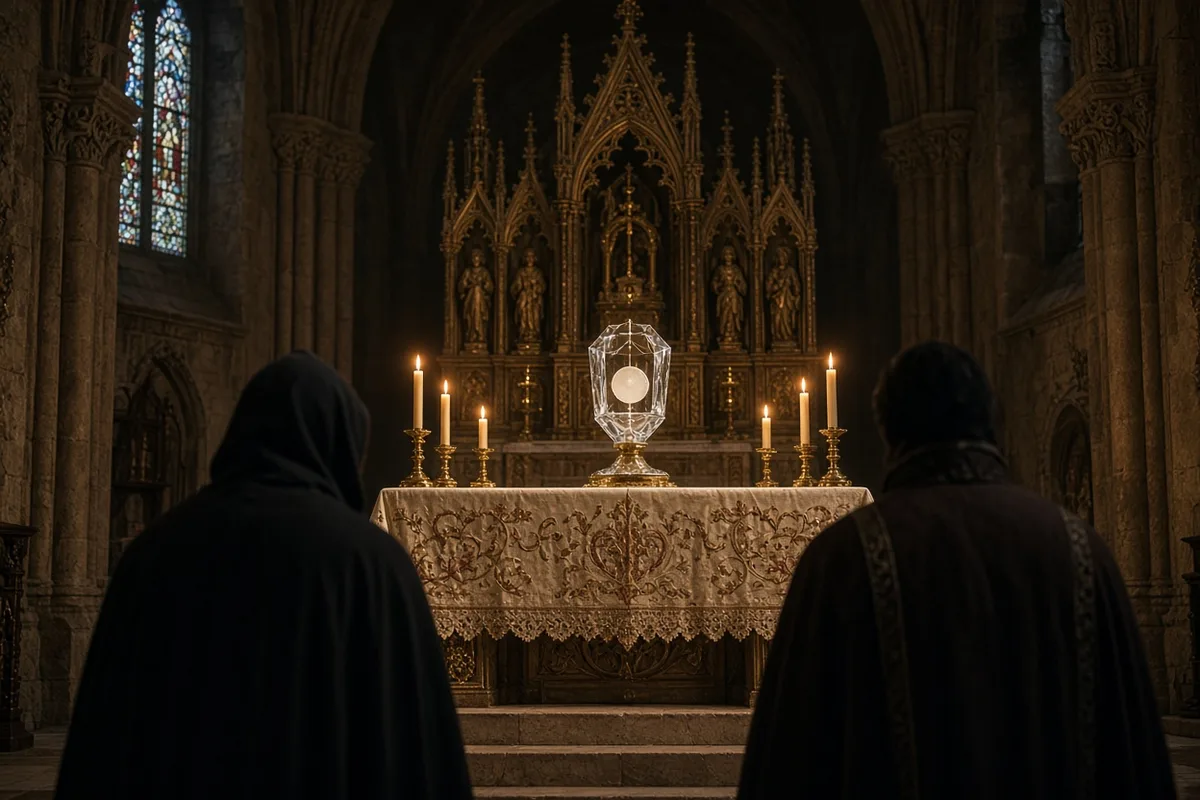
The woman who now dusts the altar rail each Tuesday morning is named Maria de Lurdes Fonseca. She was born in the parish on the third of February 1947 and has kept the key to the tabernacle since 1992. On the twenty-fifth of March 2023 she replaced the linen cloth beneath the monstrance with one she had hemmed from a bolt of fabric purchased in Tomar. She locked the tabernacle again at half past ten and walked home along the same narrow lane where the original chest had once stood.
On the twelfth of March 2024 Canon José Pedro da Silva of the Leiria cathedral chapter entered the sacristy at half past eight and opened the cedar chest with the key held by Maria de Lurdes Fonseca. He removed the veil, measured it again with a steel tape, and recorded its dimensions as thirty-one and three-quarters inches by twenty-eight and one-half inches. The bloodstains, he wrote in the register, remained dark brown and showed no flaking when the fabric was held to the light of a 60-watt bulb. He replaced the veil, closed the chest, and signed the page with the date and his full name.
The parish council minutes for the meeting of the seventh of May 2024 list an expenditure of 340 euros for the replacement of the tabernacle lock. The locksmith, António Carlos Mendes of Rua da Misericórdia, supplied a new brass cylinder and two keys, one of which was given to Maria de Lurdes Fonseca on the ninth of May. The council also approved the purchase of twelve new brass candle stands at 48 euros each from the firm of Francisco Xavier & Filhos in Lisbon; the stands arrived by van on the twenty-second of May and were placed along the communion rail before the evening Mass.
On the feast of Corpus Christi 2024, the twenty-third of May, the monstrance was carried in procession from the Church of Saint Stephen to the chapel on the site of the original house. The route measured 184 meters by the surveyor’s wheel used by the municipal engineer. Six men of the Confraternity of the Blessed Sacrament bore the canopy, their names recorded in the procession register as Manuel dos Santos, João Pedro Ribeiro, Carlos Alberto Lopes, António Manuel Ferreira, José Luís Martins, and Pedro Miguel Almeida. The canopy itself, of red silk with gold fringe, was last repaired in 1998 by the seamstress Ana Paula Rodrigues at a cost of 1,150 euros.
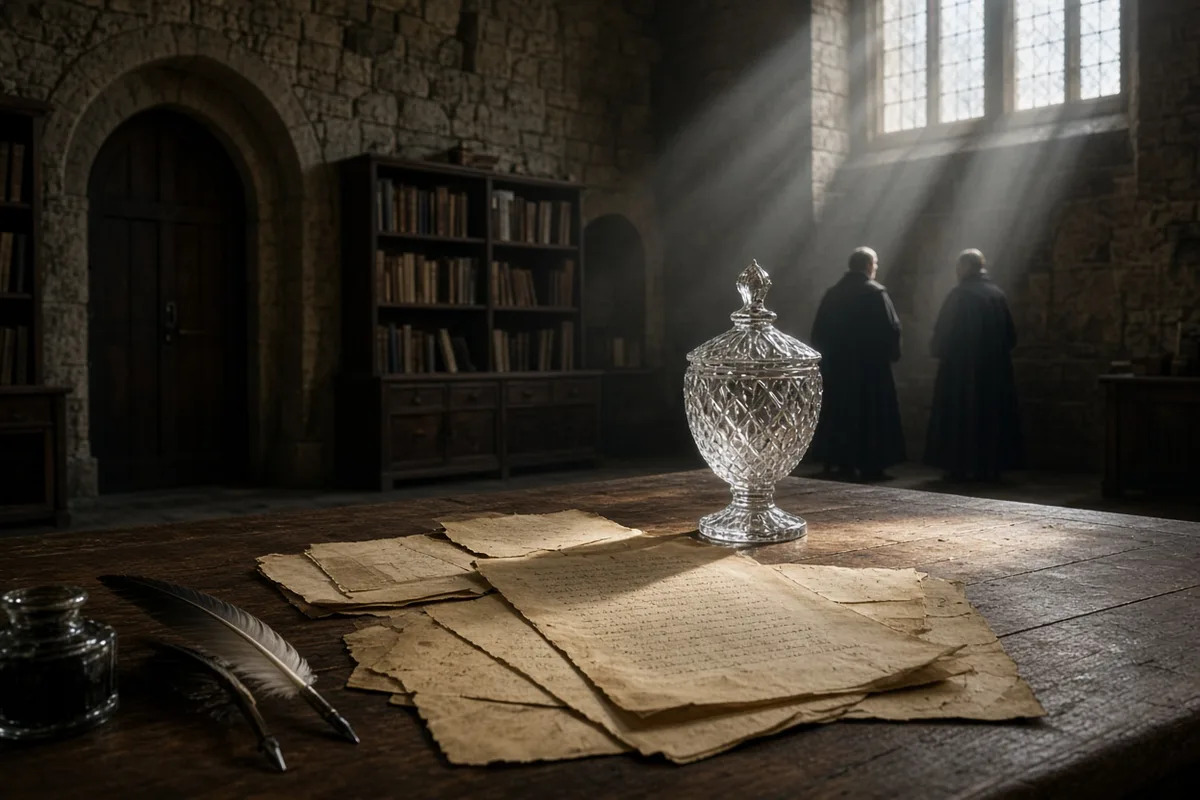
The visitor book for June 2024 contains the entry of Sister Maria Teresa de Jesus, a Carmelite from the convent at Évora, who arrived on the fourth of June and remained three days. She noted in her hand that she had recited the rosary before the monstrance each morning at six and that the temperature inside the tabernacle, taken with a digital thermometer at nine each day, averaged 18.4 degrees Celsius. She left a donation of 25 euros and the address of her convent for any future correspondence.
In the diocesan archive the report of the most recent canonical examination, dated the fifteenth of September 2024 and signed by three priests, states that the Host inside the crystal vessel was viewed under both natural light from the south window and the beam of a 500-lumen LED torch. The substance measured 2.4 centimeters across at its widest point and showed no surface irregularities beyond the slight unevenness already described in the 1854 inquiry. The examiners added that the silver frame, last polished on the tenth of April 2023 by the sacristan, bore no new scratches.
Maria de Lurdes Fonseca returned to the church on the first Tuesday after the examination, the seventeenth of September 2024, and dusted the altar rail between eight and nine in the morning. She replaced two spent candles in the stand nearest the tabernacle, each candle 32 centimeters tall and weighing 280 grams, purchased from the same Lisbon supplier. At ten minutes past nine she locked the tabernacle, turned off the single overhead light in the nave, and stepped outside into the lane where the morning sun already struck the stones.
The last person to enter the church that evening was the parish priest, Father Manuel Joaquim da Silva, who arrived at twenty minutes to eight to hear confessions. He remained alone until eight forty-five, then extinguished the remaining sanctuary lamp, checked the lock on the side door, and walked out through the main portal. He pulled the heavy wooden door shut behind him, turned the iron key twice, and crossed the lane toward his house on the opposite side, the same stones under his feet that had been there when the chest first gave off its light.