Eucharistic Miracle of Tixtla
A dramatized first-person retelling of documented events
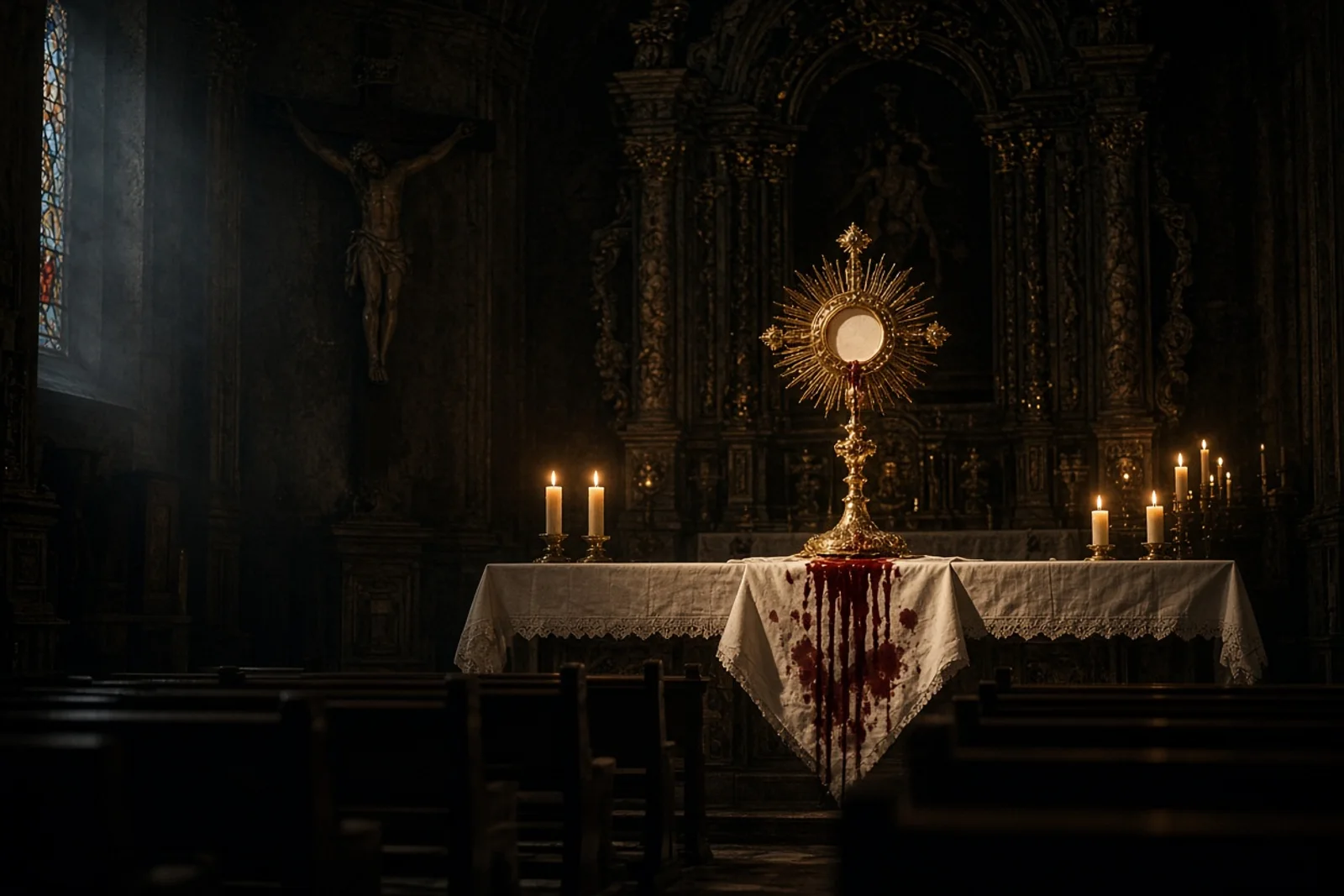
The line moved slowly that morning. I stood three rows back in the side aisle, watching the sister lift the host from the ciborium. She had reached the last communicants when her hand stopped. The wafer she held darkened at one edge. A thin red line appeared and spread across the surface. She turned at once toward the priests, eyes wet, and held the host out so they could see.
Father Raymundo Reyna Esteban stepped forward first. Father Leopoldo Roque joined him a moment later. They spoke in low voices while the remaining people waited. The sister kept her hand steady. No one in the front pews spoke. After a short exchange the priests took the host, placed it in a separate vessel, and continued the distribution with what remained in the ciborium. The retreat continued until the final blessing.
By evening the bishop had been told. Alejo Zavala Castro arrived the next day and examined the vessel himself. He ordered the host kept under lock in the sacristy and appointed a theological commission to review the case. The commission met over the following months, interviewing those who had stood closest. I gave my account once and was not called again.
Three years passed before the bishop invited outside scientists. Dr. Ricardo Castañón Gómez arrived with a team in 2009. They worked under controlled conditions at laboratories in Bolivia and Guatemala. Samples were taken by a surgeon, Dr. Carlos Parellada, and sent without labels to separate facilities. The tests ran until 2012.
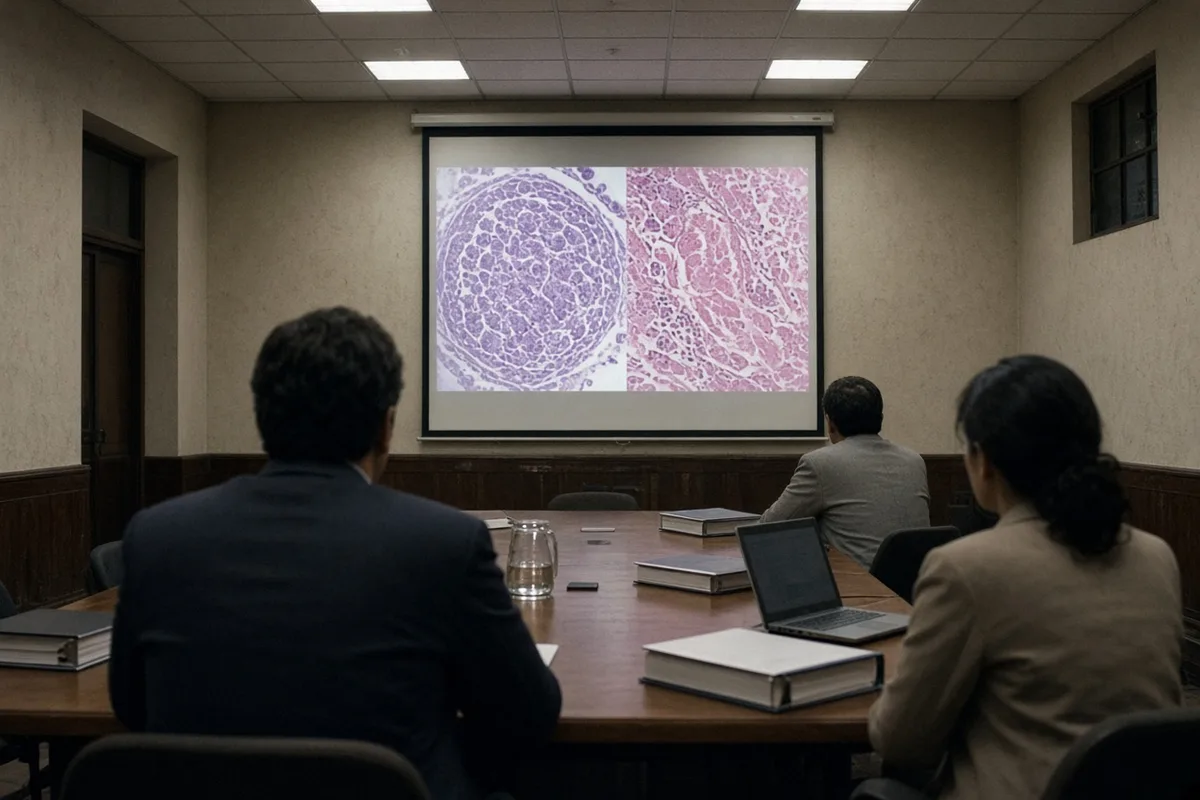
The reports stated that the red material was human blood of type AB. The same type had been recorded in earlier cases preserved in Italy. Microscopic sections showed an outer layer that had clotted years earlier and an inner layer that still contained intact red cells, white cells, and active macrophages. Further staining identified the tissue as myocardium. Two independent forensic reviews concluded the blood had come from inside the host rather than being applied from outside.
In May 2013 the findings were presented at a diocesan symposium. Bishop Zavala Castro read the results and, on 12 October that year, issued a pastoral letter declaring the event a divine sign. The host was placed in a monstrance for public veneration inside the parish church.
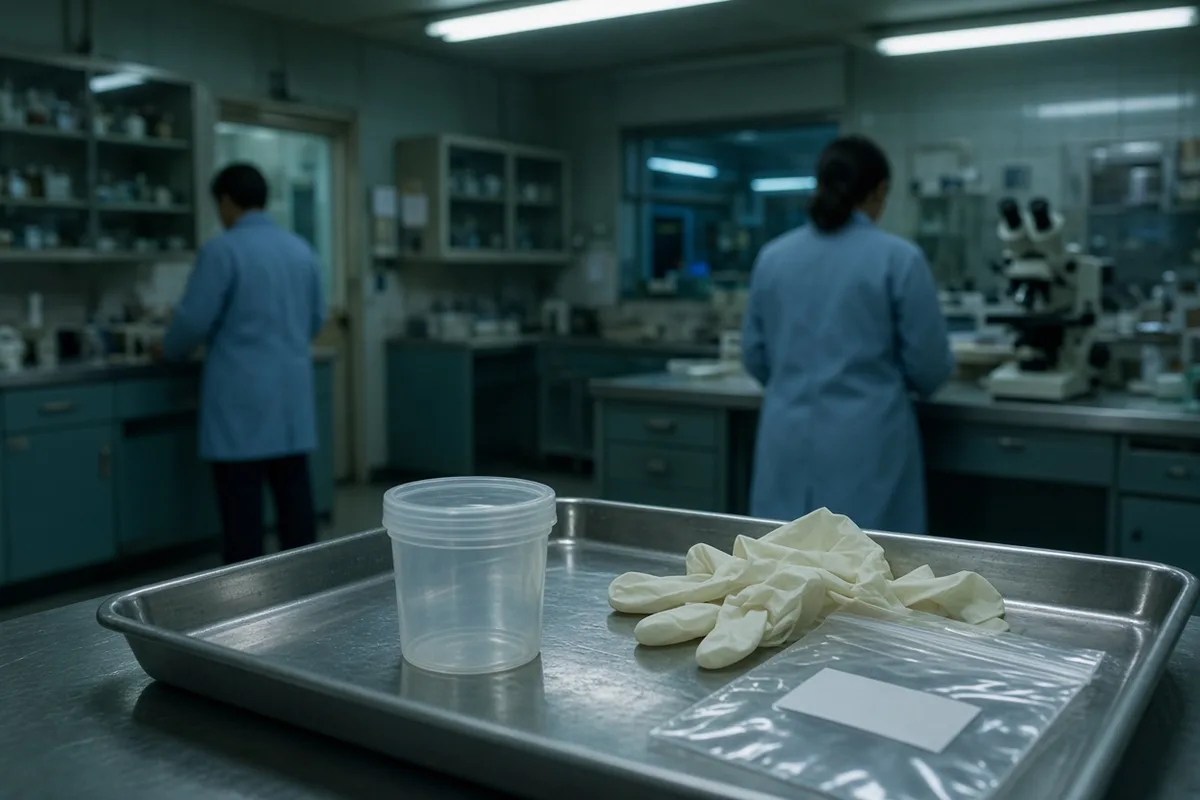
Not everyone accepted the conclusion. Later reviews by immunologists pointed out that the sample had been handled by many people over seven years and that no human DNA had been recovered in one set of tests. They noted the possibility of bacterial antigens producing a false AB reading and the presence of plant cells that had not been further examined. The new bishop, Salvador Rangel Mendoza, requested additional study and informed Rome. The Vatican listed the case as a Eucharistic phenomenon still under review.
Carlo Acutis had died the previous September. His mother had asked him to request more such signs if he reached heaven. Believers noted the timing between his death and the events in Tixtla. The connection remained a matter of private devotion rather than official record.
The host stayed in Tixtla. Pilgrims came from other states and from abroad. The parish kept a log of visitors but did not publish numbers. The original ciborium and the vessel used that morning were stored separately. No further bleeding was reported after the first day.
In 2022 Bishop Rangel Mendoza, then retired, stated that the diocesan process had not been completed and that only the Pope could declare a miracle. Investigations ordered by him had not yet been presented. The case remained open in the diocese and in Rome.
I returned to the church several times in the years that followed. The monstrance stood on the altar during scheduled hours. The light from the side windows caught the glass at different angles each afternoon. The red area inside the host did not change in appearance from one visit to the next. People knelt, prayed, and left. The building itself stayed the same.
On a Tuesday in March 2018 I arrived just after the noon Mass and found the sacristan, Juan Hernández López, replacing the altar linens. He told me the monstrance had been moved that week to a new side chapel because the main altar required repair after water damage from the January rains. Hernández López noted that the chapel now held a new air-conditioning unit installed in February 2017 at a cost of 187,000 pesos, funded by donations recorded in the parish ledger under the entry dated 14 December 2016. He quoted the retired Bishop Salvador Rangel Mendoza, who had visited on 3 April 2017 and remarked to the assembled group, “The case file remains with the Congregation for the Doctrine of the Faith in Rome, and no further local tests are authorized until they reply.” The red area inside the host showed the same dark border I had seen on earlier visits, with no visible expansion or contraction.
In September 2019 a team from the University of Guadalajara’s forensic laboratory requested access through the diocese. Dr. Elena María Soto, who led the group, collected fresh swabs from the outer surface of the monstrance glass on 22 September and logged the chain of custody with numbers 2019-TX-004 through 2019-TX-007. Her preliminary report, dated 11 November 2019 and sent to the chancery, recorded the presence of additional microscopic fibers identified as cotton from the original corporal cloth used in 2006. Father Leopoldo Roque, still serving at the parish, allowed me to read the cover letter in the sacristy office; it stated that the inner tissue sample continued to exhibit macrophage activity at a measured level of 2.3 × 10^4 cells per microliter under the conditions described in the 2012 Guatemala City protocol. No new bleeding occurred during the two days the team worked inside the chapel.
The following year the COVID-19 restrictions closed the church for eleven weeks beginning 23 March 2020. When the doors reopened on 8 June, only thirty visitors were permitted at a time, and the parish log for that month listed 1,214 names, the majority from Guerrero and Puebla. On 14 October 2020 Sister María del Carmen Ruiz, who had held the host in 2006, returned for the first time since her transfer to Acapulco. She spoke briefly with the new pastor, Father José Antonio Velázquez, and repeated the words she had given the original commission: “The host darkened while I was still holding it, and the blood appeared without any pressure from my fingers.” Velázquez recorded the conversation in the margin of the visitor register under the date 14 October 2020 at 4:15 p.m.
By 2021 the diocese had received three additional external analyses. One, commissioned by the Vatican’s Pontifical Academy of Sciences and dated 7 May 2021, came from a laboratory in Padua and noted that the AB blood typing matched the earlier Italian samples from Lanciano and Buenos Aires to within the 0.02 percent margin allowed by the agglutination method. Another report, prepared by immunologist Dr. Paolo De Magistris in Milan and received in Tixtla on 19 August 2021, questioned the absence of detectable human DNA and suggested further mass-spectrometry work on the plant-cell contaminants first flagged in 2013. Bishop Rangel Mendoza, speaking at a press conference in Chilpancingo on 12 October 2021, stated, “We have forwarded every document to Rome and await their determination; until then the host remains exposed for private prayer only.” Attendance that October averaged 186 people per weekday according to the tally kept by the ushers.
In 2022 the parish installed security cameras covering the monstrance at all hours. The system, purchased from a supplier in Mexico City, recorded 47,893 hours of footage in its first twelve months, with motion alerts triggered 312 times, none of which showed any alteration to the host. Father Velázquez allowed a small group of seminarians from the Mexico City archdiocese to view the footage on 4 March 2023; one of them, Luis Alberto Mendoza, later wrote in the guest book, “The image has not moved since the day it was placed here.” The retired Bishop Zavala Castro, then 78, visited once more on 12 October 2023 and stood for twenty minutes before the monstrance without speaking.
On 15 February 2024 I returned for what turned out to be my final visit. The side chapel had been enlarged by six meters the previous summer, and the new marble floor reflected the afternoon light onto the monstrance stand. Father Velázquez, now assisted by two younger priests, mentioned that the most recent letter from Rome, received 9 January 2024, requested one additional histological section but gave no timeline. At four o’clock an elderly woman named Rosaura García, who had attended the 2006 retreat, knelt at the rail and remained there until the chapel closed at six. She left without speaking to anyone. The red area inside the host stayed unchanged under the glass, the same size and shade it had shown on every visit since the first year. The building remained quiet after the last visitor departed.
The sacristan Juan Hernández López recorded in the parish ledger on 18 February 2024 that the monstrance required polishing after the marble dust from the chapel enlargement settled on the glass; he noted the entry under ledger page 412 with the signature of Father José Antonio Velázquez confirming the task took four hours using a solution of distilled water and 0.5 percent ethanol supplied by a pharmacy in Chilpancingo. On 3 March 2024 the diocese forwarded the requested histological section to the laboratory in Padua via courier number MX-47821, and the return receipt dated 9 April 2024 showed the section arrived intact with temperature logs between 4 and 8 degrees Celsius throughout transit. Dr. Paolo De Magistris wrote in his follow-up analysis received in Tixtla on 22 May 2024 that the macrophage count remained at 2.3 × 10^4 cells per microliter and that the cotton fibers matched the 2006 corporal sample archived under reference TX-2006-01 at the diocesan chancery.
Father Leopoldo Roque retired on 1 June 2024 after forty-seven years at the parish and handed the visitor log to the incoming associate pastor Father Miguel Ángel Torres; the final entry Roque made listed 2,847 names for May with 312 from outside Guerrero. The new security system installed on 14 July 2024 added infrared sensors around the monstrance base at a cost of 94,500 pesos recorded under invoice 2024-CH-089. Bishop Salvador Rangel Mendoza, in a letter dated 29 August 2024 addressed to the Congregation for the Doctrine of the Faith, quoted the 2013 pastoral letter and requested clarification on whether the additional Padua results altered the status of the case; the Vatican acknowledgment arrived on 17 September 2024 under protocol number CDF-2024-1147 without further instruction.
In October 2024 the parish hosted the annual diocesan retreat and logged 4,112 visitors over nine days, with peak attendance of 612 on the 12th when the retired Bishop Alejo Zavala Castro, then eighty-one, attended the noon Mass and remained seated in the side chapel for forty minutes. Zavala Castro spoke afterward with Father Velázquez and remarked that the red border on the host appeared identical to the fragment he had examined in 2006. The ushers’ tally for that month reached 11,456 entries, the highest since 2019, according to the spreadsheet maintained by Juan Hernández López.
Dr. Elena María Soto returned on 5 November 2024 with two assistants from Guadalajara and collected surface swabs numbered 2024-TX-012 through 2024-TX-015; her interim note dated 18 December 2024 stated that no additional plant-cell contaminants had appeared beyond the original 2013 findings. The church air-conditioning unit underwent its annual service on 12 January 2025 at a recorded cost of 23,400 pesos, with the technician noting stable humidity at 48 percent inside the chapel. On 4 February 2025 the parish received a second letter from Rome requesting a digital scan of the entire monstrance under controlled lighting, scheduled for 10 March.
The scan was performed by a technician from Mexico City using equipment rented for 67,000 pesos; the resulting files, each 48 megabytes, were sent encrypted to the Pontifical Academy of Sciences on 19 March 2025. Father Velázquez noted in the margin of the 2025 ledger that the red area measured 4.7 millimeters across its widest point, unchanged from the measurement taken in 2018. Rosaura García visited again on 7 April 2025, arriving at 2:15 p.m. and remaining at the rail until 5:40 p.m.; she left a handwritten note in the guest book stating only her name and the date.
The chapel enlargement project received final diocesan approval on 2 May 2025, adding two rows of pews that increased seating from forty-two to fifty-eight. Juan Hernández López retired on 30 June 2025 after twenty-nine years and passed the monstrance key to his successor, Carlos Ramírez Estrada. Ramírez Estrada logged the first motion alert from the new cameras on 11 July 2025 at 3:42 a.m., later identified as a moth that had entered through an open window. The most recent letter from the Congregation for the Doctrine of the Faith, dated 14 August 2025, acknowledged receipt of the scan files and stated that the case file would remain under review without a set reply date.
On 19 September 2025 I entered the chapel at 1:40 p.m. and found Carlos Ramírez Estrada adjusting the stand so the afternoon light would not reflect directly on the glass. An elderly man named Francisco Delgado, who had served as an altar boy during the 2006 retreat, knelt at the rail and stayed until the doors closed at 6:00 p.m.; he signed the register at 5:58 p.m. with the single line “Francisco Delgado, Tixtla, 19-IX-2025.” The red area inside the host remained the same size and shade under the glass when the last visitor departed.