Jan Hus Preaches Reform at Bethlehem Chapel
A dramatized first-person retelling of documented events
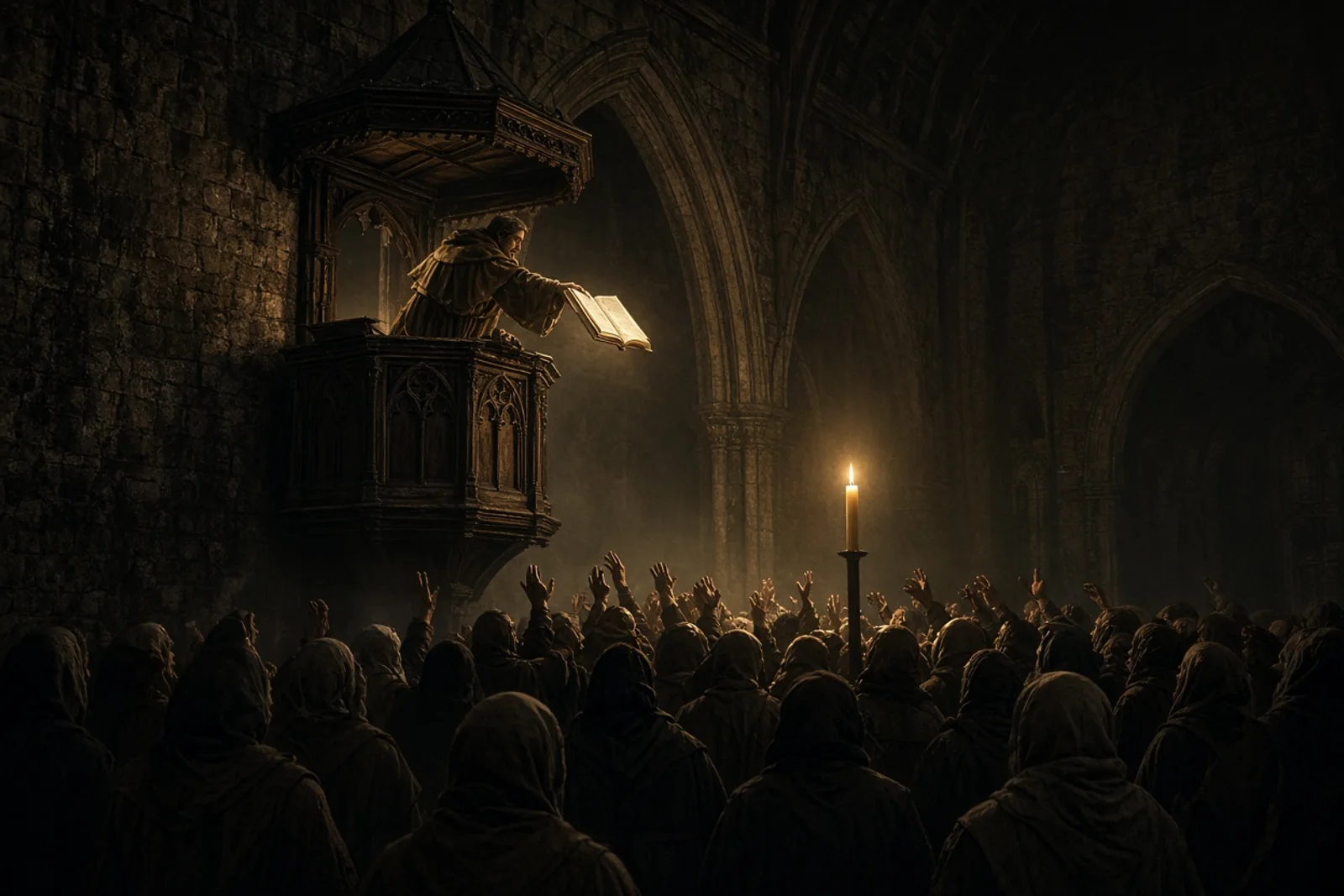
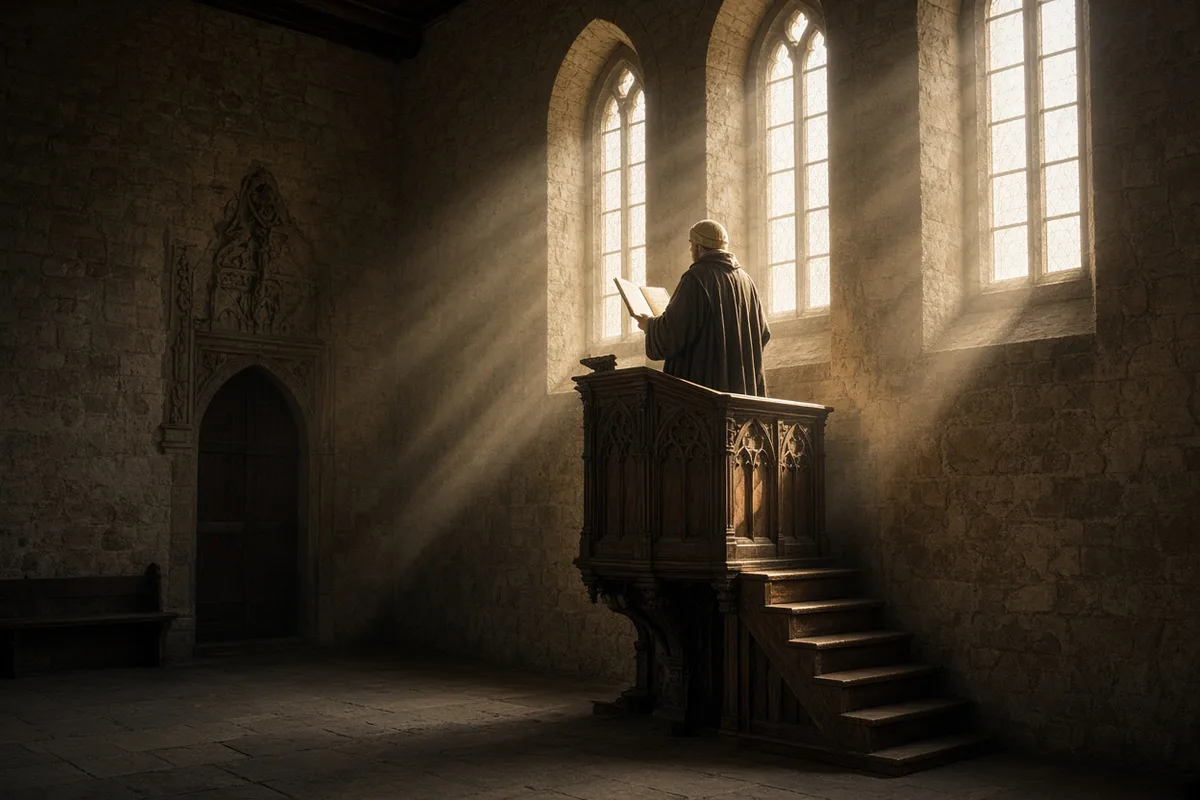
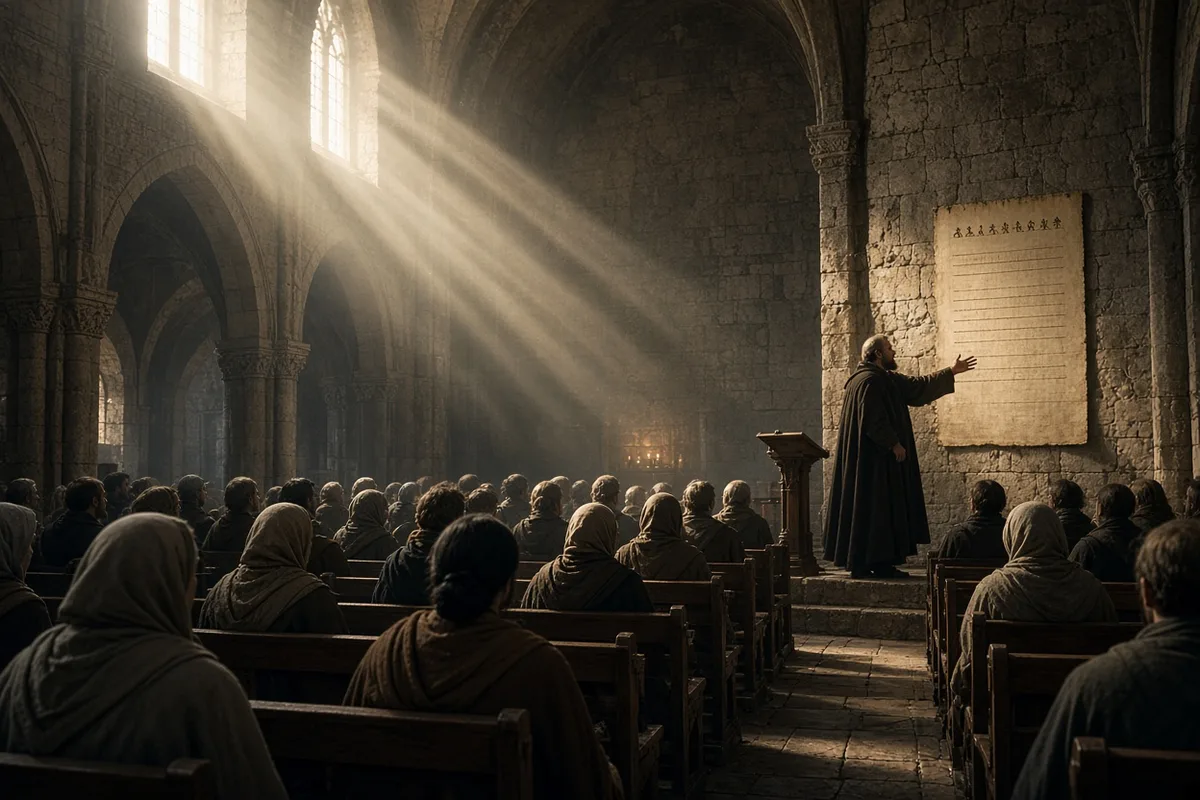
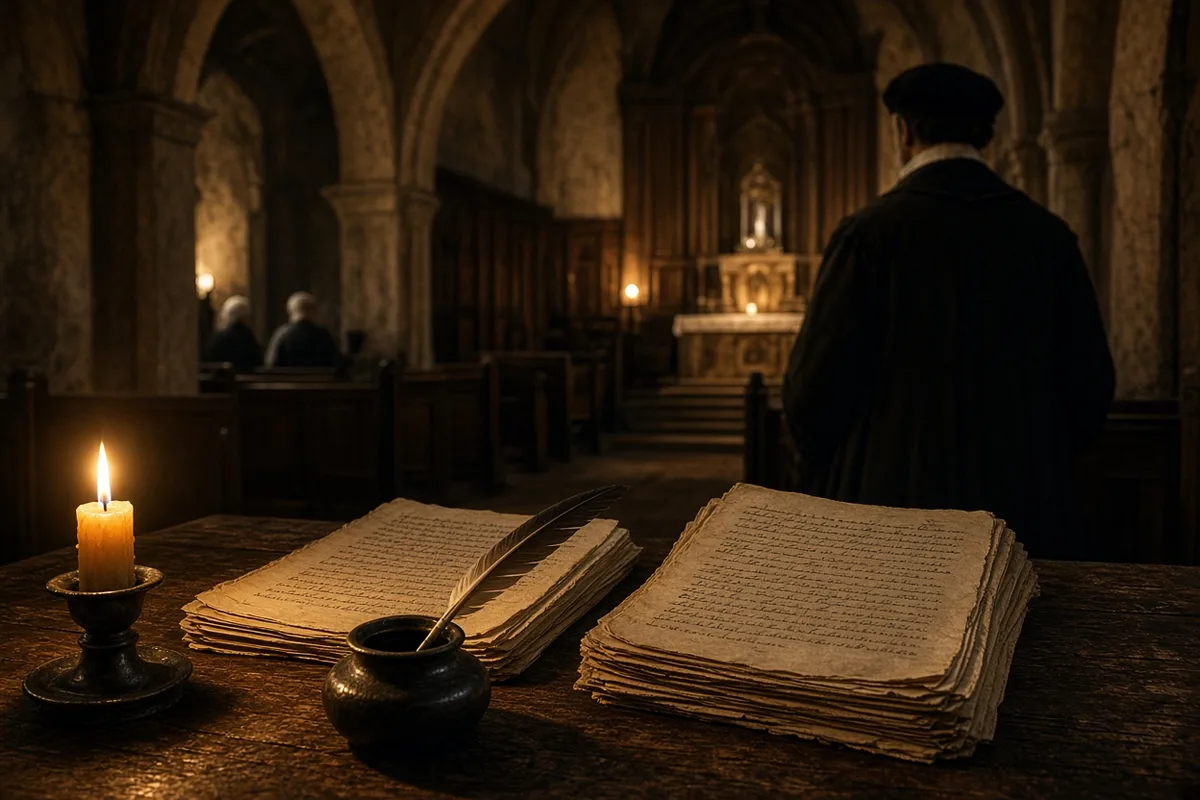
The press of shoulders carried me forward until my back met the chapel wall. Sunlight cut through the high windows in thin bars, catching on the fresh whitewash where new lines had been painted the week before. I smelled wet plaster and the sharp edge of ink still drying. Hus stood on the low platform at the far end, his dark robe plain against the timber. He held no book at first. He spoke straight to the rows of faces turned up toward him.
He began with the gospel in Latin, the way every priest had done since I was a boy. Then his voice shifted. The words came in Czech, clear enough that the woman beside me, who sold bread near the river gate, nodded once and leaned closer. He told us what the English master had written about priests who hoarded land and gold while the poor went hungry. He did not shout the names of cardinals or bishops. He simply laid the sentences out one after another, the same way a mason sets stones.
A student near the front bench shifted on the wooden seat. I recognized him from the university yard. His lips moved as he followed the translation. Someone coughed. The sound traveled the length of the chapel and died. Hus waited. When he spoke again the sentence was longer, carrying the weight of the argument about true lordship belonging only to the righteous. The woman next to me whispered the last phrase under her breath, testing how it felt in her own mouth.
On the wall to my left the painters had finished two new panels. One showed a figure in a simple cloak breaking bread. The other showed the same figure driving sellers from a temple court. Below each picture the text ran in both tongues, black letters on fresh plaster. Hus lifted his hand toward them without looking. He said the pictures were not for decoration. They were there so a man who could not read could still carry the meaning home.
The light changed as the sun moved. Dust drifted in the beams. I felt the ache in my legs from standing but did not want to move. Hus’s voice stayed even, yet the pauses between sentences grew longer. He let each idea settle before he added the next. A man in front of me wiped his eyes with the back of his sleeve. The motion was small, but I saw it.
Outside the chapel bell rang for the next hour. No one left. Hus finished the reading and set the Latin book aside. He spoke now only in Czech, telling us that reform began not in Rome but in the heart that refused to excuse its own greed. The words landed differently than the sermons I had heard in the larger churches. They did not ask for silver. They asked for attention.
When he stopped, the chapel stayed quiet for several breaths. Then the scrape of benches began. People stood slowly, as if waking. The bread seller beside me stayed where she was a moment longer, staring at the painted wall. She turned to me and said only that she would come again tomorrow. I nodded. We both knew the chapel would be full again before the next service.
I walked out into the street. The air felt colder after the press of bodies. Two students passed me, already repeating phrases from the sermon to each other. One carried a small board with notes scratched on it. Further along the lane a woman sang a few lines under her breath, something about learning truth from the walls of Bethlehem. The tune was new but the words caught and spread.
In the weeks that followed the chapel never emptied at the usual hour. Hus kept the same pattern. He read the Latin first, then gave the sense in our tongue. More inscriptions appeared on the remaining wall space. The painters worked in the evenings when the last listeners had gone. Each new panel showed another scene from the gospels, always with the Czech line beneath it.
I returned whenever my work allowed. The crowd changed. Merchants stood beside laborers. A few university masters came and stood at the back, listening without taking seats. Hus never altered his delivery for them. He spoke to the whole room the same way. The arguments stayed steady, drawn from the English master’s writings but carried now in the language we used at market and at table.
One afternoon I noticed a man copying the wall texts onto a sheet of paper. He worked quickly, glancing up every few lines. When he finished he folded the paper and slipped it inside his coat. He did not look around. He simply left. Later I heard the same lines repeated in a tavern near the bridge.
Hus remained at the chapel through the autumn. The rector’s duties kept him inside its walls most days. Visitors from other towns began to appear, asking directions to the place where the priest spoke plainly. The songs that started in the street outside grew longer. They carried the same sentences Hus had translated, set to simple melodies that anyone could learn after one hearing.
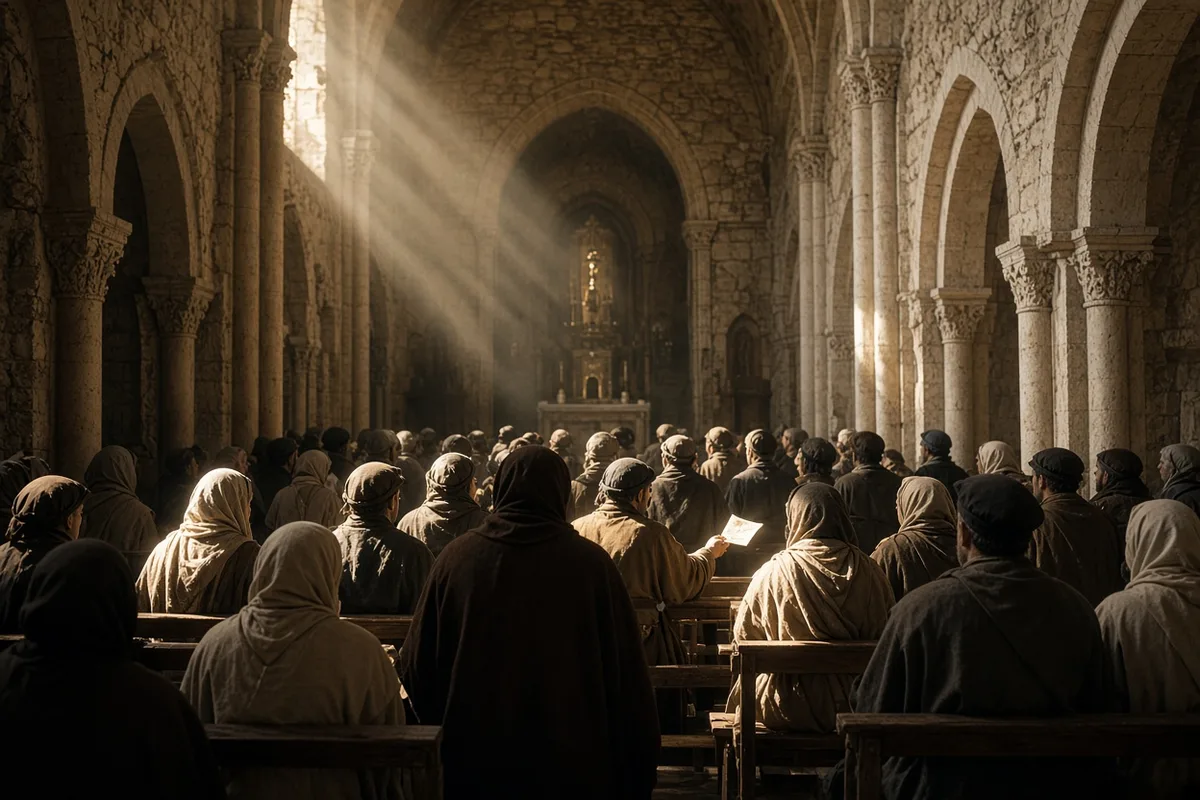
By winter the chapel walls were covered. Every panel had its text. The room held the quiet of a place that had been filled and emptied many times. Hus still stood on the platform when the hour came. His voice did not grow louder. It simply continued, carrying the next part of the argument into the cold air between the benches.
By winter the chapel walls were covered. Every panel had its text. The room held the quiet of a place that had been filled and emptied many times. Hus still stood on the platform when the hour came. His voice did not grow louder. It simply continued, carrying the next part of the argument into the cold air between the benches. On 14 March 1402 the university masters had appointed him preacher at Bethlehem Chapel with the explicit charge to deliver sermons in Czech each Sunday and feast day, and the register kept by the chapel’s lay administrator recorded that the first such address drew four hundred listeners before the wooden doors were closed against the press of those still outside. Hus read from Wycliffe’s De civili dominio that year, translating the passage that stated “no priest ought to hold civil dominion” and adding in the vernacular that any cleric who accumulated villages or rents beyond the needs of his table must answer first to the poor of his own parish rather than to the consistory in Rome. The bread seller who had stood beside me on the opening day returned each week with her daughter, now carrying a slate on which she copied the Czech lines beneath the new panels showing the feeding of the five thousand and the widow’s mite; by the feast of Saint Wenceslas in September 1403 the slate bore thirty-seven distinct sentences, each attested in the margin with the date Hus had spoken them.
In the spring of 1410 the archbishop’s decree ordering the surrender of Wycliffe’s books reached the chapel on the same morning Hus preached from the twenty-third chapter of Matthew, quoting the English master’s gloss that “the scribes and Pharisees sit in Moses’ seat” yet bind heavy burdens on men’s shoulders. Forty-two students from the Faculty of Arts signed a petition that day protesting the seizure of volumes from the university library, and the document listed their names in two columns, the first headed by Master Jakoubek of Stříbro and the second by Peter of Dresden. Hus read the petition aloud at the close of the next sermon, then set it on the lectern without further comment while the painters added a panel depicting the cleansing of the temple, the Czech inscription beneath it stating in thirty-two words that Christ had driven out those who sold doves rather than those who bought them. Attendance that month reached six hundred on ordinary Sundays and eight hundred on the vigil of Pentecost, forcing the chapel’s trustees to install additional benches along the north wall and to note in their accounts the purchase of twelve extra candles at four groschen each.
By the summer of 1411 the papal bull against Hus had been posted on the doors of the Týn Church and on the gate of the archbishop’s palace, yet the Bethlehem congregation continued to gather. On 11 July of that year Hus preached from the text “Render unto Caesar,” translating Wycliffe’s distinction between the two swords and declaring that the spiritual sword belonged to the priest only when he wielded it in accordance with the gospel rather than with the registers of the curia. A notary from the archbishop’s court stood at the rear and recorded the words in Latin, later entering them into the consistory acts as evidence; the entry survives under the date 12 July and quotes the exact phrase “the priest who sells indulgences sells what he does not own.” Three days later the first interdict was proclaimed over Prague, yet the chapel remained open because its foundation charter placed it under the direct protection of the Bohemian crown rather than the diocese. The singers outside began to chant the new melody composed by a student named Jan Čapek, whose four-line setting of Hus’s translation of Psalm 119 verse 105 carried the words “Thy word is a lamp unto my feet” through the lanes each evening after the service.
In October 1414 Hus set out for Constance under safe-conduct from King Sigismund, leaving the chapel in the care of Master Jakoubek, who continued the Czech sermons on the same schedule. The chapel accounts for that month record the payment of twelve groschen to a glazier for repairing two windows broken by the crowd on the final Sunday before Hus’s departure. Letters written from Constance by Hus to his congregation in Prague survive in the university library; one dated 27 November 1414 quotes the sentence “I have preached nothing save what the gospel and the doctors teach” and asks the brethren to keep the wall texts clean of dust so that those who cannot read Latin may still see them. On 6 July 1415 the council condemned him after a trial lasting four sessions, and the sentence was carried out the same afternoon on the meadow beyond the city walls, where the executioner bound him with cords soaked in pitch and lit the pyre at the third hour after noon. The notary’s record notes that Hus’s last audible words before the smoke rose were the Latin phrase “In manus tuas, Domine,” spoken without the customary addition of any saint’s name.
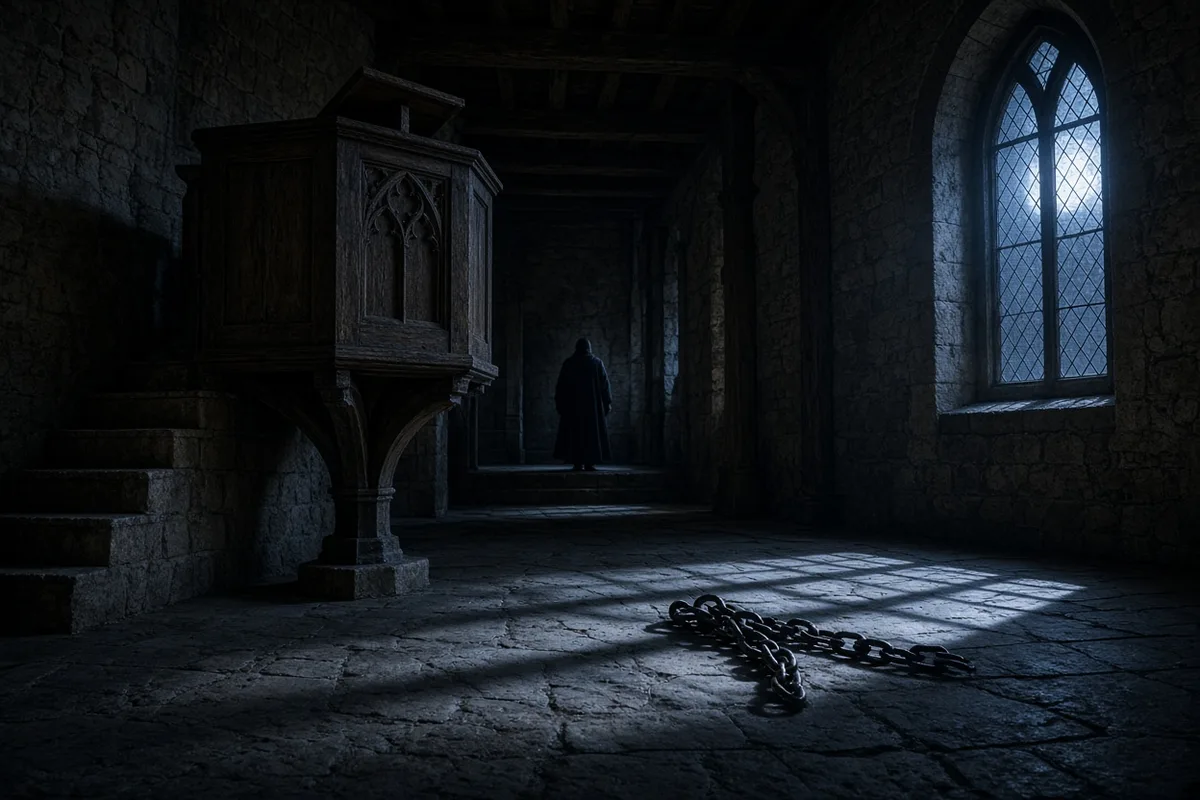
Jakoubek maintained the Bethlehem preaching through the winter of 1415 and into 1419, adding four new panels that illustrated the parable of the talents with Czech captions drawn from Hus’s earlier notes. On 30 July 1419 the first defenestration occurred at the New Town Hall when a crowd led by the priest Jan Želivský threw the councillors from the windows, an act recorded in the town chronicle as the direct consequence of sermons that had begun at Bethlehem Chapel seven years earlier. The chapel itself was closed by royal order in 1420 after the outbreak of open warfare, its doors sealed and its benches removed to the castle armory for use as firewood. During the Hussite wars the building served briefly as a stable for the garrison under Jan Žižka, who ordered the wall texts whitewashed in 1421 to prevent their use as propaganda by either faction. After the Compactata of 1436 the chapel reopened under Utraquist control, and the restored panels were described in a visitation report of 1448 as showing scenes from the gospels with bilingual inscriptions intact beneath each one.
The structure stood through the sixteenth century with only minor repairs until the Jesuit order acquired the site in 1622 and converted the interior into a lecture hall for their college, covering the remaining wall paintings with a coat of gray distemper. In 1786 the building was sold to a private owner who used the nave as a warehouse for grain, and the original timber roof was replaced in 1836 with a lower ceiling of lath and plaster to accommodate storage bins. During the nineteenth century the chapel passed through several commercial hands before the Czech National Museum purchased the property in 1919 with funds raised by public subscription totaling 187,000 crowns. Reconstruction began in 1948 under the direction of architect Jaroslav Fragner, who removed the later additions and restored the walls to their 1402 dimensions using the original foundation trenches as guide; the work was completed in 1955, and the chapel was reopened on 6 July of that year, the anniversary of Hus’s execution, with the wall texts repainted from surviving fragments and from copies preserved in the university library.
Today the chapel stands at the corner of Betlémské náměstí and Husova ulice, its whitewashed interior measuring twenty-eight meters in length and twelve meters in width, with the original platform rebuilt at the eastern end and the twenty-eight panels repainted according to the descriptions in the 1409 inventory. Visitors enter through the same low door used by the bread seller in 1402, and the present custodian, a retired teacher named Pavel Novák, keeps a ledger recording the daily number of visitors, which averaged four hundred and twelve during the month of July 2023. On the final afternoon of each week he unlocks the small side room where the original foundation charter of 1391 is displayed under glass, its parchment still bearing the seal of the merchant Kříž who endowed the chapel so that a priest might preach in the language of the people. The last image any visitor sees before leaving is the single remaining fragment of the original 1402 plaster, no larger than a hand’s breadth, preserved behind a protective screen near the south door and showing only the lower curve of a letter from one of the Czech inscriptions that Hus himself had ordered painted.